
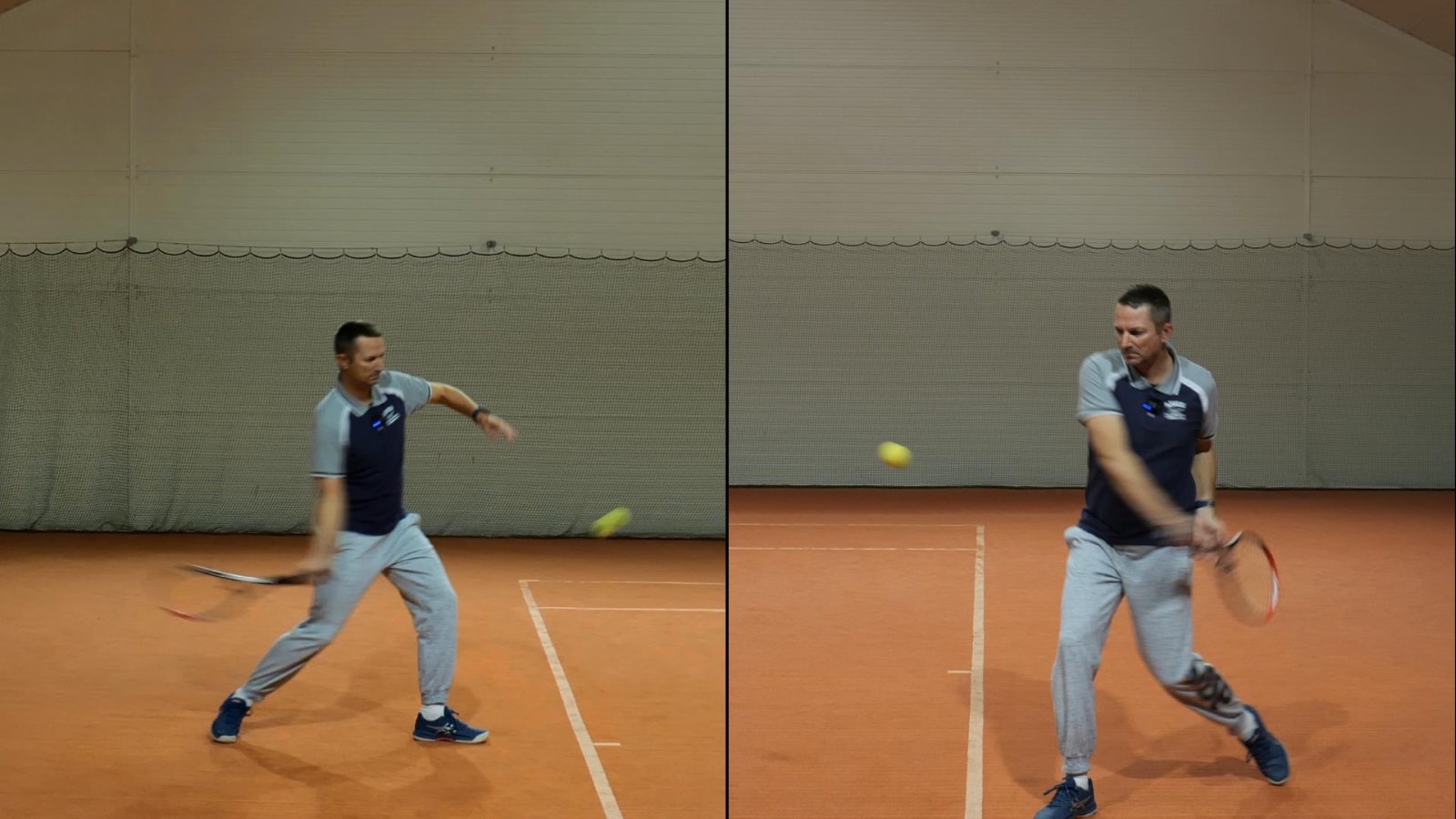
After receiving a video of Niko’s forehand, I compared it with the forehand of another lefty tennis player – Rafael Nadal – and shared three tips on how Niko can improve his biggest weapon.
Here’s a quick overview of the three forehand tips I shared in the video analysis:
1. The Preparation Is Too High
It’s easy to attempt to correct technical mistakes by simply looking at mechanics and trying to move the arm in a different way.
Unfortunately, this often doesn’t fix the problem. That’s because incorrect mechanics are often the result of an incorrect mental image of the stroke technique.
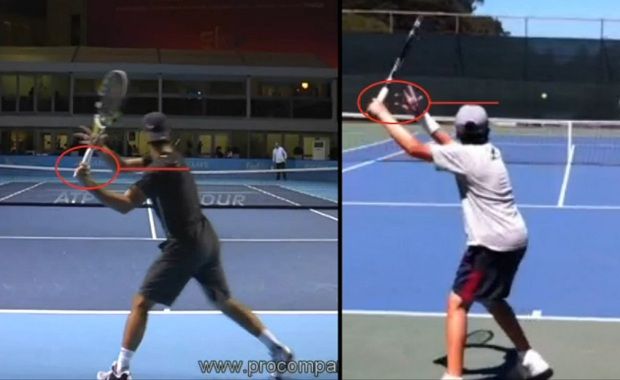
When learning from the forehand preparation of the pros, look at the hands, not at the racquet head!
In Niko’s case, his forehand preparation is slightly high, but in my opinion, that’s because he is looking at the movement of the racquet head of top pros, most likely even of Nadal, and that high racquet head deceives him.
He wants to have a high racquet head too when preparing for the forehand stroke, but he doesn’t notice that the HAND is not that high.
So, in order for Niko to improve his tennis forehand stroke, he needs to see where Rafael Nadal’s hand is in the preparation –and look to prepare in a similar way
2. The Elbow Goes Too Far Behind The Back
Niko moves the arm slightly too far behind the back before accelerating forward on his forehand.
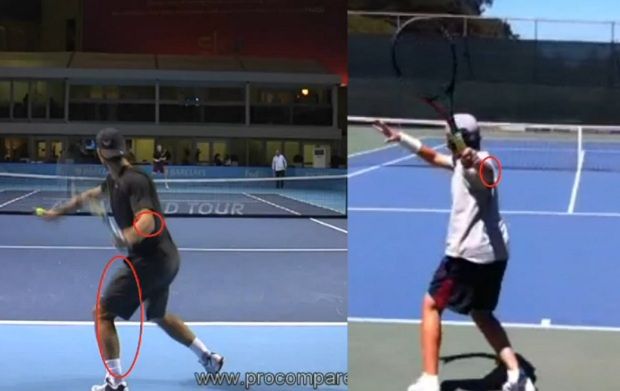
Junior tennis players typically make big backswings because they don't feel yet how to generate power from the legs and body.
That’s often the case in junior tennis because kids don’t know how best to use their body to generate force and they’re not very strong yet – so the only real way to generate force for them is to have a longer swing path.
The longer the path, the more time and distance they have to generate speed.
Of course, the negative side of that is that they find it hard to time the ball well, they are often pulled off balance, and they start to put a lot of load on the shoulder rather than the legs and the trunk, which must be the main sources of power.
The arm is also often under a lot of tension, and this results in inconsistent shots.
Therefore, Niko needs to work on shortening his backswing slightly and looking to use more power from the legs and trunk rotation.
That’s why the third problem of his forehand is also quite clear…
3. Not Using Enough Leg Drive
Niko hits an open stance forehand in this video, and his left leg bends just a little bit.
He doesn’t seem to push off the ground to generate upward force which would then be transferred into trunk rotation.
In contrast, Rafael Nadal takes a big step for the open stance forehand shot and lowers and pushes himself up off his left leg, thus creating a massive amount of energy which he will transfer into the racquet head speed.

Rafael Nadal makes a big step to begin his open stance forehand and then loads his leg to begin the upward drive.
The best way to feel how the leg needs to work in an open stance forehand is to throw medicine balls (2-3 kg) from the open stance.
The weight of the medicine ball puts more load on the leg, so the player feels the load more and knows which muscles to use to overcome that load.
Another good tip to improve the open stance forehand in tennis is to stand only on the outside leg and keep the other leg in the air, and then drop the ball and hit an open stance forehand.
That drill will also put more load on the outside leg, and the player will feel more what he needs to do in order to push off and generate force from his leg.
So, these are the three tennis tips I would give to Niko to improve his forehand and make it a bigger and more consistent weapon he can use to dominate and control rallies.
(All image credits and Rafael Nadal training video credit: procomparetennis.net)

Great Article! As a lefty myself I had to learn the hard way the 3 points you are addressing in this post. One observation I noticed on Niko’s forehand(if you don’t mind my input) is that his grip sits at, what I like to call, an extreme western state. When a player has a grip that extreme power is generally lost since they would have to pull away from the ball to hit it on the sweet spot of the racket.
Nadal does has a western grip too, but it pulled farther in(at a semi-western/western position), which is why his preparation could stand to be lower and more compact. In Niko’s case, what my concern would be is overuse of his wrist to stabilize the racket and at the same time having to overly whip the racket to generate the spin and power he is producing.
I had a grip like Niko’s when I was in high school and began having wrist issues very early on. That was until my coach noticed the grip and had me change it to a more semi-western grip(much like Nadal’s.) Now I am able to prepare my racket more compactly and start my racket below the ball as it is coming towards me.
Good points, John. Eventual move to a semi-western grip is what I would recommend too.
Nice remarks John! Can you explain (or give some hints) where I can understand better your “pull away” from the ball and the connection with the extreme power and the sweet spot? I’m very interested in this concept since I heard another coach telling to push (before the ball) and then pull-and-across (follow-through).
Thank you Robbert for your inquiry and interest in my comment.
My response is going to be separated into two sections. The first one will explain what the coach was saying in regards to pushing and pulling, and the second part is explaining in more detail how you have to almost step away from the ball to hit with a western grip.
To visually see how the push and pull concept works when it comes to hitting the ball, lets start by imagining that you are holding a long bath towel. Now let me start by saying that a towel is a god-send when it comes to helping with your groundstrokes and your serve, which I will show how it helps with answering your question.
With the bath towel, go through the motions as you would when hitting the ball. in order to get the towel moving and gaining speed, you have to step in and push through forward with the towel. Now that you are moving stepping in and pushing through the shot, in order to get the towel up and over your shoulder, you need to starting bring the racket up and over your body, and while doing this pulling it over your shoulder. If you do not pull the towel up towards your should and just go through the same motion as you did before hitting the ball, your hand will be over your should, but the towel will just be laying across your chest and not over your shoulder.
I promise that if you practice your ground strokes with a long bath towel for about 5-10 mins before picking up your racket and focus on getting the towel completely over your shoulder, you will be doing what the other coach was explaining and your groundstrokes will be crisper and more powerful.
Now onto my second part of this post.
What happens when you have a western style grip for your forehand, you cannot step into the ball to generate power…if you do you will hit the ball straight to the floor. In order to hit the ball in the middle of the racket(where usually the sweet spot is), you do not step into the ball as you would typically with a continental grip, rather you would have a more open stance and you would put more of your weight on your back foot. The perfect example of this is the video Tomaz included in this post. If you watch Rafael Nadal and focus on the time-range between 58sec and 1min 15sec, you will see the preparation Nadal does so that he can hit his western grip correctly. All of his weight is planted on his back foot and then he twists his body around and uses this twist and wrist to generate power and spin on the ball. This can be seen between 1min 12sec- 1min 15sec on the video, and shows what Nadal does to hit with such power and spin.
Every grip you can use for hitting the ball (continental, Eastern, Semi-Western, Western) all have their pros and cons.
With the Western grip you have such great spin on the ball, but you lose considerable power. To generate power, you have to hit with more body torque and wrist snap. From my experience with this grip, my wrist would get tired more easily and I also started developing wrist issues.
I hope this helps, please comment back if you have any questions on my response or if I can help with anything.
Great tips, John. I have used the towel with the serve but only once or twice when teaching the forehand. I’ll try it again with one of my students who has problems hitting the ball well with a western forehand grip.
I use the towel also for the player to hit it with the racquet – square on – and when they do, a good sound is heard and they feel more resistance.
I’ll show the “towel tennis drills” in one of the future articles.
That sounds great! Thanks Tomaz.
Thanx John for a complete explanation, including a usefull drill! I wil try it out the coming days. The tip of Tomaz hitting against a towel,I successfully used for my children to learn to hold the racket face to hit the ball. I will practice your suggestion the next days.
I’m using a semi-western and am struggling with balancing to explode into the ball with al kinetic chain energy, while “extend my arm” more for more control, direction and depth in my shots and how to fully coil-uncoil my body with a windshield-wiper follow through… Both open-stance and steppping-in situations. When drop-hit a ball it’s fine and I have a nice clean shot. When on court, there are to many situations where I get sloppy and my balls land short or not that precise with my FH…
That’s why I’m following all the tips over here to more feel the ball to be in control. Visualizing helps me a lot to simplify things (that’s main reason why i get sloppy; to much to think about); so that’s why I got into push-pull visualization.
@Tomaz: Keep bringing those fantastic videos! It really works, after understanding the mechanic technique and reasons behind it; simplify and visualize and focus on the tactics!
Good comparison.
1) leg drive, leg drive, leg drive and some more leg drive. 🙂
2) medicine ball should be called the magic ball for tennis players.
Nice job.
Thanks everyone for the helpful tips! Nikolas has been working on his forehand and we will send another video for Tomaz to post soon.
Tomaz- could you talk specifically about the wrist on the forehand? It’s laid back on the forward swing but then what exactly is it supposed to do? It seems, from the circular swing path of the racquet, that around contact the wrist wants to break on its own. I know that it eventually does break because the follow through of all pro-players shows this happening, but when? If it is breaking before contact does that mean my shot is contracted maybe, not relaxing?
Actually, the wrist doesn’t break but it goes from laid back to neutral as you’re making contact. It seems like you are stretching the wrist back and letting it release (flex) into the shot. It’s not a slap exactly but a motion that imparts topspin. Is that right?
Hi Jon,
I’ll try and explain that in one of the future articles. The wrist is quite passive in the most basic forehand. It’s laid back and it stays laid back all the time through contact.
We can rotate the forearm and that moves the wrist but we don’t really do much with the wrist joint before or at contact.
So most of what you see with the wrist happens rather than what we “do”.
Of course, at the pro level hitting heavy topspin on a slower ball, the wrist is more active but I would not teach or recommend that to recreational players as they will only mishit the ball too many times.