
You may have heard of the idea that we hit up on the serve or that we swing up on the ball when serving.
But that’s a little bit confusing, isn’t it? If we hit up(wards), then the ball will go up, right?
No, not really.
There are 2 ways we “hit up” on the ball: swinging up towards the ball and literally hitting the ball up. We’re also going to look at the confusion with the pronation that is often the cause for incorrect serves and consequently for the idea of serving down.
I’d like to thank Jorge Capestany for letting me use Milos Raonic serve video for this analysis. Please check Jorge’s youtube channel with many more videos of pros hitting in slow motion.
1. Swinging up towards the ball
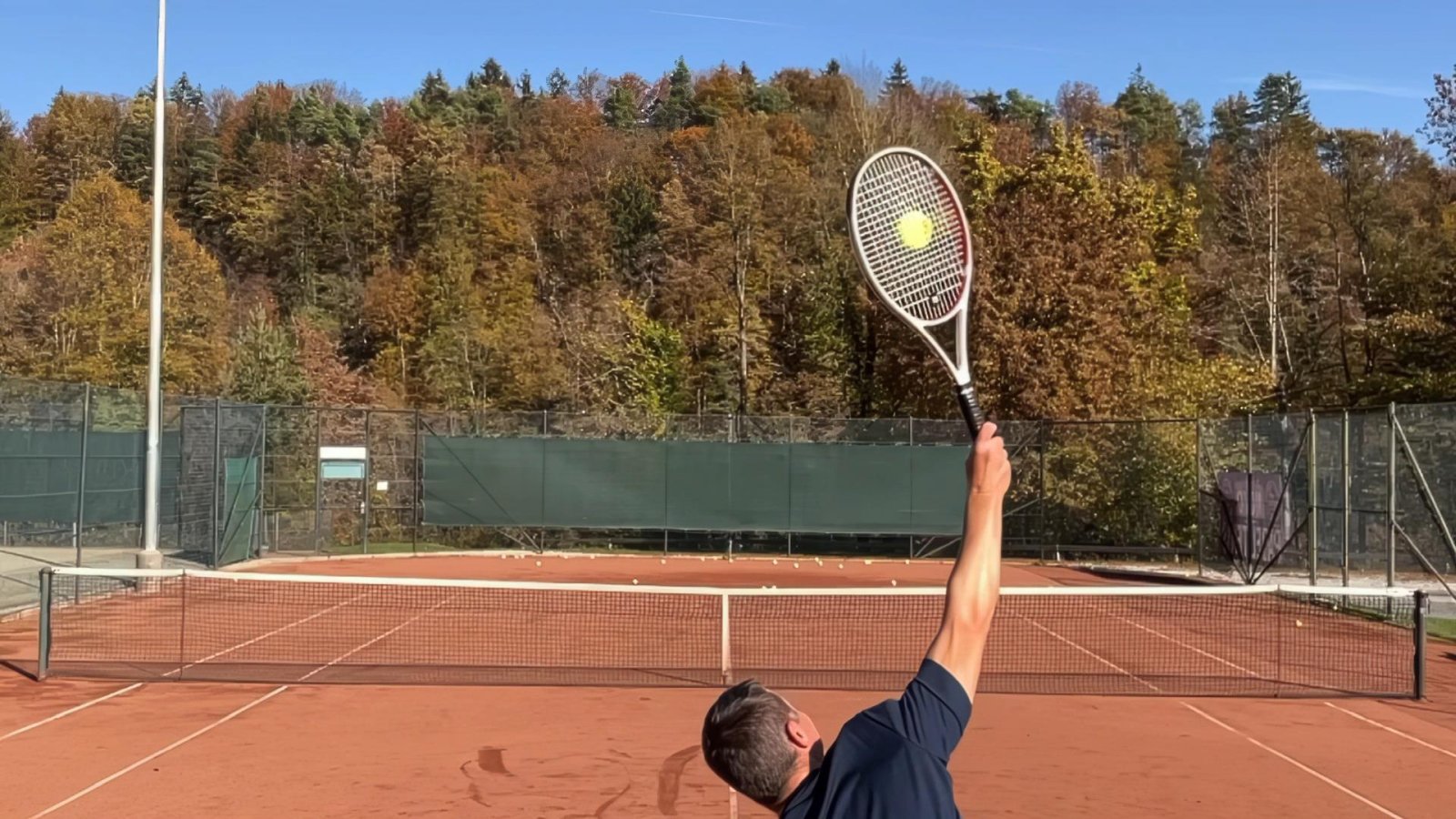
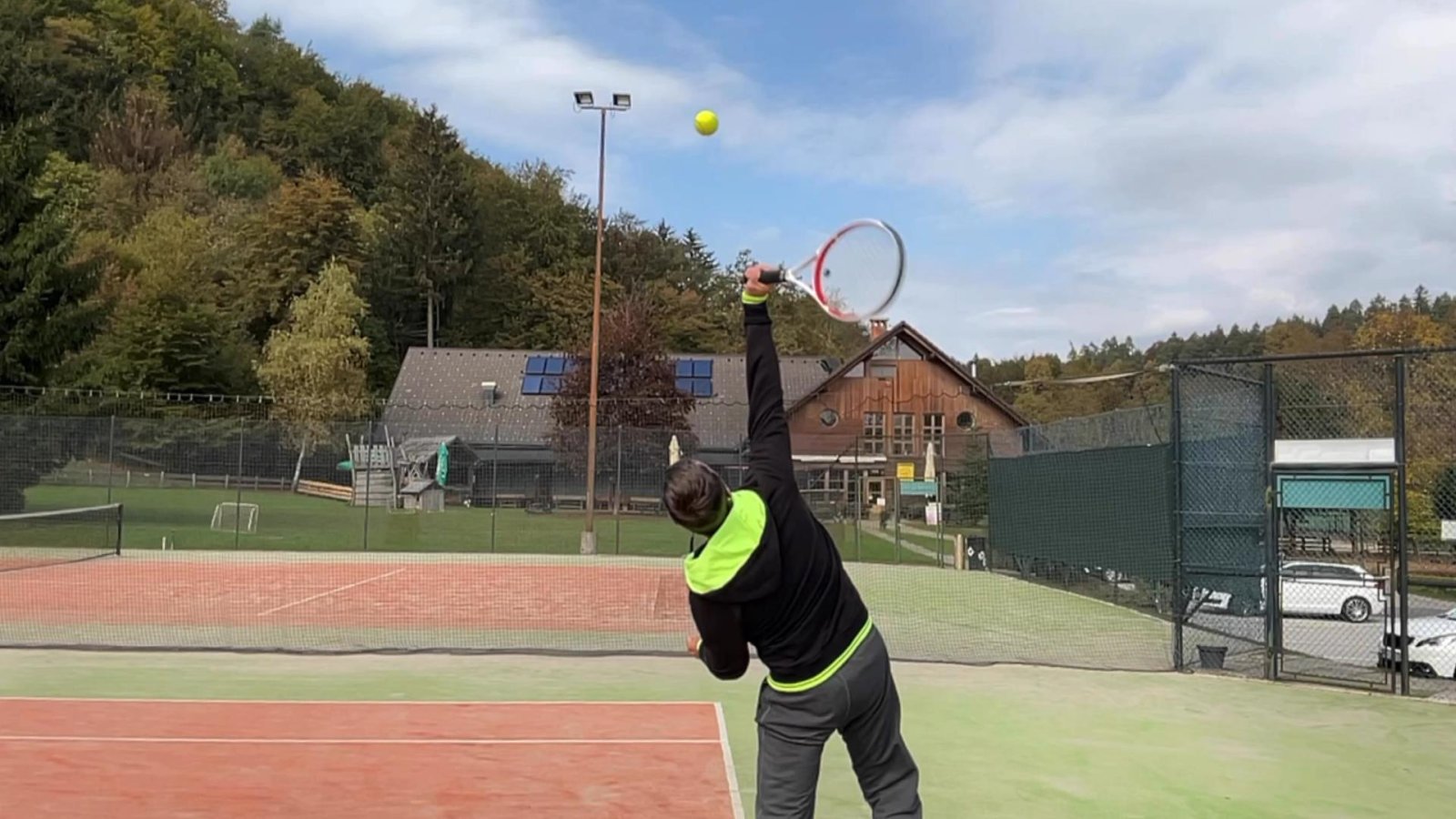
Try this and observe your racquet’s angles: swing upwards towards the sky and simply complete your serve.
You will see that, yes, at a certain point of your swing, the racquet is pointing upwards. If you made contact with the ball at that moment, the ball would really go upwards.
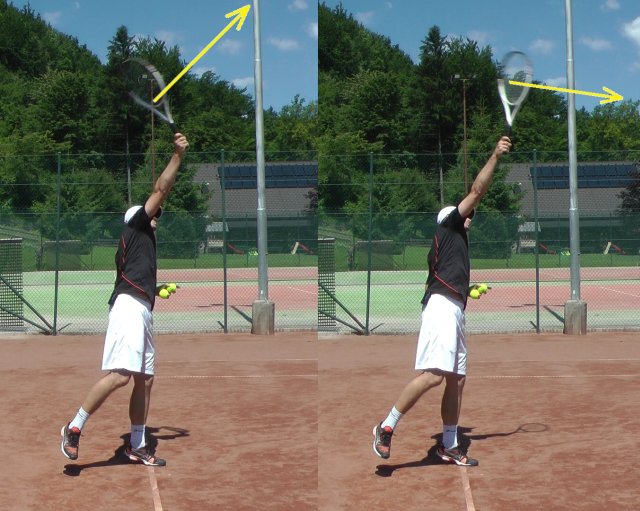
Just a reminder that swinging up does hit the ball the down if you hit it in front
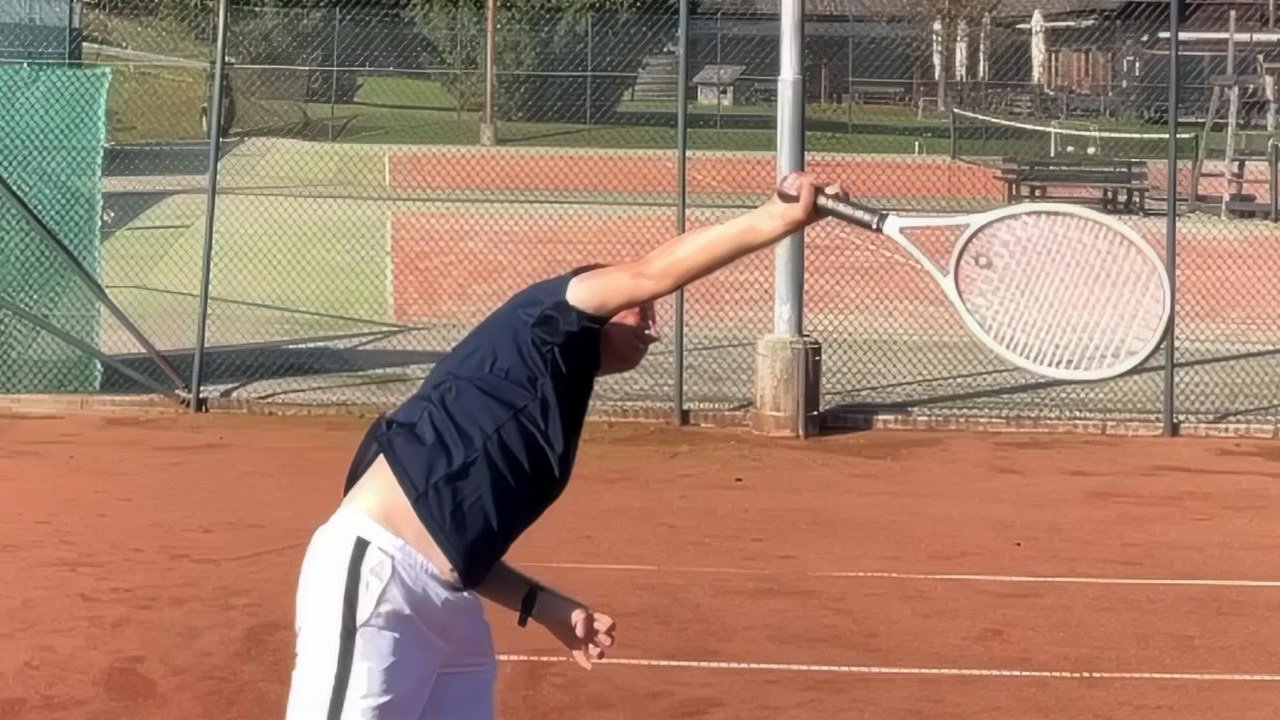
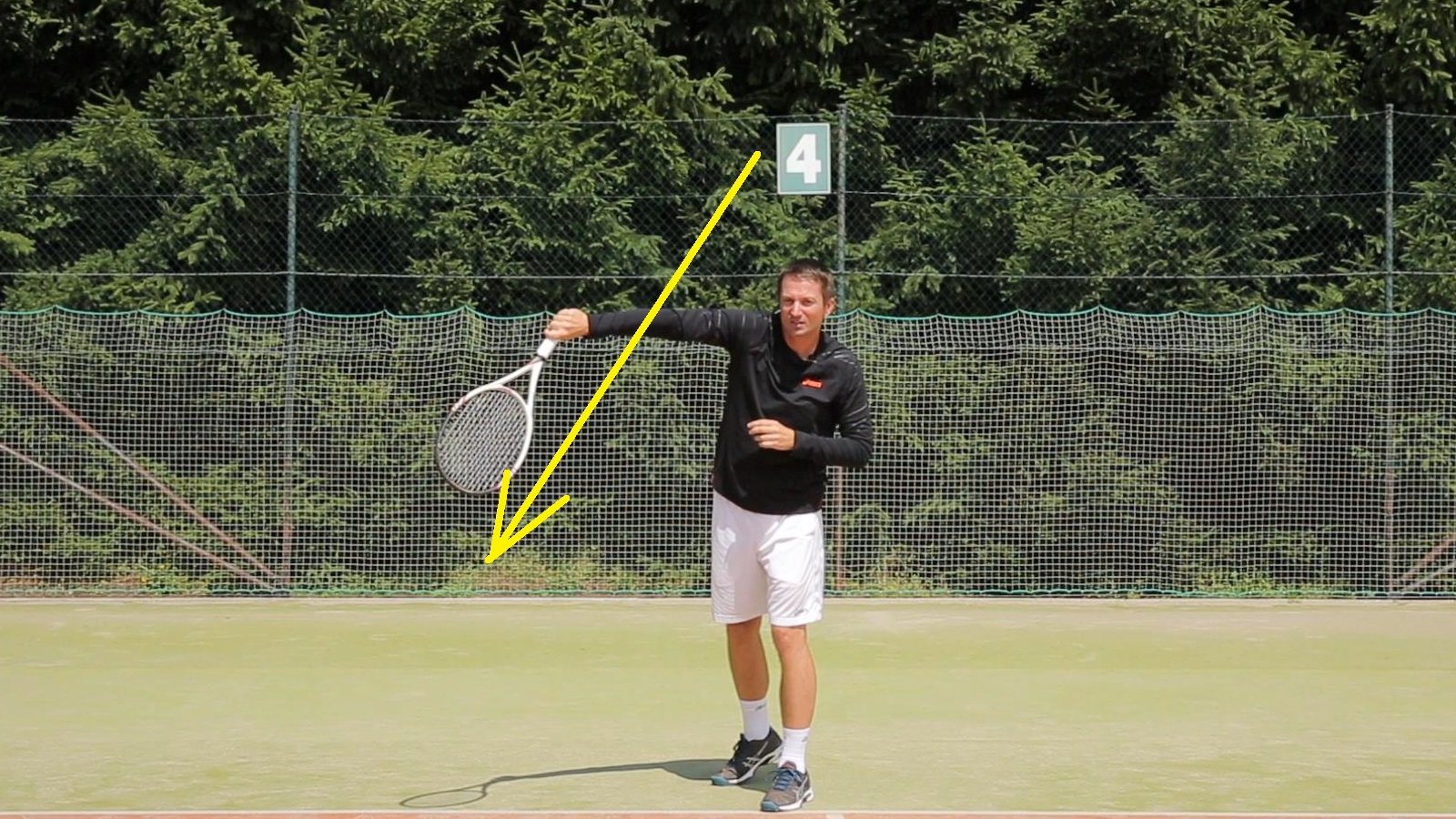
But you can also see that, even though you swung upwards, your racquet kept changing its orientation – meaning its angle – and, at a certain moment in that swing, it was actually pointing down!
If you made contact at that split moment, the ball would go downwards – even though you were swinging upwards.
So it is the racquet’s angle at contact that directs the ball down and not the direction of your swing.
You might create the main force in your swing in a certain direction, but since your arm is attached at your shoulder it will continue to go in a circular path.
If you hit the ball in the correct contact point, then the ball will go down.
The major mistake you may have been making is trying to direct the ball down by changing the racquet angle with your hand.
You might also have been confused by ideas about pronation and how players end their serves with the elbow up and the racquet head down, which suggests that this is how they direct the ball down.
That’s not true, and you will see the explanation for this in the second part of this article.
Now why do we have to swing upwards – what is the purpose of that?
There are 3 reasons for swinging upwards:
a) To generate racquet head speed
In order to generate lots of racquet head speed, we need the racquet to travel some distance.
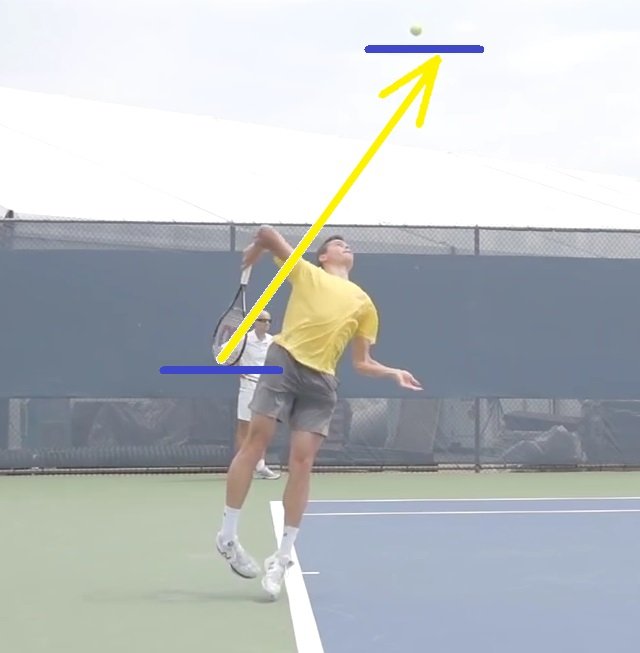
Note how much distance Milos Raonic has to generate speed on his serve
If we think very logically and say that we need to hit the ball down, then we’re going to be very slow in the first part of the swing because we feel it’s not yet time to accelerate the racquet.
We think that we need to bring it behind the ball, perhaps even slightly above the ball, and then start accelerating towards the target.
But then our path of accelerating would be so short that we wouldn’t be able to generate much speed.
Most recreational players serve with a “high elbow” or a very low racquet head drop, which simply tells me that they are thinking like I explained above.
They use common sense, and they simply want to hit the ball down, so they are trying to get the racquet above and behind the ball and then use force to send it downwards.
And because they keep trying to direct the ball down with their racquet head and by pointing the racquet downwards, they can achieve that in one way only – by tossing the ball above them and not inside the court.
Only then can they hit the ball downwards and not hit all serves in the net. If they tossed the ball inside the court and at the same time pointed the racquet downwards, they would hit every ball in the net.
Through repetition, they have realized that problem, and now they see that their approach works only when their toss is above their head or perhaps above the baseline.
b) To counter gravity
When we hit the ball when serving, most of us hit the ball when it’s falling down.
If we simply swung horizontally, the ball would end up in the net since gravity constantly pulls it down and there’s always a downwards force on the ball.
So, we counter some of the gravity on the ball by hitting upwards.
c) Impart spin
Even when we hit flat serves, we do impart some spin on the ball. We do that by brushing up on the ball, and that helps us better control the trajectory of the ball and more easily bring it down in the service box.
In summary of this first part, I hope you by now realize that we shouldn’t hit the ball down by changing the racquet angle with our hand (or by “pronating”). Instead, our body is tilted at the point of contact which automatically makes our racquet point downwards even though we don’t feel that in our hand.
What you’re going to see in part 2 is even more interesting. We literally can hit the ball upwards and still make it go down.
2. Literally hitting the ball up
To show you what I mean by literally hitting the ball up, I’ll use images from a slow motion video of Milos Raonic’s serve.
I’d like you to notice these specific details:
a) Hand position at contact and one frame later
The fact of the matter is this: the ball’s direction is determined at contact, and everything that happens after contact, meaning after the ball is gone, no longer affects the ball’s flight.
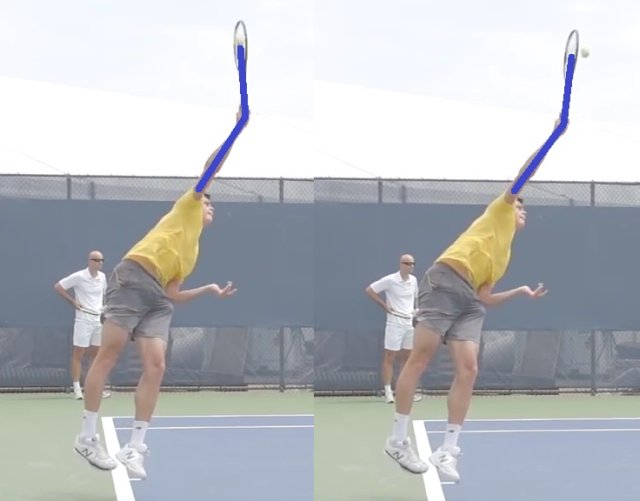
Milos' hand is "open" at contact and even one frame later
If you now look at Milos’ hand alignment in relation to his forearm, you will see that it is in fact open and NOT in a “closed” position which to us indicates sending the ball down.
What’s even more interesting is that one frame after contact, he still hasn’t reached complete alignment with his forearm; therefore, his hand is still “open”!
So, to him, it feels like he is literally serving up as he is hitting the ball with his hand still open at contact.
The reason why the ball then goes down is because HE IS TILTED.
His whole body is at an angle because he tossed the ball inside the court, and therefore his arm and his racquet have also changed angles.
So even though Milos’ hand is “open”, the racquet face is actually pointing slightly down of course, it’s just that he is not directing the ball down by “closing” the hand down on the ball but actually leaning into the court and aligning the racquet face slightly down with his body!
To better illustrate how Milos’ hand “feels”, I’ve rotated the video to the position where Milos’ body is upright (vertical).
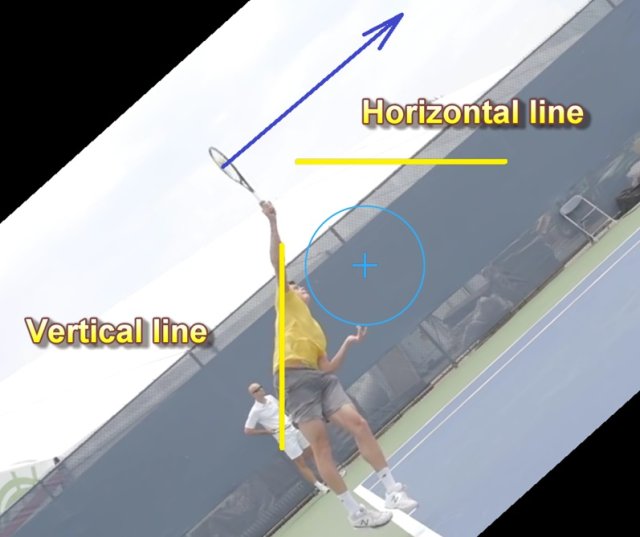
If Milos was standing upright, his serve would go up in the sky
So, if he wasn’t leaning into the court and he tossed the ball right above his head – and if he didn’t change his swing – then his serve would literally fly up!
That is how is arm “feels” at contact. It feels like he is serving up.
So, not only is he swinging up towards the ball, but he is literally hitting the ball up.
Again, the reason why the ball doesn’t go up is that Milos (and all other pros!) is at an angle when he is making contact.
This angle then counters the “open” racquet face and in fact makes the ball travel downwards at a certain angle towards the opposite service box.
b) Clearing up the “pronation confusion”
Pronation is a process and not a certain position of the arm. It is the turning of the forearm inwards.
What we coaches like to refer to sometimes as “pronation” is the position where the elbow stays up high and the racquet is pointing downwards.
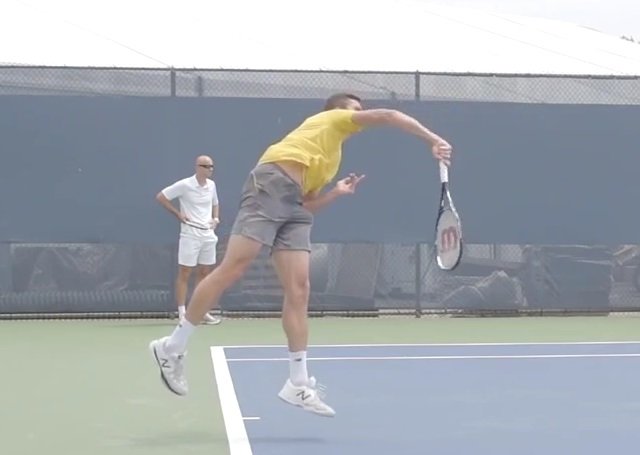
We simplify the naming of serve elements by calling this pronation
But that, in fact, is an internal rotation of the upper arm.
The “pronation” process merely aligns the racquet head more squarely onto the ball, and it contributes very little to the power of the serve.
Most power actually comes from internal rotation of the upper arm.
But let’s for now skip the proper naming of all elements of the serve and simply look at a certain position where the elbow stays up and the racquet head points down.
At first glance, it may seem that since we are accelerating the racquet head down with that movement – namely keeping the elbow up and moving the racquet head down – it is then through this movement that we hit the ball down.
But, as you can see in the video and in the still images here, the hand and therefore the racquet reach the position of pointing down way AFTER the ball has left the racquet.
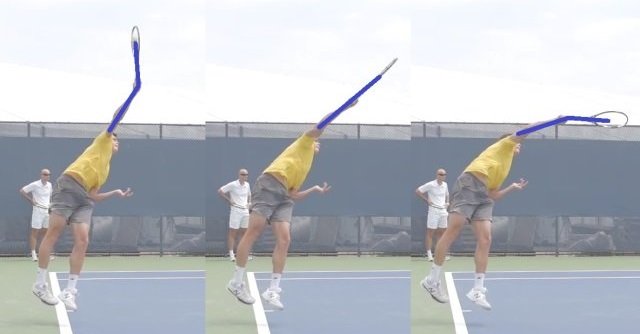
The ball is long gone by the time the hand aligns with the forearm and eventually "closes down".
Therefore we do NOT direct the ball downwards by pushing the racquet down and keeping the elbow up.
This is simply a CONSEQUENCE of accelerating the racquet head correctly THROUGH the ball using the forearm and elbow as the pivot point rather than using the whole arm and the shoulder as the pivot point.
How To Learn To Swing Up Towards The Ball
Now that you have the theory in place and you realize that the serve is even more mysterious than you thought, how does one go about learning to hit up on the serve when actually being on the court?
Even though the theory now shows you the reasons why the ball will go down even though you swing up, you will still probably have trouble TRUSTING the idea of swinging up on the ball because it will FEEL as if the ball will actually go up.
I recommend these 4 steps to develop this proper serve swing:
1. Swing upwards (no ball) and the note racquet’s angles
In this first drill, you’ll just swing upwards with no ball, as if you’re trying to throw the racquet up.
You’ll note that, if you smoothly let your racquet continue through your swing, there will be a point in the swing when the racquet points downwards.
Just a reminder that swinging up does hit the ball the down if you hit it in front
That just helps you logically understand that it is possible to hit downwards even though you swing up.
Swinging up simply means using the upwards part of the racquet’s path to accelerate is as much as possible. Your racquet is then going to carry this speed for the rest of your swing even when it starts to point downwards.
2. Serve the ball horizontally towards the opposite back fence
You’ve probably been trying to serve down for some time by using your wrist and directing the ball down with it, so the first step is simply unlearning that.
And you can do that by first serving the ball horizontally.
That will develop a more fluid swing through the ball and “serve” as the foundation of the next progressions.
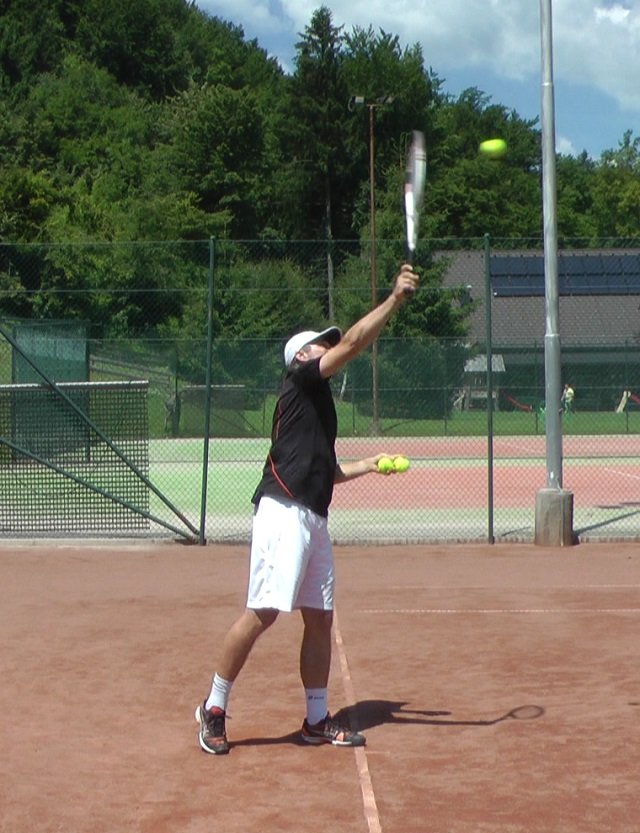
Serve balls horizontally in the first progression
I recommend you serve at least 50 balls from the baseline aiming your serve parallel to the ground or even making it go slightly up and looking to hit the back fence.
3. Maintain the same horizontal swing but toss the ball inside the court
For step 3, you’ll maintain that same swing and toss the ball more inside the court.
This helps you realize that, even though it feels like you’re going to hit the ball straight, it will actually go on a downwards trajectory because your whole body will now be at angle when you make contact. As a result, your racquet will also be angled slightly down even though you will NOT feel that in your hand.
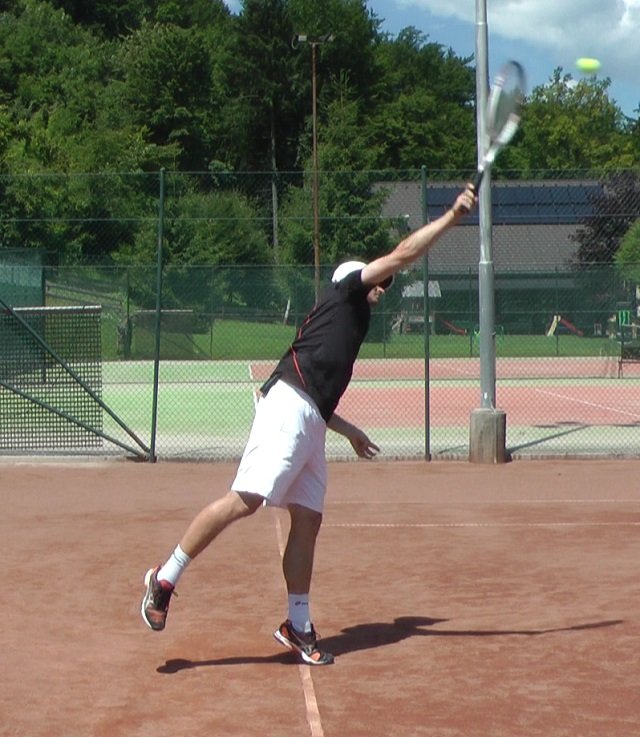
If you swing "forward" but toss the inside the court, your racquet will be pointing down even though you don't feel it
I recommend you still include a few horizontal serves here and there where you toss more above you again to see how it’s the ball’s position at contact that determines the trajectory and not your swing, which should remain the same.
4. Swing up and toss the ball in the court
Now you’ll have to take that leap of faith and actually swing up towards the ball as you will toss it inside the court.
If the ball is well inside the court, there is almost no way you can hit it up as it would be very awkward for your hand to achieve that.
If you swing up and let your swing continue very naturally – and the ball is inside the court, which means you’re at an angle (and so is your racquet) – the ball will go on a downward path.
Then it’s simply a matter of repetition and refining that swing to hit much better tennis serves.
With lots of serves hit that way, you’ll learn to trust this upward swing and use it much better to generate the racquet head speed.
This will not only increase the speed of your serves but also the consistency because you won’t be breaking down your wrist at contact anymore, which makes many serves end up in the net.
Hopefully that solved the riddle of how we can swing up on the serve and actually make the ball go down in the service box!
Hi Tomaz
Thanks once again for another in-depth and informative video; I always want to fully understand what I’m learning about and your presentations allow me to do so. Please keep up your great teaching work …..
Cheers,
Michael
Much appreciated, Michael. Will do my best to share more useful tennis tips…
What then is pronation for
See me reply below to Jaycen…
Amazing and counter-intuitive post, am looking forward to practising this!
Pros toss into the court and fall into the serve, amateurs don’t.
Great Post Tomaz! I think this is probably one of the hardest parts of the serve to understand. I had not really thought about the fact that our body is leaning down to some extent at the point that our hand is still going up. But what if a person is experimenting with this and they still would like to play some tournaments during the process. Wouldn’t it make sense to incorporate more spin to add security during the transition. This would almost force the person to hit up no matter what because adding spin will only make the ball dip even more. Then slowly a flat or slice serve could be incorporated in competition. Thanks for the great observations in this post!
Yes, Arturo, I definitely suggest working on top spin serves first and applying this idea really fully, without holding back when you’re swinging up. It will be easier to trust this process when you flatten the serve later.
Fantaastic breakdown and a perfect analysis of a model pro for a serve.
Looking forward for more.
Thanks
For me the best explanation!!!
Very insightful video but I still have one question? If the function of pronation is not to make the ball go down then what is the function of pronation? My guess would be that it is an ‘effect’ of good form on the earlier parts of the serve.
Very good question, Jaycen. The pronation, meaning the part where you see a high elbow and the racquet down is a consequence of ACCELERATING the racquet around the elbow joint. This acceleration just happens to hit the ball in midpoint of the swing and what you see eventually is the end of that action.
If we exaggerate the idea and say that you do really want to hit the ball up in the sky really fast, would you still end up with a high elbow? If you accelerate your forearm properly, then you would end up in the same position.
Don’t be confused by pronation.
In fact , pronation is to last time accelerate the racket before your racket really hit the ball.
Pronation is not for let the ball down into the service box.
I had watched and read dozens of pieces on “serving” but this is by far the most clear break-down of the theory and how to make it work in practice. I can’t wait to get out there and practice these
Hi Tomaz
Thanks a lot for solving the mystery of serving up and not Down on the serve.
My feeling is, that when I let my racket pull my arm and hand up toward and through the ball, i am serving my best with the least effort and with the most heavy ball. It feels like I reach a point, where my arm is not long enough and I get pulled up and through the ball. Its like my hand stops at contact and the racket just travels on, so I think its like almost letting the racket fly ? What do you think of that ?
I often Loose that feeling for months and just by chance come back to that feeling. I think it is because I start thinking down on my serve instead of thinking up.
Do you have a good drill for getting that feeling back ?
Thanks Again for your fantastic explanations :-))
The feel you describe sounds right. I recommend serving from about 2-3 meters behind the baseline for 20-30 serves and going for a kick serve so you can really hit up and not hold back and make the ball land in the court. Then gradually come closer to the baseline and try and maintain that feel.
Tomaz,
I have tried serving from far behind the baseline recently, first aiming for the opposite fence, then arcing down to inside the court. I was amazed to see that hitting from so far back not only emphasized hitting up but also allowed me to hit some really strong serves actually into the service box eventually, even from way back. It was a great psychological tool to have greater confidence in my power and arc as I moved closer to baseline. It broke me of that idea that I can only hit hard serves by being closer to the serve box and hitting down. Thanks. Chris
Great, Chris! And thanks for actually doing the suggested drill!
It’s very easy to just read and assume one can learn tennis by reading about it rather than actually taking action, experiment with ideas and practicing them in the long term.
Hello Tomaz,
Thank-you for this fascinating and mysterious topic on the serve. I suppose the next logical question is, “how far to toss the ball into the court?” I watched one of your previous videos and you explained that for flat and sidespin serve the ball toss is more into the court, compared to topspin serve (toss should still be inside the court … but just a bit less).
I wonder how this works for shorter players like myself (5’7″). I also notice that I’m not very good at “leaning my body / falling” into the court, so I make more errors into the net when I concentrate on tossing the ball into the court (… even with a feeling of hitting UP). I think I get the best results with a ball toss that is only approximately 10cm into the court. Do you have any advice? Thanks again for the interesting video, – Philip
The answer to “how far in the court” is based on your ability to maintain dynamic balance – and of course how tall you are.
The only way to get to that answer is by experimenting. Test, test, test…
And make sure that you do swing up. If the balls do end up in the net and you are swinging up and you are in balance, then that’s too much in the court then.
So cool! Very insightful as always. Thanks !
Excellent description Tomaz !!
Hi Tomaz:
Thanks for your brilliant & illuminating serve analysis..
I am constantly working at increasing the speed & drive of my serve… so often while hitting up my serve goes long..
I toss the ball inside the court but I did not appreciate the importance on the “body bend”…
Many Thanks,
Anya
There’s one important point to mention here, Anya. We must NOT push down with the upper body. It simply stays at angle for a split second so that the arm accelerates.
I see many rec players bend forward and “push” with their upper body as if to help with the force. That’s not correct.
The body is at an angle because the ball is in front, but it remains like that for a split second.
If you watch Milos serve in that part where I rotated the video, that he REMAINS aligned with the vertical line for quite long and is not adding force by leaning forward or “pushing” with the upper body.
Dear Tomaz:
Thank you for clarifying in the last paragraph..
This morning I was doing exactly that.. leaning too far forward & wondered why my serve was net was landing too short & twice in the net!
Anya
This really gives me a new insight into what happens at the moment of contact. All this time, I’ve been avoiding tossing into the court as I was afraid it would force me to hit “down” and net the ball… So I tossed right over the head, and that may be why I couldn’t really hit up on the ball — every time I tried to hit up, the ball seemed to go long.
I will definitely practice with a new approach — starting with tossing well into the court!
Thank you as usual for a great analysis. That Raonic image really helps.
Tomaz, you have a gift for making tennis make sense to those of us who get overwhelmed by too much technical detail. You know exactly how to balance a general, common sense approach with the appropriate amount of detail. After reading any one of your posts I feel confident to apply your suggestions, techniques and illustrations, with almost instant improvement noted. This is awesome. Thank you.
Quick question: when you refer to Milos’ wrist as “open,” are you referring to it staying extended (I.e., back of hand pointing toward him) vs. flexed?
Thanx again!
You’re very welcome, Joanna!
Yes, flexed is the right word, or slightly laid back.
I’m trying to learn the basics, but find it hard taking lessons with a group that is advanced. I get more from following your advice. Thank you and I will continue to follow your instructions
Gigi
How is it different for a topspin serve?
Thanks.
Just contacting the ball at a slightly lower contact point and more to your left. Otherwise no major difference.
Hello, I am just tennis amateur but I’ve played since 40 years. I try always to progress in technique and I’ve watched your clips on your website “feel-tennis.net.” Congratulation fot your advices about the serve, I’ve never seen a better site on the web : clear and wise. Thanks for you my serve has really got better, like I always wanted one for me.
REALLY appreciate!!!
you just pointed out my problem. If I did not see this, i probably keep practice it in WRONG way… THANK you very much!!
Tomaz,
I admire the way you analyze and explain tennis technics and instructions.
Thank you for so much,and for so high quality coaching.
Your videos are great!
Joe
Hi Tomaz,
I mostly agree with your analysis except one aspect about how the ball is hit in service box. I have been hitting long and tried to toss front which gets ball in but the problem is that is not consistent and the ball travels bit of flat slanting line which I personally don’t prefer.
But I guess the idea is to visualize the serve as circular path (which you have mentioned in one of the video) but it is bit of spiral path than perfect circle. As in, we start to draw the circle from well below back on the right side(dominant side, almost from right butt) and it ends on left side hip.
So if we our muscles are not preset to follow through after hitting high, ball wont hit in the service box. So ideally player should develop the consciousness of spiral path most importantly how it affects the ball depending where the spiral path has begun.
Also by tossing in front, it does help to get the ball in the service box, because racquet hits the ball during downward path of the circle. But the problem is we are adding more variable to the already complex motion.
Thanks and reards
-Karun
Thank for sharing, Karun. We all have slightly different visualizations and mental pictures of what goes on with the serve so as long as your image works for you just stick with it.
Thank you for this explanation you have put together. It makes perfect sense and will help many.
Hello Tomaz,
So I been playing tennis for three years as a lefty, and I’ve established a good feel for myself. One big problem that I’ve been trying to fix is my serve. Lately I’ve been working on trying to make a topspin serve, since before many of my 2nd serves were out. However, no matter what I do, I simply can’t keep my racquet up in the air and only a split second before it falls down. I think I have been too used to hitting flat serves, since now I can go up on the ball for a topspin serve but then immediately when I make contact, my body automatically cuts down at the ball, thus I could not get the spin. Do you have any suggestions or drills to fix this problem? What is the right way to confront the ball?
Thanks,
Justin
Hi Justin,
The likely problem you have is that you hit the ball at the highest contact point where there’s no more room to go upwards and therefore you cannot impart topspin on the ball.
You must hit the ball at a lower contact point and also more behind you in order to be able to spin the ball.
It’s best to first exaggerate and try to hit the ball when it’s too low.
Imagine hitting the ball when your racket is still horizontal.
Another good mental image is to imagine that you will still go up after you make contact with the ball.
If you have someone to help you, ask them to toss the ball to you like I show in this clip below:
Man you really made me understand how hit up works. many of my friends and teachers explained it to me. but when i read this article it became clear to me how my racket and body should be when hitting my serve.
Hi Thomas, another fascinating lesson !…
however what is the use of the pronation if it occurs after the contact with the ball ?? ?
Hi Olivier,
Firstly, the “pronation” is just a simple term to describe a complex movement especially this part after the contact.
But the whole movement started way before contact. So what you see at the end is 50% of the movement after contact.
50% started before contact.
Once we get the forearm going, we can’t just stop it 1 cm after the contact, it has too much speed.
So it will continue going until the end of the movement that you now see and label as “pronation”.
The “pronation” movement you see after the serve is something we have to teach initially so that the player’s movements get on the right track.
But once the player feels how to do it they don’t try to finish consciously like we teach them.
They simply feel the power of the movement and focus it on the contact.