
If you’re looking to add power to your serve in tennis, hit really fast balls and at the same time expend less effort, then this serving tip is the key drill you need to perform.
The secret to a powerful serve lies mostly in the transition from the backswing into the forward swing – or better said – into the upward swing.
If this transition doesn’t increase the speed of the racquet face and it doesn’t feel effortless, you’re doing something wrong.
In the video above, you can see a simple exercise that will help you feel the connection between the backswing and the upward swing and help you generate more force with less effort.
The “Real” Trophy Position
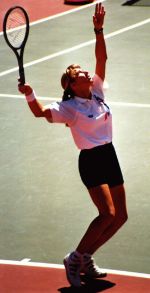
Steffi Graf accelerated the racquet from the vertical position
What is typically described as the trophy position is when the racquet points vertically to the sky in the backswing.
But most players do not accelerate the racquet from there.
In fact, only Steffi Graf actually had a vertical racquet in that phase of the serve and accelerated from there.
While the racquet might go through the vertical position during the wind-up, it doesn’t really accelerate from there but from a slightly lower position.
Most pros accelerate the racquet head from a lower position which is actually the position from which they would throw.
I found this video on youtube that talks about the “power position” which is what I mean when I talk about the position from which the racquet really starts to accelerate.
So, in the following drills, start from the position that you feel is the beginning of your »throwing« motion.
How to Practice The Serve
Here’s a quick rundown of the exercises shown in the video:
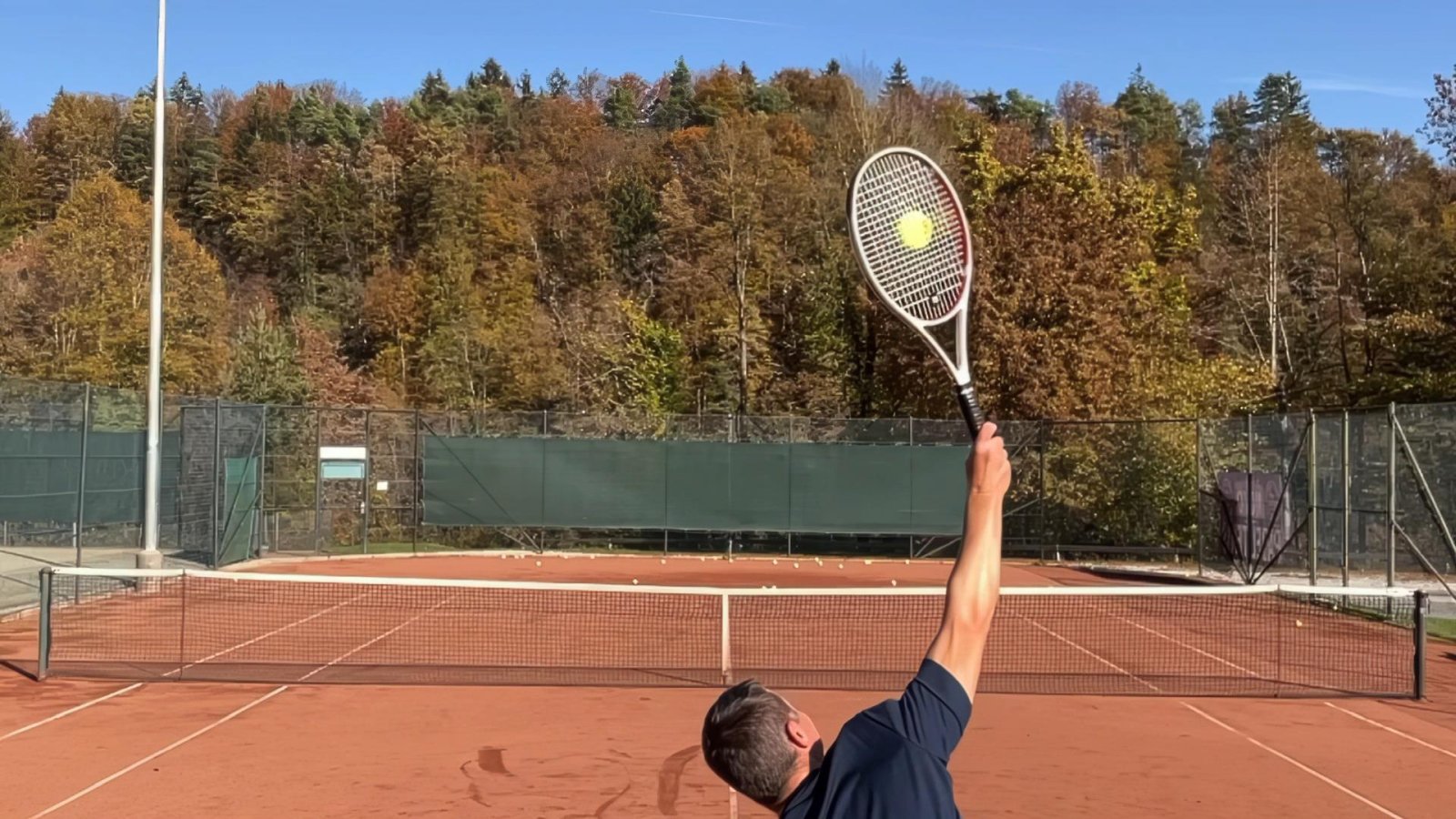
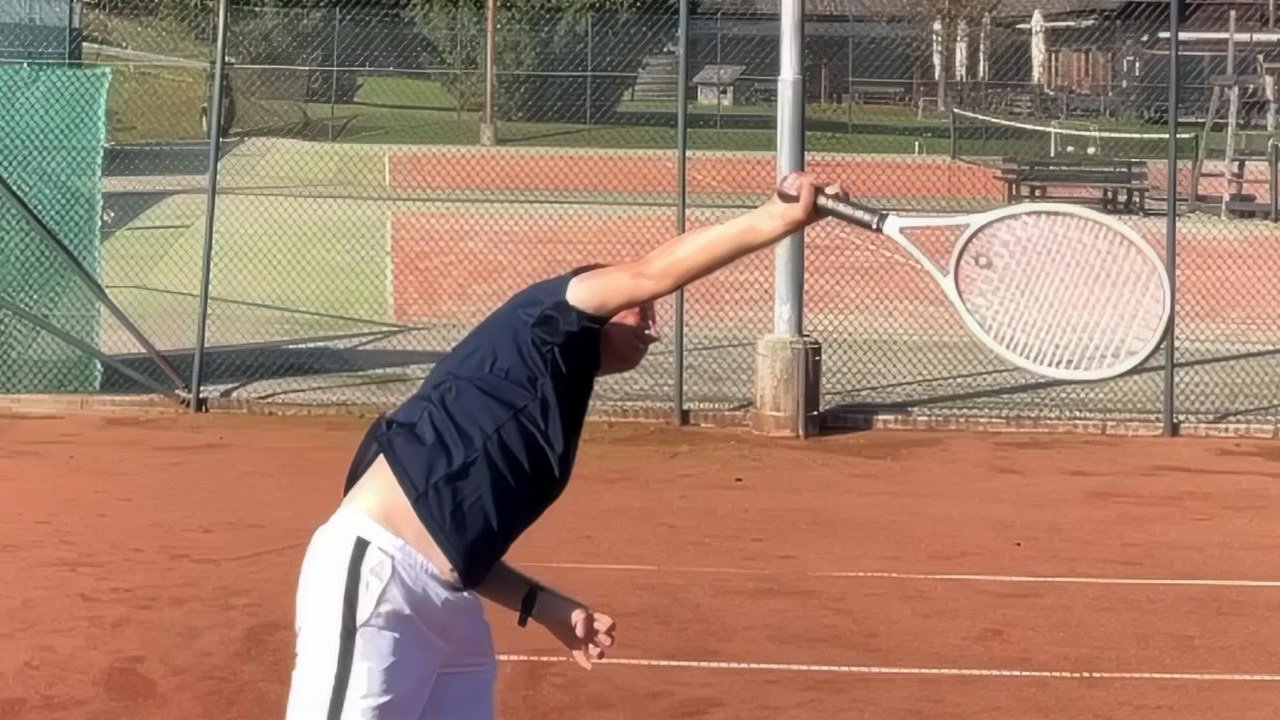
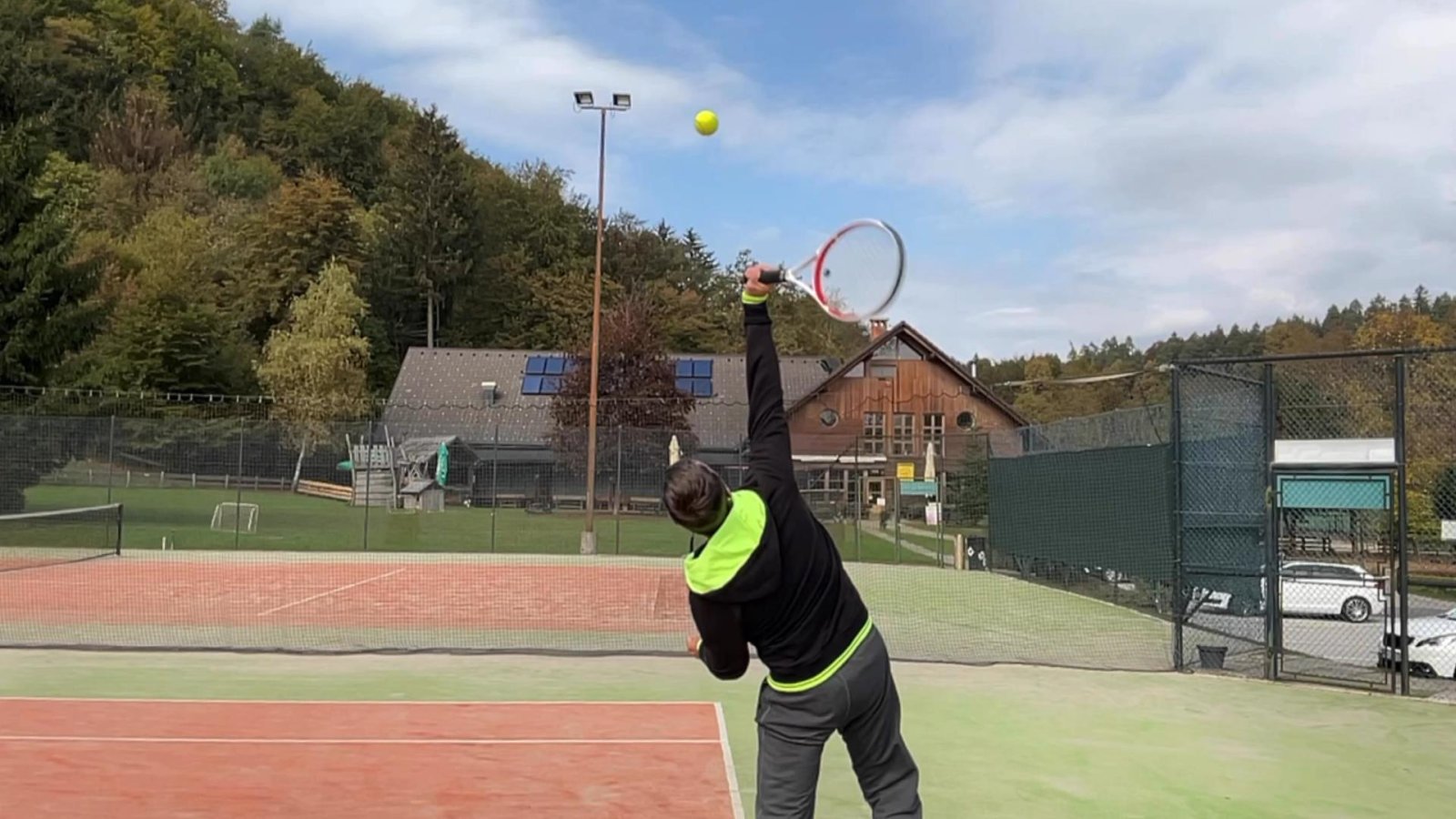
- Position yourself in your normal serving stance and place your racquet behind you in a horizontal position – or slightly higher. Then simply allow your racquet to drop – and pull it up again. Your arm and wrist must give in to the weight of the racquet.
- After a few repetitions where you feel that you can really allow the racquet to drop, turn your shoulders as you’re starting the racquet drop. Repeat at least 20-30 times (or more if needed) and search for where you feel that the racquet accelerates.
DO NOT accelerate the racquet with your arm! Your arm is still loose, and it acts now as a whip. Your focus is only on the shoulder turn – and you’ll see that the racquet flies out by itself from behind your back. - If you’re really loose and do it well, the racquet will want to come out to the side with the backside pointing forward. In the third step, you don’t really allow that to happen, but you lead upwards with the edge.
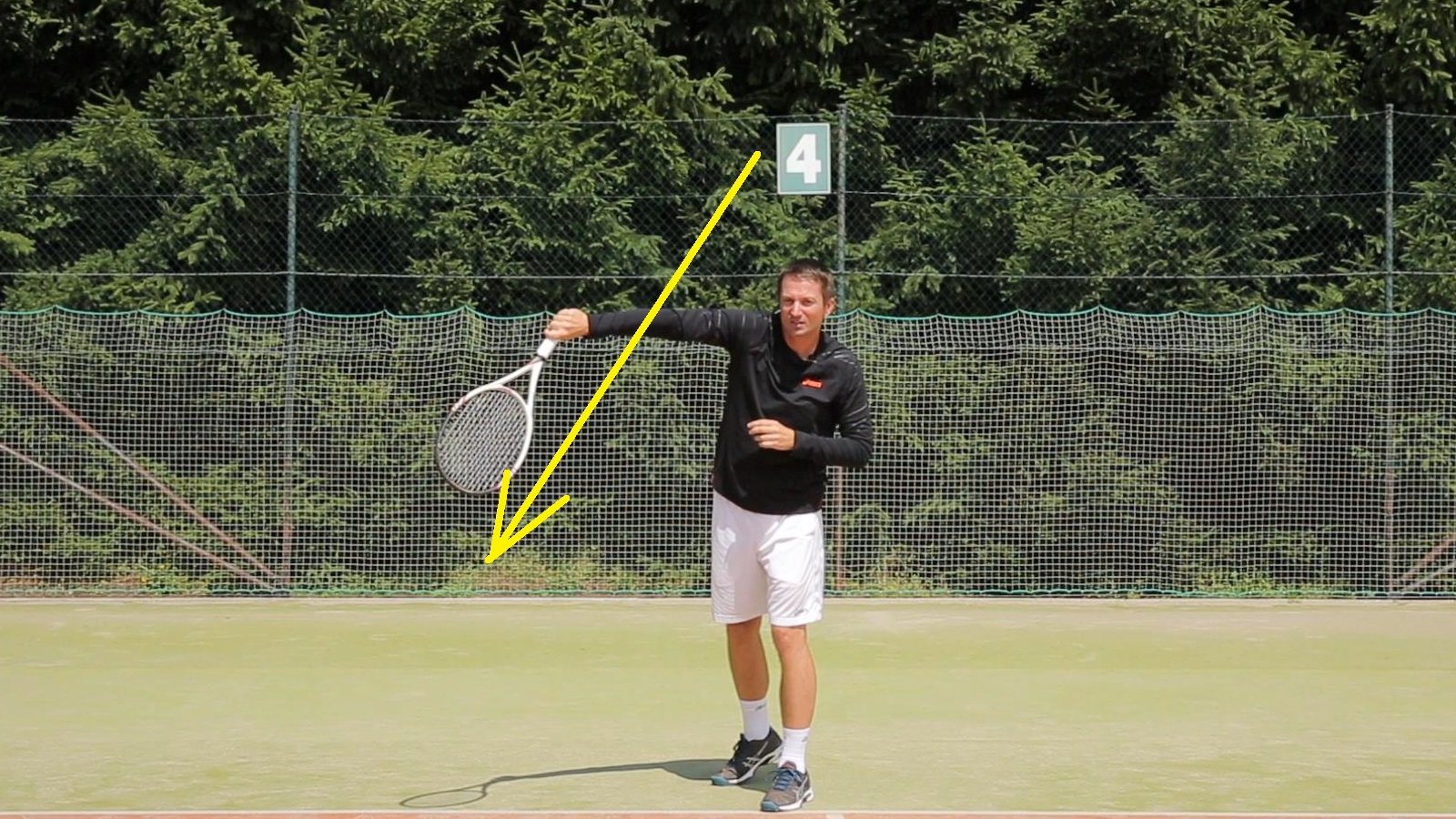
- In the last step, you complete the follow-through, leading with the opposite edge.
Repeat this sequence of movements for a few tennis sessions, and you’ll find the secret to good acceleration with little effort when serving in tennis.
Keep up the exploration Tomas — you are giving us all wonderful insights into effortless swinging.
You will find a kindred spirit in Ernest Jones — “Swing the Club Head.” Google him.
Keep it coming.
Karl Schmidt
Excellent exercise drill. The rotation of the shoulder creates the magic drop without consciously thinking about it. It happens naturaly. I noticed you kicked your knee forward, so at contact, both your hips and shoulders are parallel to target. Some players leave their back leg behind and make use of upper body rotation. Which one is better?
Danny, I exaggerate the rotation in order to show the drill and in order to feel more how the body rotation “pulls” the racquet out from behind the back. A tennis serve is very much like the throw – but not exactly. My view on this is that one needs to learn the throw well and discover how to use the body to generate forces. Once you can do that, you can take only “parts” of that force and apply it in a slightly different way.
I like your early videos for the top spin serve. However they did not shown the transition from sideway position (left shoulder facing inward) to completed full motion (full chest facing inwards).
This new addition is really great because it does that. Can you please confirm/ clarify that for the topspin serve, as you turn forward (full chest facing towards the net) do you still lead with the edge/ side of the racket? And if so, at what point do you pronate to allow the strings to brush up the ball?
It is the turn and top spin that is causing problems for me.
All the best , John
John, my next post will be about the difference between the flat and the top spin serve. It will be easier for you to see in that video what the differences are compared to me trying to explain here that only with words. The key is to remain sideways though on the top spin serve while making contact with the ball. The body (chest) faces forward long after the ball has left the racquet.
Thanks Thomas – so I remain sideways – arg!! Even with that it’s not going well – it just does not have that kick – or even the feel I am spinning the ball.
But if the rotation causes the racket drop – isn’t that very rotation the thing that takes me from sideways to forwards?
Really looking forward to the video on the topspin – your early ones were great – but would like to see the end position of the topspin. And, how the topspin fits into the throwing action – I have seen some other videos talking about pitchers arm – i.e. leading with elbow like a pitcher.
I would good to see the whole topspin serve in slow motion – I am just not getting any top – it feels like the power is going nowhere – this contrasts with when I just throw the racket at the ball – same motion as throwing a ball – i.e. sideways and then ending up facing the net – very easy and comfortable power that takes me naturally to the net – it feels like no energy is wasted – feels natural
But topspin – I just cannot get it but would really like a TS serve with some real controlled topspin.
You make it seem so easy – and as though no energy is wasted.
Looking forward to your next upload.
Great website
John.
John, I hope my next video explains this better – will be up in a few days…
Thank you very much Tomaz for the top spin serve video – very quick at posting it. I have been trying it out – it works better – so I think the form is right. But how do I get that real bite/ spin? I can generate and really feel topspin on my groundies – but I cannot get the feel. I will keep practicing!
THank you,
John
PS will you be demonstrating a twist/slice serve?
John, the real bite comes from good coordination of your forearm and wrist – and they need tons of repetition to work in perfect harmony. Just don’t force it – serve smooth and look for good feel instead of super fast serves. Will plan a kick serve video at some point…
you are one of the best I watch, Tomaz. If you would consider converting your mental game program into a video, I would buy it. I don’t like to read that much, and have more time to listen or watch on dvd. just a thought. thx.
Don
Thanks for the kind words, Don. I hope to get the mental ideas on a DVD too at some point…
Hi Tomaz,
I love your videos and articles. My coach has been telling me not to use my
arm while serving but I should rotate my shoulder and let the hand follow.
Your video showed an easier way to practice it in 4 steps. That is why I
think you are a great coach. Your previous video about accepting the
mistakes was also very educational.
Practicing forehand and backhand by first holding the racket with both hands
in front and just pushing the ball to get used to the racket movement and
feel was extremely useful for me.
Best regards,
Steve
Another fantastic piece, Tomaz. My only objection is to the teaching of Rick Macci in the second video. His drill where he has his students freeze in what he calls the “power position” is very likely to create a hitch in the service motion. The “power position” must be passed through but it must not be a stopped pose, especially not a pose with tense or frozen muscles. The racquet and body will move and accelerate at different rates through the range of the service motion, but the complete motion must be fluid so that the kinetic chain never comes to a stop.
Good point, Andrew. If the power position is stopped just a few times to check whether it is correct, then it shouldn’t be a problem. If it is part of learning process, then yes, it can be a problem.
I think a better way to teach the power position is to just have kids throw lots of things (balls, racquets, sticks, footballs, etc.) many times. It will develop naturally.
If you create it artificially through “technique” it will be just a movement without energy transfer…
This tip has helped more than anything I’ve watch or read in years. I always conceptualized the trophy pose, racquet drop, the kinetic chain etc, but it always seemed forced. The power position along with watching the sholder turn after bouncing the racquet really clicked for me. Now I’m really able to get some whip on my serves with less effert and they’re more likely to drop in without shaving off pace. Excellent…Thank you!!!
Watched this one again,Tomaz. Fantastic drill to feel the “whip” of the serve. Is this the same motion ,except the toss , for the kick serve?
Yes, the movement is the same but with the kick serve there’s a key difference.
Tomaz,
Great exercise! I am very analytical regarding mechanics and your insight about feel really balances it all out. Keep up the great work. There is one serve I have never been able to hit, the slice. Do you have any advice on how to hit it?
Hi Kevin,
I’ll make sure to record a video on the slice serve in the near future. For now imagine throwing the racquet almost past the ball so that it just catches the ball on the side.
See where the ball goes and adjust (only in your mind) by aiming more to the left, or to the right or higher or lower. Keep hitting. 😉
Fantastic Drill. I showed this to my son for teaching purposes. I am exited as to what kind of improvement this will do to his serve. He complains about having to struggle doing the kick serve.
Keep it up.
You are my hero! Your drill on the transition to the upward swing has given me the fluid and fast serve I’ve been trying to find all season. It’s even held up in competition and is starting to generate a few easy points.
Much appreciated!
Nice video, thanks!
About serving, I am having problem with the timing at the moment of the stroke at the contact zone. Sometimes I hit late, sometimes early. Any advise? I will appreciate your help…
Carlos,
My advice is to hit 2000 more balls (and more) and your timing will improve. Try to remember the rhythm and feel of the serves that you hit well and just focus on that on consequent serves.
my double faults are decreasing with the slice serve. thanks tomaz
Excellent training video ! Thank you for sharing with the world
Hi Tomaz. On this tip, I was going thru it again. Do you feel you generate the power from your legs off the ground, or more from the snap of the pronation and shoulder turn? Don
Don, the power originates from the ground and it flows through the body and ends up in the wrist – and obviously the racquet. If I didn’t use the legs I could still hit quite hard from the forearm / pronation.
The key is to listen to the energy surge through the body, feel where it is and amplify it there.
The serve drill that I am showing in the video does just that – I generate power from the shoulder turn and once I feel it has reached my arm and then activate the arm too.
It’s a chain of links where each link must be activated precisely when the energy reaches it. So this is not an analytical process, rather it’s a process based on feel.
Hello Tomaz,
I love your teaching style! I have a question regarding serving. Is the wrist involved in the serving motion?
Thank you!
KS
Yes, the wrist does its part in the serve but it is the last link in the kinetic chain and most players activate the wrist much too early in their backswing. This causes tension and prevents energy to flow through the body and arm to the racquet head. You need to have a loose wrist until the last split second before you contact the ball.
In fact, experiment hitting some serves with a loose wrist throughout the serve. See what happens… (holding the racquet with 3 fingers helps to get that feel.)
Tomaz,
Your “feel tennis” philosophy makes so much sense!
Here’s one for you based on this serving topic: I have a decent slice and kick serve and good abliity to place the ball where I desire when serving. BUT my pace on the flat server is not what it should be. Why do I say that? 1) Ball often bounces twice before hitting the back fence and 2) I can generate more pace by starting with the racquest fully dropped behind my back than with my normal serve!
This leads me to believe my problem is insufficient racket
head drop that has been solidified into my muscle memory. (Can’t seem to break out of this pattern when practicing the serve.) Is it possible that I’m not dropping the racket head enoungh due to a toss that’s too low? Have you experienced students who fail to drop the racket head due to problems synchonizing this with the toss? I’m sure many other club players experience my problem.
Thanks for this refreshing approach to helping us get better!
Hi Geoffrey,
Thanks for the kind feedback.
As for lacking pace on your first serve, there could be several reasons, many of those I address in the Serve Unlocked video course.
1. Yes, your toss may be too low and then you need to rush to get from backswing up to the ball and in the process you tighten your grip and the wrist is not free to “whip” at the contact.
2. You may also think “hard” when hitting a flat serve and tighten the grip again. You need to think “fast” and let go.
3. You may want to control the first serve too much and you tighten the grip again. I tell my students that a first serve is a lottery and that we do not control it. The more you swing freely and let it happen, the more chances you have that the ball will go in.
You will gain more control by letting go of control. Once you understand this sentence 🙂 and feel it in your serves, then you’ll be on the right track.
Tomaz,what a wonderfull and informative post on the serve.My question is how do you keep more sideways (shoulders) on a second serve and still try to feel the rotation of the shoulders whip the racket around and up so as to get maximum loosness.As I bring my shoulders thru I feel like I coming more forward than you may have suggested and may not be able to generate as much top/side spin to have a dependable second serve. I hope you understand what I mean. I have been trying to develop a more reliable(spin) serve for a long time. sorry for the long post.your information is second to none,please keep up the great work and look forward to every one of your posts.
Hi Dennis,
Thr second serve feels more like throwing in that direction where in the end you throw more with the arm. So yes, the body holds position for split second.
The flat serve feels like a throw where you want to add extra energy with the body so body rotates more – BUT at some point also stops so that the arm accelerates.
The spin serve also feels that you throw the racquet to the side but the ball actually flies off to your left (for righthanders).
Hit a lot of serves nicely, maybe at around 50-60% power so you can be more aware of what’s going on.
Nice montage nice explication, congratz!, i have 1 question, i try to develop for the first serve -flat serve- , but now i want o add some spin for the first serve and of curse power , what do you suggest to learn for the first serve :slice, topspin slice, only flat?
I’m little confused about the spin of the first serve, and how to incorporate.
Best regards from Romania!
Thanks, Bogdan.
You should learn spin and slice and add some of that to your first serve so that you mix up your serves and make them unpredictable.
Flat serves are very risky and shouldn’t be used much. Just here and there to try and surprise your opponent.
Dear Tomas,
is it true normally the “flat serve” is hit with a slight spin of a combination of top and side spin? (Source http://www.menstennisforums.com/showthread.php?t=114696); it means the ball travels in a slight arc before going down? (unless the person is very tall above 6ft2″ that it is possible to hit the ball straight down into the court on a flat serve.
Regards.
Hi Benedict,
Yes, the measurements have shown that flat serves also spin somewhat as it’s almost impossible if not actually impossible to move the racquet face completely straight into the ball without any sideways or upwards movement.