
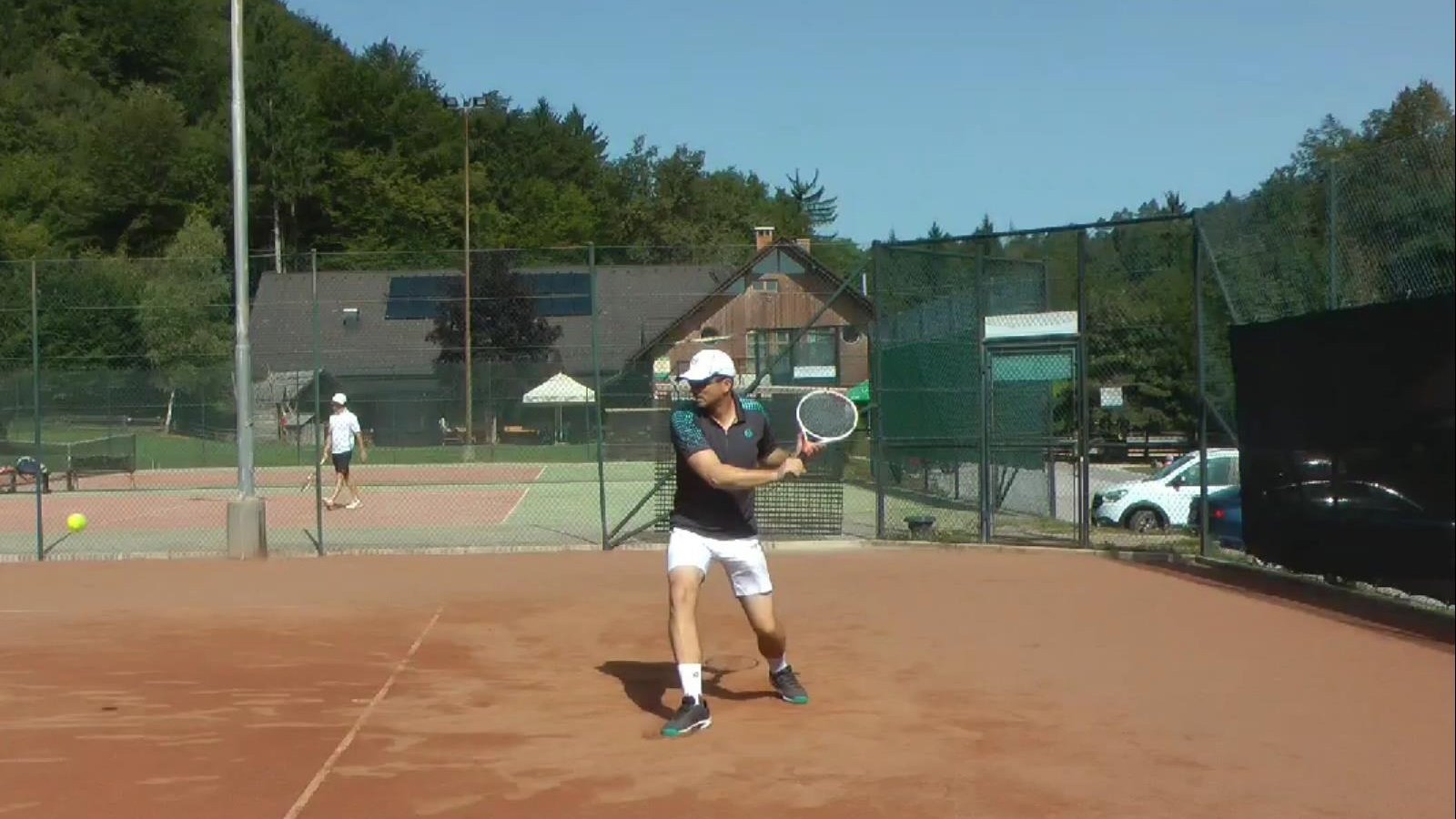
The analysis of Fernando Verdasco’s backhand is another video released in collaboration with Jason Frausto from TennisUnleashed.net to whom I’d like to thank for letting me use some of his videos for these unique types of analysis.
Fernando is a perfect model for magazine covers and for the two-handed backhand technique as he demonstrates the unit turn and the swing path beautifully in these two clips.
Troubles With The Unit Turn And How To Do It Right
One of the most common mistakes players do when preparing their strokes is that they use their arms too much.
That creates unnecessary tension in the arms which causes very inconsistent strokes and causes the players to swing too much which makes it difficult to time the stroke well.
Players use their arms because can see that the arms and the racquet move through space as the player is preparing their stroke but they fail to see that all this movement was simply caused by body rotation.
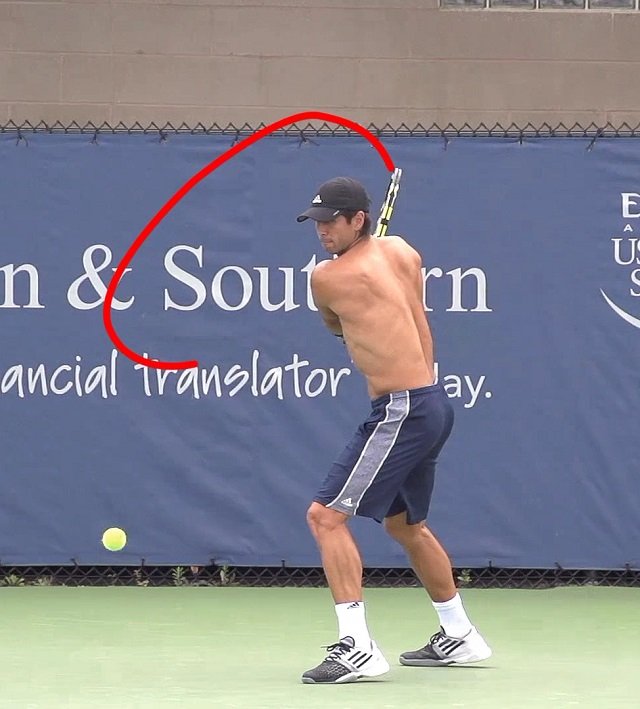
If you're looking only at the racquet, you'll perceive stroke technique incorrectly.
If all your focus is on the racquet movement which you’re trying to imitate, since you think that’s how you’ll learn correct stroke technique, then you will most likely use your arms to move the racquet in the path that you’re trying to copy and not really your body.
That’s why I’ve removed the racquet from the clip so that you can focus only on the body and notice that the preparation is really just a turn, meaning a rotation of the body around its axis.
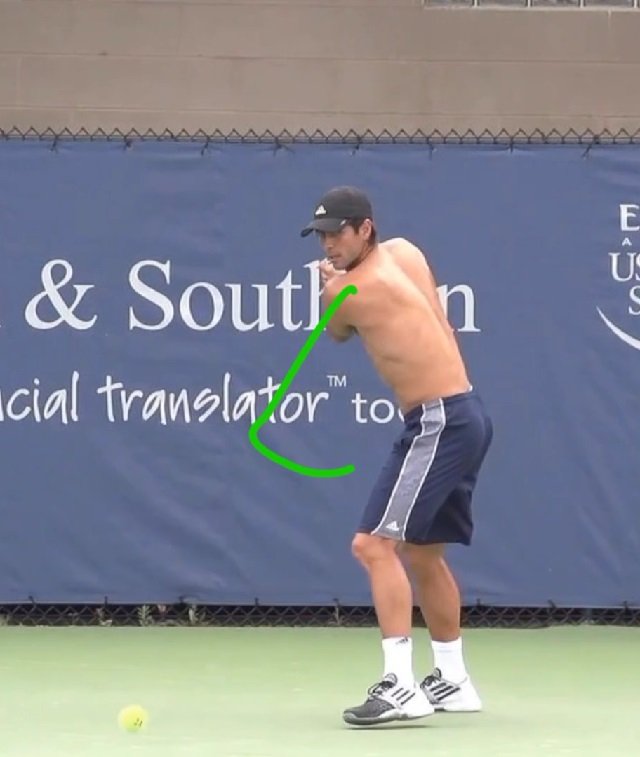
Does this picture help you imagine a more simple backswing?
That’s why we call it the unit turn, meaning that the body and the arms move together as one unit in this initial stage of the preparation.
This becomes even more clear if you look at this side by side comparison where I stopped the first clip when Fernando turned roughly 90 degrees from the ready position.
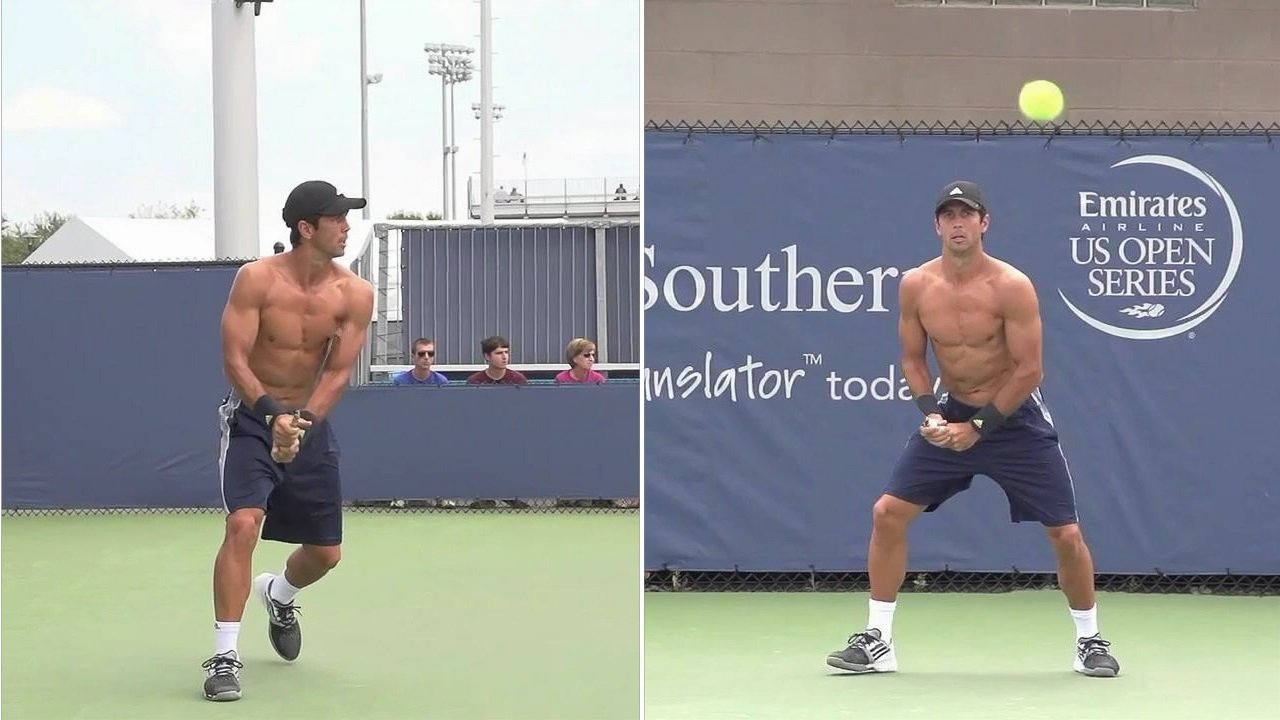
The term "unit turn" means that the arms are not really moving in the initial preparation. (Click to enlarge)
If you look at his body and arms position now you can see that they are almost the same as they were in the ready position.
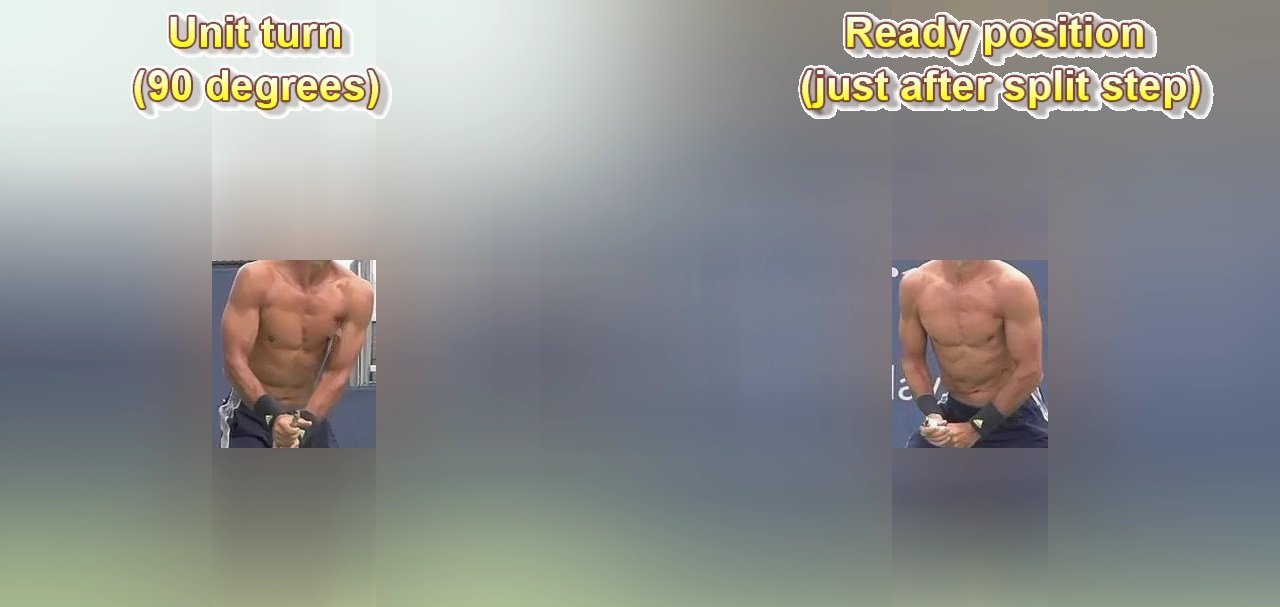
The perfect unit turn (click image to enlarge)
So to conclude, whenever you hear about the unit turn in tennis, that means they the body simply turns sideways and that the arms almost don’t move at all in this first phase of preparation.
All that the player is doing is turning the body sideways but we can often misinterpret that since we see the arms and the racquet move through space and we think that the player used their arms to move the racquet.
The Simple Swing Path (If You Can See It)
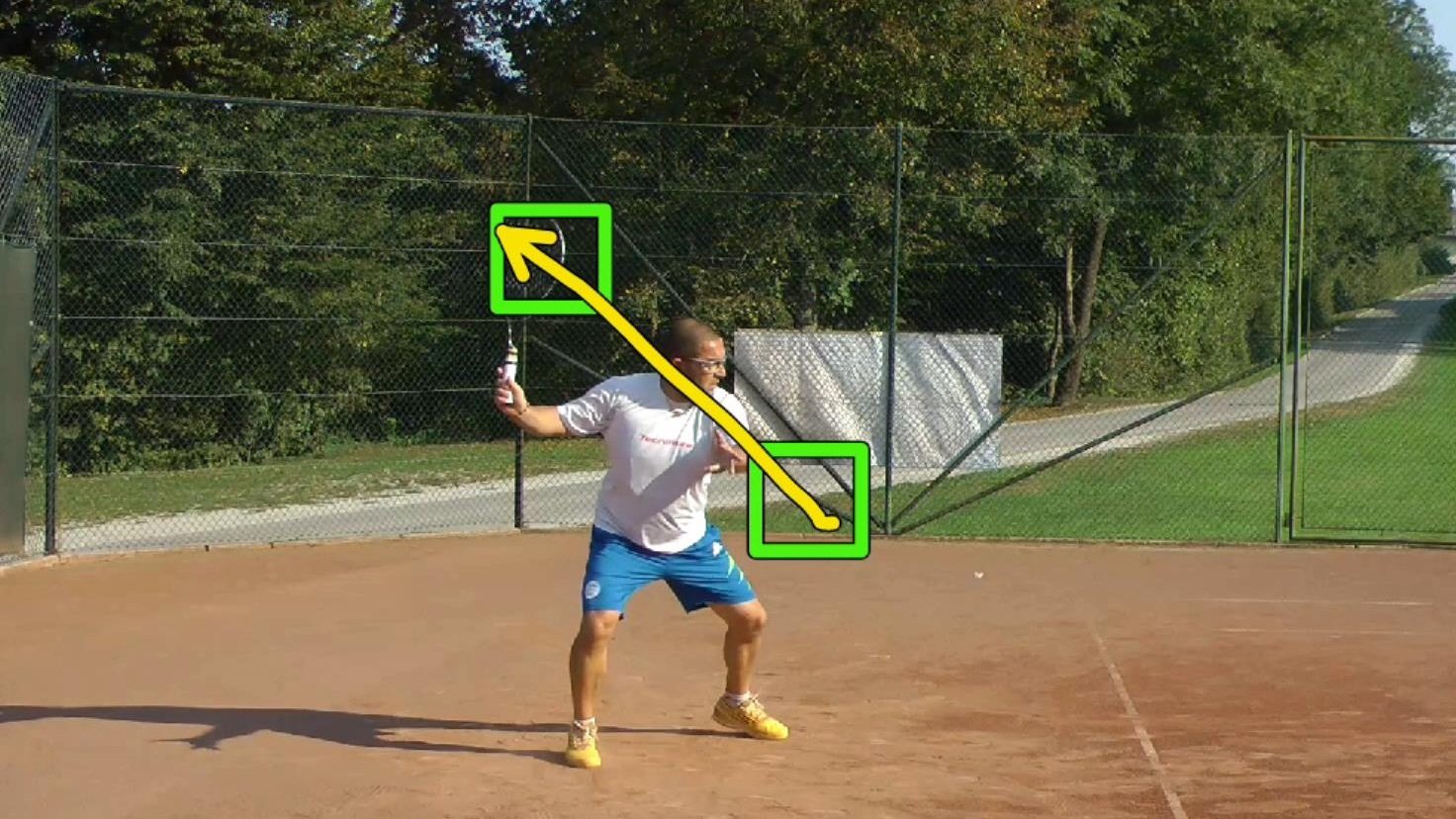
The second thing Verdasco does great with his two-handed backhand is the simple swing path since he uses the more straight back preparation rather than making a loop.
The most common mistake again is paying too much attention only to the racquet which may deceive us into believing that we have to swing a lot to prepare and to hit the backhand.
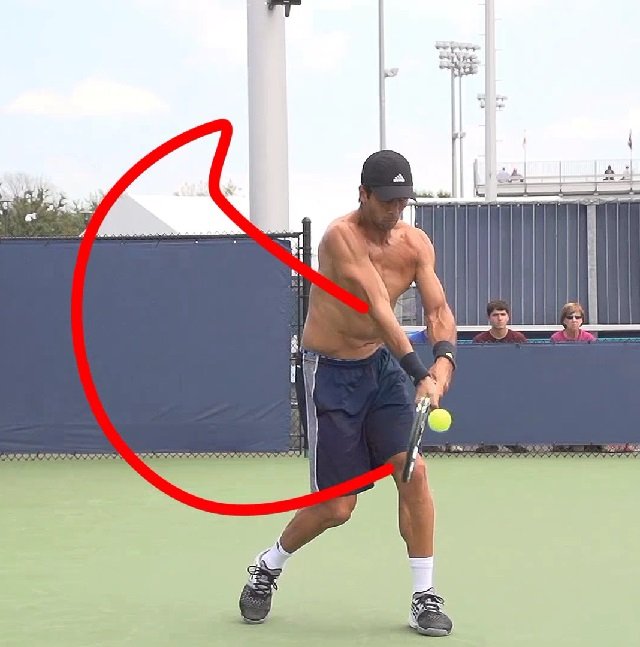
The racquet illusion makes the swing look very big
As you can see the tip of the raquet makes quite a long journey from the start to finish.
But once we remove the racquet and pay attention only to the hands, we can see how simple and compact his swings are.
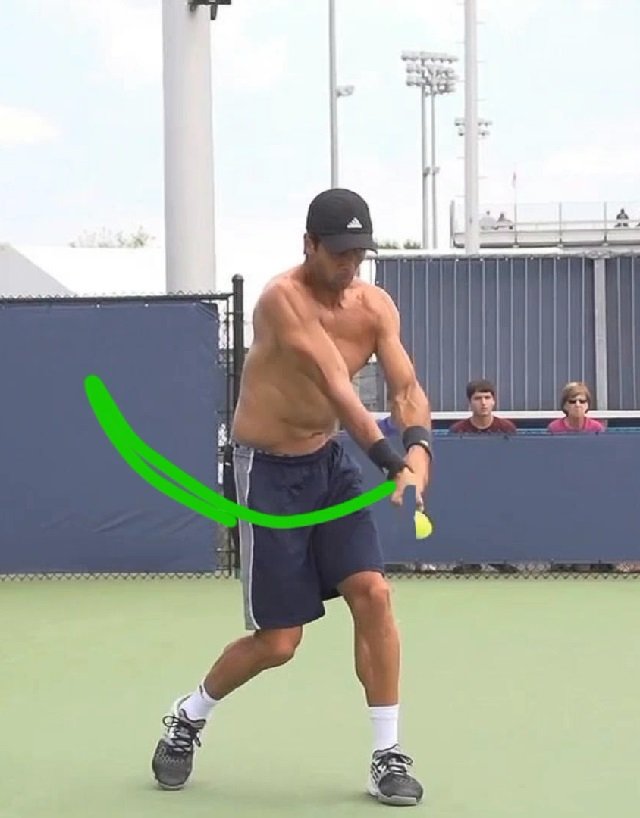
With your focus on the arms you can now see how simple the two-handed backhand is.
What’s really interesting about Fernando’s two-handed backhand is that his forward swing goes almost through the indentical path as his backswing.
I believe that that’s how Fernando gives himself the right feel for the swing path.
When he does his backswing, he feels the exact path of the racquet, meaning the curve of the swing, so that when he swings forward, he has a really fresh memory of how to swing towards the ball.
Another thing that you can see is here is how short and compact his swing is when there’s no racquet in the picture – see how short the distance is from his maximum backswing position to the contact point.
Again, looking only at the racquet might deceive you because you would feel that the distance from maximum backswing position to the contact point is really long – and that would cause you to take big swings at the ball and make it difficult for yourself to time it well and control it well.
So to create a correct mental image of your two-handed backhand, look at Fernando Verdasco’s two-handed backhand technique when there’s no racquet in the video.
Let me know in the comments below if this helps you imagine your backhand differently and if there are any benefits to that once you go on the court.
What a great analysis. This video definitely changes the way how I perceive the swing path of the two handed backhand. Always thought I needed to create this huge loop with my hands. Thanks for the insight.
Great, Anne!
Some players do make a loopy preparation but if you pay attention to their hands you’ll see that it’s a very small loop compared to the path of the racquet.
It’s like MAGIC! How did you make his racquet disappear? Best 2 handed lesson I have seen. Short, compact, and very effective. Just like like Fernando’s backhand. Thank you.
Jeff
The racquet disappeared with the help of a video editing wizard. 😉
Hi Tomaz
Thanks for this great explanation in granular detail.
Would I be right to say that, at the backswing stage, the curve and the power of the swing are created by quick release of the wrists?
You’re welcome, Fulya. Yes, the wrist are released in the backswing stage which creates a lag that produces a lot of power. It needs to be controlled though and we do that through intention and a lot of repetition.
Your brain is fascinating! I would have never thought to delete the racket or isolate the hands. I’m going to ponder this some more! I feel like my BH is kind of “handsy.” The pros always say it’s a left hand dominant shot but when I hit my FH I feel my body weight into the shot. Not so much on my BH.
Another way to say it is if you told me to hit the curtain/fence with my FH I could do it no problem but if you said do it with your backhand I don’t think I could easily. My feet feel very grounded and I swing with my torso and hit low to high…very consistent but nothing special. I am always in awe watching Serena hit winners with her BH.
Oh and “click image to enlarge?” yes, please!! LOL. Nice set of abs…also good for the BH, yes?
Keep watching Fernando’s backhand with no racquet, Christina, and don’t exaggerate with the “low to high”.
Think more about the actual trajectory of the ball you want to play rather than how to move your arms.
Ah, yes, abs, meaning core power is very important for all strokes in tennis.
TRX workouts, pilates, medicine ball exercises – all very helpful…
well done!!! very informative.
Thanks.
Thanks
Yes the compact movement of arm and the big C of racquet. And how he end up in the w racquet all the way over the shoulder very good video.
I am curious on Noles backhand. He leans in bit more into the ball.
Thanks for your comment, Siby. Jason might have a video on Nole in the future, check his Youtube channel.
Tomaz,
You’re a genius.
Your “feeling” approach makes everything look easy and doable.
Thank you for all your work and insight.
J
Much appreciated, Mary, thanks for stopping by!
another brilliant video tomaz. from the ‘feel-perspective’ – how would you explain the lifting of the hitting shoulder in the two hander? nole does it as well, rafa doesn’t as far as i can remember..
Hi Tomi,
The lifting of the hitting shoulder is just a preparation to swing downwards and get under the ball so he can lift it with his shoulder axis that drive the arms up rather than using arms independently. Think levers…
Great video. Thanks. I’m curious about the dropping of the racquet at the beginning of the forward swing… Is this a conscious wrist movement being made or is it the product of relaxed/loose wrists reacting to the body rotation?
Hi Tim, since the drop can be achieved with the help of gravity, I am sure Verdasco finds it much more efficient to allow the gravity to take down his hands rather than him doing it with a conscious wrist movement.
Thank you for your timely video. I have been practicing only two handed back hands for a month (and left handed forehands) because I am recovering from right arm tennis elbow. I like his full swing and I think that I do the same thing. I have been reprimanded for my full swing but it seems to work with most of my left arm doing the work. Is his left arm doing most of the work? Pushing forward with left leg is my next goal.
Hi Dee, since Verdasco is a left-hander, then his right arm is doing most of the work on his backhand.
Thanks I realized my error immediately after my message. I am trying to emulate his swing. Is there much twisting of his wrists?
Wonderful video,
Being a natural right handed golf/baseball player oddly enough play hockey left side!..while learning Tennis my backhand was more developed than for-hand…I use double handed swing using the torque of upper body as my young years playing hockey.. arms alone can never reach this power..I keep the ball very low by Brushing up the lower portion of racquet tighter strings…keep head DOWN! thanks again Tomas!
Your images with and without the racquet are unique and very helpful. From the beginning of showing your tennis illusions, I enjoyed watching them over and over. I found it difficult to respond to your questions about the images, even though you paused the screen for a short time to do so.
Do most right handed players use one or two hands for their back hand strokes or both? If one is a beginner which one would you advice to learn?
Thanks again Tomaz for all this knowledge that you give to tennis players.
George
Hi George,
Most pros use two-handed backhand technique because they start learning very young and it’s easier for kids to learn a two-handed backhand.
I teach kids and beginner women a two-handed backhand, and beginner men a one-handed backhand. Adult males usually don’t coordinate both arms well and have troubles developing a smooth stroke.
This is a fascinating observation, Tomas. Something for me to think about.
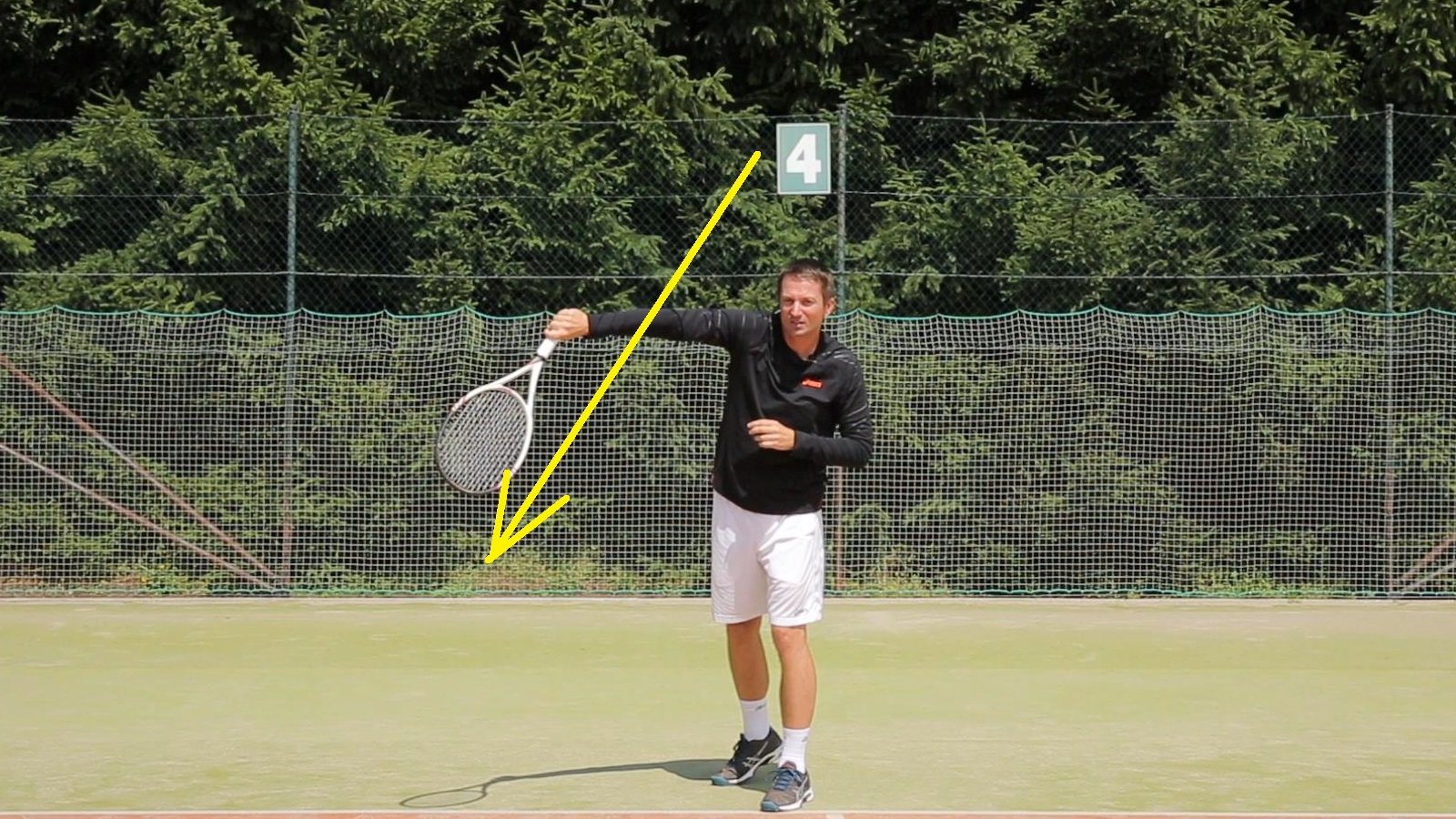
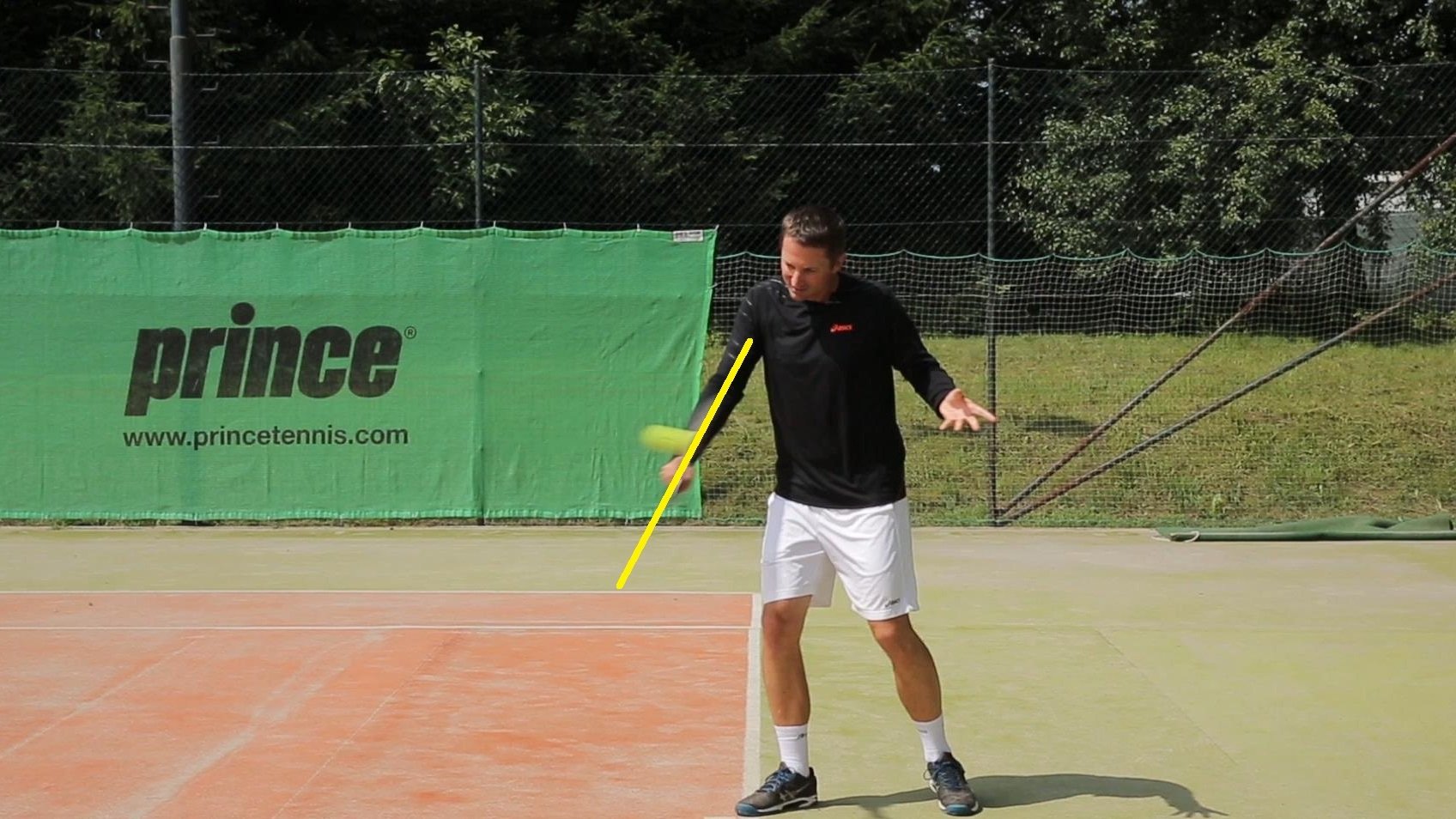
One thing that struck me in the clip of RF serving with racket removed is that while his racket does drop, that is swing down behind his back, his hand really doesn’t. That was an illusion that had me doing something a little extra as I uncoiled toward contact. Recently I was taught to be more aware of the hand, and all this is making a lot more sense.
Great video! I can’t wait to get on the court to try this out. Love the analysis without the racket. That really helps visualize what I should be doing on the backswing. I’m going to focus on making the turn and taking a straight back swing rather than looping it. As well as taking the forward swing along the same path as the backswing. I feel I have a lot of wasted energy / movements on my backhand. Anxious to try it. Thx for such great videos!
You’re welcome, DeeDee, let us know how it worked for you.
Great analysis! I find i actually lose power when i overswing. I think over swinging the arms prevents my wrists from staying flexible and throws off my timing. Thanks for this look at the swing – – seems so simple
Yes, J, timing is thrown off with big swings hence “no racquet” videos that help you see through the illusion of the swing…
Hi Tomaz,
once again wonderful stuff!
I am right handed with dhbh, after making contact with the ball. Do you extend the left arm straight-ish through the ball or pull across with arms bent to a over the over shoulder finish?
Part of me thinks the ball is gone but going through the ball you must still go low to high in the contact phase?
regards, marky
Hi marky,
I wish I could give you a black or white answer but there isn’t one. Anything that I say and you make it very conscious is not going to work on every ball.
It’s a combination of both. How much of “forward” vs “pull across” is determined by the clean hit of the ball. Hitting the ball clean with efficient and effortless power is what corrects the little nuances of forward vs across.
That said, I teach beginners much more forward first than across. Only later is start emphasizing the possibility of pulling across.
Hi Tomaz, Terrific, really good instruction you’re providing. With me standing at the net, I used to instruct students that their forehand follow-through should finish up with the racquet pointed vertically at me, as a result it would ensure full arm extension. That was 30 years ago, now I have children, before moving the racquet gradually upwards, is full arm extension important?
Yes, full arm extension is important but I wouldn’t teach a static finish, I prefer to teach a more continuous follow-through so that players don’t tense up.
Making players hit inside out and down the line encourages extension of the arm. I also give an example of bowling (have players “bowl” a few tennis balls on the ground) where the arm will naturally extend when we aim into a certain target area.
Similarly it should happen on all groundstrokes…
Hi Tomaz, I do learn a very important concept from this video. I did too much loop on my backhand preparation, through this way I thought I could make my ball powerful and have more spin, but I always felt like I put a lot of effort but gained little result, after watching this video, I found the answer to my question. Thank you so much, and I enjoy watching every of your video analysis.
Great analysis