
You can learn to prepare for the volley in tennis in just two simple steps that will also teach you the correct volley technique.
Too many times, the technical instruction for the volley becomes too complicated, especially if you want to learn footwork and how to move your arms at the same time.
A lot of that can happen naturally if you just follow the right progression.
Step By Step Volley Preparation
Here’s a quick recap of what was in the video:
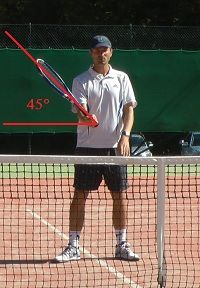
Step 1 - Prepare for the volley by opening your wrist by 45 degrees
1. Plant your feet shoulder-width apart and look for good balance. Try to feel the ground well.
In this volley drill, you won’t be moving your feet at first, so just find a good stable position.
2. Get the feel for the laidback wrist. As is often the case, we use the principle of exaggeration to help us really feel what’s going on.
In this case, you have to open your wrist to each side of the hand by 90 degrees.
Just let it drop to one side and to the other.
3. Now the goal is to find the optimal position of the wrist, which is roughly 45 degrees from the vertical.
Just allow your racquet to move from one side to the other with roughly a 45 degree angle on each side.
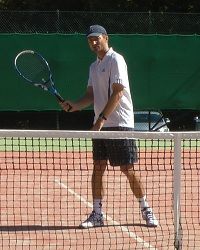
Step 2: Rotate your body by roughly 45 degrees and you're ready to hit the volley
4. Let’s start with the forehand side. Now open your wrist by 45 degrees and rotate your body so that the strings point toward the net.
You’ll see that you need to rotate roughly 45 degrees, too.
That’s because in the process of laying back your wrist and rotating your body, your hand will open up a little bit more again and it will point the racquet head straight towards the net.
From there, you’re ready to hit the volley.
5. Repeat the same process on the backhand side. First, separate step 1 – laying back your wrist – from step 2 – rotating your body, but eventually merge them together in a smooth way.
6. Keep practicing for a minute or two on the forehand and the backhand volley so that your body remembers better what it needs to do.
Once the ball starts coming towards you, there won’t be much time to observe what you’re doing.
7. When you start practicing with the ball, begin step 1 – laying back your wrist – first, and then have the ball fed to you.
8. Eventually wait for the volley in the ready position and react to the ball depending on which side it’s coming towards you.
How to play the ball on the volley and what your mental image should be is a topic for another article.
For now, just imagine that you want to play the ball gently, hit it slightly upwards, and apply slice on it.
You need to know how to play volley slowly first before you attempt faster ones.
In fact, if you play singles, there are many more volleys that you need to play with feel and guide them towards the target than there are volleys where you hit them hard and aim to finish the point.
So, in my view of the tennis volley, the foundation is playing the volley slightly upwards with slice. You build other types of volleys based on this foundation.
Let me know how this volley technique works for you the next time you’re on tennis court – or even in your living room – and we’ll work on the rest of the technique and feel in future articles.

You are the best, Tomaz. Simple basic straight forward. Thanks.
such a beautiful lesson in it’s simplicity.
Tomaz, your instructional video on the volley was excellent. I have had many hours of instruction on the volley…but no one has made the simple imagery rule of preparing the racquet at 45 degrees and simply turning.
I think being aware of feeling the balance of the body over the leg below racquet is essential. Wonderful instruction. Thank you !
Hi Tomas,
Another winning tutorial. Many thanks. Also, thanks for the brew in Bangkok (we met through Frank, bangkoktennis.net). Couple of things… I notice your non-grip hand holds the frame when you bring the racquet back for the volley. I found this really helps me a lot (thanks, Frank) and thought you might want to underscore for your viewers.
Another thing is would it be possible for you to explain how to volley balls hit straight at you? I’m lost here. Never know what to move first (eg., feet, torso, hands), so it would really help to have the “simplified” approach like you’ve demonstrated here.
Great work!
Regards,
Jonathan
Jonathan,
Thanks for pointing out the non-dominant hand’s role.
As for volleys hit straight at you they are typically played with the backhand volley. What to move first shouldn’t be that analytical – but attempt to play them with the backhand and get out of the way as much as you can.
The ball coming towards you often makes you freeze so you can practice still being alert and nimble on your feet and try to make some space so that you can volley with a little bit more control.
Another brilliant video. I have been using your tips to teach my granddaughter (13 Years) and it has been amazing how quickly she picks up the simple imagery. She had a bit of trouble with pressing and rolling the tennis ball so I changed the imagery slightly.
We started by rolling a hula hoop to each other to give her the feel of rolling up the ball. We then rolled the hoop with her racquet for a while. When we returned to the court she hit forehands which she could not believe!
But it is not only for kids! I have found your videos incredibly useful myself.
Thank you so much.
Graham
South Africa
Good idea, Graham, to use the hula hoop! Even a big beach ball would be a good training aid for that. Thanks for sharing.
Great stuff Tomaz, I really enjoy your lessons and I always try and incorporate it in my lessons…I should give you percentage of my earnings 🙂 Thanks for all your hard and brilliant work! Go FeelTennis!!
I think you are really on to something with your simple exercises,in this case to get the feel for a laid-back wrist and previously, to add speed to the serve. These are great aids to developing muscle memory that with repetition, for me, seem to translate into lasting improvement. Looking forward to your next video.
Eureka! I now know where I have been going wrong. What a simple video, thanks so much for a great lesson.
thank you tomaz for showing how a very simple way to learn the volley.
great video, thanks
Hi Tomaz
Thanks for making it that simple!
I already feel the difference in the painful transition from double-handed to single-handed BH volley.
From 0 to 5, how tight is your grip hold at the ready position and at the time of hitting?
Hi Fulya,
My grip at ready position is probably 1 and when I volley a typical nice ball in the warm up it doesn’t go over 3.
In the real game it really depends on the pace of the incoming ball and my intention so I might to up to 4 but I doubt I go to 5 ever.
Most of the time it’s between 2 and 3.
Tomas,
Thank you for simplifying volleys! For years I have STRUGGLED with volleys. Whenever I volleyed, I was so preoccupied with how I was moving my feet, shoulders, and arms, that I was tense and had horrible results. Although I always made contact with the ball, I rarely hit it with any direction or control. Consequently, I tended to retreat from the mid-court to the base line instead of moving toward the net.
Two weeks ago, I watched this video and had immediate success. Now I am relaxed at the net and like volleys so much that I actually volunteered to play doubles for my team. I am still marveling that your two simple instructions made volleying so easy.
Your video on top spin ground strokes was so helpful that I recently purchased your forehand course. I very much like the way in which you break down the lessons and muscle memory drills for that course. I’m actually learning how to hit with open stance thanks to your excellent explanation and drills.
Great to hear, Ally, thanks a lot for sharing your feedback!
Last year worked hard on my volleys. Got BH volley mechanics down and its really solid, but continued to MASSIVELY struggle with my FH volley. Until watching your outstandingly simple volley preparation video!!
While watching the video and rewinding while doing some shadow volleys, I realized on my BH volley, I naturally tilted my racquet back 45 degrees at same time I turned my shoulders just as you illustrate.
But on my FH volley, I kept my racquet vertical as I turned my shoulders and THEN pushed the racquet handle forward first, trying to create the desired racquet tilt. It produced horribly inconsistent volleys.
Tonight with my ball machine, I worked on my FH volley by making your simple adjustment of tilting racquet back 45 degrees while I turned. HUGE, HUGE difference for better. My ability to maintain a firm wrist and associated control was 20X better.
Thank you for the wonderful feedback, Russell!
I plan to share more volley tips in the future once I am more or less done with groundstroke topics…