
Wouldn’t it be great if you could crush those short second serves that so invitingly sit up in front of you?
You may be of two minds, not being sure what to do because when you go for a winner you make too many mistakes, but when you don’t attack them you play back to your opponent and waste an opportunity.
But there is a way of attacking short tennis serves that will tilt the scales in your favor in the long term, and it all comes down to having the right objective.
1. Apply pressure with the goal of forcing mistakes (and not hitting winners)
While you may hit some winners if you attempt them, you will also miss quite a few balls and basically give your opponent a free point even though you just had the upper hand and a chance to take control of the point.
That’s why your objective must be to apply pressure with an aggressive shot into a safer target area about 5 feet from the sideline and the baseline.
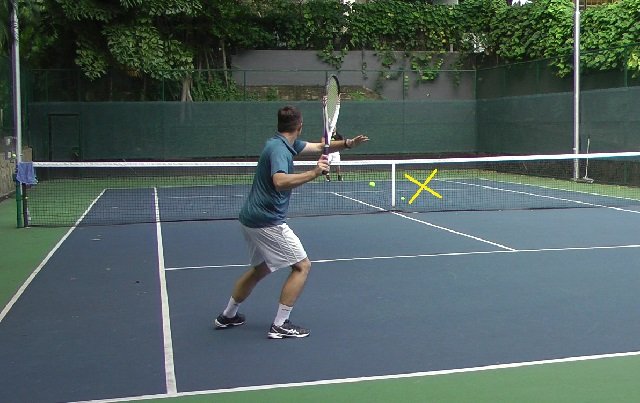
A good target area to aim at
That gives you enough margin of error to keep the ball in the court on almost all shots while still putting your opponent in a very difficult situation.
There are three very likely scenarios that you’re looking for:
- your opponent gets to the ball but misses so you force an error,
- your opponent gets to the ball and hits it short, which allows you to finish the point with the next shot, or
- you hit a winner because you missed your target a little bit.
There is also one scenario that’s not in your favor, and that’s when you miss your shot more towards your opponent and he can then hit a good shot that neutralizes you or even puts you under pressure.
This is part of the game and the probabilities you’re dealing with, and it cannot be avoided.
Because there are three scenarios in your favor and one against you, you’re still winning in the long term.
2. Deciding in advance
The return is the only stroke in tennis besides the serve where you have enough time to decide in advance what to do.
You may think that, because you don’t know where the serve will be directed, you can’t decide your return direction in advance, but you can.
You simply prepare two plans depending on where the serve goes.

Know where you'll return in case of a forehand and in case of a backhand return
Have a clear target and trajectory for the case of returning with your forehand and another plan in case the serve goes to your backhand.
You can choose to direct each of your strokes to the weaker side of your opponent, but you can also choose different directions of your returns when you feel that you can hit a better shot in that direction.
For example, you can decide in advance when returning on the deuce side that, if the second serve goes to your forehand, you will stretch your opponent wide with a short cross court shot, but if it goes to your backhand, you will hit down the line as it’s easier to hit the ball accurately when swinging in that direction.
This little trick of preparing your “answers” in advance can do wonders for the consistency and accuracy of your returns.
3. Hitting the ball on top of the bounce
Returning the serve when it’s on top of the bounce is an optimal position from which you can create a lot of pressure.
If you hit it on the way down, you’ll have to return it possibly from behind the baseline and that will give your opponent a lot of time to get to it.
You’ll also have to hit up, and you won’t be able to hit it very fast.
That’s why it’s best if you step into the court and hit your returns right when the serve reaches the top of its bounce.
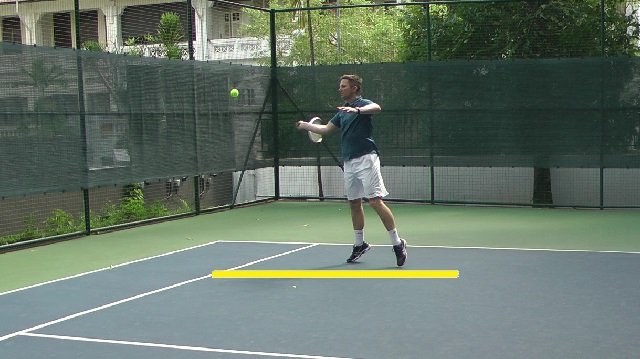
Step in and take that slow second serve on top of its bounce
That also allows you to swing freely through the ball without having to adjust to its trajectory.
Namely, if you were to hit the ball while it was still rising, you would have to close your racquet face a bit to compensate for the angle of deflection from your racquet. If you were to hit the ball on the way down, you would need to compensate again and add more lift to your stroke.
Therefore, hitting on top of the bounce is the easiest way to control the ball. And because you’re returning the serve inside the court, you’re giving your opponent less time to react which increases the chance of him missing the shot.
4. Creating enough space between you and the ball
While the idea of creating enough space between you and the ball may not seem like a key piece of advice in this situation, I feel the need to include it because I’ve seen players jam themselves too close to the ball in their eagerness to attack it.
For some reason, the intention of playing an aggressive shot makes players come too close to the ball very often, so I am including this suggestion here in case this happens to you, too.
You need enough space between you and the ball in order to swing freely and loosely, which will create a lot of racquet head speed without much effort.
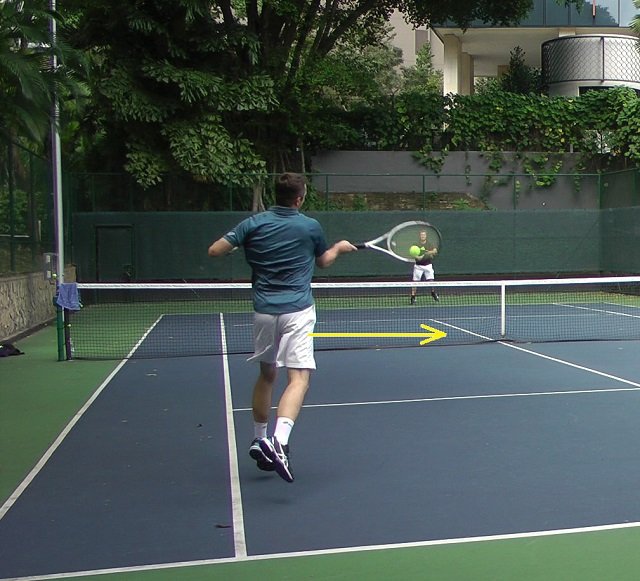
Find enough space for a comfortable swing
If, on the other hand, you get too close to the ball, you’ll muscle it. While it will feel powerful to you, it won’t have much speed because muscling the ball actually slows down the racquet face.
It also works the other way, of course – if you only know how to muscle the ball, you’ll probably jam yourself into it.
So hopefully keeping in mind a good distance from the ball will also help you develop a more smooth and effortless swing.
5. Seeing the ball clearly
One of the most common reasons for missing an aggressive return (or any other shot, for that matter) is taking your eye off the ball.
The reason why I point out keeping your eye on the ball again in this situation is that you are hitting an aggressive shot, which means your racquet will travel very fast through the air.
That also means that any small mistake in its path or angle will result in a big mistake once “multiplied” with the high speed of your swing.
Therefore, you really need to focus on seeing the ball clearly after the bounce and keeping your head still while making contact with the ball.
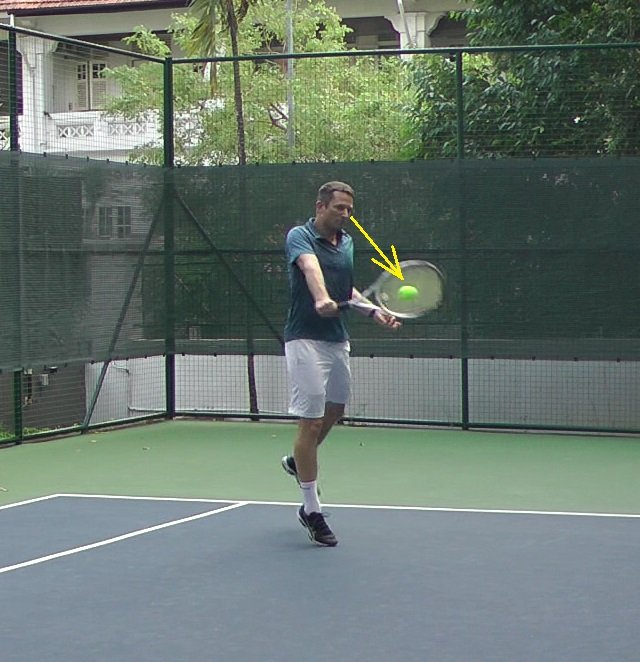
Try and see the ball clearly and keep a still head
You will be tempted to look at your target, especially when you have already made up your mind where you will hit your aggressive return, but you must resist the temptation.
Trust that the ball will go close to your chosen target even when you don’t look at the target. Focus on making a clean hit.
6. Recovering immediately
As I mentioned initially, you might also miss your shot slightly towards your opponent, which won’t put him under much pressure. In fact, he can respond with a good shot.
You need to be ready for that, which is why you need to recover immediately after your return to the middle of the possible angles your opponent can play, just in case your return doesn’t land where you wanted it to.
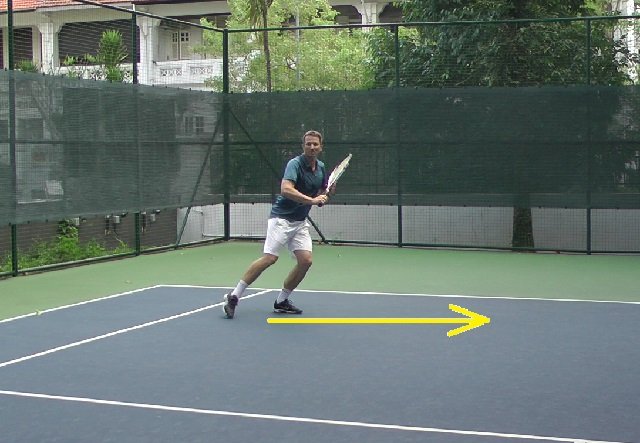
Immediately start recovering after your return "just in case"...
You could also approach the net after your return, but you must do so very quickly and expect a good reply from your opponent, no matter how unlikely it is.
In summary, punishing those butterfly second serves is very doable. You can turn most of those situations in your favor following these six tips:
- Look to force mistakes rather than attempting to hit winners (you will still hit plenty of winners in the long term when you miss your target slightly).
- Decide in advance where you will return.
- Create enough space between you and the ball.
- Hit the ball on top of the bounce.
- See the ball clearly after the bounce.
- Recover immediately.
And if you happen to be one of those players who serves easy-to-attack second serves, then sign up for the free three-part video series on how to boost the effectiveness of your second serve and prevent any attacks on it.
Great Explanation!!
How many times a great opportunity is missed trying to play a winning return of serve instead of a well-placed one that creates a difficult situation for your opponent…
And how many times have I been the admiring “artist” serenely contemplating how my opponent unexpectedly manages to return my masterpiece, and improved!!
We all know the feeling, George. That’s why we need to play the percentages and expect the unexpected! 😉
Hi Tomaz, I have faced this kind of serve on many occasions from players who push, lob and slice for a living so to speak. This means that unlike the player in your video demo, they push the serve in; slow, high or low and usually short but then they react like a cat and (as you pointed out so well in your previous post regarding pushers – they do not intend to try and win the point).
They love to chase down your return and send it skyward to the baseline. When the serve is low and short they love to see you hit up on the ball and see you struggle to decide (from a no man’s land position) whether to come in and face the lob or the pass and they stand inside the baseline daring you to drop shot them.
If you stand well in for the return, they hit the ball deeper to jam you and force you to take a slow high ball on the rise, or drive you backwards. Add in a slow court, an off day for ball striking and well, you get the picture.
My biggest issue, as you also point out, is my mindset. I have some decent weapons which I want to deploy against this ridiculous tactic but it seems all too easy for the guy to push, push and just laugh.
Hi Grahame,
If they are really good defenders, then look for a short cross court shot that’s not fast but it makes them run out wide really far.
They will defend and then your next shot is to the open court and you could possibly close in on the net. Think of it as a 1-2 punch rather than really attacking with your return.
Also throw in a drop shot here and there on their weak second serve just to break their rhythm and surprise them.
i dunno if you usually do this but I like at the end how you made a concise summary numbered 1-6 for things to remember. it really helps concretize everything after the video is over.
Also: did I see you switch between hitting a forehand return of serve from traditional low to high as you came across the body (the modern way) and then a couple through internal rotation of elbow/pronation of wrist as you came across body (the “more” modern way).
At 4:43 it seems like you do the latter. But then again it looks like you might have just done the former, and then turned over just after contact.
Thanks again. Love your stuff.
Thanks, jjg.
The “switches” that you talk about on the forehand return just happen, I don’t “do” anything. I simply want to make the ball go how I want and my technique adjusts.
I really suggest that you forget the mechanical nonsense and focus only on the trajectory of the ball and the amount of spin you want.
Over a lot of my career I have been the poster child for Your Number Four: What do you do with all the time you have on this pushed serve? Overrun the ball, of course! I think being relaxed and therefore patient has a lot to do with this.
As an added note, I think this advice is every bit as valid in doubles, at every level.
Yes, Robert, these tips are valid for doubles too, especially the part where you decide in advance. Don’t let the net guy distract you.
If you aim at the wide service box corner on the opposite side and know in advance that you’ll play there, it’s very likely that you’ll play very close to that area which makes it almost impossible to reach for the opposing net player.
Hi Tomas,
How would you adjust your list in case of doubles ?
I would just adjust the target – as I mentioned before, I would aim into the wide service corner area on the opposite side for both forehand and backhand return.
That would be my “default” return but I would definitely hit some down the line returns just to keep the net player “honest”.
as to #6 I would say: ‘Recover immediately or come into net”.
On these weak 2nd serves – I agree that one’s mindset should be to simply ‘pressure’ the opponent … which is the same mindset I have when hitting an approach shot.
Ideally – you want to ‘take time away from your opponent’ i.e. – rush him/her and/or make him move. A lot of people are off-balance after they serve and they are often looking at where their serve lands and wondering if it was in, because they don’t have a lot of confidence in their serve.
If you move in and take it early and hit it deep you will often get a weak reply. If they start retreating to play defense, you can mix in a few sharper x-court angles to keep them off-balance and guessing.
You can also ‘fake’ coming in and hope they go for too much and make a mistake or that they throw up a lob – which is often easy pickings if you’ve stayed back because you should have an easy overhead off the bounce that hits in front of you.
Good points, John.
Just to reiterate – when an opponent serves, they typically land inside the court on one leg. If you then put pressure on them, they will be in much more trouble than when they are in a rally behind the baseline on both feet.
So the same attack on the same short ball / short serve will cause them much more trouble if they have just served compared to being in ready position behind the baseline.
Therefore we don’t have to take that many chances (power, accuracy) with returns off short serves than we have to when we attack a short ball in the middle of the rally.
agree Tomaz. Funny thing is that sometimes it’s the bigger/ better servers that are more off balance for that split second after the bounce, because as you say – they are putting more effort into their serve and often landing on one foot and/or otherwise taking a step into the court and because their toss may be a bit off and/or they tossed the ball behind their head a bit to get topspin on the serve – these bigger/better servers can be just a bit off-balance for a half a second following the serve – as opposed to the patty-cakers that just pop the serve over without moving their feet.
I’ve noticed that one of Djokovic’s best returns is the one that takes early and hits back deep up the middle – sometimes right at the feet of the server – causing even great athletes like Nadal to struggle – since he’s forced to try to execute what is essentially a half-volley reply when – as you note – he’s just landed on one foot inside the baseline and is attempting to regain his balance.
Obviously, the ‘chip and charge’ is a variation of this tactic, but Djoker doesn’t necessarily come in; he just steps in – makes good contact – and sends it back deep down the middle and anticipates the weak half volley reply and then attacks. Again – I’ve seen Nadal and others sometimes struggle to get it back into play and even if they do it’s often a weak shot that puts Nole on the offensive.