
Learning how to hit your forehands and backhands with topspin is the foundation of advanced tennis. However, this advice can easily be misunderstood and cause a lot of mishits and short balls.
That’s because you’re still trying to apply topspin to the ball in the same way you were taught at the beginning. At a more advanced level, your technique for applying topspin has to change because of the faster tempo.
You now need to upgrade your understanding of how to apply spin to your shots so that you can hit them cleanly with good power and still enough topspin for highly consistent shots.
How You Learned To Hit Topspin And Why It Works Only On Slow Incoming Balls
When you first learned to hit topspin forehand (and backhand), you realized that, in order to apply topspin to the ball, you need to move the racket vertically up and brush the ball on the back side.
The friction between the strings and the ball makes the ball rotate. In turn, that spin makes the ball dip towards the end of its flight, therefore allowing you to hit with good power and still keep the ball inside the baseline.
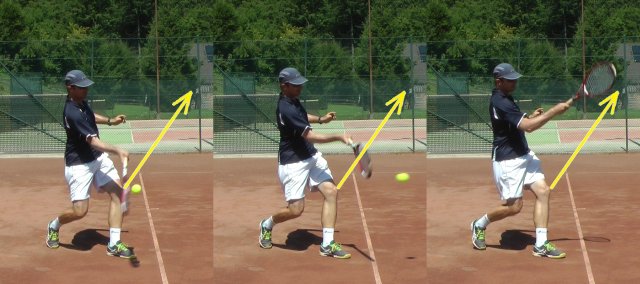
Your mental image of creating topspin is probably an almost vertical move of the racket on the back side of the ball
Because you were still learning the topspin, you had to use your arm, forearm and possibly your wrist to move the racket in an upward direction, which imparted topspin on the ball.
Your coach was feeding you very slow and nice balls right into your strike zone as you were learning this new idea of adding spin to your forehands and backhands.
After some repetitions, you realized that you were able to apply topspin to the ball by DOING a certain movement with your arm, forearm and wrist.
And you have been doing that ever since…
But once you started to play with higher-level opponents who played much faster, you found yourself struggling to hit a clean ball in the sweet spot while trying to apply topspin to it.
You were still trying to DO topspin by engaging your arm, forearm and wrist and moving the racket very steeply up to brush the ball on the back side while it was flying very fast towards you.
Because the ball is going in one direction and the racket is going almost perpendicular to that direction, it’s then very difficult to time the exact moment of when the ball and the racket’s sweet spot meet.
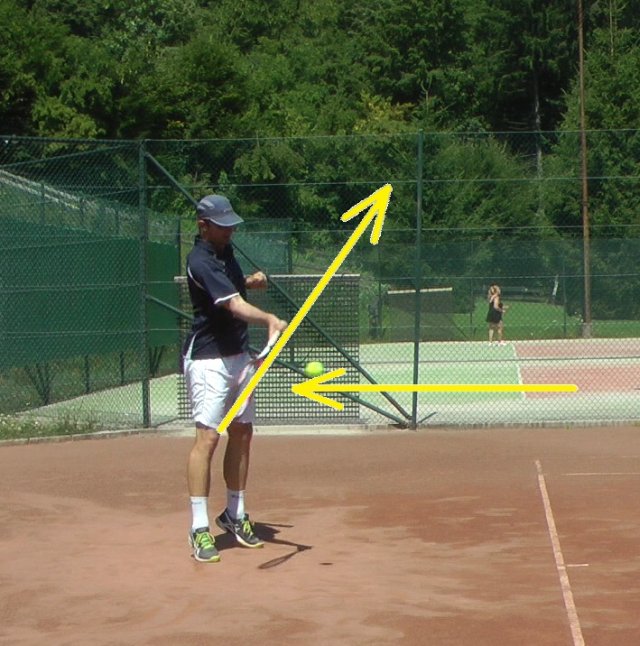
Can you see why it's so difficult to hit a clean shot when attempting lots of topspin on a fast incoming ball?
That’s why there are so many mishits and balls hit off the sweet spot, which then results in a very slow and short ball that can easily be attacked.
You are confused now on what to do since everyone has been telling you to hit with more topspin.
How is it that you now hit a lot of poor shots even though you are trying your best to hit with a lot of spin?
The solution is that you must learn to make spin just happen rather than doing it.
How To Make Spin Happen
If you look at a forehand (or backhand) swing path from the side, you can see that it has two distinct stages.
When we swing our arm naturally by the side of our body, then it will travel more horizontally when it’s closer to the body and then transition to a more vertical swing as it goes away from the body.
The arm is attached at the shoulder to the body, and it acts like a pendulum so it just swings around its anchor point, the shoulder.
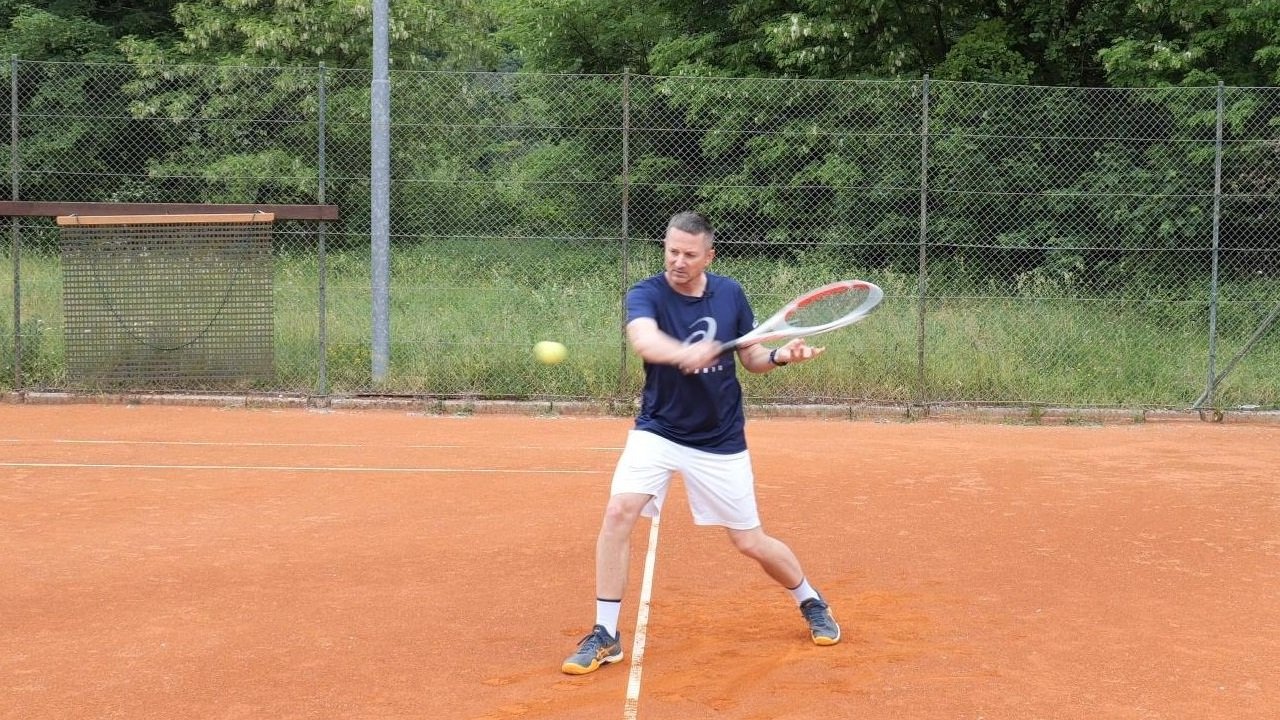
That tells us that, if we hit the ball closer to the body, we will hit the ball flatter since the racket will be moving more horizontally. Conversely, if we hit the ball more in front, we will hit with more topspin since the racket is going more vertically.
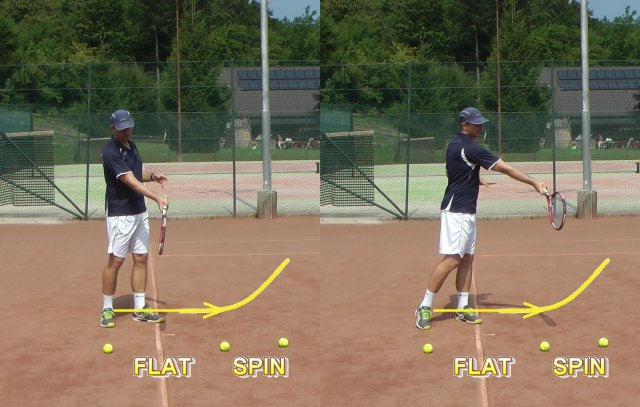
The natural swing path of your arm shows you very clearly where spin happens
This is the key mental image you need to use when hitting your groundstrokes.
That’s because this tells you immediately that you don’t have to DO topspin so much but you can make it happen by hitting the ball more in front.
The swing path alone will make the ball spin since the racket is traveling upwards by itself because of the inertia and because the arm naturally swings in a circular way.
Therefore, we can make the spin happen by simply swinging and letting the racket hit the ball while it’s bouncing up and is a little more in front of you.
If you are then receiving a fast, incoming ball, you should try to find the right part of the swing path that is a bit more horizontal.
Doing so will make it easier to hit the ball in the sweet spot while maintaining the upward movement that will make the spin just “happen” on the ball.
This is how Urban and I play when we rally with each other at a higher tempo.
We don’t really “DO” the topspin by engaging our forearms and wrists, but we use a more shallow swing path towards the ball and the topspin just happens.
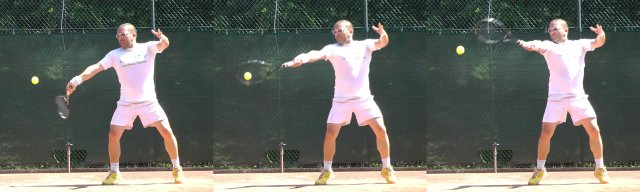
There is no extreme work with forearm and wrist but it's just a swing path that creates topspin
Sure, this is not extreme topspin, but the ball spins fast enough that we can control it quite well and play very consistently.
Doing The Topspin VS Making It Happen
I wrote this article because I see most adult recreational players try to DO the things they’ve learned when they are hitting the ball.
They learned how to hit a topspin by moving the racket vertically up on the back side of the ball and brushing it, so that’s what they do.
However, they forgot that the initial exercise was an exaggeration that helped them understand and feel how to apply topspin to the ball.
Now they play at a faster pace, yet they still DO all their topspin movements the way they learned them.
They don’t know they should try to apply LESS topspin on faster incoming balls and simply make spin happen by swinging the racket naturally and hitting the ball a bit more in front.
I prefer to teach topspin in the beginning with the compress & roll exercise that doesn’t create a mental image of a vertical “brush up” on the ball even at the beginning and yet the players are able to quickly apply topspin to the ball.
And a good way to correct the “vertical brush up” mental image that causes problems at higher speeds is the rolling topspin drill that again guides the player towards a more shallow swing path through the ball.
In summary, we can apply extreme topspin to the ball only when we receive a slow ball. Only then can we still hit the sweet spot regularly even despite swinging up very steeply in relation to the incoming ball.
And when we receive faster incoming balls, we should swing at a more shallow swing path and let the spin happen.
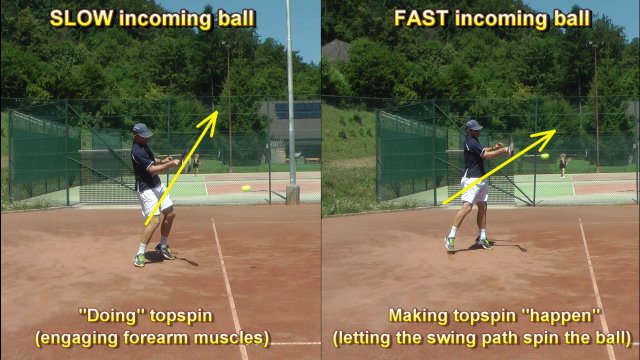
The difference between "DOING" the topspin and making it "HAPPEN"
We can, of course, add a bit of upward movement by engaging our forearm and wrist, but that should be the next stage after we get a good feel for allowing the to spin happen simply through the swing path and contact point.
As you saw in the video above, Urban and I don’t swing at very steep swing paths and we don’t really engage our forearms and wrists when we rally at a higher tempo.
We look for that ideal contact point in our swing where the racket is already moving upwards by itself, and we therefore make the spin happen without much effort.
Give this concept of “making spin happen” a try, and share your thoughts in the comments below. Thanks!
There are two components that determine the amount of topspin. The one most people think of is the degree of incline in the racquet as it approaches, and then strikes, the ball. The steeper the incline, the more topspin generated.
However, the other component is the racquet head speed. For a given degree of incline, the faster the racquet head moves, the greater the topspin generated. This is why many people, including some pros, think that using a co-poly string “generates” more spin. What actually happens is that the co-poly string generates less ball velocity for a given racquet head velocity, enabling the player to swing faster and harder without losing control of the ball. The net result is that they generate more topspin than if they were using a multifilament string because they are achieving greater racquet head velocities.
So how do you keep, or better, increase, racquet head speed when receiving a ball with a lot of pace? What I see most of the pros doing now (Jack Sock’s forehand is a great example) is really shortening the backswing and then accelerating the racquet head more quickly and forcefully than with a “traditional” stroke. Viewing lots of videos, I see this technique generating lots of topspin without a Nadal-style extreme incline and “buggy-whip” followthrough.
Hi George,
You asked “how to keep the racket speed high when receiving a fast ball”? By LOTS of training. Years and years of training are required to develop such good timing and accuracy of the swing.
Regardless of how the player accelerates the racket it eventually moves very fast at an upward angle and yet they still hit the sweet spot most of the times.
Copying their technique doesn’t help much if you don’t have the timing skills and accuracy of the movement that has to be developed from very early age…
And frankly, we don’t need it for our recreational level of play. The idea of “making spin happen” by swinging at a more shallow angle and not being so obsessed with extreme spins will hopefully help some players reading this handle faster incoming balls much better.
Do you use the same grip on both swings? Thanks.
Yes, of course, same grip, Semi-Western.
Thomaz, excellent information.
I have two questions related to this video:
1. What kind of grip are you using or do you recommend? (Continental, Eastern, or Semi-Western)…or does it matter.
2. Can you tie this instruction to your previous video on how to hit fast incoming balls?
It seems like there is a continuum here between just reacting and hitting a ball on a short hop; or getting into position and hitting the ball with underspin; or positioning and hitting the ball back with topspin as described in this video.
Thanks again!
Scott
Hi Scott,
1. I recommend a Semi-Western grip as I believe it’s bio-mechanically optimal for the hand and the arm when hitting topspin forehands.
2. The previous article on fast balls was more about technique of shortening the stroke and the mental approach to them, meaning staying calm.
This article just adds the idea of simply swinging through the ball and looking to make spin happen rather than constantly engaging forearm and wrist and look to add some massive spin that’s constantly being suggested to players from their “knowledgeable” coaches…
My friend Tomaz is always great at putting a new angle and rate of spin on age old, classic aspects of the tennis game.
Great fine tuning explanation Tomaz, Great Insight!!
Thanks,
With Topspin,
Ricardo 🙂
Thanks, Ricardo, glad to hear that. Tennis is very deep once you want to go to higher levels of play, that’s why this journey to mastery is so interesting…
I’ve been hitting with a younger ex-college player once a week (probably better than taking lessons in my opinion – for me) – I pay him a little and he just hits hard balls at me. You’re absolutely right Tomaz, you can’t try to hit topspin on those balls – I was actually trying to do that today a bit and it didn’t work (except high balls where I think you have to use some wrist) – all you can do is try to relax and swing out. It’s all timing and it can only be learned through trial and error. Funny thing is, it’s actually a lot easier to play when you stop trying to hit topspin, lets you relax.
My real problem is doing it on the one hander – i practice and practice but something’s missing – the timing is so much harder than a slice, why!? On an easy ball, no problem but not with a good player who hits hard. Even some pros can’t hit it though – Lopez used to hit all slice. I’m considering giving up on it and maybe winning some tournaments for a change – I used to have a great slice.
I wish you would do more videos on the one hander.
The reason why hitting with topspin is much more challenging than hitting a slice is because you need to change the direction of the spin on the ball.
The ball is spinning “forward” and by trying to hit a topspin you need to reverse that spin. That requires some effort and excellent timing.
If you hit back a slice, you hit with the same rotation that the ball arrived with, meaning you’re not “fighting” the spin. That’s why it’s easier.
Thanks Tomaz, that makes sense.
Really? Surely it’s the same concept in each instance.
Yes, when you receive a ball hit towards you with topspin it’s spinning forwards as you say and, yes, you’re seeking to reverse that rotational direction.
But doesn’t the same concept apply with slice?
The sliced ball approaching you is spinning backwards – the exact opposite of the top spin ball – and if you slice it back then you’re in turn reversing that direction of spin – it approached you with the bottom of the ball moving to the top and it leaves with that perspective presented to your opponent and therefore from your side the top moving to the bottom.
Am I missing something here?
Perhaps the difficulty in returning top spin with top spin is to do less with rotational change than with the fact that top spin produces an energetic and rapid bounce with parabolic form whereas a slice tends to float in and struggle up off the court, bit like a geriatric such as me? That in turn requires rapid response, precise connection and excellent timing, as you say.
Hi Murdoch,
My reply to JonC was about incoming topspin balls. He has trouble applying topspin to an incoming topspin ball because a change of rotation needs to take place.
Not with a slice.
As for slice vs slice, there’s a catch too.
If the incoming slice shot is not fast with a lot of slice, the ball will change direction upon the bounce. It will spin forward as if it’s coming with topspin.
Only if the slice if fast and low with lots of backspin it will retain the backspin rotation BUT at a much lower rate as the contact with the ground will take way a lot of rotation.
And of course, the faster and steeper the ball bounces off a topspin, the more challenging it is to time it.
Slice goes in a more straight line but it can skid and of one cannot read it and anticipate the skid then it’s likely a miss.
I play a guy that his top spin almost knocks the racket out of my hand. I have tried to hit heavy top spin like that but it does not happen. How does one hit heavy heavy top spin?
Hi Larry,
The key to a heavy topspin is a relaxed wrist and forearm as you start your swing forwards as that makes the racket lag. You must “lose control” for a split second to make the forearm act like a hinge that you’re accelerating.
Then just before contact you strongly engage the forearm and wrist and pull up on the ball to add even more racket head speed.
You may be too tight in the acceleration phase to get the speed going so see if you can relax more and throw the racket into the ball rather than pushing it forcefully.
I can relate to the idea of “making it happen”. When I switched to a more Western grip, once I worked out the angle of the racket face at impact, the spin just “happened”. Something about the grip itself made my racket swing from low to high and simultaneously forced me to hit the ball further out in front. Et voila, spin!
Also, and for some unknown reason, the spin and pace seem accentuated when I keep my head down after contact. This is true on serves as well. Was it always this “simple”? That’s in quotes ’cause it’s one thing to KNOW what to do, it’s quite another to constistently DO IT!!!
Many thanks and praise for your excellent site! Your devoted wheelchair fan – Jim Davis, Montreal
Thank you, James. And yes, there is big difference between “knowing” and actually “doing” it.
I can only share the “knowing” part from my side and then I hope that the readers will spend some time playing with the idea presented and eventually find the experience of “doing” it.
And in this instance, perhaps learn how not to “do” the topspin. 😉
Keep in touch!
Hello Tomaz,
Good morning from India. Concept is well understood as you have explained it in a simple and effective manner. What kind of swing paths to be applied when hitting a slower and speedy balls and what length to be hit, I think no body explains better than you.
And also no one invests that much time to explain for the benefit of tennis players at all levels.
Thanks Tomaz, looking forward to more interaction. Good day & Best wishes.
Jawahar
Hyderabad, India.
Thanks, Jawahar, keep in touch!
Tomaz, Your tutorial is exactly what I do regardless of the height or spin of the incoming ball. However I didn’t realize it until this video! Thank you so much for the excellent work that you do for us.
You’re welcome and thanks for the comment!
I have a query on your latest post on topspin method for incoming fast ball. So you apply this to backhand also?
Yes, it’s the same principle.
Tomas, Great stuff to me, particularly about not actively engaging one’s forearm and wrist using this technique you are teaching. I love your point about a key having the contact point far enough in front(and somewhat to the side I suppose) where the release point in the swing (as you say) is moving from horizontal to vertical.
I would think this contact point would be more natural to achieve with more of a straight arm forehand which to me seems to allow for more “reaching” for this point. Nadal and Federer seem to do this. Nadal reaches this point to me so well that his release point allows him to consistently get to the outside of the ball for his signature hook topspin forehands.
Hi Jon,
Nadal and Federer play with a more extended arm when hitting forehands so their contact point where the right spin happens is more in front. But since Nadal also wants to hit a high loopy ball often he pulls the racket even more steeply up and ends up in his typical finish above his head.
Hello Thomaz,
As a tennis coach/teacher myself you are my favorite online instructor. I am glad you agree that most amateurs should not try and copy some of the aspects of the pros as in the extreme topspin forehand drive. I liken this lesson to golf in that you let the club do the work and let the golf ball get in the way of the swing and not try to manipulate .
Thanks a lot, Richard. Yes, it’s a really good exercise to work on trying to see if one can impart topspin on the ball without doing it first.
Then once you get that right, players can then start adding some of their “work” to the swing to accelerate the racket even more.
Excellent video. In the last few months I have been working on trying to get more topspin on the ball. I have just played a match where I was badly beaten by a player who hits the ball very fast and I kept miss hitting and hitting the ball short. This video has come at exactly the right time. I can now practice hitting the ball further out in front and letting the topspin come more naturally.
Thanks,
Roger
Thanks a lot for your feedback, Roger.
Keep in touch!
so enlightening Tomaz, cheers mate
Regarding your latest video about keeping ones head still while executing a tennis drive;the benefit is that the sweet spot is struck.
Does this follow that the sweet spot needs to be struck during the serve stroke as well.
I tend to strike the ball slightly above and to the right of the sweet spot, to avoid going to the net.
Hi Bertie,
Yes, we always want to hit the sweet spot because we get most power and control from the racket when we do that.
Hitting above sweet spot will not avoid making the ball go in the net as the ball goes in the direction of the racket angle. And so the whole surface of the racket angle points in the same direction, it doesn’t matter where you strike the ball.
The difference is in power as the racket is “more bouncy” in the middle and produces more power.
Can you make enough topspin by classic forehand? By enough I mean enough for beginner/intermediate player to get some consistency and added net clearance.
Hi Mik,
Can you share more on what you mean by “classic forehand”? Does that mean a forehand hit with a continental grip or in a neutral stance mostly or something like that?
Hi! Classic forehand: closed stance, usually eastern grip, path from low to high with over the shoulder ending follow-through. Modern forehand: open stance, more western grip, “windshield wiper” style wrist action for topspin.
Basically what I’m asking is that can you get enough topspin by only swinging from low to high or do you have to do the wrist movement (windshield wiper). The wrist rotation is killing my consistency (which is bad anyway 🙂
Thanks for your input Tomaz!
https://tt.tennis-warehouse.com/index.php?threads/modern-vs-classic-forehand-preference.504061/
Hi Mik,
The modern forehand is not an open stance forehand nor it has a windshield wiper motion.
That’s an amateurish approach to classifying forehands and the windshield wiper is a total nonsense that should never be taught – at least not in a way that’s being taught.
I have discussed before the open vs closed stance and if you follow the link below you’ll find my thoughts and you’ll see 3 videos where Federer, Djokovic and Dimitrov warm up and where in most cases they step into the ball.
There is also no windshield wiper.
https://www.staging.feeltennis.net/tennis-forehand-contact-point/#comment-5670
What they are doing is using the fundamentals of modern tennis.
So to answer your question, yes, we can hold an eastern grip and apply more than enough topspin that we want without any windshield wiper motions.
Also, don’t think low to high but think about spinning the ball.
Spin the ball, man, just spin it! 😉
Don’t think about your arms movements, think what you want to do with the strings to the ball. It really is that simple. Just spin the ball and if it’s not enough, then spin it more, just want more spin and it will happen.
Your arm knows what to do, you just have to give it a specific goal.
Low to high is not specific, it’s generic.
You must focus on the ball, not on swinging.
Give it a try…
Closed stance is what I’m always aiming for. There are so much articles and videos about modern vs classic that I’ve started to think I should switch to modern. But maybe I’ll just forget it. I am a total beginner by the way.
I remember from one of your videos that we should always have a very clear intention what to do for the ball, not the technique. Maybe that’s what I should do and stop thinking the classification of my stroke 😀 So just practice practice practice on the court I guess? 🙂
Yes, intention comes first and stances will all likely happen if you don’t force them.
Stay tuned for my Effortless Forehand course where I will explain how to practice and develop neutral and open stance forehands.
Thank you again! You really know your stuff.
I have surfed you tube for many tennis instructional videos. Tomaz, your videos are very easy to follow and are truly instructional.
Since I have already used many of your free videos, I will now buy few from your website. You deserve some business and reimbursement.
I wish you were in USA, I live in Richmond Virginia. You could be my coach.
Well, I just wanted to THANK YOU.
Truly
Mohammed
Thank you very much for this kind feedback, Mohammed, really appreciate it.
I’ll keep producing more videos, stay tuned.
Hi, a nice read and I’ve been looking for advice around this topic for a while. I taught myself to a reasonable playing level and i use strong wiper action. my backswing starts low and then comes up and across, now I get good topspin against slower players but against faster players I do hit a lot of short shots and struggle to hit through people.
Would you suggest a change of technique? One thing I was told was to keep my racquet higher on the backswing and concentrate on the ball more in front. Only issue here is after playing with my current swing for so long I struggle to keep the ball in.
Thanks
Hi Oliver, I would just suggest you extend through the ball more rather than moving away from it with a windshield wiper thing that is total non-sense in serious professional coaching circles.
You will not hear this nonsense on an international coaching seminar. It was invented by tennis marketers so that they can sell you their latest thing.
Thank you, Tomaz, for this excellent lesson (and all your other “no nonsense” tennis instructional videos you make)!!! Can’t wait to try this out and keep that ball in the court and out of the net.
Great, Lee, let me know how it goes.
Hi Tomaz,
Thank you for an illuminating article. I play with an eastern grip and contemplating switching to SW. When I hit with my coach, I get fairly good pace from them and I do well. When I practice by myself with a ball machine that feeds at a very slow pace, I make that work too. My problem is that I get into tennis matches I get tentative/conservative. I like to swing aggressively but don’t. And while I usually win, I feel like I’m playing below my potential. One idea is to play better competition more often. But even so, I need to learn to take advantage of these slow (often times short) balls that even better players will at times hit.
Last night I went out to practice after a match with a concerted effort to swing up aggressively (still with eastern), and saw dramatic improvement with pace and consistency like your example. Depth was not totally dialed in but I see that working out over time. Only thing was that it really tired out my arm. Of course I had a match earlier, but I think that it may still have been a problem even if I was rested if I had to do that for a whole match. My question is that when you play a match and you get a slower ball with fair depth, do you personally hit more up like your demonstration from this video? And if so how do I learn to hit aggressively but without killing myself when playing weaker players?
Thanks!
Hi Bryant,
If your arm is tired it means you’re not using your legs, hips and shoulders properly to generate power.
You need to look into my forehand course to learn that, I cannot possibly explain biomechanics and the drills required to develop it in one comment.
Secondly, you may not be freely swinging down with the help of gravity before you start swinging up.
So your racket has no speed before you swing up and then it is a lot of work to get it going.
Check these articles that relate to swings:
https://www.staging.feeltennis.net/steady-racket-acceleration/
https://www.staging.feeltennis.net/relaxation-and-rotation/
https://www.staging.feeltennis.net/universal-swing/
Meeting the ball in front and making topspin happen is very true. I will definitely follow this the next time I hot the courts. Thanks for the tips!
Topspin comes naturally, but I’m continually looking for that solid topspin that I happen to hit only once in a while, where the ball arcs and comes down quickly, like an arc of a circle rather than a parabola. I don’t know what changes in my stroke when that happens, but maybe I’m extremely loose during those shots and hitting the ball far out in front. Could that be it?
Hi Pavolo,
You can try focusing on accelerating the racket head at the end of contact.
So you can start your swing at normal speed and accelerate as usual gradually towards the ball, but then you imagine that at the last moment when you’re already hitting the ball you add that one last bit of extra acceleration on the top of the ball.
And yes, that may happen naturally when you’re loose and hit well in front.
I have a very difficult time hitting the ball out in front of me. I also seem to open my racquet face at contact
Hi Pam,
Don’t worry about the open racket face, focus on aiming into a certain window above the net.
Hitting the ball in front is very difficult, try this tip of focusing in intercepting the ball in the zone as shown in this video:
https://vimeo.com/384209186