
You’ve probably heard from online or on-court tennis coaches that you need to be relaxed when playing tennis and yet you cannot get really limp.
There needs to be some firmness in your body but not to the point of tightness.
So, how does one find the right amount of relaxation when hitting forehands, backhands and serves in tennis?
Before I answer the above question, let me pose another dilemma: You’ve surely heard that you need to rotate your body or your shoulders when hitting forehands and two-handed backhands (not so much on one-handed backhands).
However, you’ve also heard that you need to extend after the ball, stay with the ball and so on, which all indicate a more linear part of the swing.
So, how does one find the right amount of rotation and linear extension?
The reason I am addressing two seemingly different topics at once is that they are in fact very similar.
How To Combine Relaxation And Firmness
A simple way to combine relaxation and firmness is to imagine a line next to you that divides the space into “behind” you and “in front” of you.
Now imagine that, when you’re hitting a groundstroke, what happens behind you must be relaxed and what happens in front of you is more firm – at least the first part where you contact and direct the ball.
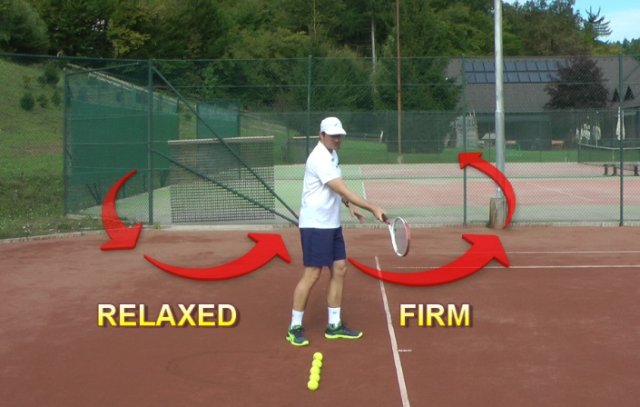
The backswing is done being more relaxed and hitting is a more firm sensation.
Keep in mind I am not saying that you need to be tight or tense when hitting the ball.
Instead, you need to simply be a bit more firm than how you were in the backswing and the first part of the forward swing up until the contact with the ball.
We need to be relaxed in the backswing so that the swing can actually happen.

Everything happening "behind" us needs to be relaxed...
We can only swing the racket when we are relaxed. We need to lift the racket up somewhat and then let gravity help us accelerate it on the way down, and that will work only if we are relaxed enough.
The Universal Swing (outward–inward swing) also happens only when we relaxed enough.
The wrist lag also happens very effortlessly only when we are relaxed.
So, all these elements of the stroke will happen very naturally and effortlessly if our backswing and forward swing are made with some relaxation.
Important: What is not relaxed in the backswing are our legs, hip area and core! They are the main engine in this stage of the forehand or backhand, and they are engaged! The relaxation I am referring to applies only to your arms and hands!
But, as we start to approach the ball, we need to firm up a bit because we need a stable racket head for the moment of collision with the ball.
We also need to direct the ball somewhere. If we are very relaxed at contact, the racket will not hold direction through the hitting zone.
Rather, it will keep turning in our hands and therefore keep changing its angle, and that results in very inaccurate shots.
So, you can imagine a more firm part just before and after the contact with the ball, but of course you can then relax again and allow your racket to follow-through naturally towards the other side of the body.
How To Combine Rotation And Linear Extension
When we’re hitting groundstrokes, we need to use some body rotation to generate power, but we also need some part of the stroke to go more in a straight line so that we can accurately direct the ball.
When I analyze a tennis stroke, I look for mistakes in the amount of rotation and the amount of linear movement.
Players can over-rotate, which means that they keep rotating their body throughout the stroke, or they can overdo the linear part of the stroke, which means they just try to move their racket back and forth in a straight line with no body rotation.
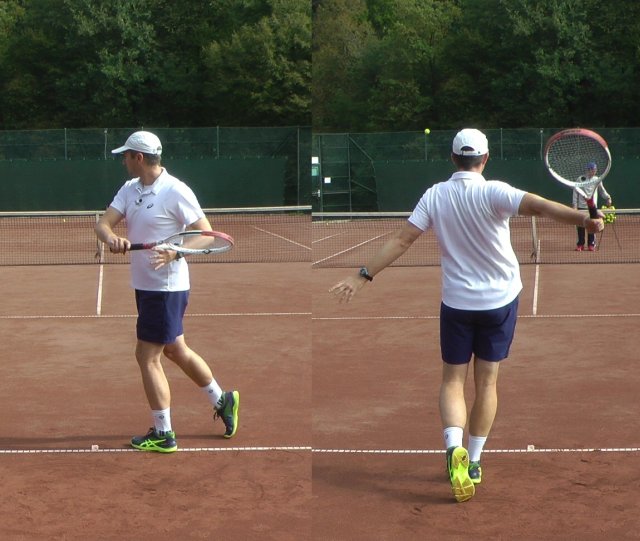
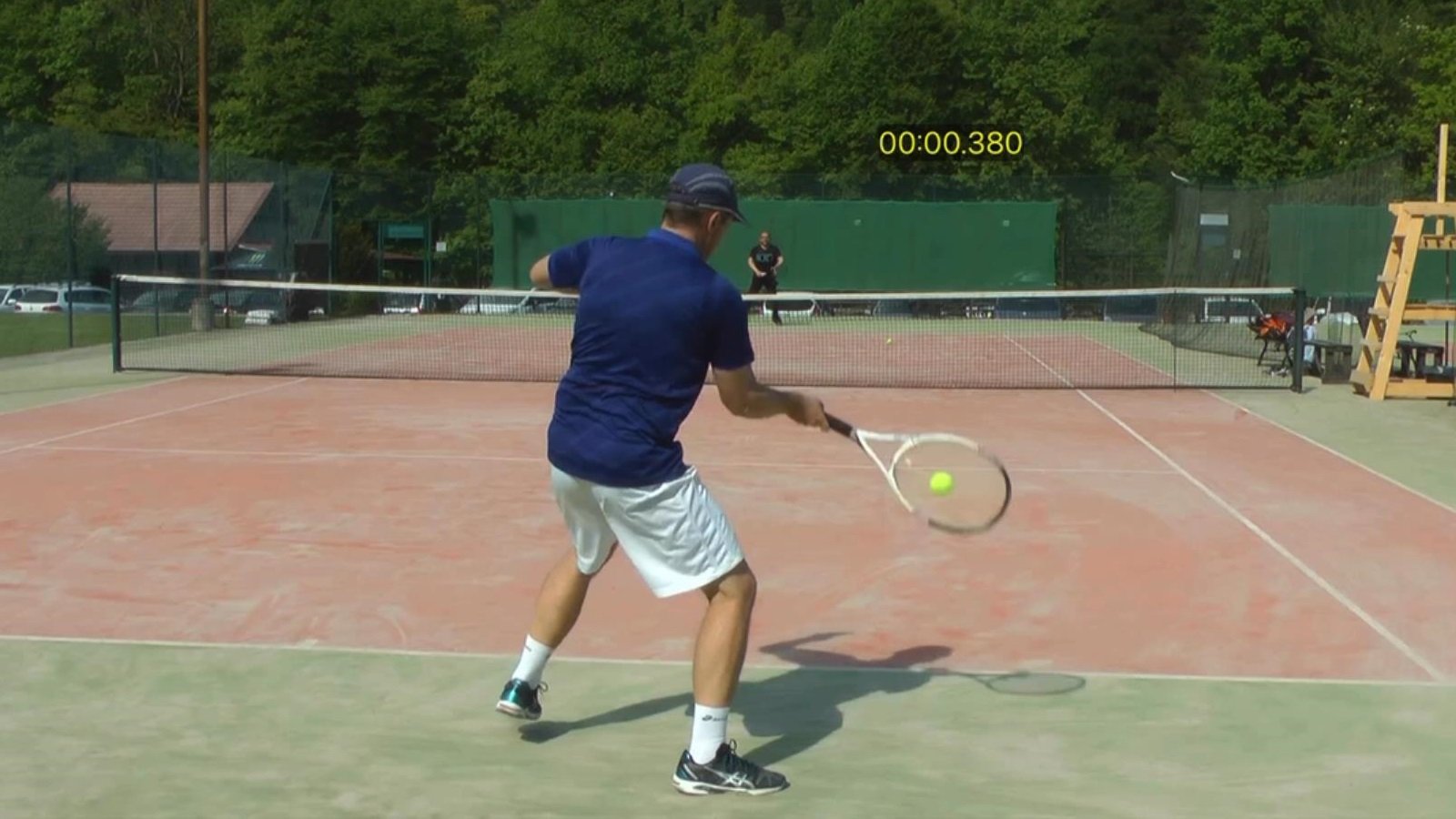
This is how typically forehands and backhands look like when players over-rotate.
The correct stroke technique lies somewhere in between, and we can now use the first mental image based on the relaxation and firmness explained above.
What happens behind you – in other words, the backswing and then the forward swing up until close to the contact point – is more circular and based on rotation.
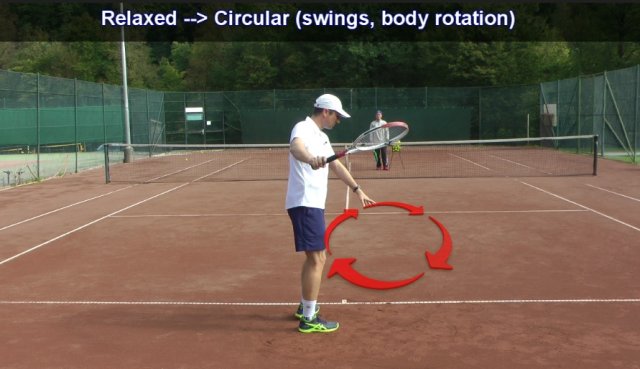
The circular parts of the forehand are the swing and the body rotating back and forward.
We turn the body back in preparation – starting with the unit turn – and then we let the racket swing in a somewhat circular (rotation!) motion again so that we can accelerate it forward with the forward body rotation.
As you can see, the word “rotation” keeps appearing in the above description.
But, once we approach the ball, we need to transition into a straight line – a more linear arm movement – so that we can direct the ball well.

We need to transition to a more straight swing through the contact zone to be able to hit accurately.
This also corresponds to the part where we are a bit more firm as we need to stabilize the racket for contact and keep it moving through the hitting zone without changing its angle.
Important: The straight line extension may seem like an old way of teaching, but it is in fact the fundamental movement of all groundstrokes.
If you look at the pros warming up, you will see that, even at their level, they still swing straight towards the target for a certain length in their forward swing before they swing across the body.
Can you see how Grigor Dimitrov goes through the extension phase on his forehands and backhands before swinging across the body?
I recommend this technique to everyone before one upgrades it with the so-called forearm acceleration where we pull earlier away from the ball in order to accelerate the racket head faster,
Most recreational tennis players don’t have good enough timing to pull this off and still manage to hit the ball cleanly most of the time.
Even I base my strokes on a very long extension through and after the contact zone, and I use shorter forearm acceleration only when needed. (Note: This happens completely subconsciously.)
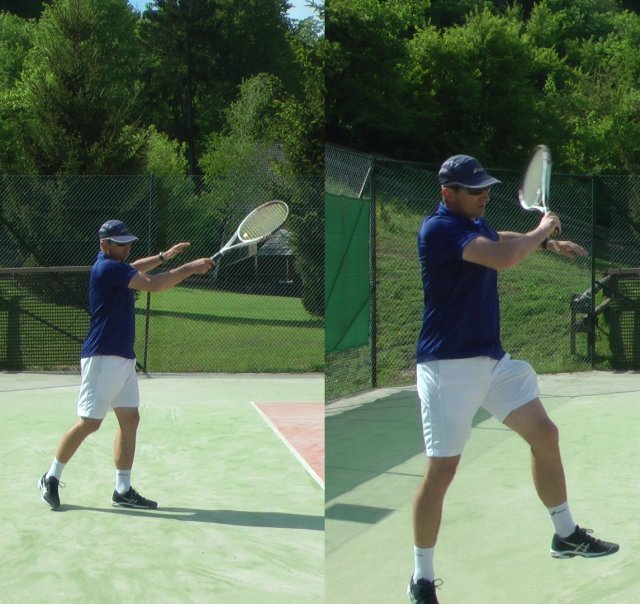
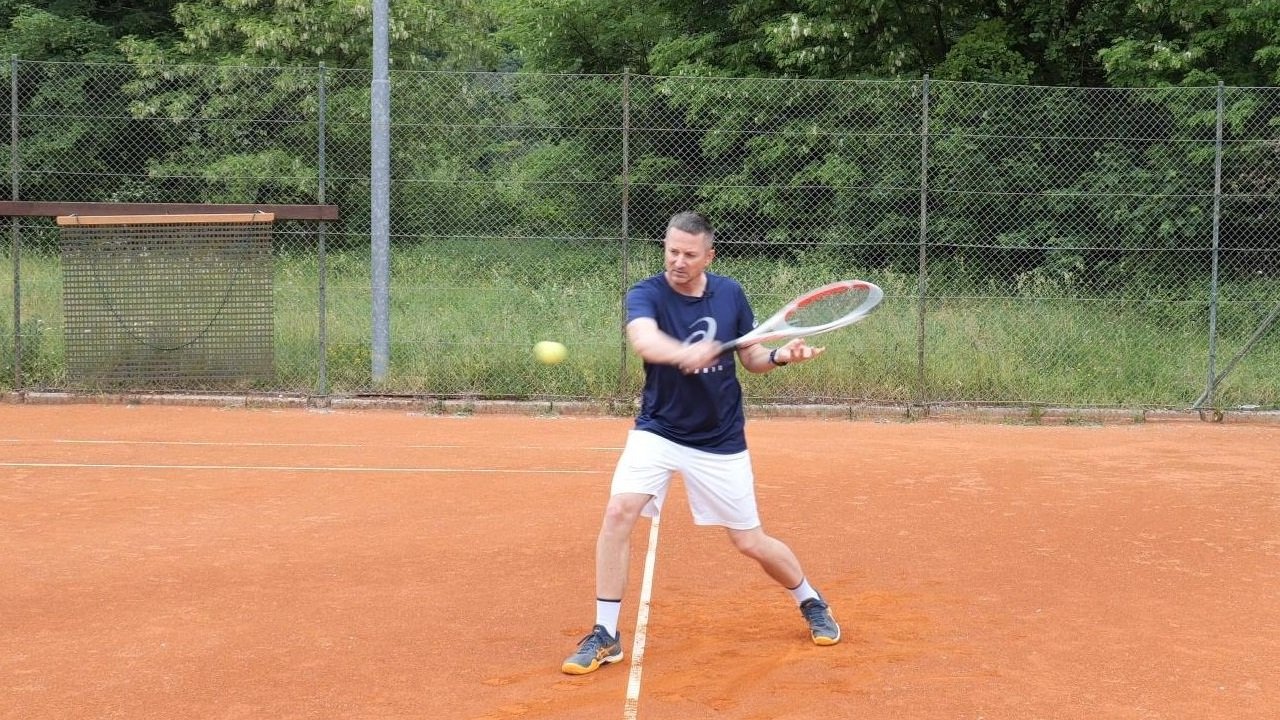
The forehand on the left is the fundamental forehand with a longer follow-through and the forehand on the right is a variation (using more of the forearm) needed in that particular situation
So, as you can see now, the relaxation and body rotation (and somewhat circular swing path) in the first part of the stroke leading up to the contact point happen at the same time.
Similarly, the firmness and linear extension happen around the contact zone and a bit later when we are directing the ball.
Looking at the stroke this way will hopefully give you a simpler way of figuring out how to transition from relaxation to firmness and how to transition from body rotation to arm extension.
Remember, this is just a simplification of a relatively complex process. You now need to rely on feel and the results of your shots that will give you feedback on how to more finely tune this process.
Don’t take it literally, but use it as a guideline.
The Simplified Swing Path Of Fundamental Groundstrokes
We can now create another mental image of the swing path armed with the knowledge from the above explanations.
The swing path of a fundamental forehand and backhand in tennis can be described and shown as curved → linear → curved.
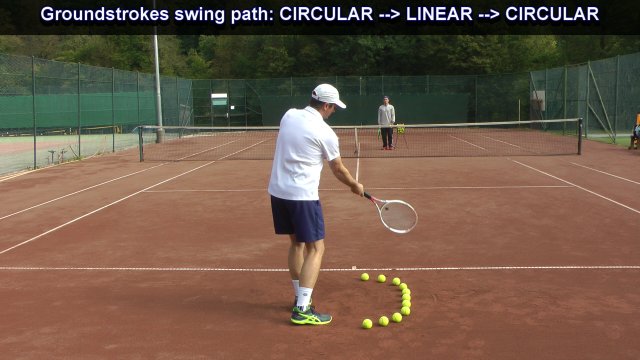
This is how you can imagine a swing path on the forehand side...
The first curved line represents the circular swing of the racket as a consequence of the initial outward–inward swing that brings the racket close to our hip and the body rotation that follows and accelerates the racket outwards first.
After this phase, the racket is now getting closer to the hitting zone, and that’s where we guide it in a more straight line in order to ensure a clean hit and direct the ball accurately.
After that phase comes a circular path of the racket again since the body wants to uncoil and the racket has a lot of momentum and wants to swing naturally across the body in the follow-through.
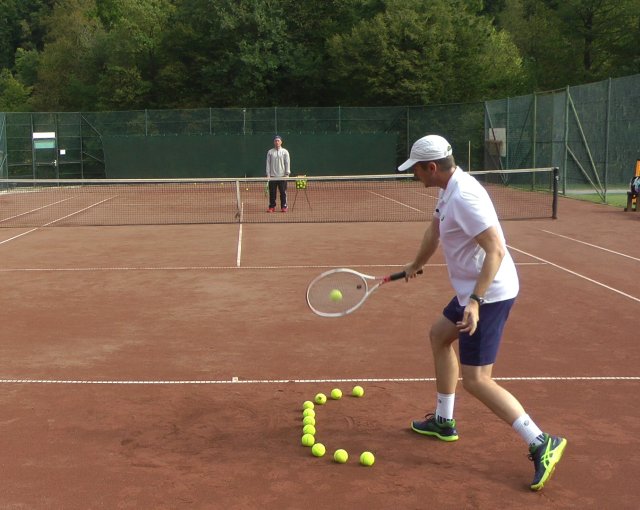
... and this is how you can imagine a simple swing path on the backhand side.
As you can see, you can easily recreate this swing path on the ground with a few tennis balls. Practice some shadow swings above the balls and see if this idea of the swing path makes sense to you.
In summary, what I am sharing here with you are basically my own feels and mental images that I have regarding the groundstrokes which have developed over the years of playing.
I am trying to convey how I feel the transition from relaxation to some firmness in my strokes and how I visualize the swing path for both forehands and backhands that I hit.
Give this idea a try, and let me know how it works for you!
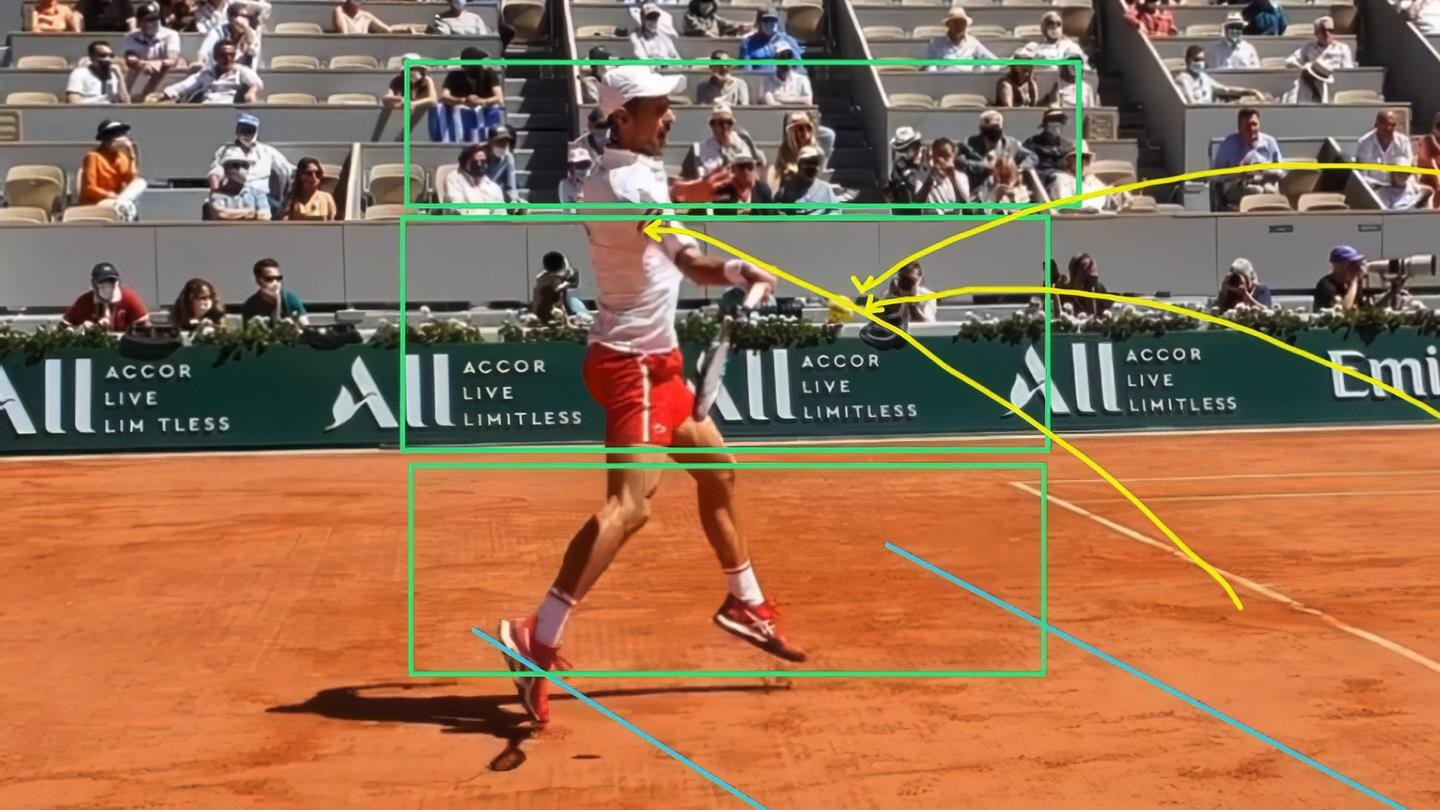
Great explanation Tomaz. I really like the visual aids that you placed on the court so that the players can see the swing paths clearly. I love it.
Thanks, Joel. Test these ideas with your students, see how it goes.
Wow Wow Wow…. You always deliver something that is deeper than what most other coaches are talking or repeating about. Great job!
Most people that around me are either good at liner extension (Eastern Grip) or rotation (Semi Western).
I have worked hard on rotation, but tend to mishit and frame the ball more than I should be. I thought it was mainly due to looking up too early. But now I think it is a combination of that and lack of extension. I have a effective hitting point instead of hitting zone. Great job!
Thanks!
Thanks, Lu!
Yes, you could be looking up too early too.
Also, you may be pulling away from the ball too quickly.
Check this video for more info:
https://www.staging.feeltennis.net/why-your-strokes-lack-power/
Thanks Tomaz. Great stuff, as always. You put the pieces together in a nice intuitive way. I enjoy thinking about these things during practice & warm-up, to inform my tennis brain on how strokes should feel.
One question: How do these concepts relate to slice FHs & BHs, which feel less rotational (and maybe less relaxed)?
Thanks, Mike.
Slices are different types of strokes, we pull more in the direction of the handle first.
Also, they are not that relaxed in the first phase.
I would just visualize circular –> straight for slice shots without the following circular even though it may happen a bit. That’s because body rotates less for these strokes.
Thanks Tomaz. That makes sense for the slice.
Just had another thought. It seems like the serve & overhead have a bit of what you are talking about above as well, even though it’s probably not recommended to think about that as it’s happening, since the firm/straight piece is so short. Thoughts?
Excited to warm-up topspin FHs & BHs tonite!
Yes, serve and overhead also follow the “relaxed to firm” transition. And of course, there is a circular loop and a more straight line to hit the ball.
Thanks a thousand Thomaz, you are a great technician
Hi Tomaz, I have thought a lot about this as well after some of your earlier material and guidance touched on this. In the very loose warmup forehand I can see Dimitrov’s back foot move a bit forward as he strikes the ball. Almost as if there is a kicking motion. Of course, it is not completely a kick but it feels like there is some part of this that turns the body to the court and then initiates contact. I realize that on other forehands this is not the case. But I just wonder what you think about this back foot motion which borrows the kind of feeling we have when we kick a ball.
You really do a nice job of showing how there is rotation, contact, extension and then some rotation again since the body cannot stop entirely and just go straight.
Thanks!
Arturo
Hi Arturo,
I am not sure which of the forehands in the above video you have in mind but what I see is that his hip which rotates forward pulls the back leg forward.
I usually say that “the hip is the boss” so the leg must follow.
Many times players keep the back foot on the ground and block the hip from rotation so in that case “the leg is the boss.”
Yes. I was thinking that the hip has a similar feel to a kick. Except it reverberates to the arm and hand rather than to the leg and foot. Same engine but extending to different body parts. Does that make sense?
Very well explained indeed
Thank you Tomaz for your lessons and advice.
I enjoy watching and learning from you a great deal, and look forward to your videos. You are a wonderful coach, always offering practical advice in a clear way and I wanted to thank you for sharing your knowledge.