
Short balls in tennis are opportunities either to start dictating the rallies and pressuring your opponents into mistakes or to finish the points if the balls are really short.
Yet, so many of these short balls are wasted because players do not move quickly and smoothly towards them. Instead, they end up in awkward positions from which they make more mistakes when they should be making points.
While there are many ways to move to a short ball, we can narrow down the movement patterns to two types of footwork used most commonly, depending on whether the ball is just inside the baseline or whether it’s a really short ball closer to the service line.
Two Types Of Short Balls And How To Move Towards Them
A simple way to define short balls and movement towards them is to place them in two categories:
- shorter balls just inside the baseline where you need some adjusting steps to get to them, and
- really short balls that land around the service line where you actually need to run towards them.
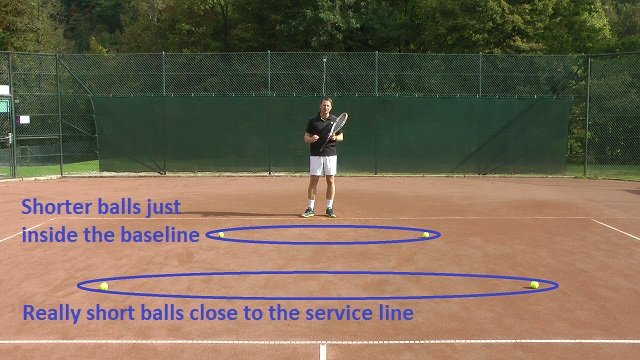
Two types of short balls that result in different footwork patterns
Let’s see how the footwork patterns and other elements of tennis technique differ depending on which type of short ball you’re receiving.
Shorter Balls Just Inside The Baseline
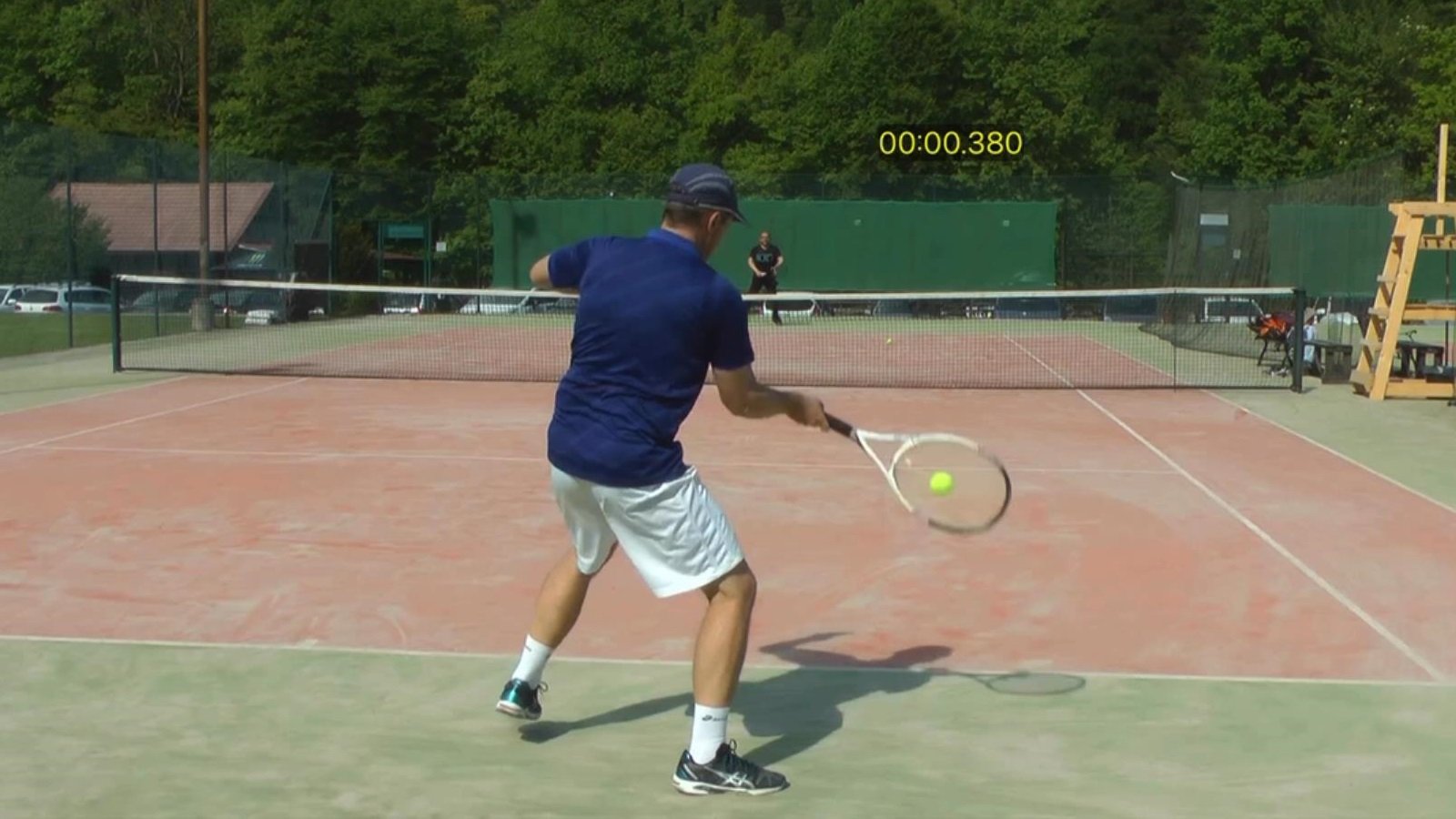
When you have to move forward 2-3 meters (6-9 feet) towards the ball, you need to use an adjusting footwork pattern.
The sequence of actions you need to do is TURN – STEP – SHUFFLE and HIT, of course.
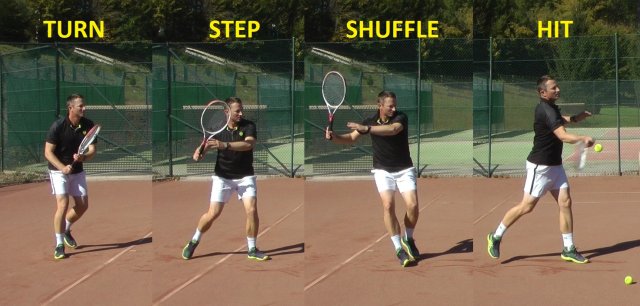
This applies to the forehand as well as one-handed and two-handed backhands.
The most common mistake that players make in this situation is that they don’t turn their upper body first (unit turn) and simply run towards this short ball.
Then they realize they have to execute the whole stroke from start to finish in a very short amount of time.
That’s why the stroke is rushed. The player is not balanced, and this typically results in a poor shot or even a mistake instead of allowing the player to take control of the rally.
So, it’s crucial that the player first turns their upper body and makes one step forward before making the final adjustment to the ball with the shuffle step.
That way, the player will have already executed half of the stroke at the beginning.
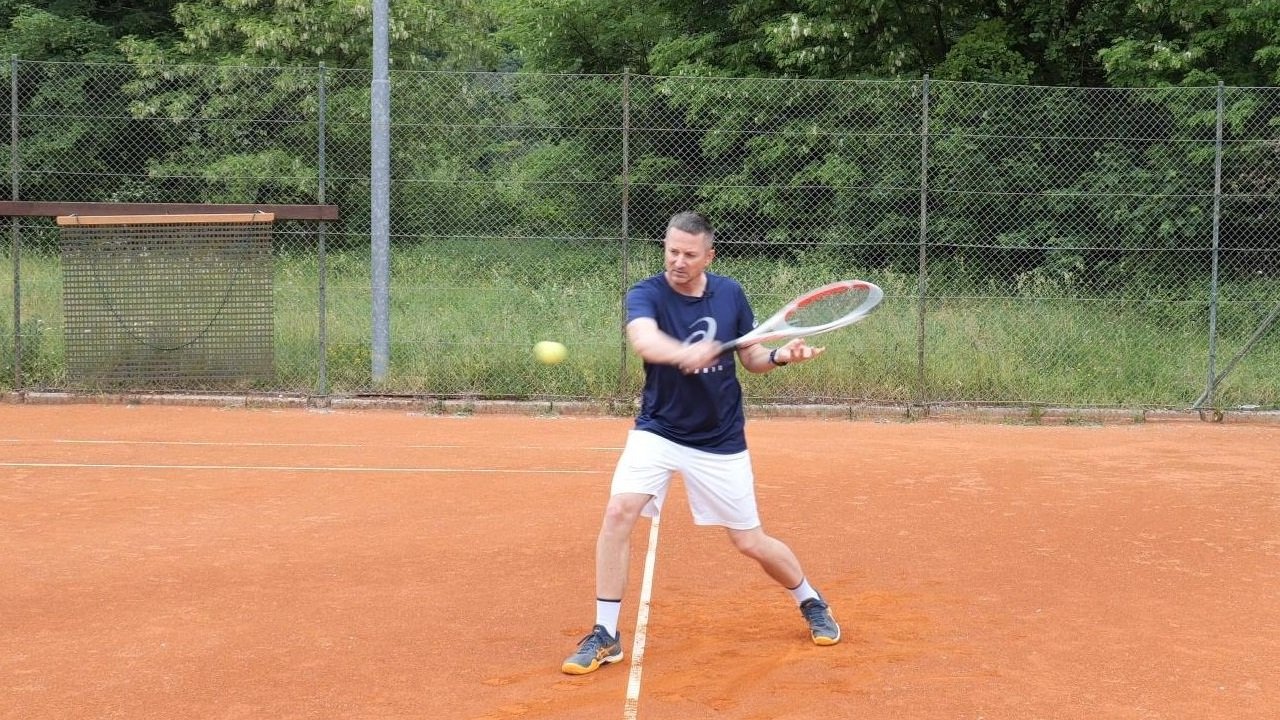
The player is now in a correct neutral stance position that allows for good balance and weight transfer, and the resulting shot is therefore very likely to be a good one.
Really Short Balls Close To The Service Line
When the ball is bouncing around the service line and it’s not struck with pace, you will have to run towards it as the previous footwork pattern doesn’t get you far enough nor is it fast enough.
Players will, of course, run towards this short ball, but they will usually make a very similar mistake like in the previous case. Specifically, they will not turn their upper body and start the stroke preparation along the way.
They will typically just run towards the ball. Then, once they reach it, they will realize that they still have to execute the whole stroke and therefore run out of time to do it well.
The correct sequence of actions is then RUN – TURN ALONG THE WAY – STOP and HIT, of course.
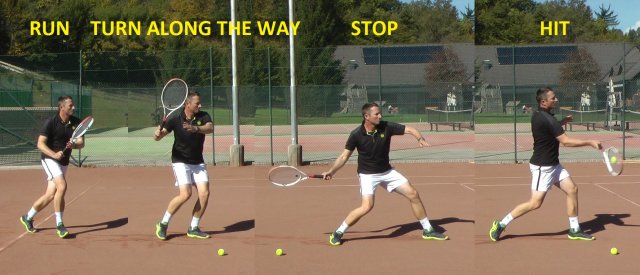
This is a more difficult sequence of movements that requires more coordination between the arms and the legs since the player needs to keep running and start the upper body turn and stroke preparation along the way.
That’s why it’s really important that you practice this because it does take some time to master.
The benefit of mastering this footwork is that it gives you the ability to get to a short ball quickly, in the correct stance and with your stroke already prepared to fire.
And that, of course, will allow you to win most points where you receive a short ball. Just make sure you know how to accelerate the racket when attacking short balls.
How To Practice Footwork Patterns
The footwork patterns of moving to a short ball and all other types of movement are best practiced first without playing a real live ball.
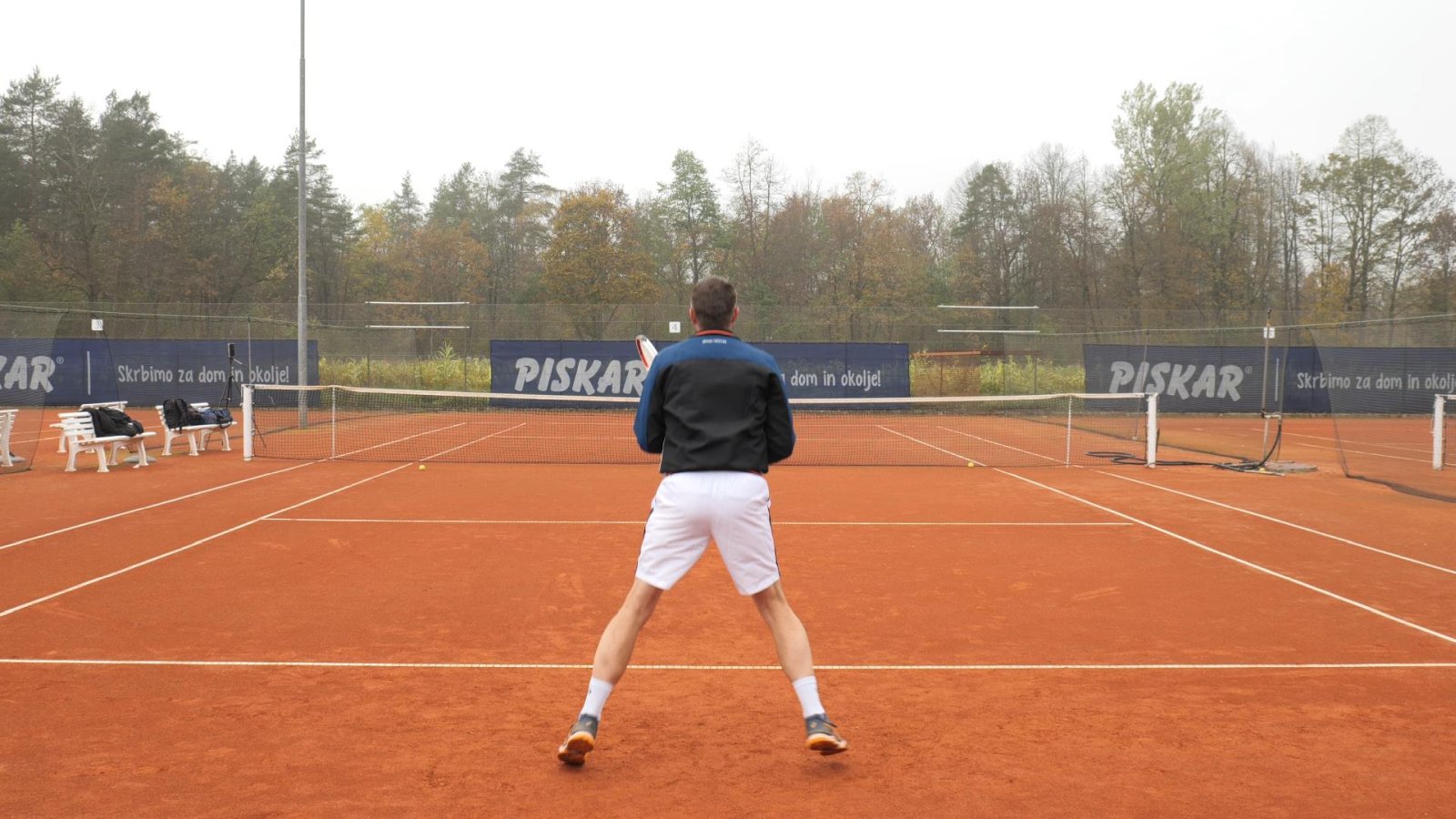
You can simply place the balls or cones on the ground like I did and practice your movement patterns for a few minutes.

Most of the footwork drills are done without hitting a ball at first
That’s because we cannot think about our feet and play tennis at a high level at the same time.
Footwork patterns must be stored into the subconscious with drills.
Our subconscious mind will then choose the most appropriate footwork pattern for each specific situation we end up in while we play.
You cannot improve your movement on the court by watching videos and simply understanding how footwork works.
You must drill these movements until they become second nature, and then your mind will be free to focus on the clear intention of how you want to hit the next ball.
And because you’ll reach a short ball with plenty of time in a correct stance with good balance and your stroke ready to go, you’ll win most of the opportunities from short balls and turn the tables on your opponent – or simply enjoy the game of tennis much more if you play in a free hitting session with your buddy.
Hi Tomaz,
I like that this is something you can practice alone, and even if you don’t have access to a tennis court. I would love to have a whole list of things that you can practice anywhere and at any time like this.
One question: when you are moving back to the base line to repeat the sequence it seems like it would be a good time to practice backward movement–that is, the type of movement you might do if your opponent hit a good, deep shot or a lob. Is the kind of backpedaling you do in the video the right way to move backward from the position you end up in here? If not, what would be better?
Thanks. Zac
Hi Zac,
If you adjusted to a short ball then you can move back with a few backpedaling steps if I can say so, although you will very naturally find the right footwork since you’ll probably have to move slightly diagonally too to get back to your ideal recovery position.
If you had to run forward to a really short ball, you’ll just move forward to play at the net and you won’t be moving backwards any more since you have no time.
The footwork patterns for moving backwards (when having to play the ball) are in the Effortless Forehand course and will also be included in the One-Handed Backhand course.
Hi Tomaz,
thanks for that awesome video and explanations ! Missing short balls is one of the most frustrating thing at tennis in my opinion. You feel (and rightly so) that you should win or at least take an advantage in the rally and you just immediately end up losing the point instead. I feel that bad footwork when it comes to short ball proves fatal in a vast majority of cases.
Gregoire
Hi Gregoire,
Tennis is a complex game since one needs to be quite good at stroke technique, footwork and also tactical and mental skills.
A short ball basically challenges all these skills and if even one of those is not good enough a mistake usually happens.
Thanks for the tips. I’m famous for over running the ball, maybe the sideways on first is the best approach.
Although this is about footwork, do you position yourself differently to hit the shot at net? I don’t know if my tendency to hit shortfalls into the back fence is totally on bad footwork or bad positioning or bad stroke when ball is a high bounced sitter.
Hi Dan,
Over-running is a sign that you’re observing your opponent and not the ball.
You want to know where he will move so that you play to the opposite side.
We don’t play tennis like that, we must pay attention to the ball otherwise we might over-run it. 😉
If you mean volley when you say “shot at net”, then footwork is usually different. We more move through the ball with small steps, it’s more like gliding around the court rather then shuffling.
Hello Tomaz:
Thank you again for your tennis insights I find them very valuable. As I get better I find that I am unable to finish/do damage with shorter balls which higher level players I play with can. This video helps me build the tools on how to start hitting winners/damaging shots from favorable positions consistently.
Pablo.
Glad to hear that, Pablo, thanks for sharing your tip!
Hi Tomaz, will you do a two-handed backhand course or this will show the difference between one and two-handed?
Thank you a lot.
Roger (not Federer)
As usual Great
You explain things so simply. Thanks
I love the suggestion to “get the turn out of the way.” For some reason it drives the point home more than just “turn first.” Kept on saying that to myself during my game today, and it made a big difference.
Hi Tomaz,
Many thanks for the video and the instructions!
Regarding the shorter ball (near the service line), what’s your opinion on running to it with a cross-over step? I’ve seen a few instructional videos on the net where the cross-over step is suggested for this kind of a short ball.
It’s also possible, Mahesh, but the player needs to be well coordinated with his feet. Most adults are not so I don’t even mention that…