
Do you use your racket as a tool or as a weight that you swing?
That’s the concept behind this week’s article as it affects how you use your body when executing a stroke and how effortlessly you can play.
Most recreational tennis players unknowingly use their racket as a tool whereas skilled tennis players use it much more as a weight. Let’s see why that is so…
How We Engage The Body And Arm When Using Tools
Our hands have the ability to be extremely precise if we want them to be. Just think about all the “tools” that you’re using during your daily life: toothbrush, cutlery, phone, keys, pen, etc.
Whenever we use “tools” with our hands, we use them with a high level of precision. And, when we need precision, we must NOT use our body.
Our body needs to be relatively still and calm in order for us to be precise in whatever we do with our hands.
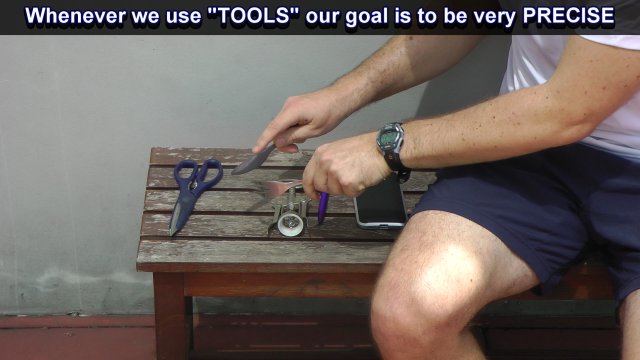
We usually don't move the body when using "tools"
So, hopefully you see where I am going with this…
If you grab your racket and think of it like a tool, you will automatically use it like a tool – and that means you WON’T use your body. You won’t engage body rotation and weight transfer.
Your body will be very stiff and still, and you’ll just use your arm.
And that definitely is not the right way to play tennis.
How We Engage The Body And Arm When Swinging A Weight
The easiest way to understand and feel what it means to swing a weight is to grab a backpack or a heavier bag and start swinging it back and forth.
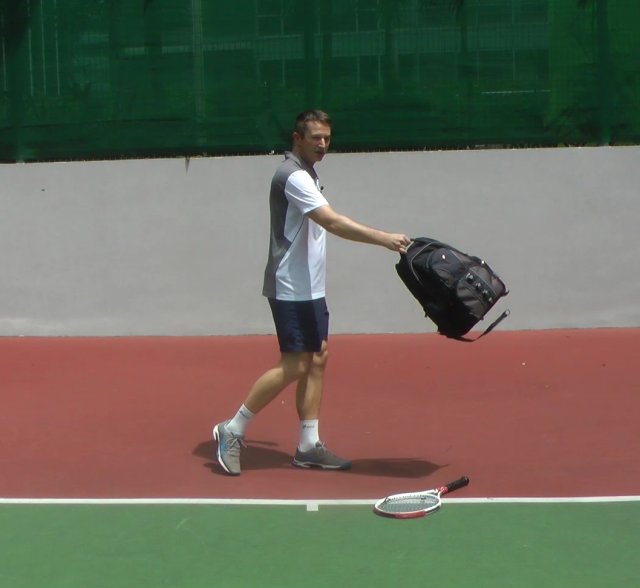
Swinging happens automatically with a heavier "item"
You’ll see that swinging a backpack automatically engages your body. You start transferring weight back and forth, and you rotate your hips and shoulders.
Your arm becomes very passive. It simply holds the handle of the backpack and doesn’t do much else.
And that is much more how a skilled tennis player treats their racket. They use it as a weight that they will swing against the incoming ball.
When we engage body rotation and weight transfer to swing the arm with the racket, the groundstrokes become much more effortless.
In the long term, we actually gain more control of the ball than if we just use the arm.
Why Players Tend To Use The Racket As A Tool
To better understand yourself and how you got on the wrong track by using your racket as a tool, let’s take a look at several reasons why that is so.
1. It is an instinctive reaction or “mode” that happens as soon as we hold something with our hand.
I believe this is quite an instinctive thing to do since we operate in this mode by using our hands and executing precise movements most of our daily life.
We don’t deal with heavier things that we need to swing around, so that mode of operation is foreign to us.
As soon as we grab the racket with our hands, we automatically switch to “using a tool” mode where our arms are active and our body is passive/inactive.
2. The brain simplifies the challenging task of meeting a fast-bouncing tennis ball with a moving racket (often while we’re moving).
A tennis ball typically flies around 1.5 seconds from baseline to baseline in a higher tempo exchange between two amateur tennis players.
Our body has hundreds of bones and hundreds of muscles, and our brain needs to coordinate all these hundreds of bones and muscles in the correct sequence in about 1 second of time.
Surely you can see that this is an extremely difficult task for the brain to do.
So, the brain simplifies the task of meeting an always-different incoming ball with a moving racket by not using many body parts.
The brain figures out that it’s much easier to meet a moving tennis ball with a moving tennis racket by just using the arm.
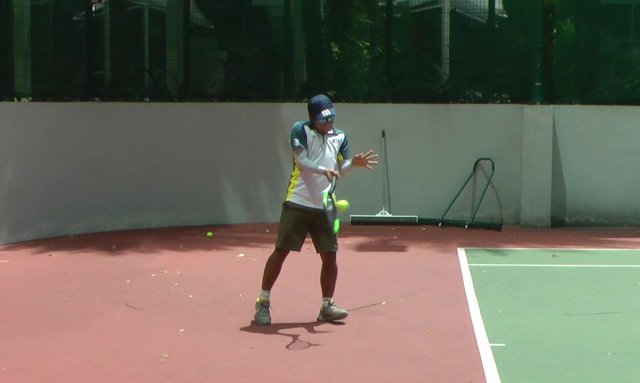
This is a very common problem in tennis that compounds late contact, no body rotation and hence using only the arm.
The brain basically shuts off other body parts (legs, hips, shoulders) so that they don’t move and disturb the movement of the arm as it is not capable of including them in the calculation of timing the stroke.
While the brain solves the task of hitting a tennis ball, it does not solve the problem of efficiency and effortlessness.
Effortless tennis strokes happen only when the complete kinetic chain of the body is engaged, and that requires the brain to coordinate all the major body parts.
So, the main reason your brain cannot do it is because you start to play tennis that’s too fast for your current abilities.
Perhaps you take only a few lessons before you start to play matches. In a tennis match, your opponent will move you around the court and cause you all sorts of troubles so that you cannot really calm down and set up for the shot.
Your brain cannot solve the body coordination problem at this stage yet. It will always just use the arm to hit that difficult ball that you’re facing.
And repetition by repetition, you’re building a new habit – a habit that is getting more and more ingrained and that will be more and more difficult to change.
That’s why, even after some time, perhaps after a few years of playing tennis when your ball judgment ability has improved a lot and your brain can now process information much faster, you still retain that old poor stroke technique.
You still use your arm and don’t use your body rotation, swing and weight transfer to execute your strokes with better technique and better efficiency.
The only way to naturally develop a tennis stroke where you’re using the whole kinetic chain is to play at a slow tempo.
You need to rally at a slow pace so that your brain has a chance of coordinating many body parts in the available amount of time in order to meet a moving tennis ball with a moving tennis racket.
The time frame in which your brain can coordinate your body well in a slow-paced rally is measured in weeks and months, not in minutes and hours.
That’s why most players never get there: They are too impatient and start playing points way before their technique is stabilized to a point when it doesn’t break down under pressure.
Unless of course you have someone to help who knows how to untie this complex knot of 3 mistakes happening simultaneously – hitting the ball late, not rotating the body and using only the arm.
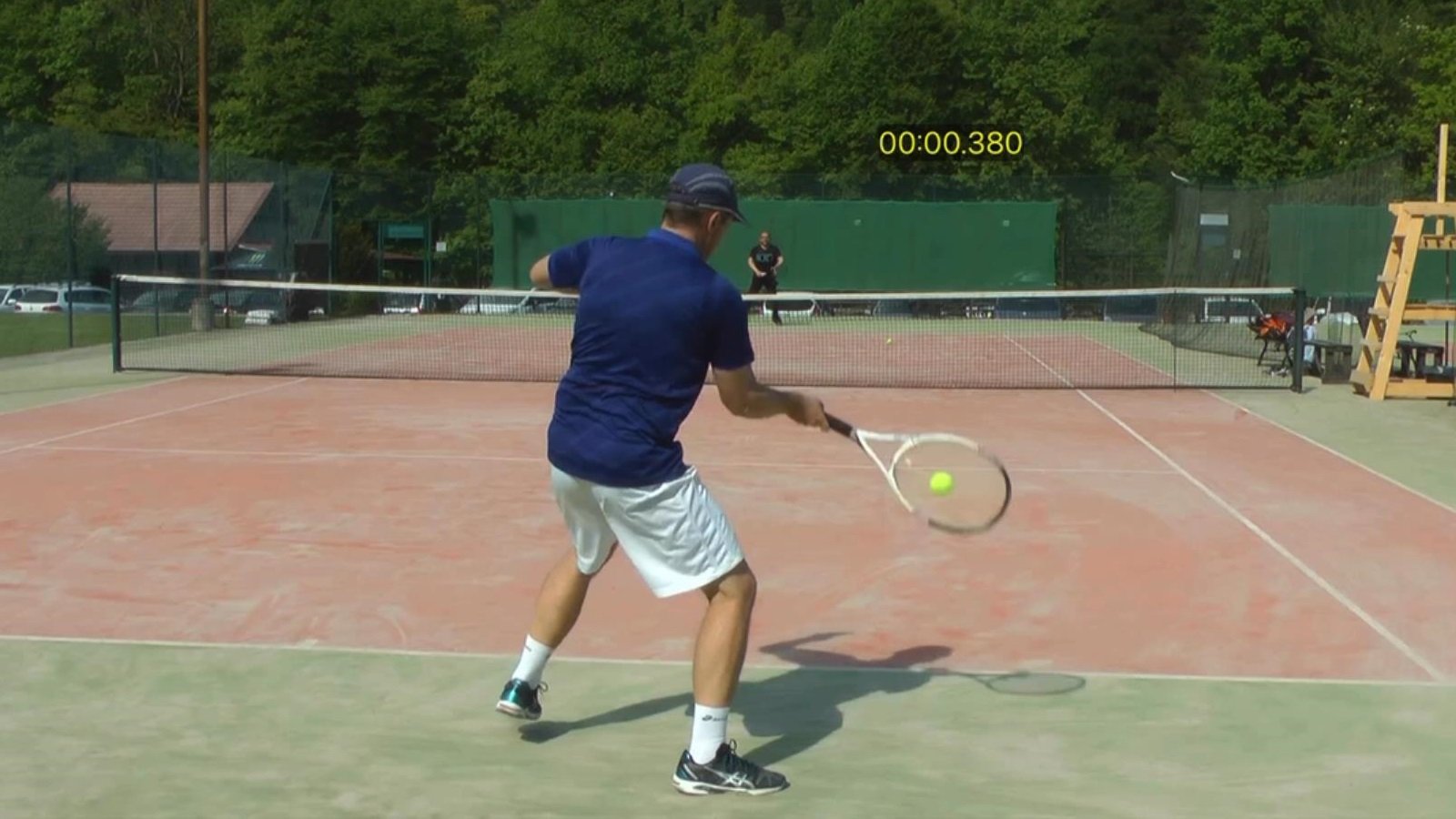
The same player you saw above hit late, could eventually hit more than 50% of the balls at the end of the second 2 hour lesson where most of the time was spent reprogramming the movements and changing his timing to meet the ball in front.
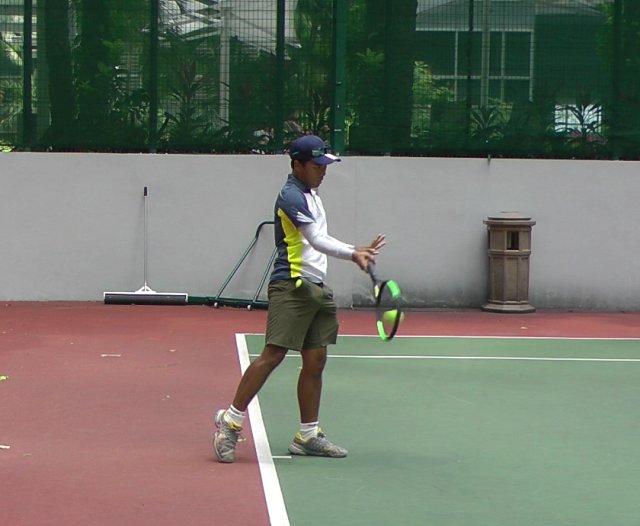
It took about 3-4 hours of work to get to this stage where he can hit a forehand in front using also body rotation.
3. Desire for control and judging mistakes so negatively cause you to play extremely cautiously with no room for swinging freely and experimenting.
Even if you don’t play for points, you may still judge missed shots as failures and view them very negatively, meaning you feel very bad about yourself and your tennis abilities.
Then it’s natural that you will try to avoid these negative feelings as much as possible, which means you will try to avoid missing the ball in ANY SITUATION as much as possible, even if it is just a practice session.
How are you going to develop something new if you have no room for errors and no room for experimentation with new techniques or new movements?
Obviously you won’t.
I have written in the past about how to be more at peace with mistakes in tennis, and I invite you to read that article again.
4. Rackets are too light and allow you to actually use them as tools.
Modern rackets are quite light with the default weights around 300 grams for men and around 275 grams for women. Some models are much lighter, sometimes even around 250 grams or less.
That allows you to maneuver the racket in space solely with your arm without really feeling the need to engage the body for help.
The old wooden rackets were much heavier and way less bouncy and therefore required much more precise hits with more momentum needed for a good hit.
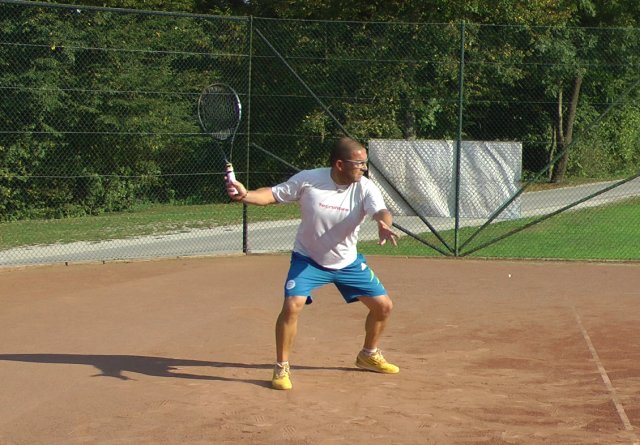
So, players naturally had to learn how to swing those rackets and use them much more as a weight that they swung towards the ball which automatically put them on the right track in terms of engaging the whole kinetic chain into the stroke.
Which Tennis Strokes Rely Most On Using The Racket Like A Weight
A tennis stroke that functions most on the principle of swinging a weight is the serve, of course.
That’s because we toss the ball to ourselves so it’s not coming towards us at a fast pace and so we can swing the racket quite freely through the ball.
We also always serve from the same distance to the net so there are very minimal adjustments needed for consistent serves.
We must just find the right placement of the ball with our toss so that we can simply swing (or “throw”!) the racket towards the ball and we’ll use the most efficient way of accelerating the racket.
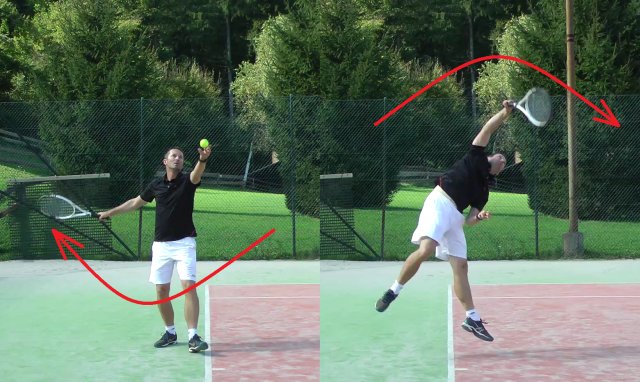
A tennis serve is basically a swing backwards and a swing forwards.
I can by now tell whether the player knows how to serve well just by looking at how they hold their racket before they even initiate the backswing.
If they grip the racket like a tool, I can tell they will try to move around with their muscle power. Otherwise, I can tell if they grip the racket nicely like a weight, then they will hit a serve by using swings and momentums.
Think about that the next time you hold the racket and prepare for the serve.
The groundstrokes are very much based on swinging a weight in a neutral rally exchange when you’re simply hitting the ball in a nice cooperative rally with your partner.
The more comfortable the incoming ball is, the more you can swing.
If the ball is more difficult and you have to move to it and adjust your stroke more, then you swing less of course.
In a previous article, I described this constant adjustment between “throwing” and “pushing” and explained the idea behind managing power and control of your groundstrokes.
Volleys and most slice strokes are based on controlling the racket through the forward movement, and we don’t really use the racket as a weight, perhaps just a little bit on easier incoming balls.
In summary, the idea behind this article is a very simple concept: Try to use your racket more like a weight and less like a tool.
It’s very likely that you are controlling the racket too much in the same way as you control a tool when you hold it with your hands.
The hands become dominant and active, and the body becomes very passive or completely still.
To hit an effortless tennis stroke like a groundstroke or a serve, you need to do the opposite.
You need to engage your body more and make your hands more passive in the same way as you would do if you were to swing a backpack or a heavier bag.
The “swinging a weight” approach is much more efficient once you master it, but it takes longer to learn because your brain needs to coordinate more body parts in a short amount of time.
That’s why you must give yourself some time and be patient while you’re working on bringing your tennis to the next level.
Give this approach a try and stick to it for a while. Let me know if you notice any changes in your tennis techniques and how effortless you can hit the ball.
Great input, Tomaz. I’m still working on my serve so only three days ago your pendulum scenario set me thinking is my Babolat too light and should I ask Tomaz should I weight the head.
Just hold the racket nicely, Terry, and try to feel the weight not only of the racket but of the racket head. Once you feel it, just swing it. 😉
Very informative and I think it suggests why under pressure I revert to a forehand slice or “squash shot”. Tough to change old habits however. ;-(
Yes, it tends to happen, Peter.
Try to step back a bit from the baseline to buy yourself more time and to buy yourself more space to hit into and then the swing may return since you’ll feel more freedom to go for it.
you say when a player serves you can tell by the way he is holding the racket…. whether its a tool or weight. Can you elaborate on that? Should the grip be loose and really towards the end of the racket?
No need to hold really at the end but you need to hold the racket nicely. “Loose” can be misinterpreted because the racket must not be loose in your hand. Meaning it must not move in your hand around being loose.
You must hold the racket by wrapping your hand around the handle completely and yet allow your wrist to move freely throughout the service motion.
Think about “dangling” the racket head down and yet holding the racket well, with no space between the handle and the hand.
As usual, great stuff Tomaz! I am finding that old habits from racketball and squash are not corrected easily!
It’s my experience too, Andy. Squash players have trouble transitioning to long smooth swingy tennis strokes…
Brilliant.
Did you get educated as an engineer ?
Yes, I do have a degree in Electrical Engineering. 😉
Hi Tomaz,
I really enjoyed the video!
What about the abbreviated serve motion? Andy Roddick for example: https://www.youtube.com/watch?v=SZbxKuLEP_o
Hi Tomas, see my reply to James.
Hi Tomaz,
Great, thanks for your answer! Love your page and your videos. Keep up the excellent work!
The tool/weight concept pair is a great way of explaining why we lack power and look stiff while playing tennis, Tomaz.
I would only mention that grip pressure is critical in achieving power and fluidity. I believe if you are holding the racquet with a tight grip you cannot swing it like a weight. It then becomes an extension of your arm just like a pen or a knife is an extension of our hand. The grip should be just tight enough to prevent the racquet from slipping and a good way to help achieve this light pressure is to keep the racquet hand fingers just lightly touching the handle until the forward swing begins and the non-dominant hand releases the racquet (which it has been supporting till now). On the serve, of course, you have to begin the stroke with more grip pressure since the non-dominant hand has to release the racquet very early in the stroke. So here, I find it helpful to feel my grip relax as I complete the racquet drop position behind my back.
Thanks for the comment, George!
I can only add to Tomaz by noting that I have used this approach after consulting with him many years ago.
I have used his approach to teach my three kids.
Even when coaches asked for harder or more pace, I never told my children to do that.
The most important thing was smooth, rhythmic and trying to use the whole body as much as possible.
It really works!
But it is hard to learn as an adult.
Be patient. It took me a long time (about 5 years) to be able to learn to be as relaxed as possible and to use my body.
One tip that I do use in practice at least is to see how loosely I can grip the racket and not have it fly out of my hand.
I feel like the forehand and serve benefit the most from a loose grip.
The backhand not as much but does still.
Once the arm is very calm then the body tends to have to engage.
Otherwise the ball won’t go anywhere.
Thanks as always Tomaz!
Thanks for sharing, Arturo, always great to hear your comments and experiences!
I have a similar experience of about 5 years of trying to correct a tight forehand to a more relaxed version. Yes, the loose grip/relaxed wrist is really a key, as it makes the racquet feel like a weight, as Tomas describes it here. And just as you’ve described, it can feel like you’re just managing to stop the racquet from flying off your hand on the follow through if the stroke has been produced in a proper relaxed manner.
And yes, you have to be really patient if you’ve developed bad habits as an adult recreational player. I think it’s easy to under-estimate how tight you may be if it’s become chronic over many years, and you need some critical feedback either through video analysis or by a coach.
Unfortunately, most coaches don’t seem to have good ways to correct this, even though it seems to be the number 1 problem at the club level (I see some guys at the local club who get coaching weekly and their tension hasn’t reduced at all over the years, for example). I basically had to gradually work it out myself with help of several different coaches over the years.
And very few resources are available online on these topics either, Tomas here being probably the best person online. In my experience, the thousands of videos of analysing the Federer forehand are pretty useless since they don’t tell you how to fix such a fundamental problem (Tomas came to the rescue once again of course with his video comparing Federer and Halep forehands).
Tomaz,
Once again your instruction is so great! I have always used the racket more like a tool with a lot of tension. That has caused me tennis elbow problems for the last six months and I haven’t even been able to play. I’ve always been a small person, so I think I had the impression that somehow I had to move the racket fast with my arm to gain power etc… It makes so much sense that I need to use the whole body and hope to start learning to swing more effeciently when I get back to playing in the spring. Do you have any tips for preventing and healing Tennis Elbow issues?
Hi Mike,
Yes, I’ve heard that belief before – namely if you’re a bit smaller person that you need more effort to hit the ball well.
It’s not true except on pro level.
The reason why your height or weight don’t matter much is because even if you’re smaller and you weigh for example 60 kg, you are still 1000 times heavier than a tennis ball which weighs around 60 grams.
If you manage to move your body against the ball with rotation and weight transfer and keep your arm relatively passive, the ball will fly off effortlessly because you’ve generated so much more momentum than the ball has.
So it doesn’t really matter much whether one weighs 60 kg or 80 kg, you already have more than enough weight to create enough momentum to bounce that ball off easily.
It’s just tricky to learn this way of engaging the body and I really recommend you swing some backpacks here and there to stimulate your body and engage it often and then see if you can do that when you’re hitting a tennis stroke.
Yes Tomaz. There is a small child at our club who swings loosely and effortlessly to hit harder shots than the majority of adult players.
Also I wanted to add that if you are reading this article then you are further along than I was…for me this is confirmation after the fact! It took me awhile to realize that what I wanted and what I needed to do was go backwards and attempt to change my stroke. As an adult club player this took time and still takes time.
I tried to do it myself for about 6 months and then I just had to breakdown and get a pro. The benefit was that the pro sees what you are doing, not what you think you are doing. Which in my case was the turning point of change.
For me it was amazing to find out that what I thought I was doing in my mind was not either what the pro was telling me to do or even what I thought I was correcting. For this point alone I suggest getting a teaching pro or at the very least a good video camera when you are on the ball machine or rallying with someone.
One day you will have some breakthroughs and then regress the rest of the week. Let those small victories move you forward. You will laugh and cry at how you will move to the ball with all the intention and then marvel at how your body and mind want to do the old “comfortable” thing rather than trusting that uncomfortable new thing. Get ready to be uncomfortable and enjoy it!
I’ve found the relaxation through the stroke to be a challenge as well. I am used to getting the ball and “doing” something so my core is usually tight. Now it’s almost opposite…the core and breathing feels relaxed and the ball kind of explodes off the racket. It’s very jarring that tennis could be this way. Exciting but uncomfortable.
And Tomas can you address the feel component of this? I guess what’s difficult is that you can no longer just let your instinct and muscle memory take over. Your mind has to actively talk through the shot so that you CHANGE what you are doing (actually all of the cues happen before the shot).
We have also worked on just finding new ways to get there so that we are forming new patterns and habits. But as a feel player you will have to be quite cerebral to change in my opinion. “stop thinking and just hit the ball” is not going to quite apply here until you get to a certain point. Would you agree with this?
Good point, Tina.
If one works on technique then a video camera is a must and seriously committed tennis pros have it on the court. If they don’t have it, then their lesson will be very ineffective. (And yet they’ll get paid the same…)
As for how to achieve a change, the best way I found is through feel based drills.
So if I want the player to better engage their body I hold their shoulders for example with my hands and provide resistance so that they FEEL what it means to use the body more.
If I want them to rotate the hips, they pull a rubber band with their hip rotation to FEEL what the hips must do.
If I want them to use more ground force, I push them down and they need to push me up so that they FEEL what ground force means.
If the player then really feels the right thing, only then can they be somewhat cerebral and keep reminding themselves what to do engage.
But if they don’t feel, then thinking about a certain body part and how to move might not work.
As usual, succinctly put! I am on the right track. I’m glad my coach finally decided to go with more feel based teaching. We’re Americans so guys aren’t exactly all that willing to put their hands on ladies no matter what the instruction value LOL. Takes time to establish trust here.
Totally agree and think that it will work!
Now I think I need two things to make this happen. 1. Some sort of weight around the neck of my tennis racquet so I can “feel” the weight. 2. A video of my self, so I can “see” if I REALLY am passive with my body in all of my strokes. Off to research!! ThanksT! Q
Even sticking one tennis ball in the throat of the racket will increase its weight by 60 grams, Q! Usually the balls fit in there in most rackets…
I play with many players that use the racquet as a tool. Their swing path, and mechanics, are exactly what you described…choppy, no fluent, sharp. They just react and then hit with really no plan. They just want to get the ball back. No plan of trying to construct a point. I am working really hard to have the right mechanics and using the body more in my ground strokes. Now, when I play players like I described above, it is somewhat distracting. I have to not focus on their stroke. Thanks so much for the information.
Yes, Debbie, it’s distracting and also prevents you from getting into a good rhythm. If you can find a partner to hit with you for an extended time, like even 1 hour with breaks in between, you’ll be able to find your swing.
But you must play slow and easy tennis.
Look at how Federer is warming up. He and other pros always start with very slow tennis where they just swing and “throw” the racket into the ball and let it fly.
https://www.youtube.com/watch?v=osBSs1DpHLU
They also miss and don’t even bother. Just take another ball and start the rally again.
This is how everyone should start their tennis sessions because the reason the pros do this is to immediately feel the swing and the relaxation so that they can retain some part of it later on when they start accelerating.
Hi, Tomaz. It’s a great philosophical insight into the game of tennis.Congratulations! Your tool/weight concept explains fundamentals in a very sound and clear way. I cannot help thinking that in order to get better results one should use his/her imagination to the full potential. Just simple like that…
Sometimes we CAN cut through the complex techniques with a simple concept, Georgiy. Give this idea a try…
Hi Thomas, thank you for another great lesson.
You say that the serve is swinging back (and then forward). But I see pros tossing the ball and then raising the serving hand almost straight up. They do swing behind their back when the racquet is up and going back down but not when separating the tossing hand and the racket hand at the beginning of the serve.
Hi Alex,
See my reply to James!
I agree with everything you said here about using the racquet as a weight and getting more body weight into the shot rather than arming it. However, on the serve you seem to suggest that if you use an abbreviated (straight up) takeback that it means you’re using the racquet as a tool.
I think I would disagree with that as I believe that the abbreviated serve takeback is a valid mothod for serving and was done very sucessfully by players like Roddick, Monfils, Gasguet, etc.
Speaking for myself, I used to use the full pendulum takeback like you use but I found that I was having issues with lack of power and consistency beause I couldn’t time my trophy position correctly. I found that by the time I had my racquet up to the “trophy” position near my head with the elbow bent, I had already dropped my tossing arm so that my trophy position actually had level shoulders rather than the tilted shoulder position you want to be in before launching upwards and cartwheeling to hit the ball.
I tried different strategies to fix this (e.g. toss higher and hold the tossing arm up longer) but nothing ever really worked. Only when I switched to a more abbreviated takeback (not letting the racquet head drop below the level of my hand and taking the racquet more straight up) that I was able to actually reach a correctly time trophy position and my serve got much better.
My takeback now looks a lot like Mackenzie McDonald’s serve here:
https://www.youtube.com/watch?v=WGOtb6DD3RM
However, this seems to be exactly what you say not to do.
Thoughts?
Hi James,
I had a similar question not long ago through my email as one player was asking me why shouldn’t he serve they way Andy Roddick served with an abbreviated backswing and more body rotation into the ball than most players rotate.
So before you read my answer, I think the reason the abbreviated backswing worked for you is because you had trouble with coordination of both arms and timing of the swing.
You solved those problems with a shorter backswing and your serve is better.
But is it the best it can be? Possibly, if you have a good throwing motion already from childhood and if you know how to release the muscles and not contract them for hitting the ball.
If you don’t, then your serve is not the best it can be,
And here’s my answer to that student:
———-
The reason we swing GENTLY downwards with the help of gravity which effortlessly swings our racket upwards towards the trophy – hence NO waste of energy in redirecting the momentum – in order to ENSURE that our arm is loose.
Because only with a loose arm can we create a whip effect. Even Andy creates a whip effect even though not obvious.
You have to differentiate between a learning stage and learning process and an absolute master of a certain skill.
If you are in a beginner or intermediate stage of learning and you DO NOT loosen up your arm in the initial downward and backswing, you will NOT in a 100 years find a looseness in your arm from the trophy position onwards.
If you initiate your movements in a tense “mode”, you will continue to execute them in tense “mode”.
You do not have the mastery of your body and your muscles to change tension and looseness / relaxation when you want. Andy can though.
A black belt karate master who has been a black belt for 20 years does not do things he teaches his students. He can do completely different things and he knows his students cannot possibly do what he does until they complete the 20 year training.
We as coaches know without a doubt that a recreational tennis player cannot possibly come even close to learning an effortless serve unless they become loose and swing initially.
Again, there is no way you can do what Andy does and serve effortlessly with a whip effect. If you attempt the Roddick motion you will muscle the ball and hit with tense muscles.
And tense muscles cannot move the racket head fast. Only loose muscles can do that.
Not limp muscles but muscles that are releasing from a contraction.
Because what Andy and other good servers (and throwers) do is that they “tense up” as a way of storing energy.
Golf swing, baseball pitch, football quarterback throw, javelin throw, etc. All work on storing and releasing energy.
You need energy to squeeze a spring, that’s how you store energy in the metal. Then you simply release and then spring shoots up.
A tennis ball has to forcefully compress to store energy and then it releases it and bounces off.
A tennis serve is a store of energy through the whole body and then a RELEASE.
But 99.99% of recreational tennis players have no experience with storing and releasing energy because they were not involved in sports for years as children where they would naturally develop these motor programs.
Hence an adult rec player only “knows” how to create force by pushing, which means he adds MORE CONTRACTION.
You are likely increasing the force in your arm when you are swinging towards the ball and I am decreasing the force in my arm (relaxing it) while I am approaching the ball.
Increasing the tension in your arm while moving it towards the ball is a completely wrong concept and it never works. The speed of such serves reaches a plateau at less than 100 mph.
So we need to teach you – if of course the player is seriously interested and motivated – a different way of accelerating the racket which is completely foreign to you.
And it can be difficult but also relatively easy.
The easy way to get going is to start swinging and throwing a lot. This in time gives you a feel of how this accelerating by relaxing the arm works. In other words, how storing and RELEASING energy works.
Once you get that you can serve effortlessly.
Once you master the feeling, you do not need that CLUTCH any more which is that you must initiate the serve with a loose arm and swing downwards or backwards.
There are hundreds of players on ATP that do not swing back like Federer.
They have an abbreviated backswing as it’s called. Tsonga, Nadal, Sock, etc.
They are masters of swinging and throwing, they are 15 year Black belts of tennis and they can do whatever they want in the backswing and yet still know how / feel to release and relax their arm into a swing.
Players in the learning stage – white and yellow belts of tennis – can’t do that. Period.
They will INEVITABLY RETAIN / HOLD the tension they created in the backswing and use it to muscle and push the ball forcefully.
That is the most common and logical way of applying force to the ball and hence everyone does it and hence no one can serve faster than 100 mph (or even 85 mph) in the recreational tennis.
So what you’re looking at is just external and visible parts of the serve and you think that if you copy Roddick then you can also serve well.
But the secret lies in the invisible part which is how and when – at which moments – are the muscles contracted and released and in what sequence does that process go through the body.
When you learn the sequence, feel it, you know how to generate acceleration. No tennis technique training needed.
I played volleyball for 16 years and learned how to accelerate my arm. I did not have one single lesson in my life in tennis and yet I can serve powerfully and effortlessly.
My friend played for the National handball team in Slovenia for 10 years and he can serve as fast as I do and yet he never had a lesson in his life on tennis technique.
If I get a baseball pitcher to my lesson, he can serve with power from day 1. I only need to tweak his technique so that it adjusts to the dimensions of the tennis court and net height.
He already knows how to get power effortlessly.
You need to learn how to accelerate your arm effortlessly regardless of the sport (tennis in this case) and once you have that you can serve, throw or spike with no problems in any sport.
And how will you learn to do that?
Not by analyzing videos but by throwing and swinging.
It is as simple as that. Throw old rackets 5-10 minutes per day and swing the Serve Master or a ball in the sock for 5 minutes per day, ideally twice a day.
You will learn but it will take time.
Our body has over 600 muscles and out brain needs to coordinate MOST of them for a service motion and do that in about 1 second which is the duration of the service motion.
It cannot be done consciously.
We teach the brain how to do that through feel based exercises like throwing and swinging and we feel when we got it right.
Our only guide is feel and the sensation of speed of the racket or pendulum we swing and we can also hear the sound, the whoosh.
That’s how we know we’re doing the right thing
With thousands of repetitions and months of training we get better and better at this.
Typical time frame to develop good body coordination and storing and releasing energy is about 6 months with a 9-12 year old junior player who comes to training at least twice a week.
Hope that gives you some perspective.
Tomaz, excellent. You talked about the weight of the racquet. Would you discuss the relationship between racquet weight, swing speed and acceleration given the intrinsic ability of bodily movement? Thank you, Patrick
Hi Patrick, in my opinion swing speed and racket head acceleration are overrated and over emphasized – if you’re a recreational tennis player.
Tennis coaches like to throw these ideas out because they hear them at tennis conferences and or certification courses because those are geared towards developing a serious competitive tennis player starting from junior years.
So yes, for a junior it’s important to work on racket head acceleration and swing speed because one day they will be able to control that speed and play with high consistency too.
But for a recreational tennis player the goal should be not be very high swing speed or high racket head acceleration because they can’t control the racket angle that well. They simply don’t drill enough.
So what matters more is a steady racket head speed which you achieve much better with a slightly heavier racket.
A heaver racket helps you stay in the swing path as you cannot easily “pull it off” the path. It has more momentum and if you don’t fight it, it will nicely guide you to a correct stroke technique.
That’s why I post articles like this that reinforce this idea:
https://www.staging.feeltennis.net/steady-racket-acceleration/
Yes, Tomaz.
I use a heavy raquet, and I have noticed it forces me to have good technique.
A light raquet, I can just muscle the raquet.
Hi Tomaz,
I exercise in my living room with an old Slazenger wooden racket. Without ball of course. It seems to give me more feedback in feel than my normal racket that I bring to the tennis courts. Do you recommend to train with this racket on the court as well?
Best regards
Rob
Hi Rob,
You can practice with an old wooden racket on the court but you must receive nice and easy balls so that you can swing it.
Then after 5 minutes, switch and use your usual racket. You can alternate like that for a while to get the swing / gravity feeling for the racket.
I play with a 340 gram racquet in an effort to slow down the swing and discourage a predominant arm & wrist action. The effect was limited though, until I saw your videos! It’s easier to generate more speed on serve with a slightly lighter racquet but overall, I find that heavier is better.
Another excellent & insightful article Tomaz. Thank you so much for explaining so explicitly, what I’ve been struggling to get my head around for years!
I’ve never had any problem with hitting a moving ball and I suspect that your description of why the arm becomes predominant explains my own situation, perfectly. As a kid, down at the local park (usually, once a year, during Wimbledon), I learned to keep the ball in court by “smothering” it, hitting across the line of flight.
Imagine my difficulties in getting out of that habit when I took up the game in middle age! My subconscious simply couldn’t seem to accept that a “full swing & hit” wouldn’t send the ball over the back fence.
Your universal swing video is the single most helpful piece of tuition I’ve ever had and all these other articles are also brilliant. Keep up the good work!
Glad to hear that, Peter!
And thanks for sharing, I am sure many readers can relate and know that they are not alone in this interesting and challenging journey of mastering the game of tennis.
Hi Tomaz, your articles explain what merely studying a professional player’s technique cannot. Whilst a player can try to emulate Federer’s style from videos, it cannot be appreciated how each part of Roger’s body feels, as he processes that swing. Your example of swinging a weight vs using the racquet as a tool, is a good example of this.
Also, your observation regarding Federer’s “disguise” of the universal swing principle, is another. Clearly, he is generating the rotation and synchronisation of shoulders & hips, without it being obviously evident.
Perhaps the simplest yet clearest example, is your analogy of sweeping a leaf. So simple but most things are, once you’ve been told!
Presumably, this is why you named you website, feeltennis? At first, I wasn’t fully convinced, as I’ve been obsessed with technique and trusted my coordination.
Your talent for analysis & teaching is exceptional and I love that you combine technique and timing issues, so intelligently. I get so frustrated with coaches who simply tell you what you already know from textbooks but who are unable to see or explain why their students’ strokes are breaking down.
Thanks again, Peter.
Yes, feel tennis name of this website is based on various reasons – I teach a lot through feel, meaning I try to have players feel what they are supposed to do instead of just telling them, the game is played with feel and not with tightness and muscling the ball, and feel also gives the rigid mechanical technical movements some life and energy…
Excellent explanation of this fundamental concept. Explains a lot of my struggle to hit smoothly in matches. Unfortunately everyone wants to play points.
“Unfortunately everyone wants to play points.”
God, do I hate that! I agree that if you want to play matches you need to practice matches, but there are many other creative ways to do that. I like Ian Westermann’s idea that you alter the rules to drill skills while you practice playing for points. As for matches:
“MATCHES? WE DON’T NEEEED NO STEEENKING MATCHES!”
(tennis-loving Mexican Banditos in “Treasure of the Sierra Madre”)
Some great posts, I particularly appreciate references to the innumerable, seemingly inescapable, Federer Forehand analyses circulating on YouTube and how useless they actually are to the club or recreational player.
Sometimes I feel lucky to play wheelchair, because we don’t spend a lot of time talking about the modern forehand, the windshield wiper or “lag-and-snap”. For us, it’s more about the basics: ball tracking, court coverage, clean contact, eliminating errors, physical conditioning, and so on.
It could be that our situation in life makes us more honest with ourselves and more realistic about our abilities, but really Guys, it’s obvious:
Working hard on the basics will do more for
our game than analyzing advanced techniques beyond our reach, as if we hit the ball like a Top Ten professional.
Hi Remguy, good comment, thank you.
I allways loved working on technique, and my goal was to have the technique of an ATP pro.
With Tomaz’s help and a lot of practice, I can say I finally hit my ground strokes as well as an ATP pro.
My technique is the same, but my hand eye coordination is far from the ATP professional. I can’t move hardly as well, and am not as coordinated in general.
But just hitting against a wall, I can hit the ball as well as an atp pro.
I compete at 4.5 level at best where ATP level is 6.0-7.0
Tracking the ball and basics like you mentioned are very important as well.
Wow. I think you have fixed my ‘arming’ the ball when I get into a match. I have been trying to control the racquet through the swing path rather than let it swing.
Tomaz, I just love your posts. Your ball toss ‘fixed’ my serve. As someone who is always overthinking every shot your analogies and explanations just seem to work for me. Thanks.
Great stuff again Tomaz!
Could you point me to or link to one of your videos where it has you rallying the most. As you can learn so much just watching a live ball scenario.
many thanks marcus
Thanks, Marcus.
Perhaps check out this one:
https://www.staging.feeltennis.net/free-hitting/
Hi Tomaz, good job once again. You use the tool-weight analogy, that is quite interesting.
Personally I usually say that people tend to think to racket as a hammer, but really they should think to have instead a whip in their hands. So my preferred analogy ishammer vs whip… What do you think?
Good one too, Roberto! We need to have many tips and solutions for the same thing because different people respond differently to different key words or ideas.
So if tip #1 doesn’t work, I try tip #2. Then tip #3 and so on. They are all trying to correct the same problem, just from a different angle.
So I keep trying until I can unlock that puzzle that every new player presents to me.
Great article. I believe you are spot on also. I had years of coaching as a junior, off some very good, well established national coaches, and they never approached this subject. I think you possibly left out an important extra piece to back up your (correct) theories here – the result of the weight transfer and kinetic chain you refer to can been seen quite clearly when watching top players if you watch their left foot raise off the ground on many forehands for example. It’s equivalent of a boxer landing a large below to a body bag or opponent.. the weight transfer from proper (efficient) technique will nearly automatically result in that action, although obviously training / coaching/ practice and concentrating on the technique itself rather than the result is what is needed.
Any comment on whether the lighter rackets are actually the stimulant for the techniques that don’t use weight transfer, rather than the result of it ?? I would be of this opinion myself. (There’s an exception to every rule and Rafa is of course that! Super-freak:) )
Thanks for the feedback, Peter.
When you mention the left foot coming off the ground you need to specify in which stance the player is.
If they are in open stance and they are right-handers, then the left foot will come off the ground many times.
If they are in neutral stance, then there is difference between fundamentals and match play. In fundamental tennis strokes the foot does not come off the ground, it stays glued to the ground.
As for lighter rackets, they surely don’t help feel the swing. When it comes to pros, it doesn’t matter what racket they use because they have mastered the fundamentals when they were 10 years old.
Yes, I was referring to certain open stance forehands when there is time to get a good foundation etc. The left side of the body acts as a counter weight essentially to swinging a “weight” on the right side. Of course there are many shots where the feet will stay planted, or the back foot will come up sometimes for shorter control-based shots etc..
Great article and website .
Ps. Very good slow motion video of federer shows a nice throwing motion here (55 seconds in…)
https://youtu.be/xNPaZj4yn00
Tomaz, I always love all your instruction and think it is the best on the internet. I’m try to break a very bad habit, but so far, I can’t seem to gain any progress. I get the racket arm way too far behind me, and it causes me to hit late all the time. I have tried early racket preperation and keeping my elbow up, so the racket doesn’t go back to far, but when the ball starts coming with pace, I just revert back to my old habit. I can cover the court very fast, but my reaction time with my feet seems to me late all the time. Is it realistic to break a habit that I have had my whole life at 60 years old? I really want to learn how to shorten the swing and start hitting the ball out front with that effort less power they always talk about. Please give me some insight and hope in fixing this problem. Thank you for any help you can give me….. Mike
Hi Mike,
I’ll make a video on that but to be honest it’s tough to do it yourself. The mind needs to be tricked with various drills and exercises to let go of the habit.
You need a very experienced coach who knows how to do that.
Send me a video and I’ll take a look at what is going on with your stroke…
This lesson goes with Tomaz’s lesson on swinging with centrifugal force.
An old pro I had used to tell me, “don’t just swing your arm, rotate your body together with swinging your arm.” – I tried to force myself to do them together, but I never felt comfortable with it because I didn’t understand or “feel” why I should rotate and swing at the same time.
My ground strokes have advanced from 3.5 to 4.5 in several months after Tomaz explanation that your arm will swing naturally as you swing it like a heavier weight, INITIATED by body rotation. I finally got the feel of how they happen naturally together.
I practice swinging 4 pound bumb bells in each hand, following a figure 8 path; Swinging the weights with body rotation, and following a natural circular path, where centrifugal force also comes into play.
Tomaz, could you give some instructions to us players who haven’t played tennis for a long time, how to get back into the game. The psyche cannot always best understand what is lost over time and what causes our frustration. Thanks for the great tips.
Hi Misa,
The frustration comes from underestimating the difficulty of tennis. I believe tennis is the most difficult recreational sport of all as it requires a lot of skills to be at a very high level and that’s just to rally consistently from the baseline.
Here are just some of the skills required: anticipation, reaction, ball judgment (perception of ball’s speed and distance from you as well as reading the type and amount of spin), general body coordination, footwork coordination, hand eye coordination, balance and so on.
So when you come to play tennis after a longer break all of those skills have dropped to lower levels as you have not been stimulating your brain and body to keep them at a high level.
That means it will take quite some time before all those skills rise to a needed level where you can play tennis comfortably.
And that understanding will hopefully stop the frustration.
And remember, if you still get frustrated after reading this then it means you still underestimate the difficulty of tennis or overestimate your own skill level.
Yes, absolutely true. My problem is a particularly high posture and that my arm (s) are pulling my body, not the other way around. I’ll work on it. Thanks again.
This is a great post that I keep coming back to. After playing tennis my way (which is way too much arm) for 30 years it’s hard to change but possible with work. A big part of the struggle for me is that I rely on a precision game in singles and I can get great control by using must my arm, especially on the backhand. It’s a killer shot but only up to about the 3.5 level (USTA). When you get to 4.0 and higher it’s not good enough. So I need to be able to hit with more power, take the ball earlier and still keep some control. As I practice using this technique I can say it really works. I can do it reliably with slower balls and in time should be able to do medium and higher speed shots.
Hi Tomaz
Can you tell how to implement this swinging like a weight vs. swinging like a tool when executing a two handed backhand?
Hi Shimley, it’s not so easy to feel on the two-handed backhand since it’s a more compact stroke. But it would help if you put some extra weight on the racket head.
You can use the standard lead tapes or simply wrap some wire around the tip of the racket. Then you’ll feel the weight better and finding the swing will be easier.
The “weight vs. the tool” really works for me, but I must relax and allow more time to swing the racquet thru the stroke rather than “pushing” the racquet thru the stroke. Thanks!
Thank you for your instructions. This has always been one of my favorite articles. However, I keep getting confused on one thing when I am using my racquet as a weight. Are you swinging with the weight of the entire racquet or focusing more on the swing the weight of the racquet head?
More on the racket head!
More on the racket head!