
The serve is the most complex stroke in tennis, yet we can learn its fundamentals in simple ways.
The most common mistake is to immediately start teaching the tennis serve technique without developing the main fundamentals (biomechanics) of the serve, which in my view are the throwing and swinging motion.
If the serve is taught only through technical corrections (grip, stance, backswing and toss, trophy position, pronation, follow-through, etc.), the player is unlikely to develop effortless power because we are in fact breaking down a smooth continuous motion into smaller chunks and creating very mechanical and uncoordinated movements.
The power of the serve – meaning the ability to effortlessly accelerate the racket head at high speed – is based on a swinging and throwing motion which smoothly connects many body parts into a synchronized movement.
That smooth, synchronized movement is the key to effortless power and achieving high racket head speeds at contact.
While we have to work on the serve from the technical standpoint in order to make it work for the game of tennis and its rules, we must also develop the player’s ability to improve their swinging and throwing motions as they are the fundamental biomechanics which efficiently connect different body parts and generate power.
In other words, if you cannot throw well, you cannot serve effortlessly.
Why Do We Need An Effortless Serve In The First Place?
It is, of course, also possible to muscle the serve and hit it relatively hard.
Most players instinctively use this approach, and it does get them to a certain speed of the serve.
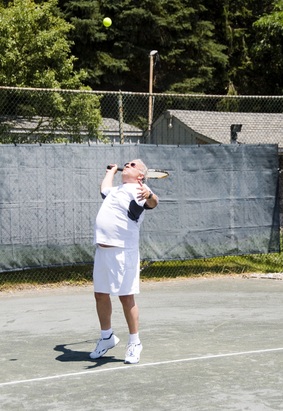
The usual serve based on a lot of tension
But, this type of serving has quite a few disadvantages:
- The “muscling” approach based on muscle contraction relatively quickly plateaus, and the player is unable to serve faster, no matter how hard they try.
- Because the player tightens up their body and arm muscles too much when serving, they lose the feel and the ability to precisely guide the racket head to the ball. In other words, the serves are very inaccurate.
- The player expends lots of energy and quickly fatigues his arm, which results in even lower speeds of the serve.
- The player has a greater chance of injury, especially in the shoulder region.
These are then the main reasons we need to develop a different type of serve that’s based on a more relaxed and smooth swinging and throwing motion which allows us to achieve much higher racket head speeds with way less effort.
Which One Comes First – The Biomechanics Or The Technique?
If a person who previously trained a sport that involved a lot of throwing or spiking a ball like volleyball, handball, baseball, or football comes to tennis and starts to serve, they will immediately have power.
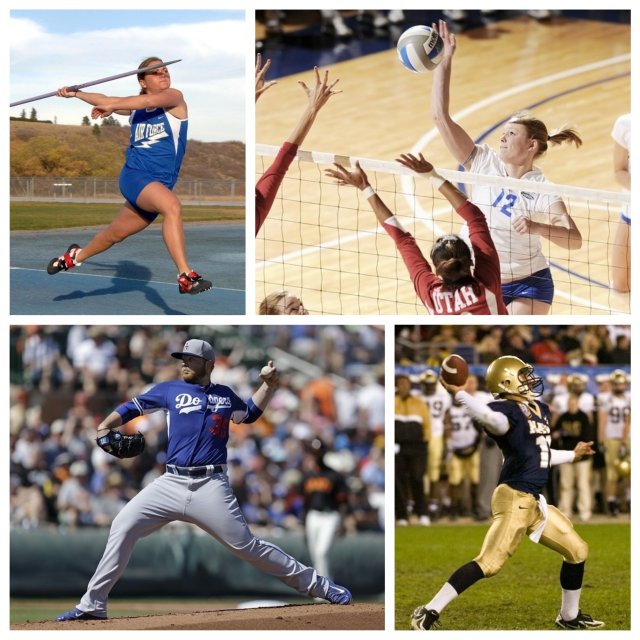
All these sports develop the fundamentals of a tennis serve
Their body parts will be well coordinated, and they will be able to whack a tennis ball at a very high speed with their serve.
While they may not be accurate and consistent at first, they will have no problems hitting with power.
If a person who can barely throw a tennis ball from the baseline over the net in the middle of the court wants to develop more power in their serve, they can take a million tennis lessons on the serve and they still won’t be able to hit the ball anywhere close to the speeds of the players I mentioned above who were involved in sports with throwing or spiking.
I can tell you that with 100% certainty after teaching tennis for over 20 years.
That is why I always work with players on developing the fundamentals of the serve, meaning improving the biomechanics of their throwing motion and their ability (or skill) of swinging a tennis racket.
The way to develop a better swing and a throw is surprisingly simple.
It requires only a few exercises and a disciplined, long-term approach that gives the brain and the body enough time to learn how to coordinate over 600 muscles in about 1 second as long as the serve lasts.
The Continuous Swing And Throw Drill
In order to practice the fundamentals of a tennis serve, you need to swing some weight around you in a figure 8 pattern and eventually release/throw it.
Simply take one small grocery bag and wrap it around 8 tennis balls.
Then put this small bag in a bigger grocery bag that allows you to dangle it using the handles off your two fingers.
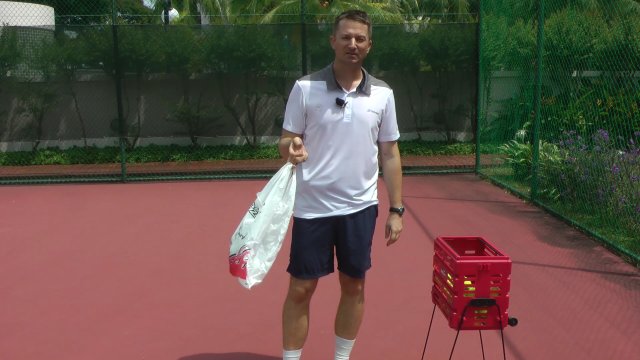
Congrats – you’ve just created a perfect training device for developing the fundamental biomechanics of a tennis serve.
If you have a light medicine ball of around 0.5 kg, you can use it instead of the 8 tennis balls in the bag.
I found that 0.5 kg is just the right weight for this swinging and throwing drill.
Now swing the bag around you in the continuous swing pattern that I demonstrated in the video above.
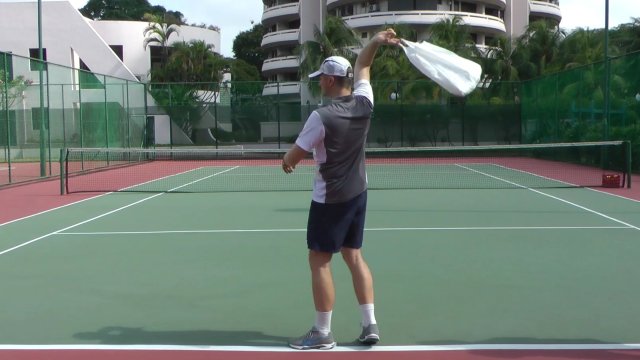
It may take you a few minutes or perhaps a few lessons to really master this swing pattern.
Be patient and keep trying until you can do it.
This continuous swing pattern teaches your brain and your body how to coordinate many body parts in a very short time into a smooth motion.
Keep in mind that, if someone trains tennis professionally from a young age, then they will do a variety of other exercises to develop the explosiveness of their movements, especially targeting the core muscles as they need to generate the most power through the body.
Players will perform various types of medicine ball throws, rubber band pulls, various throws of a light medicine ball isolating the arm and so on.
But, since most readers of this blog are recreational tennis players who will not very likely pursue such advanced training techniques, then my recommendation for improving the fundamentals of a tennis serve and its biomechanics is the continuous swing and throw drill.
It will make the most difference in your serving ability with the least time invested.
I suggest you practice the swing and release drill every time you work on your serve for at least a few weeks (possibly months).
Just spend 10-15 minutes per session practicing the continuous swing and release before working on more technical details of the serve.
You can also just use the swing and throw drill alone and then proceed to serving without thinking about technique but simply feeling the same sensation in your body from the previous exercise and looking to implement it into your existing serve.
Most Common Mistakes When Performing The Swing And Throw Drill
Every exercise out there can be performed incorrectly and therefore lose its purpose, so make sure you avoid the following common mistakes:
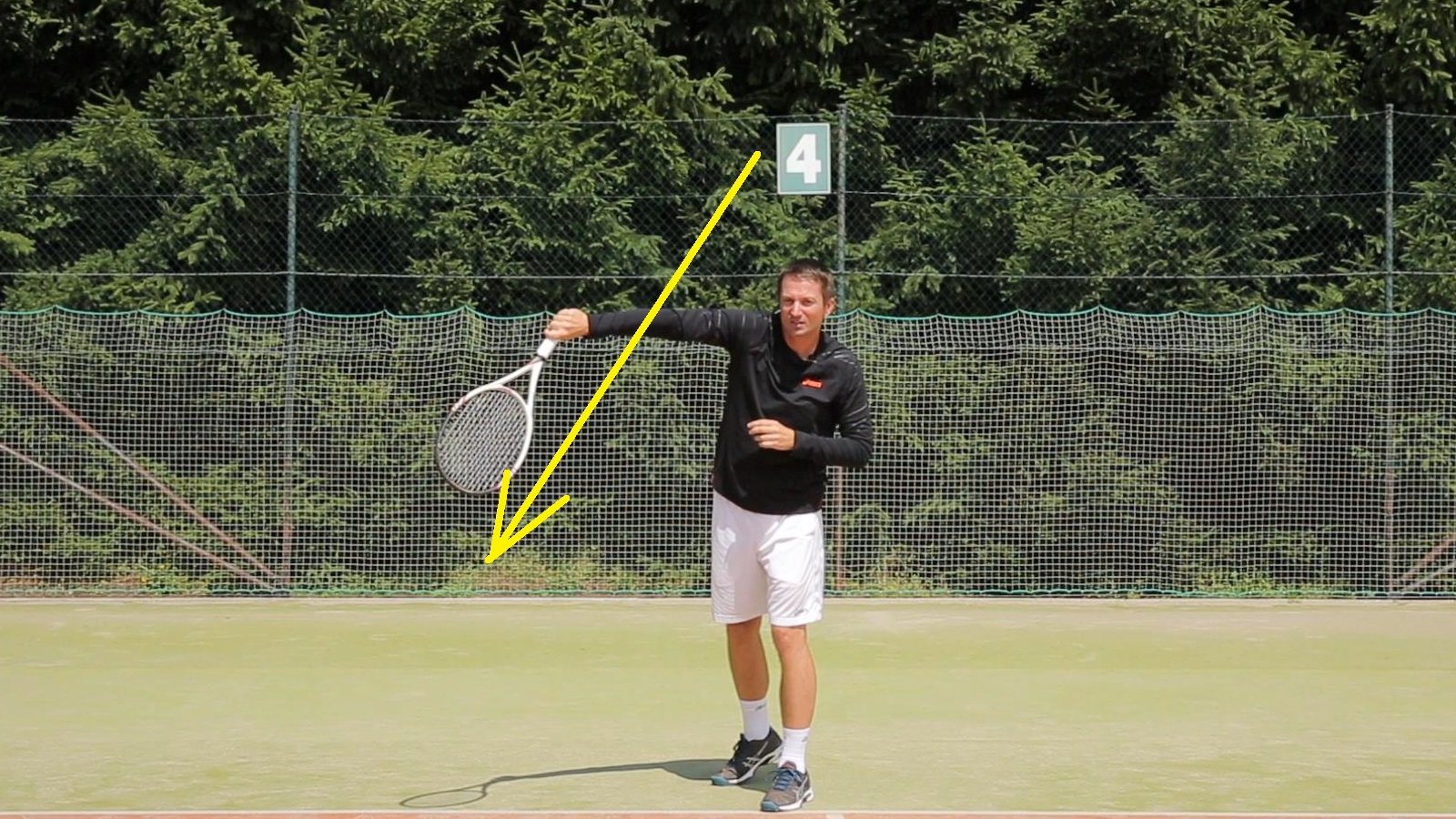
- Not enough body rotation and incorrect elbow position. If you don’t turn enough and at the same time push the elbow further backward, then you’ll know either consciously or subconsciously that you can hit yourself in the head while swinging behind you. As a result, you’ll automatically bend your wrist to change the swing path of the balls, which will just reinforce the waiter’s serve technique that’s so difficult to correct. So, make sure the elbow and the hand get behind you so you can swing easily past your head.
- Turning your head together with the body rotation. So, even though you want to rotate your body by 90 degrees back and forth while executing the continuous swing, don’t turn your head with the body. If you do, you will turn the body too much and possibly lose your balance, too. Try to keep your head straight – simply look into one of the poles of the back fence on the other side of the court.
- Not timing the drop and the body turn correctly. The usual mistake is that the player waits too long and allows the bag to drop all the way down to the bottom of the swing path before they start turning the body forward. That’s too late and you won’t get the maximum acceleration. A good guideline is that you start turning your body forward just as the bag is behind your head on the way down. Another possible mistake is that you turn too early. In that case, the bag will hit you in the back and you’ll immediately know that the timing was off.
Probably The Most Important Exercise For Improving Your Serve
What I just showed you above may be the most important drill for your serve.
You will NOT improve your serving ability by correcting only small technical details.
As I mentioned before, breaking down the serve into smaller chunks will also break down the natural coordination and and connection of body parts and therefore break down the source of effortless power.
While we have to learn the serve technique in that way in order to be able to develop all the smaller details of the serve that contribute to consistency and accuracy, we must also work on the underlying principle that generates power.
This principle is not unique to tennis – it is, in fact, the basic throwing motion used in various sports like handball, baseball, javelin throw and others.
The volleyball spiking motion is also based on this same principle, and I can tell you first hand as a former volleyball player that I never had one single lesson on the tennis serve technique and that I could serve well from day 1 playing tennis.
I only had to slightly modify my spiking motion to work for the game of tennis and my serve was functioning really well and became one of my main weapons in competitive tennis matches.
That is another reason I am sharing this article with you.
I know first hand that biomechanics comes first and that technique comes second.
I didn’t read this in a book; I experienced it myself – and so did many of my friends who used to train various sports that involved a lot of throwing or ball spiking. They could all serve really well despite never taking one single tennis lesson from a coach.
Use the swing and throw drill with the grocery bag and some weight in it (tennis balls, light medicine ball, etc.) as one of the main drills for warming up your service motion and for developing good biomechanical foundation of your serve.
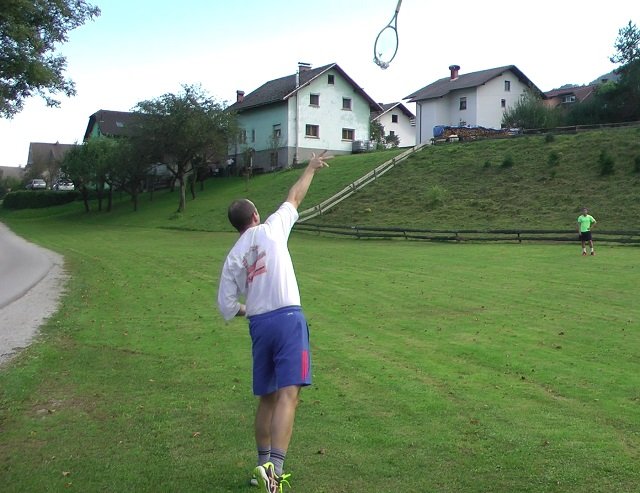
You can complement this drill by throwing old rackets (to which you can add some extra weight), light medicine balls or simply tennis balls.
Give these drills a try and report back after a few days or weeks of practicing and let us know how you’re progressing.
Great tips Tomaz! I can personally say that this process works. It takes a while but the serve will continuously improve. The idea of working on the parts of the serve separately reduces tension a lot. Over time I found that using your approach led to a very different feeling of the serve than I had ever imagined. The only thing you have not taught me is how to spike. The video gives me such satisfaction. Maybe I will go out and try it!
Thanks, Arturo. Yes, try this drill, everyone that passes by your tennis court will stop by and look at what the heck you’re doing. 😉
Many thanks Tomaz.
I have been using your Unlock Serve for many years. I believe this swing exercise together with your “7 steps” method are the most valuable for players who have problems in serving in the right track. My experience in learning serve is: Once this is mastered, the other things (techniques etc) in serve become easy, then serve becomes a fun, not a torture.
David
Tomaz, again one of your core videos, many thanks. Would you agree that the throwing motion compared to volleyball, handball, baseball-pitcher, quaterback is different in the way that they all throw from their position to a position straigth forward whereas the tennisserve is a throwing-motion straight up / vertical in the air ? By holding the tennisgrip (instead of relinquishment) at the end of the throwing-motion the raquet headspeed gets generated (I understand this inter alia from the Milos Raonic video “Hitting Upwards”)
Hi Andreas,
The serve is based on a throwing motion. We simply tilt our body so the throwing motion has to slightly adjust but it’s far from vertical. Perhaps you have a wrong mental image about the swinging up to the ball.
I’ll make a video on that to clarify this. You’ll see how little difference there is between a throwing motion where shoulders are horizontal (like a baseball or handball throw) and a serve in tennis or a volleyball spike.
I absolutely agree, serve is throwing.
As a tennis teacher, I still have a problem with my serve even though I throw well. When I throw I coil my body. When I serve I can’t coil and toss the ball in front, it goes too much to the right. Any advice Tomaz ?
Try serving without control and without aiming, Jean-Pierre.
You are (b)locked somewhere somehow and you need to unlock yourself.
You can simply be locked into a habitual movement having learned serve “technique” at some point and you now follow those movements.
Or you can be locked because you want to serve the ball in the service box which is difficult so you always apply control.
How would you serve if you were on a football field and wanted to serve as far as possible? 😉
I make a video of me serving on a football field and I give you the link 🙂
Hi Tomaz. Great serve lesson! Really breaks it down well. Tim USPTA pro
Dear Tomaz,
Thank you so much! Due to lack of money to pay for lessons throught my life,I have spent a great deal of time reading articles and studying film.I go all the way back to Vic Braden’s tennis on TV.
I truly learn the most from your instructions, and your teaching techniques.
Thank you so much for sharing your passion for the great game of Tennis!
Much appreciated, Kevin!
The drill with a bag of tennis balls worked for me as I could not do the racquet drop with a ball and racquet. After half an hour of doing the drill with the bag of tennis balls, I was able to do the racquet drop. I will work on the drill the next time I practice my serve. Thank you.
You’re welcome, Francis, thanks for sharing!
Tomaz, Your swing and throw is the best presentation of this principle I’ve seen. I wasn’t able to grasp the concept and movement from others, but picked it up almost immediately following your step by step illustration.
It has not become automatic for me, yet, but has provided substantial improvement and consistency with a more relaxed and smoother stroke.
Although I can feel the loop behind the back (the second loop) in my serve now, I’ve not seen it in any of the pros. In which men and/or women pros is that element most evident? Bob
Hi Bob,
Every pro has a loop behind, every single man and woman that you see on TV.
Where is it most evident?
With those that are the most loose, perhaps Lopez, or Raonic, or Federer…
https://www.youtube.com/watch?v=iVOWNRZzvjc
https://www.youtube.com/watch?v=l0jAVOXOkFQ
https://www.youtube.com/watch?v=8xbC31AQqSg
Wow! Those videos are great. I wasn’t able to see the loop when watching live matches. Their continuous motion is also easy to see in the videos as well. The loop seems to be automatic – as in the lag on ground strokes from the arm, etc. being loose and relaxed.
Do you have similar videos of some female pros? I have a friend who is trying to teach high school girls how to serve who might be able to relate to female videos better than male. Thank you again for your excellent teaching.
Hi Bob,
As I said, every single female pro you see on TV uses the loop in the serve. It is not possible to play serious tennis without correct technique.
Here is Serena:
https://www.youtube.com/watch?v=sDynWX27zIk
Just search for any player you want on Youtube and add “slow motion serve” next to their name.
Here’s Ana:
https://www.youtube.com/watch?v=h8_sVbLhOAo
Thank this was a really illuminating and effective method which makes a lot of sense
You are unbelievable. The best serve instruction ever. I did the bag trick for a while and next time I played my serve improved instantly. I will work on it for the next six month and hope it will be imprinted on my brain. Thank you so much for sharing your knowledge. Anita
Wonderful, Anita, thanks for sharing! It will definitely get even better over time…
Hi Tomaz, I am a great fan of yours, but I am not so sure about this drill. I did hurt my shoulder doing it! (just next to the collar bone.) I am 1.60 tall and 50 Kg, maybe I should have used less weight in the bag?
Hi Ines,
The usual always applies – make sure you are physically fit for tennis, that you properly warm up, that you “listen” to your body as you gently introduce it to new movements and see if the body responds with any pain.
Start with small number of repetitions and gradually increase giving your body enough time to adapt.
Hi Tomaz,
Can this drill be performed with a servemaster? Does it need any modifications?
Hi Rami, yes, you can throw the Serve Master too, no need to change anything. Just swing it a few times and then throw it.
Hello Tomaz:
Your teachings are the most detailed and informative. Big fan here. Continuous learning/improvement. Thank you!!
Mike
Hi Tomaz!
Congrats for another great video. Not much more to add, basically agree with the other bloggers on the quality of your instruction. Much appreciated as always.
I have a different question this time (if you want to share): how do you do to “figure out” this conceptual elements of the sport? How can you sort out what is surface from what is core? I admire that capability on you. It´s not easy on my opinion. Most tennis teachers lack it.
I’m enthusiastic to try this in the court. I did the bag drill at home and I hit my back, not sure if it´s because of insufficient coiling or because of that I “pause” the movement after the first half (lower) loop (and the bag comes around my fingers and hits me).
Cheers!
Thanks for the kind feedback, Guillermo!
Well, lots of experience, attending tennis coaching seminars for over 20 years, experience from other sports that open the mind to other possibilities, engineering study, etc.
No problem if you hit your back, it takes a bit of time to find the right movements. Just stick to the drill and wait a bit, you’ll find a way to do it smoothly…
This, like all your videos is great – easy to understand and uses things I have around the house. Your videos are the BEST out there! Thank you!
Thanks for the wonderful feedback, Peggy!
I have spent thousands of dollars on tennis lessons and I’m still using the waiter’s serve. Coaches say that I change my grip at the last minute and open up. My new year’s resolution is to practice with the grocery bag in my backyard to get the swing-throw concept down. My muscle memory is almost hard-wired at this point! I revert back to the waiter’s serve during matches because I find it ‘more reliable’ because it’s a service motion that is ingrained. How do you suggest we tackle club matches when we are making this transition? thanks!