
Being well balanced (or stable) while hitting a forehand or a backhand tennis stroke is one of the most important parts of your tennis skills as it allows you to play with consistency and power.
In this video article, you’ll learn:
- why is balance so important,
- the disadvantages of not being balanced when hitting a tennis stroke, and
- why you aren’t balanced in the first place.
In the upcoming article, you’ll also learn how to work on and improve both your balance and your awareness of it.
As a reminder, this is a continuation and a more detailed look at each of the tennis fundamentals explained before.
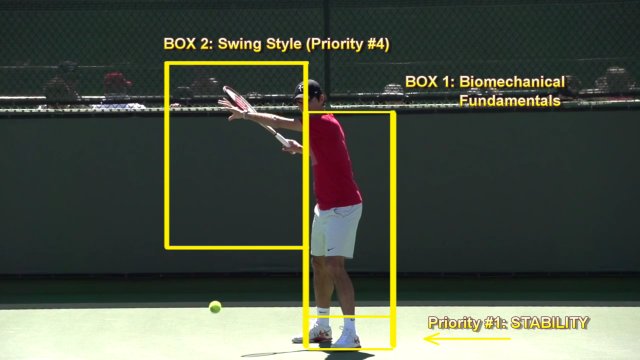
This article focuses on stability / balance which is priority #1 in terms of tennis fundamentals.
The Primary Problem Of Playing Tennis
To better understand the importance of balance/stability, we need to go one level deeper and ask ourselves: what is the actual primary problem of playing tennis (or any sport that involves balls)?
That problem is controlling the ball.
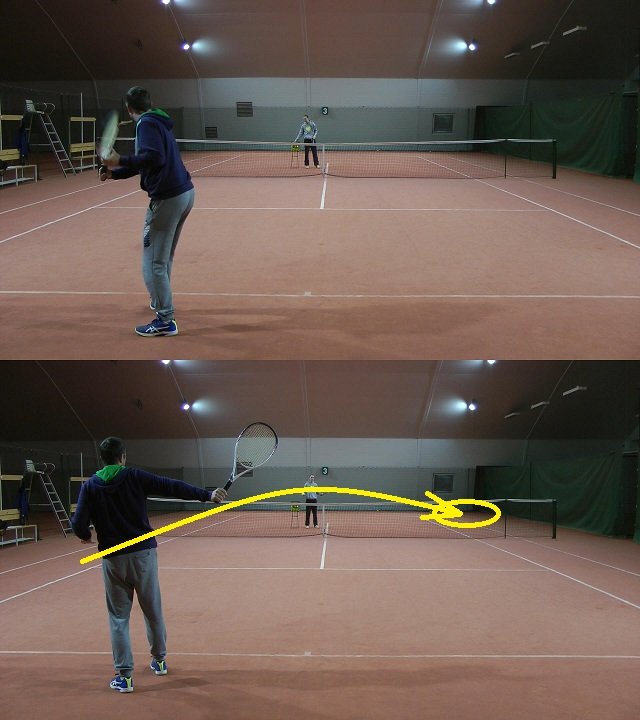
I wanted to hit cross court backhand but I couldn't control the ball and it landed wide.
We would like the ball to go in a way that we want, whether that’s into a target area on a tennis court, into a basketball hoop, into a golf hole, or past the block into the court in a volleyball spike.
In all these and other sports that involve balls, we try to make the ball go in a certain trajectory to reach a certain target.
And in none of such sports is complete control of the ball possible.
In other words, no one can play tennis with zero unforced errors, just like no one has a 100% shooting percentage in basketball or even in putting on the green in golf.
We only deal with probabilities. That’s how all sports were designed, and that’s why they are exciting to the audience.
Spectators are never 100% sure that their favorite team or player will win since they are not in complete control of the outcome.
If they were, it would cease to be a sport anymore.
Back to tennis…
Tennis is an especially difficult sport because we hit the ball with a racket, which makes it much harder to control than if you were holding the ball in your hand and throwing it.
The Common Sense Instinctive Solution To Controlling The Ball
As soon as you started to play tennis, it became painfully obvious how difficult it is to control the ball, meaning how difficult it is just to rally cooperatively with your partner while keeping the ball in play.
You were immediately faced with the “ball control” issue, and you also likely realized that the ball goes in the direction of where the racket face is pointing at the moment of contact. (We’ll ignore heavy topspin and slice shots for now since they are more advanced.)
The instinctive way to control the racket head is to stiffen the wrist and control the arm movement since the racket is obviously in your hand.
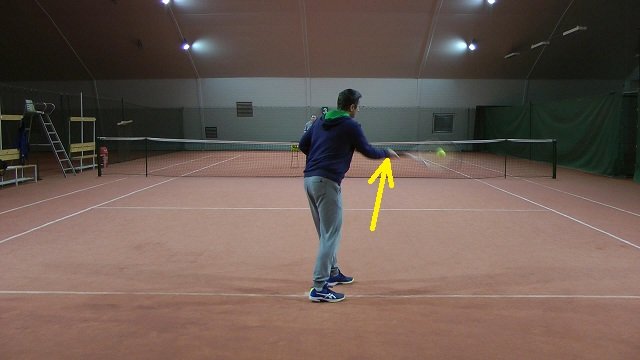
It seems we control the racket head with the wrist and that the rest of the body doesn't matter...
Logic dictates that, in order to control the ball, you need to control the racket angle. You do that by holding the racket really tight, not allowing it to flail around or wobble, and therefore you also stiffen the wrist.
The entire focus of the player then goes into the hand and the arm movements as they seem to be the key to controlling the racket angle and the trajectory of the ball.
In this process, the player “forgets” about balance, positioning and body movements/rotation because they don’t seem to matter.
So, the player is basically just trying to reach the ball, not paying attention to balance and calm and steady body movements.
The player does not realize that it is the loss of balance during the hitting phase that contributes mostly to the loss of control of the racket head and therefore loss of control of the ball.
A higher-skilled tennis player already knows and feels that they will have good racket head control (and therefore ball control) if they control their body well.
And by “controlling the body,” I mean mostly dynamic balance.
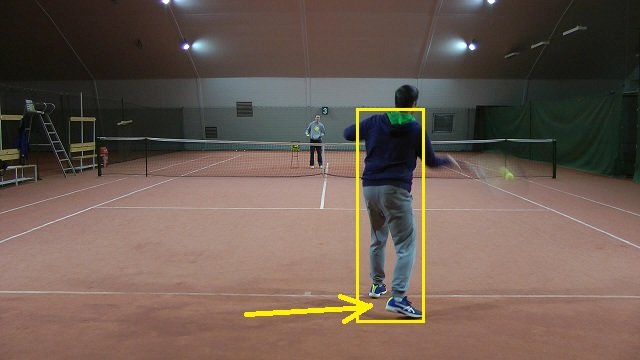
A well balanced / stable position on the forehand helps control the racket head easily.
Even though I move while hitting the ball, I am not thrown off balance through various forces, such as from my movement or because of my own swings.
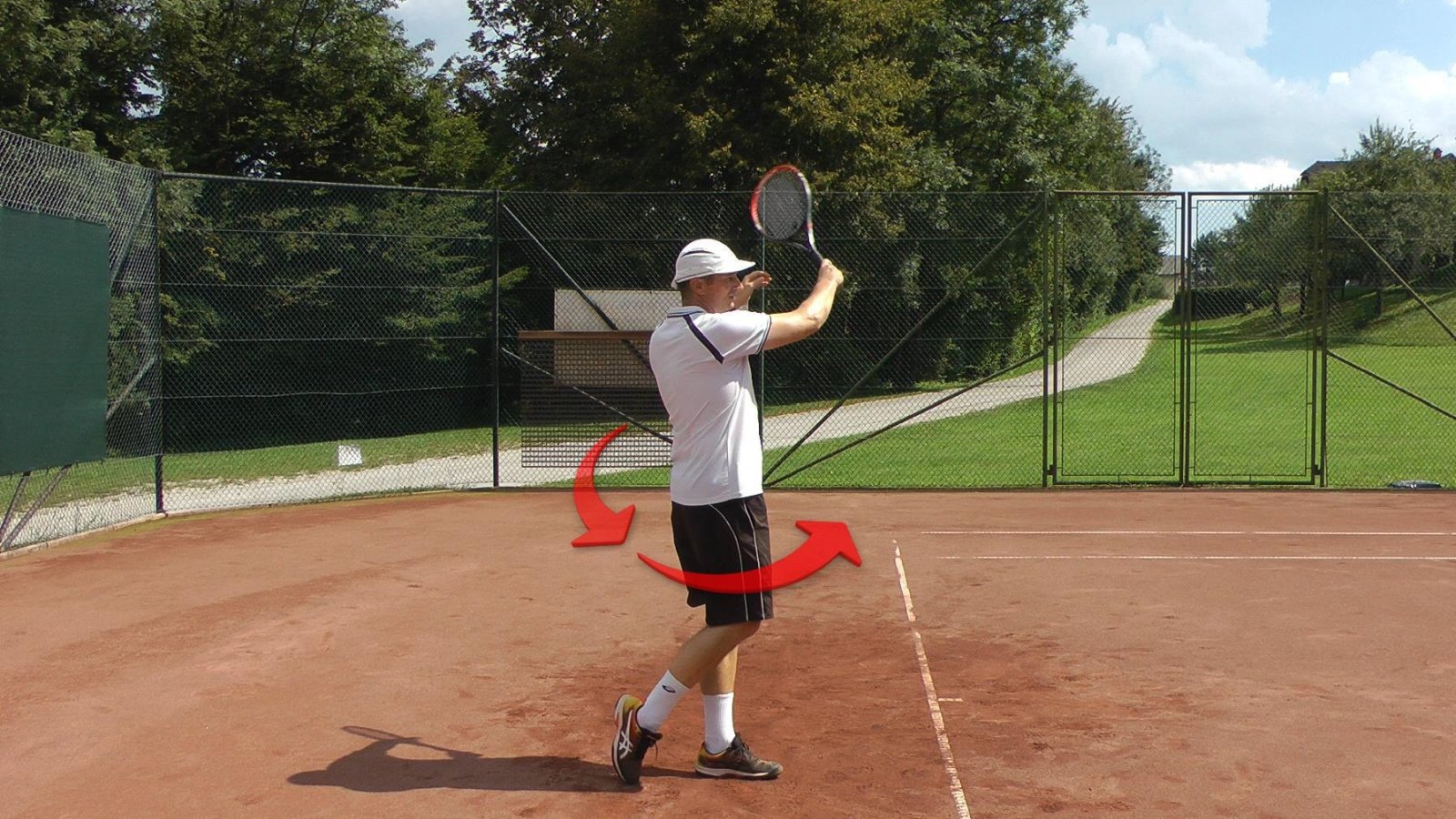
Because you never really fall down when playing tennis – which would be a really obvious message to you that you lost balance – you don’t realize that you are often losing balance somewhat and then regaining it by “catching yourself.”
It is this short loss of balance that I want to make you aware of because this loss of balance happens right when you’re hitting the ball, which makes it affect the consistency and power of your strokes.
A few examples of how this short term loss of balance looks like and how the player looks like after improving balance.
The Disadvantages Of Losing Balance
In what ways does this loss of balance negatively affect your strokes? It affects your play in at least 4 ways:
a) Unstable base
Imagine shooting at a target with a rifle while you are standing on a boat that’s rocking on sea waves.
You would surely not be accurate, but it’s not your rifle’s fault. Instead, it’s that your base/foundation is moving while you’re shooting.
In the same way, it’s not your forehand’s fault if you miss a shot. It’s more likely your loss of stable base that caused inaccurate forehands or even mistakes.
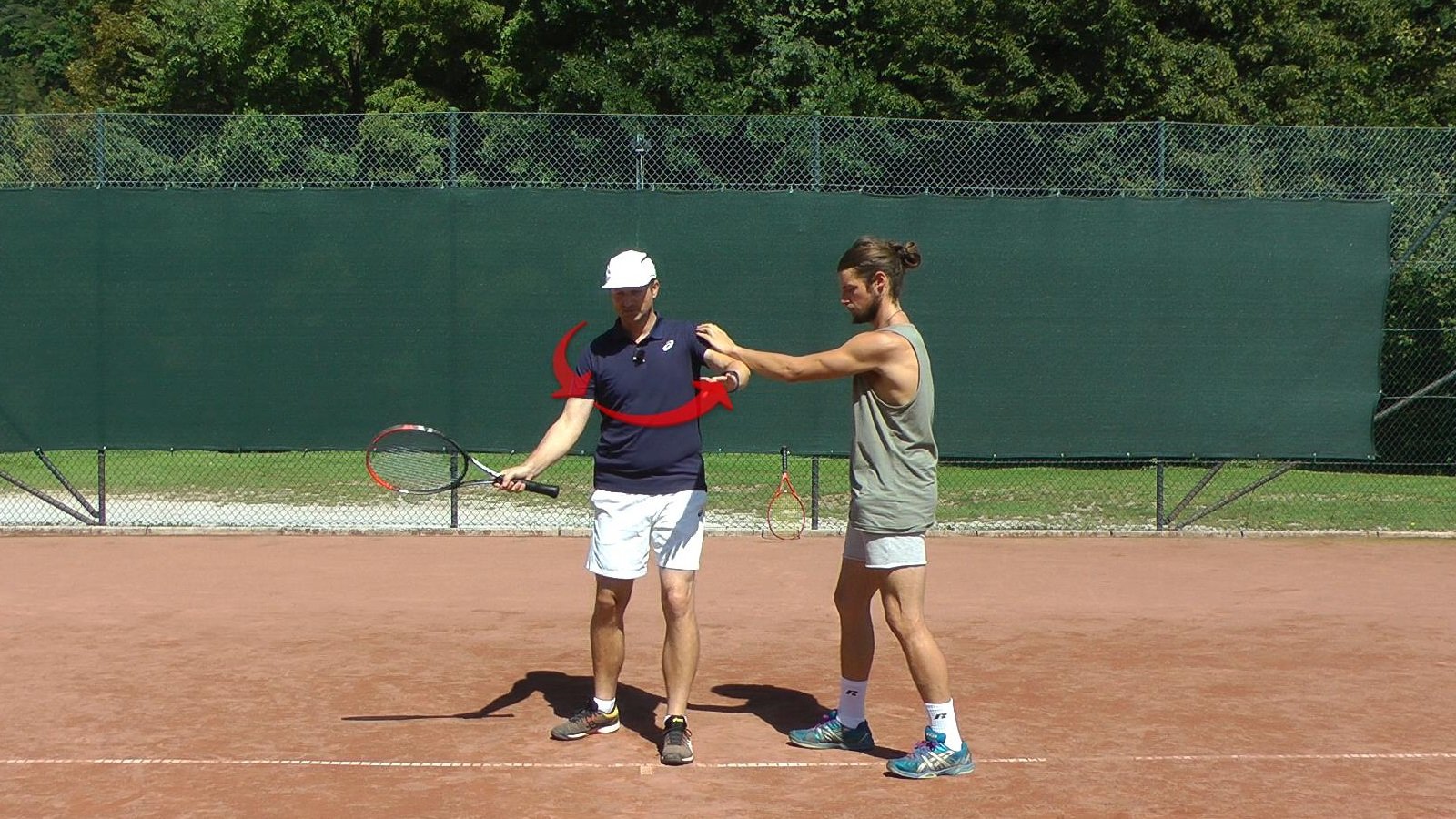
b) Inability to rotate the body fully into the ball
If you are off balance, falling off slightly to the side or backward, and you attempt to fully rotate your body (from hips to shoulders), you would fall on your back. Feel free to try; just have a soft cushion on the ground for landing.
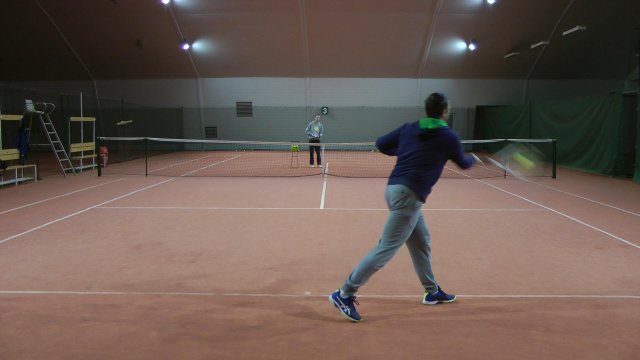
I cannot fully rotate by body into the stroke if I end up in this position at contact.
We subconsciously feel that loss of balance, and the brain will simply stop body rotation at some point before it’s too late to recover.
When we cannot fully rotate the body into the ball (which is the key on forehands and two-handed backhands), then we lose the consistency and power of the stroke.
We have no other way to hit but mostly with the arm, which results in muscling the ball and inaccurate shots.
c) Tension in the body and arm
When you’re stable and balanced, there is no real stiffness in the body and arm because stability allows you to be comfortable.
When you are comfortable, you execute strokes smoothly.
When you’re off balance, you’ll be tight in various segments of your body and you’ll execute strokes in a jerky way, which means you’re losing control of the racket head and therefore of the ball.
d) Panic or anxiety as you’re hitting the ball
When you’re losing balance, your mind goes into a short period of panic since you’re actually beginning to fall.
The brain then has to react quickly by triggering certain movements to keep you balanced.
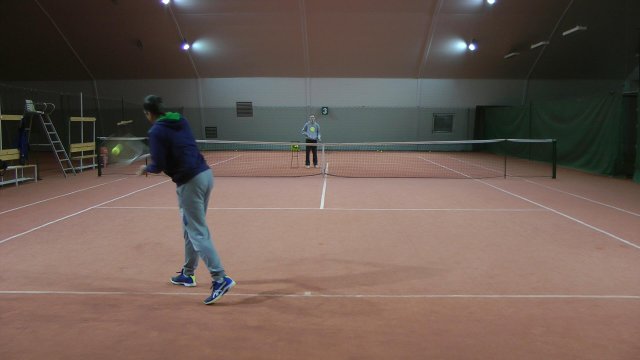
The mind certainly isn't calm and clear if you're falling while hitting.
If you’re in a temporary state of panic or anxiety exactly as you’re hitting the ball, then you’re likely losing a clear intention of the shot and not really watching the ball well.
Again, you can see how this will negatively affect your ability to control the ball and hit it well in the sweet spot with the right timing.
But, when you are well balanced and stabilized before and during the stroke, you will feel calm!
Stability of the body doesn’t in any way excite the mind, and you can calmly process the incoming ball flight and execute the stroke.
Why Aren’t You Balanced (In The First Place)?
Before we go into how to improve balance, it’s good to become aware of the causes of poor balance and stability in your game of tennis.
a) You play points before you develop fundamentals.
When you play competitive tennis before learning about the importance of balance (and actually feeling the difference!), then you’ll only be focused on reaching the ball rather than positioning well for it.
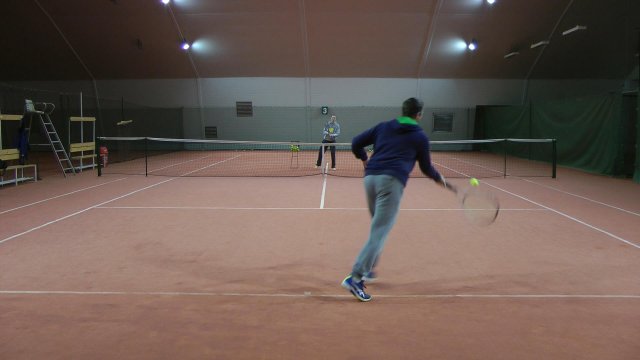
You're constantly scrambling to reach the ball in tennis point play especially doubles.
Since the tennis scoring system is very harsh in that the opponent gets a point if you make a mistake, getting the ball into play and not missing seems to be the most important part of the game.
When that’s your mindset, then all you want to do is to reach that small, fast tennis ball flying away from you.
As you play like that and repeat your movements to the ball and stroke movements to hit it, your brain keeps memorizing them. You’re creating a habit.
That hurts your game in the long term. In time, you may track the ball better, feel more time, and not feel so rushed, YET you still won’t try to balance yourself well before the stroke.
I see that every time with a new adult client that I work with. Most of them are not beginners, yet they are still losing balance and falling off even though they are now perfectly capable of balancing better.
It’s the habit that holds them back – and, of course, their lack of awareness, which I am attempting to create now with this article.
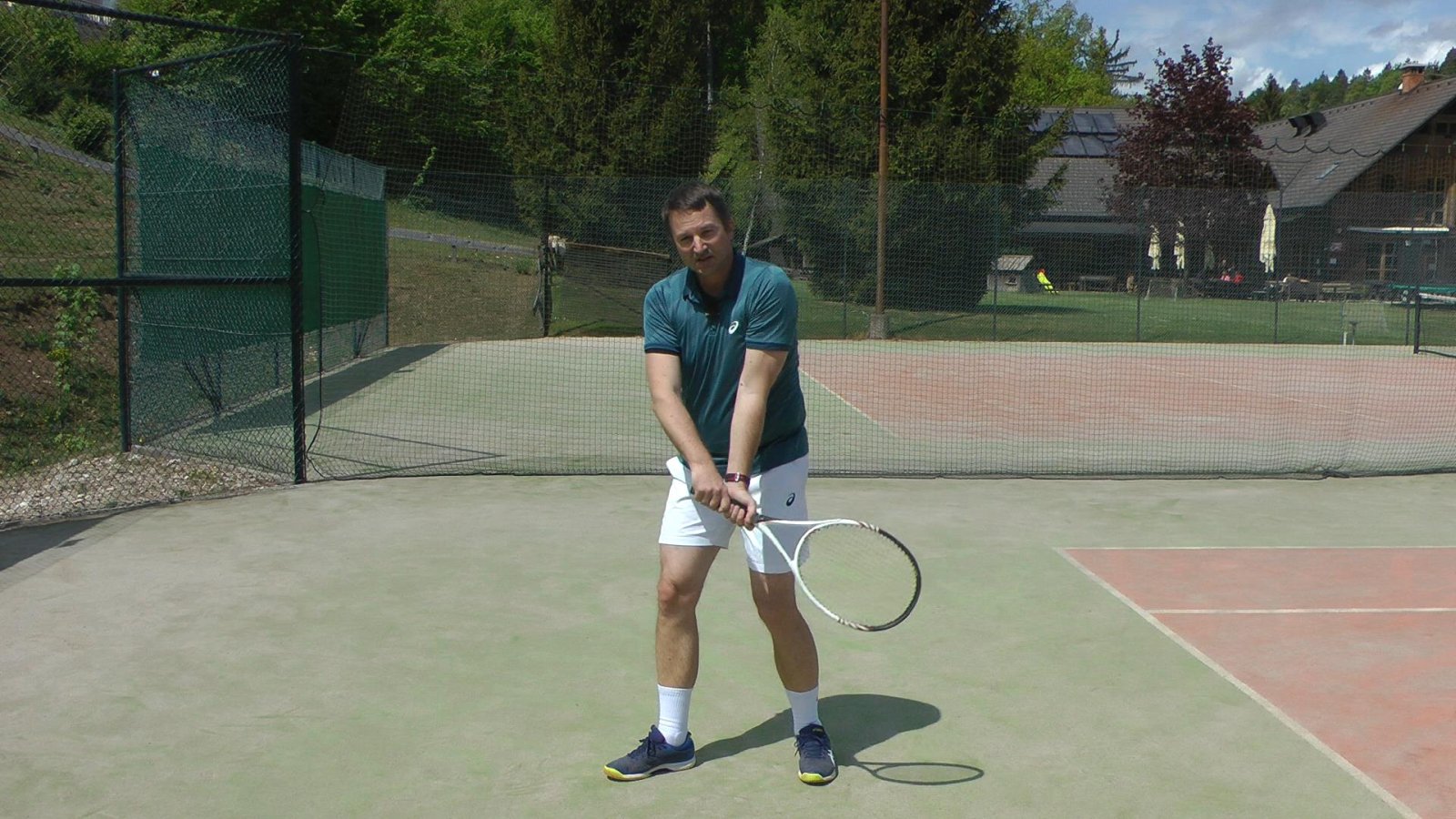
b) Your feet are too close together when hitting a stroke.
This problem is simply physical and can be improved relatively quickly with awareness and training.

Your goal is to have a wider stance than in this example as you position for a stroke.
When players move toward the ball, they end up in a position where their feet are close together.
That provides very poor base/stability once the player swings their racket because their own swing creates inertia that throws them off balance.
If the players are more advanced, they can learn to keep their feet wider relatively quickly.
A simple rule of the thumb for an adult male is to be able to place a racket between their feet on the ground. (from the handle to the top of the racket head)
That’s how wide you should stand before initiating your swing toward the ball.
For a female, the width of the stance is a bit less on average; of course, it all depends on height.
I know from experience that players feel very strange when I ask them to place their feet so far apart, so don’t immediately reject this idea when you feel somewhat uncomfortable.
Encourage yourself to play in a wider stance (whether neutral or open), and see how you’ll adjust to it and what benefits it gives you.
Beginners judge the ball poorly, and they will many times end up too close to it before the stroke and therefore end up with their feet close together.
We can’t ask a tennis beginner to position wide with their feet if the cause for feet too close together is not a simple physical task but actually a mental one – they simply cannot judge the ball well yet.
In these cases, we have to be patient for a while – despite seeing the problem of a narrow base – because a beginner simply isn’t capable of correcting it in the short term.
c) Your posture is too upright.
When you are not in an athletic position, then you’re not really well balanced when you move around the court.
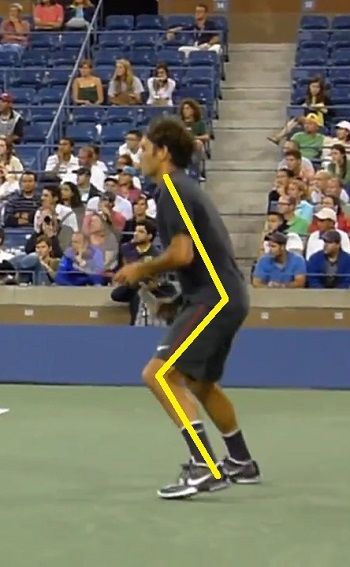
Roger Federer maintains this posture throughout the rally. Do you?
If you are too upright, you can get away with it when the ball is short since you’ll step forward.
In the process, you’ll learn forward slightly and end up in a good athletic posture (unless your knees stay completely straight).
But, when it comes to open stance strokes or moving backward, then a too-upright posture will end up with you leaning backward when hitting a stroke, and that will cause a loss of balance and loss of ball control.
In sports like basketball, soccer, and volleyball, participants maintain an athletic forward-leaning posture even if we move backward – and the same applies to tennis.
Those who have played more sports in their life will likely do that naturally correctly, and those who don’t come from sports backgrounds and have started to play tennis in their adulthood will have to be taught specifically how to move around the court and how to maintain an athletic posture even when moving backward.
Observe Roger’s posture throughout this point. It remains the same regardless of the direction of movement.
d) You would like to conserve energy
Players don’t position well or attempt to balance for the stroke because they are lazy – or, said in a nicer way, they would like to conserve energy.
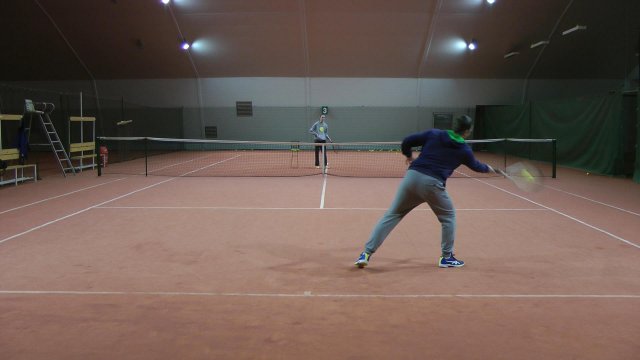
Reaching for a ball requires fewer steps and less effort than...
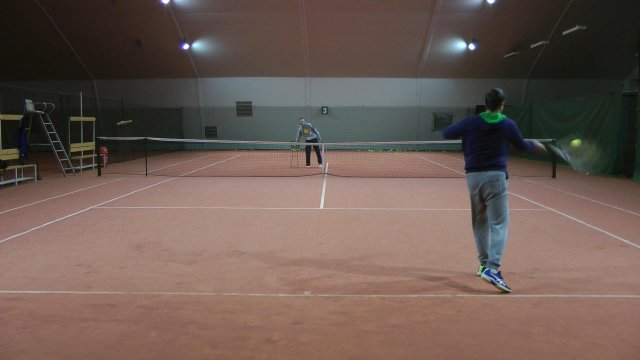
... moving to the ball quickly and positioning accurately and keeping balance.
They may simply avoid the physical discomfort that all people feel when we move more intensely or for a longer period of time.
A person who never really went through any demanding physical training – whether sports or military or anything similar – is very sensitive to physical discomfort.
As soon as they get signals from their body that the current activity is causing this discomfort, they will try to consciously or subconsciously avoid it or lessen the discomfort in some way. This attempt translates to less movement, lower intensity movement, or not really using the leg muscles fully.
A person who went through a lot of physical training in the past also feels discomfort, but they are used to it and they simply ignore it.
They know it’s a LOOOONG way from this current discomfort they feel to the discomfort caused when their body is signaling them to stop with the activity before some serious injury or complete depletion of energy reserves happens.
A person who has never trained will feel immediately that their level of discomfort is already dangerous to their health and their energy reserves – but they are very wrong.
They simply haven’t tested their limits, and they have no idea what their body can take in sports activities.
We coaches face this issue every single day when working with tennis juniors because they are always resisting hard work.
We don’t really need to call them lazy – it’s a derogatory expression and simply lowers their self-esteem and their self-confidence.
Rather, we just need to understand that there are levels of sensitivity to physical discomfort and that a junior is just at the beginning of their “desensitization” process.
In the long term, they will accept physical discomfort as part of the game and will not avoid it anymore.
This same thought process applies to adults who never trained hard, except that, in this case, there is no one to push you through such sensitivity levels. You have to do it yourself.
Again, you were likely not aware of such thing as different sensitivity levels of physical discomfort and how we need to desensitize players to them so that they care only about the highest level of performance they strive for in order to play tennis to the best of their ability.
When the player doesn’t yet feel the difference between the quality of the shots when they are balanced compared to the quality of the shots when they just reach for the ball off balance, then they see no point in positioning better because it seems like a waste of energy.
Getting to the ball early enough to position well and balance takes more effort than just to reach it!
So, until the player feels the benefit of balance and stability, they will likely just keep reaching for the ball and playing tennis off balance while blaming their strokes for mistakes rather than their feet. As a result, they will never get to the next level.
Yes, really never.
For many years, I have been observing some local tennis players that play on the courts nearby, and they have no idea that it’s their loss of balance that causes poor shots.
They still reach, lean, and lunge for balls and never figure out that this hurts their consistency and power.
I hope this article helps you become more aware of the importance of balance because, in my view, you cannot play any decent level of tennis without stabilizing really well before and during the stroke.
e) You have weak legs.
If your legs are weak, then they cannot act as springs.
When we hit a neutral stance forehand or backhand, which means we step forward into the ball, leg strength is not a key issue unless the ball is really low.
We can easily stop our forward momentum with the front leg acting as a brake without needing much leg strength.
But, when we play an open stance after we have been moving to the side (which is a very common situation in tennis), then the outside leg has three functions:
- it needs to stop you first from the sideways movement;
- it needs to bend and load to store energy;
- and it needs to extend and release that energy upward through the pelvis.
All this happens in a split second. If the leg is weak, it cannot do all those three functions.
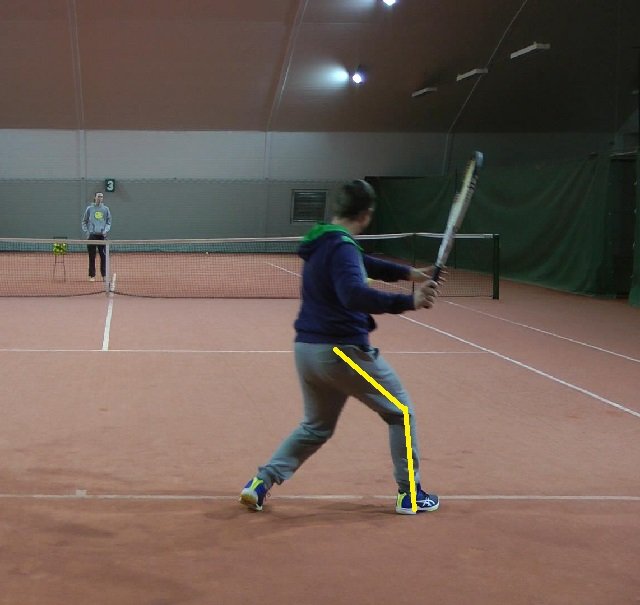
The right leg in this case has to be strong to properly function in an open stance forehand.
You will feel that in some way and have one of two reactions. You might keep the leg very stiff as you’ll know that, if you bend it, you won’t be able to extend it to push most of your body weight up.
Or you might bend the leg somewhat, but then you’ll just fall off to the side and lose balance as your leg won’t be strong enough to push you up.
The issue is not just physical but also technical/biomechanical.
When you learn to play tennis incorrectly mostly using your arm, then you neglect the lower body and it simply doesn’t function.
Many tennis players do not feel that their forehand or backhand starts from the ground up.
As a result, they don’t use the legs not necessarily because the legs are weak but because they don’t know how to engage them into the stroke. Even worse, they may not know that legs are the first link in the kinetic chain of tennis strokes.
I have been in touch for a while with Nathan Martin, the founder of tennisfitness.com and he allowed me to share this short clip of simple leg strength exercises for tennis players.
Just follow the number of sets and repetitions or simply adjust at first to the current level you’re at and go from there. There are also a few core stability and balance exercises that perfectly fit the topic of this article.
Nathan also offers quite a few courses for different levels of players including the “Over 40 – Strength, Movement and Mobility” program. (Disclaimer: I receive a small commission if you purchase the tennis fitness course through the above link.)
So, hopefully, this first article of balance in tennis gives you more awareness of why balance is so important and why you may have not paid enough attention to it.
In the second part, we’ll look at some simple ways to work on improving balance and stability for better control and more power in your tennis groundstrokes.
Hi Tomaz
I realize now that I’m prioritizing reaching the ball over balance. I’m guilty on all counts: playing for points too early and playing doubles. I’m developing bad balance habits this way. Look forward to part II of the video.
Guy Vidal
Los Angeles.
Thanks for the feedback, Guy.
Once you start to note the difference in quality of shots when you’re balanced / stable vs out of balance, it will encourage you to position better.
When we play points, our mind is often times stressed and we don’t really register what we feel. Even if the body / mind is signaling a loss of balance, you don’t “hear” that feedback because the mind’s focus is on observing how the ball is flying, where your opponent is moving, what he is up to now, what tactics to play next and so on.
That’s why point play is bad for improving tennis fundamentals, one doesn’t register any feedback from the body.
Only in cooperative rallies when you have nothing to worry about and can focus on yourself will you “hear” what your mind / body is signaling to you and can then adjust and correct.
I practice daily and play 2 times a week. I’m going to focus on only one thing for the next several weeks: balance. I’ll report to you after
Great video! Another reason why balance is important: If I am off balance, I need more time to recover after the shot. The result is that I am out of position and/or unable to start moving to the next shot.
Yes, good point.
thank a lot ….very useful video
Another fantastic video.
The point about players’ focus being on their hand and arm hits home for me. Without realizing it, I’ve been thinking about my tennis shots as primarily located in the hand and arm for decades. It takes a lot of cognitive effort to transfer my awareness to my stability and balance.
I also like that you keep the errors (and the slip) in. As you say, there are no guarantees in tennis. It seems like balance is a necessary, but insufficient, condition for good shots.
As a test for this I recorded myself hitting and I see that my balance is worst on my weakest shots: serve and forehand. No coincidence!
Looking forward to part 2. I very much want to work on my balance and stability.
Hi Tomas , lesson on balance by far the best and most important I had seen so far. Lack of balance due to lousy positioning (judgement, late movement of feet/body and so on) make for 80 % of missing a stroke.
Great Job! And now how to fix it? Not only hours on court , but working the right way when You are there (and before You step out.
GH
Thanks, Gunter!
It’s not so difficult to fix, it’s mostly about awareness and repetition. We have a very good “system” for balancing ourselves since we actually rarely fall.
We just need to listen to this system / feedback and detect when it signals to us small losses of balance. As we are more aware of that, the system self-corrects.
For higher / pro level tennis you would need to do specific drills, but for regular play, I think awareness and feeling good balance when it happens is going to help a lot to improve balance long term.
How I would have liked to have been taught tennis with these fundamentals 40 years ago! We learned it intuitively and with adjustments but that did not have a biomechanical foundation.
Thank you. Greetings.
Fantastic information ! Wish I had learned about this before learning technique. Can’t wait to see part 2
Tremendous. You have done a great job of articulating the problem. I sorta of new about the importance of balance and stability but could not put it into words You also did a great job of explaining what holds us back from achieving balance and stability Thanks very much for sharing. I look forward to the next videos
Is quite some time I understood balance is one of key components for tennis… And I am working hard to improve balance with some off-court exercises because I discovered myself weak on balance over one feet on my left side… I think a great school for balance is ski…. You need over the top balance in that sport… And I think that helped a lot both Andreas Seppi and the new rising star Jannik Sinner come exactly from that sport, where both excelled…. (I think Sinner has won itałian championships under 12)…
Thanks for sharing, Roberto. Yes, as it turns out, almost everyone has a “better” foot and a “worse” foot when it comes to balance.
In many cases, that determines on which side they hit better, forehand or backhand…
genius as always Tomaz
if only we could all find a local teacher as good as you…marcus
Super!
really appreciate the “desensitization” process part.
So true.
thanks Tomaz, greetings from Triest
Another internet pro talks about his training with Tom Stow, who emphasized balance before strokes. Yet, after all these years, this is the first instruction I’ve seen about HOW TO DO THAT.
Gracias, all is very interesting and usefull
Hey Tomaz,
first of all I’d like to thank you for your very instructive courses – they have really helped me a lot! One thing I was somewhat unsure about is whether to turn the hips or shoulders into the ball when hitting a stroke – I know of course that turning one will invariably also turn the other, but mentally, should I focus on turning my hips into the ball (and letting the shoulders follow), or turning the shoulders into the ball (and letting hips follow). I’m guessing this applies to both BH and FH.
Many thanks !
Simon
Hi Simon,
When we’re finally hitting the ball we feel the shoulders. But the usual problem are the hips as they often stay behind.
So I usually have to stimulate the hips for players with various exercises for them to engage them.
So for that period of training they should feel the hips.
But once hips sync with the body, you shouldn’t really feel hips as separate but as the whole body turning into the ball.
You can feel the shoulders as quite firm and stable at contact as the rotation of shoulders now drives the arm.
Hope that answers your question.
Hi Tomaz,
it certainly did! My thanks for your quick reply, and for your work in general. I’m sure it has helped many others as it has already helped me 🙂
Kind regards