
A tennis forehand backswing is often executed incorrectly, especially at the recreational level but also at the junior level.
The most common mistake is that players swing too much with the arm, not realizing that a forehand backswing is actually quite a short arm movement.
The player could have been taught an incorrect forehand backswing technique, but it’s also possible that they misinterpreted what they saw when they were observing the forehand technique of other tennis players.
Today we’ll tackle the second option, namely the misinterpretation of the forehand backswing and how your mind can trick you when you’re observing tennis strokes.
What Causes Misinterpretation Of Tennis Strokes?
If you’ve watched the video above, you’ve seen how quickly the mind can be tricked when you had to describe the position of my racket in relation to my body.
While at first glance, it seemed that the racket was behind me, you then realized that it was actually just on the side of my body.
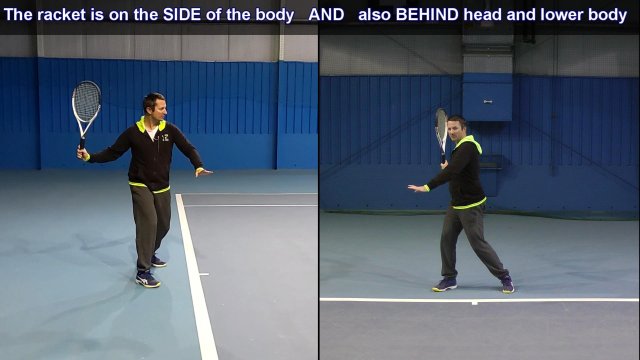
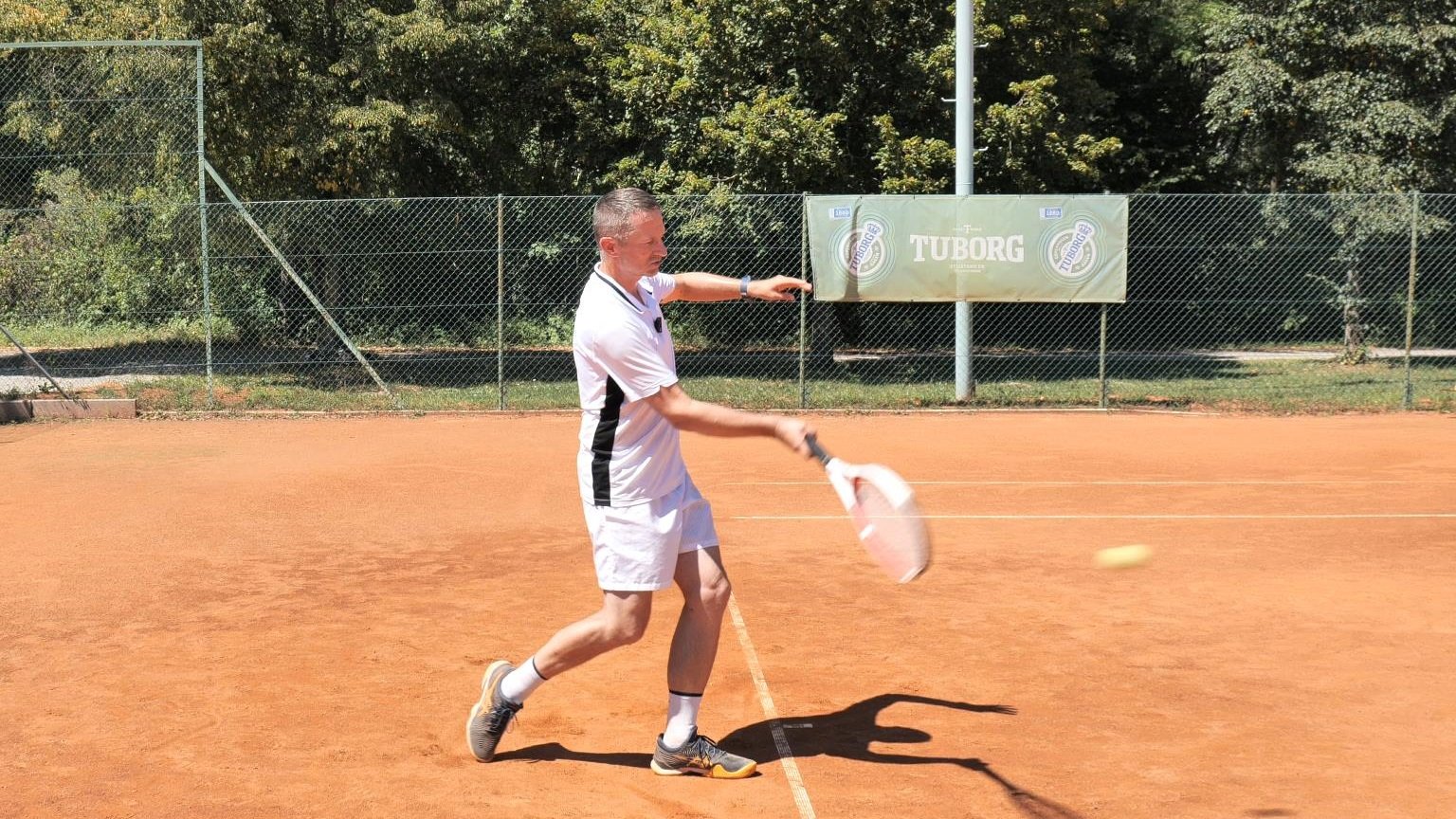
The reason for that misinterpretation is that some parts of my body turned but other parts didn’t as I prepared for the forehand stroke.
My trunk rotated by 90 degrees, but my head didn’t turn at all since I was still looking forward.
When viewing this movement, the mind gets confused by trying to define what is “behind” since the racket was behind my head but not behind my body.
When I stayed in the open stance, then even my feet would not have moved and it would really seem like the racket was behind me.
We always need to define the racket’s position in space in relation to the trunk rather than other body parts.
The Two Movements Of The Forehand Preparation
If you observe me preparing for the forehand, first you’ll notice that my forehand preparation/backswing looks just fine.
I am not doing any different movements than usual just to prove my point.
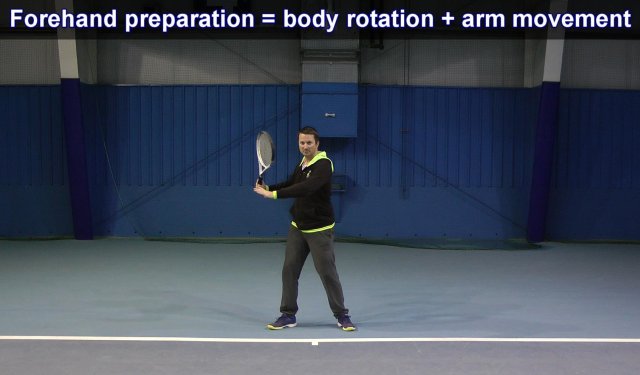
But, if you observe carefully, you can see that a forehand backswing is a combination of two movements that happen simultaneously: body rotation and arm movement.
As we prepare for the forehand stroke, we are simultaneously executing a certain movement with the arm and we’re turning our trunk to the side, rotating it around 90 degrees.
These two movements cause the racket to move quite a lot in space, meaning from ready position to the backswing position.
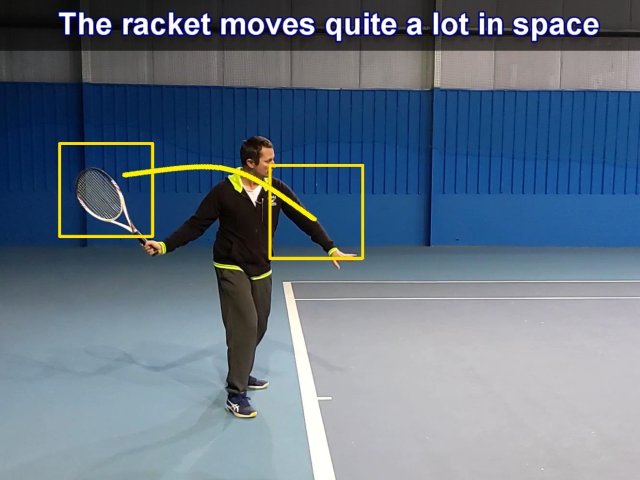
Because players see this big movement of the racket in space, which is held in the hand, their mind can incorrectly picture that this movement was executed mostly with the arm.
When they execute a big arm swing with body rotation, they end up swinging too much. That causes most balls to be hit too late, which results in a lack of power and control.
To reveal the illusion of the arm backswing, I am going to break down the body rotation and arm movements so that they don’t happen simultaneously but apart.
If I now only execute the arm movement of the forehand preparation and do not turn my body, I will end up just lifting my arm with a short movement where the hand is around the same height as the shoulder.
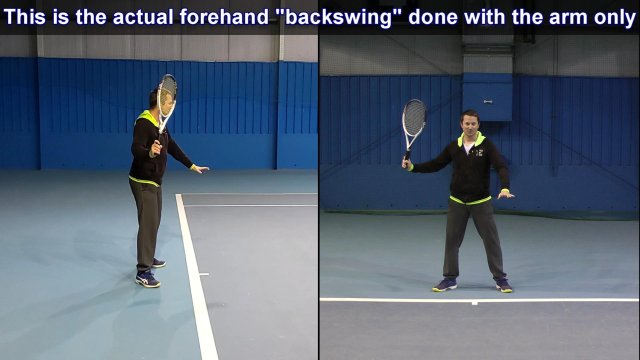
That’s all we do with the arm in a forehand backswing!
It may seem like a strangely short movement to you, but if I now add the body rotation separately, you can see that the arm and the racket end up in the correct backswing position.
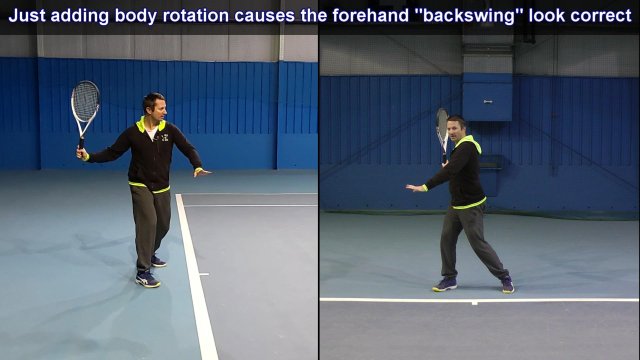
In reality, most of the forehand backswing is done through body rotation, and the arm just executes a short lift of the racket.
While the arm does swing a bit more backward as we initiate the forward swing, it’s not really a voluntary movement that we “do”. It simply happens because the racket lags behind the forward body rotation.
Revealing The Short Arm Movement Of The Forehand Preparation
It may be hard to accept that the arm movement of the forehand preparation is so short, so we’ll look at a real-life example of my buddy Urban’s forehand and analyze it in detail.
What we want to see is how much the arm moves in relation to the body in order to isolate only the arm movement.
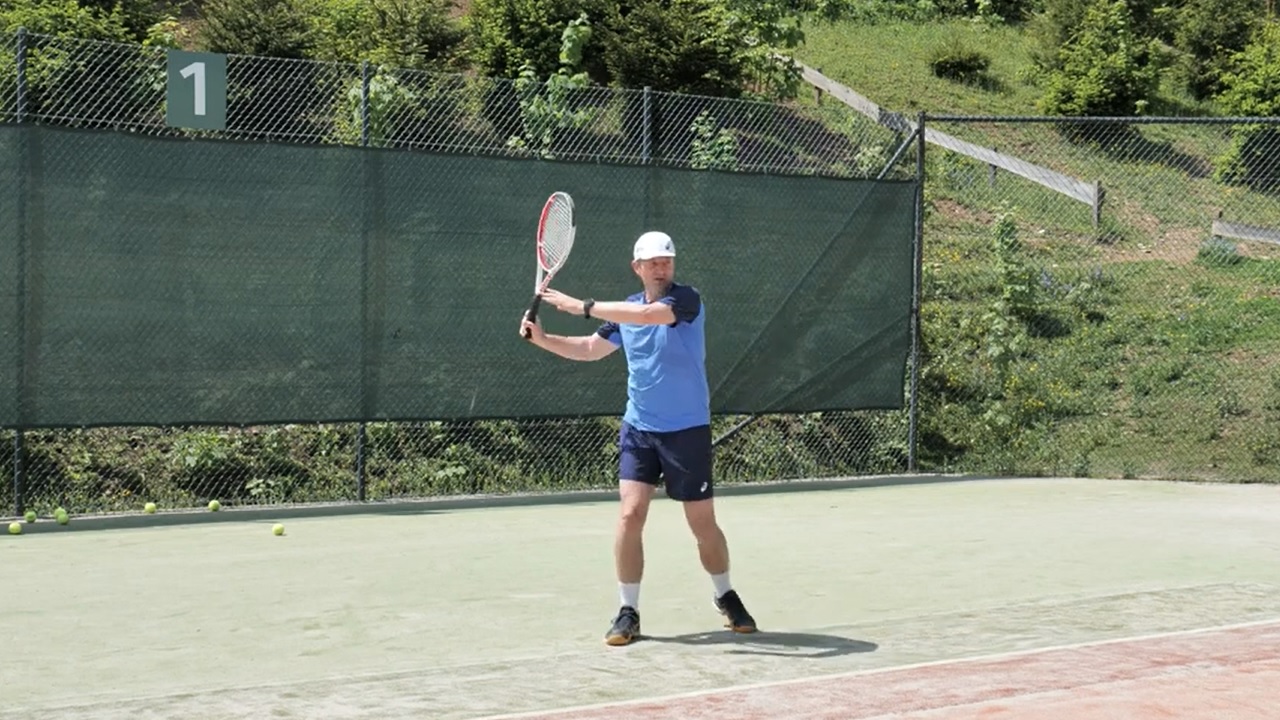
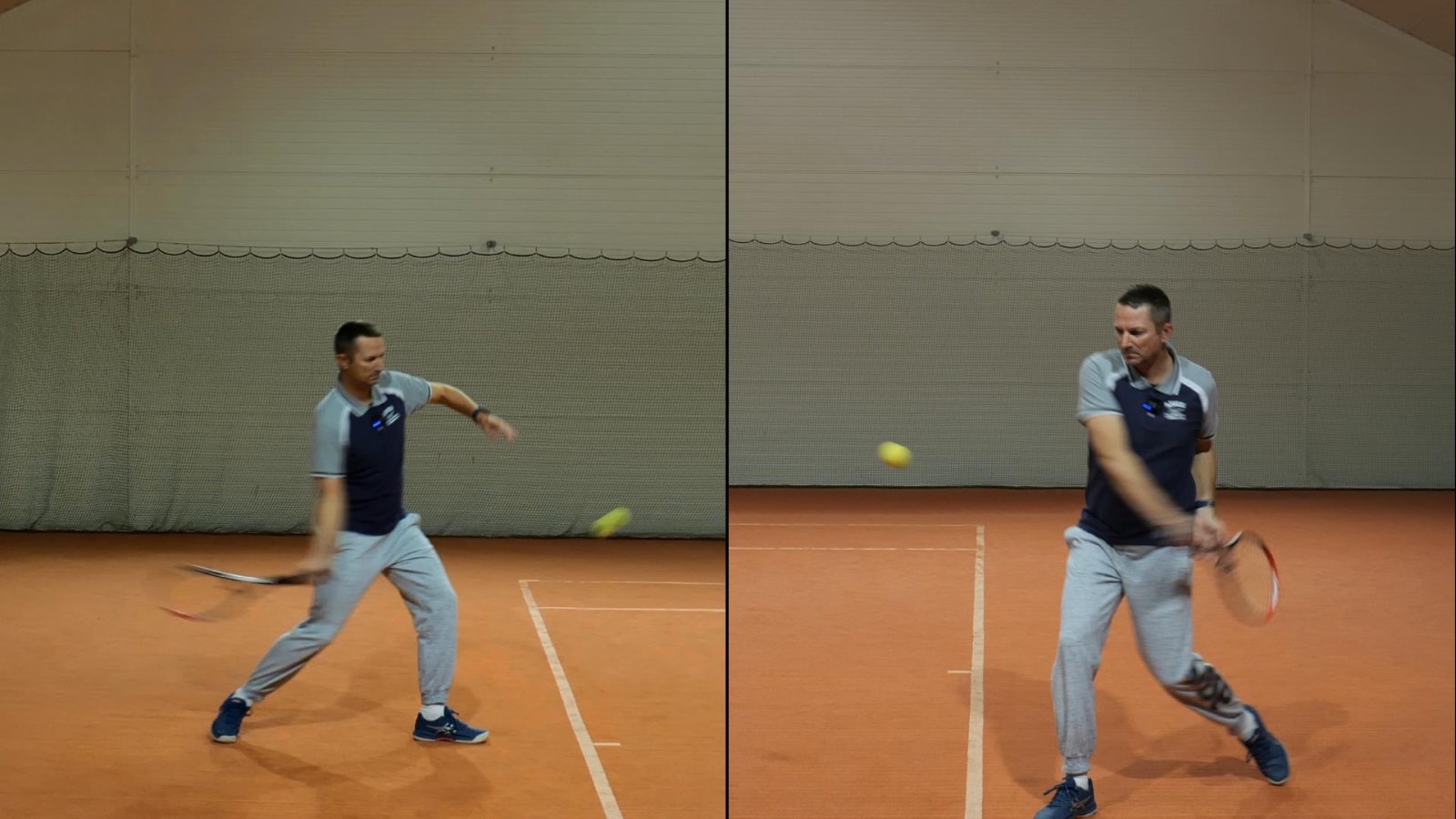
We’ll take two images of Urban’s forehand – one in ready position from the front view and one as he is prepared to hit a forehand from the side view.
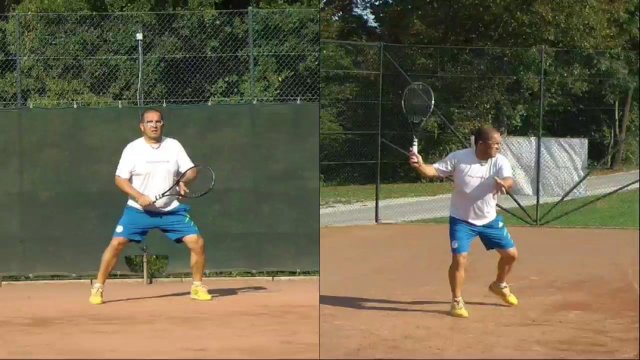
You can see that, in both cases, the body/trunk is facing the camera.
If I crop the images to remove all the distracting body parts like the head and the legs, leaving only the trunk and the arm, you can already see how short the arm’s movement is in relation to the body.
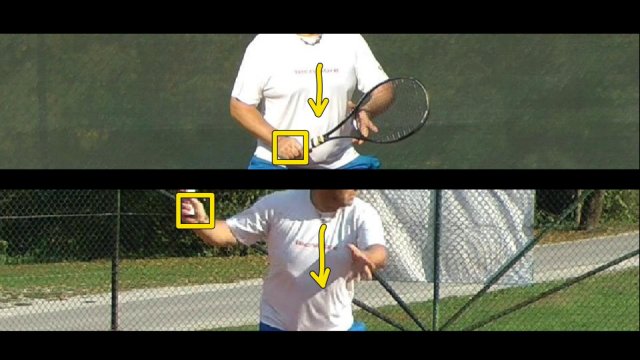
Because the body orientation is the same we can isolate the arm movement.
If I now overlay the images so that the body in both images aligns perfectly, you can clearly see the arm’s movement in relation to the body.
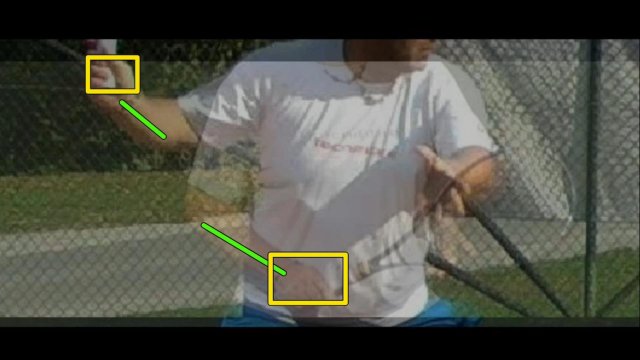
The arm only lifts the racket upward in a relatively short move in relation to the body.
The illusion of the backward arm movement happens because of the body rotation. The arm and the body are moving simultaneously.
The mind is tricked because it doesn’t observe the arm’s movement in relation to the body. Instead, the mind observes the arm’s movement in space (which is quite significant) and subconsciously assumes that it’s the arm that caused such a big movement.
This creates a mental image (mental map) of the body movements necessary to approximately copy the movement observed. As you now realize, this mental image is incorrect, resulting in an incorrect forehand backswing technique.
To better see the difference of the movement of the arm compared to the movement of the racket in space take a look at the previously published Roger Federer’s forehand video article where I have digitally removed the racket from the image to reveal the actual arm movements in space.
Summary
I invite you to execute some shadow swings of the forehand preparation at home in front of the mirror or simply record yourself and try to observe the length of the arm movement in relation to the body.
Try to separate the arm movement and the body turning so that you can become aware of how much each of these two movements contributes to the movement of the racket in space from the initial ready position to the preparation position.
As you can see, there is no backswing on the forehand nor on any other stroke, except a type of serve where the player actually swings backward to initiate the serve.
Stay tuned for more videos on the topic of tennis illusions/misinterpretations as I will soon follow up with the backhand backswing illusion and then a series of videos covering serve, volley, and slice illusions.

Very interesting and helpful info. I can see a benefit of this kind of “backswing” because it simplifies the stroke. I can also see this helping deal with an opponent who hits very fast groundstrokes. You get the racket prepared by taking moving the racket arm 90 degrees which puts the racket in the path of the oncoming shot, even if you didn’t get to make the unit turn.
You can actually turn but only the upper body and just shorten the backswing. No matter how fast the ball comes, it should give you time to hit the ball out in front. I often warm up with minimal backswing in the short court and focus only on contact in front. This helps me to simply adjust depending on how much time I have.
Yes, Arturo, that’s how the mini tennis warm should be played.
https://www.staging.feeltennis.net/mini-tennis-technique/
Thanks for the link Tomaz I will try mini tennis on out tennis wall instead of trying to punch a hole through it! I appreciate all you do, love to meet you if you ever come to Oz.
Every normal forehand has this backswing, Henry. This is not a shortened backswing that you would use for fast balls.
I am showing you that it’s a normal full size “backswing”, it’s just that you may have not realized how short the arm movement is.
As always very good and accurate analyses.Tomaz thank you very much for useful and helpful article.
Glad you liked it, Borut!
Hi Tomaz, As you might remember I use the forehand that you taught Kamille often. Basically, have her use her off hand to grip the wrist of her hitting hand. This does not allow her to move her arm back much. I also remember gripping the mouth of racket as another trick you use. The forehand is such an illusion and I often see very long backswings. It works at lower levels but once the balls come too fast then it becomes very difficult. Thanks for the great article!
Very important and clear clarification. The term backswing is indeed very misleading. Hope you can show similar explanations on serving movements about the racket arm. Thanks.
Any fundamental difference on the backhand side? You’re incredible!
The same idea on the backhand, stay tuned, the video is coming up next week.
I am guilty of using too much arm, and I often hit the ball late, and too close to my body, no matter how slowly the ball is coming. Great video as always Tomaz, I think you give the best explanations as an online coach, and demistify tennis in an easy to understand and follow way. Much appreciated.
Thanks for the wonderful feedback, Craig!
Thank you for sharing. Well anatomically explained. The range of motion of that swinging forehand in that body rotational limitations can be completed by other joints. You are well versed and knowledgeable also with kinematic chains. More Power to you Master Yoda! You the man!
Thanks, bro, learned a lot of good ideas from you!
Thanks Tomaz. I feel that a few of your recent videos on the forehand (like the one on the non-dominant arm) have really helped me, and I’m sure this is going to continue the process, it really simplifies it. I’ve definitely been guilty of trying to do too much of a backswing. This feels great in my sitting room and I’m looking forward to taking it into practice and games.
Tomas, you are a very clever person. I enjoy your posts. Thanks
So spot on. You are the best. Federer, Nadal, Tsitsipas, Del Potro, I can so see their forehands using this principle you shared.
Very interesting also to watch the fast-slow-fast movement of the shoulders. I think another illusion I have fallen for in the past is that of the shoulders rotating further – thinking that the right shoulder going further forward is needed for more “hitting through”. It is clear from the slow-mo that Fed’s shoulder is actually just pulled further forward (by his rather heavy racket) in the follow through as the racket goes behind his body. Less “hitting through”, more “throwing through”.
Very clever !!!