In part 1 of the tennis illusion series, we looked at the forehand backswing illusion. In this second part, we examine the one-handed backswing illusion.
If you haven’t seen part 1, I recommend you read/watch the video article first because it will give you some theoretical background as to why these illusions or visual misinterpretations happen in the first place.
The two-handed backhand backswing illusion continues below in part 2 of this article.
The Two Movements Of The Backhand Preparation
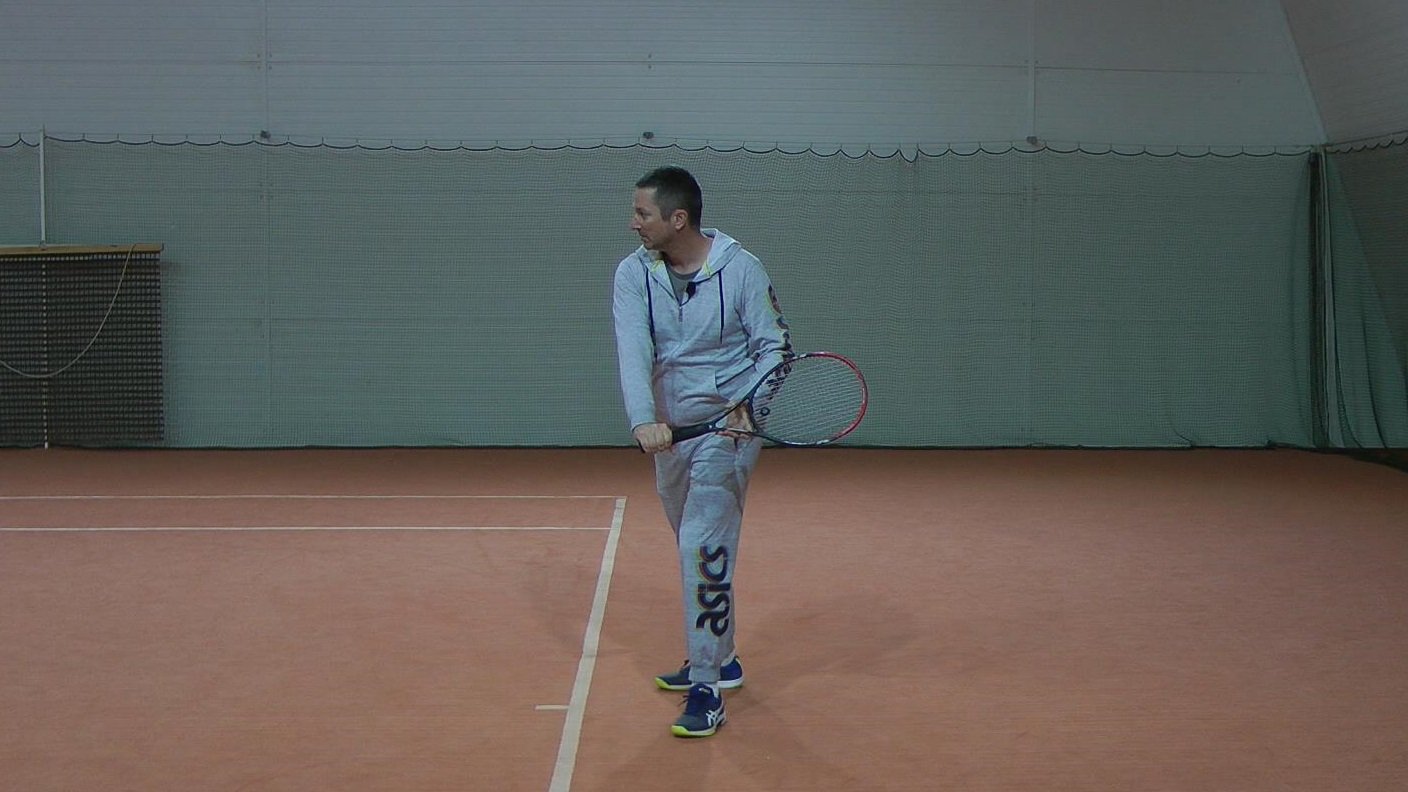
As I am preparing for the backhand starting from the ready position, two movements happen at the same time: I rotate my upper body around 90 degrees, and my hitting arm moves up to prepare the racket for the downswing.
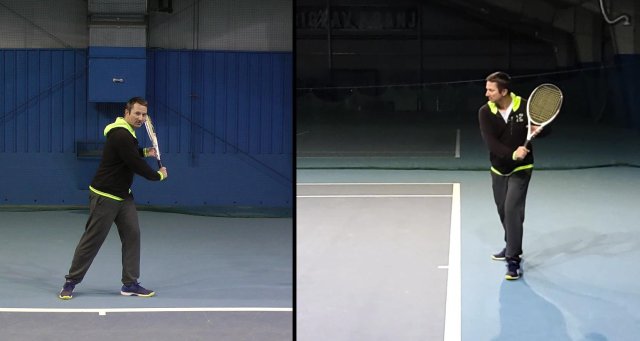
What seems like a one move are actually two happening at the same time...
While I am preparing for the backhand, the racket travels in space quite a lot from the initial ready position to the preparation position.
Because we hold the racket in the arm and the racket moves 4-5 feet in space, it first appears we move the racket backwards with the arm.
The second reason why for the illusion of backswing is that, when we initially turn the upper body to the side, our head and our feet have not yet turned to the side.
So, the lower body is facing forward, the upper body has turned 90 degrees, and the head is still facing forward.
That makes it tricky for the mind to determine what is actually “behind” when we try to copy a backhand backswing after observing a player we’re visually learning from.
If we don’t carefully observe all the body segments and the relation of the racket to each of them, then it appears the racket goes “behind” the player.
If you perceive that the racket goes behind, then you will attempt to move your arm as far back as you can in order to match the movement of your body to what you see.
That’s a mistake. If you move your arm backwards and add body rotation, you will end up with a backswing that’s too big. That will cause you to hit late and have trouble with difficult balls.
Revealing The Arm Movement
If I now isolate the arm movement without adding the body rotation, you will realize that it’s just a short lift from the ready position.
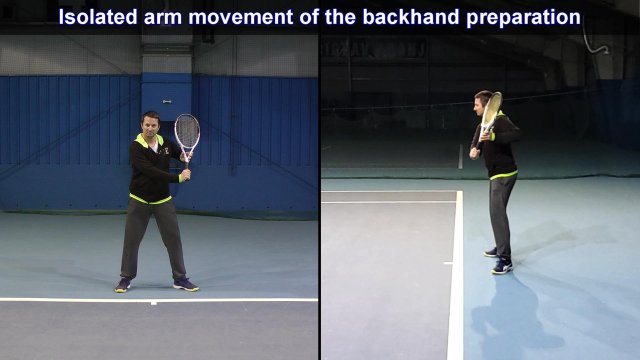
Does this look like a "backswing" to you? 😉
We could also call it a short pull since the non-dominant arm is pulling the racket up. It is stretching mostly the shoulder muscles of the dominant arm, which are now ready to be released.
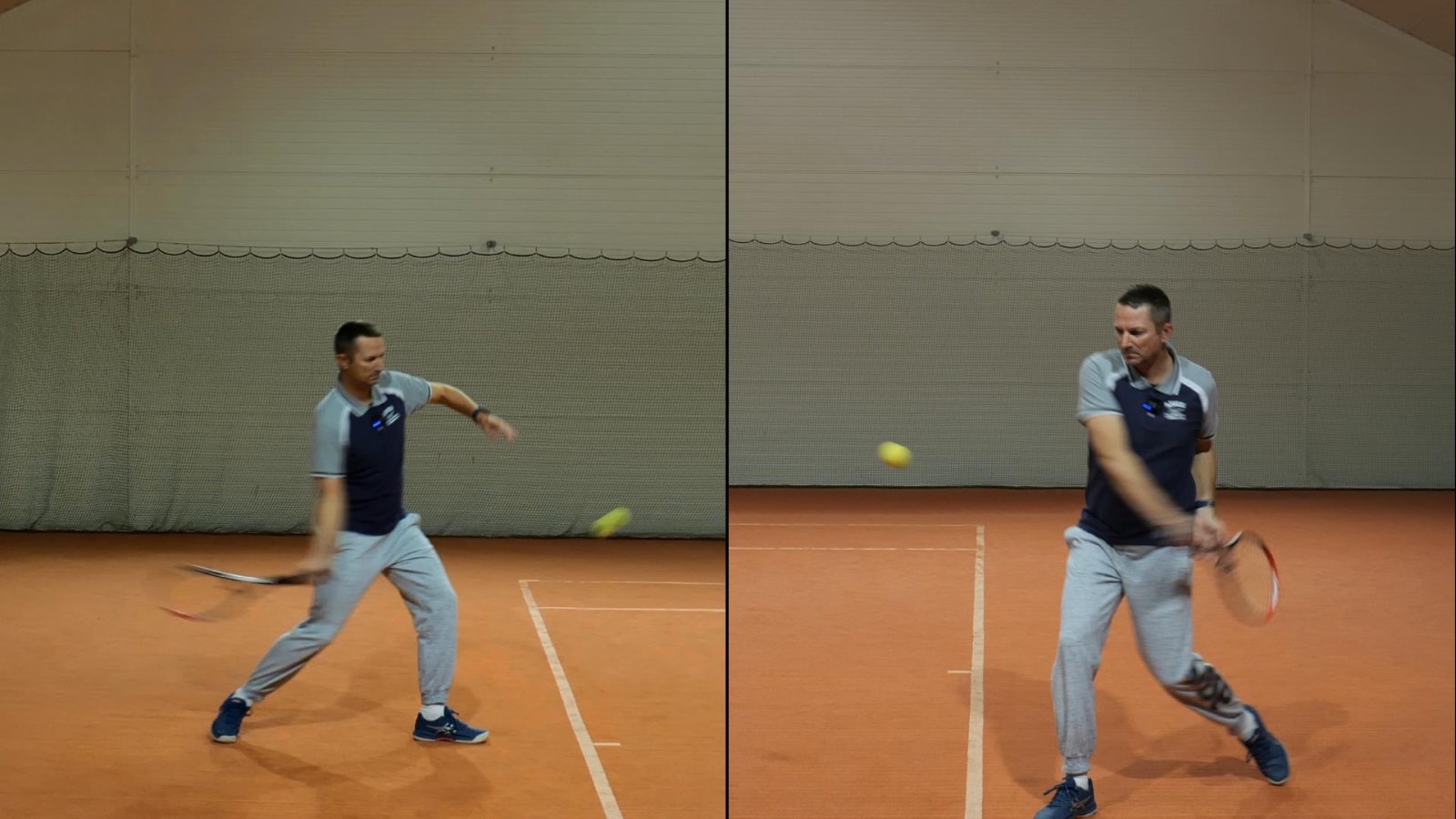
Let’s look at a real-life example so that you see that the short arm movement also happens in real play.
What we’re interested in seeing is how much the arm moves in relation to the body.
We can take two images, one in the ready position and one in the backswing phase, and look at the arm movement in relation to the body.
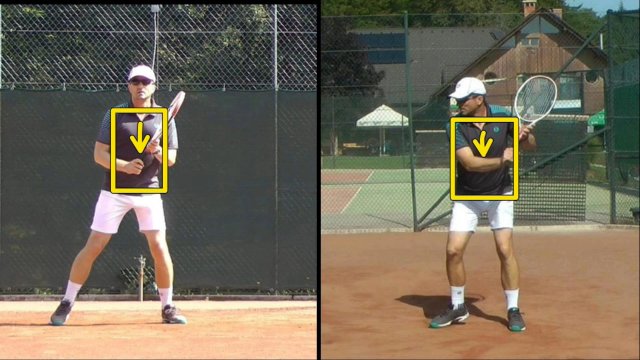
Because the body is facing the viewer in both images we can isolate the arm movement.
We can crop away the head and the lower body so that they don’t distract our eyes, and we are now looking at the body in both cases facing the viewer with the arm movement clearly visible.
If I overlay the images so that the body aligns well, we can clearly see how little the arm moved from the ready position to the so-called backswing.
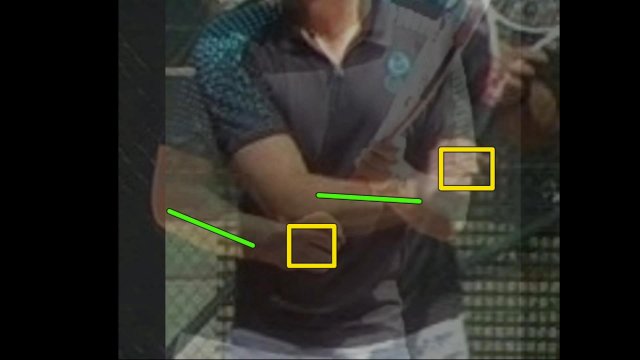
This is how much the forearm and the hand moved from ready position to the "backswing".
It’s just a short lift helped by the non-dominant arm.
The hitting arm will, of course, swing further back when the body starts uncoiling, but that’s not something we really “do.” It’s just something that happens.
That’s exactly why I am sharing these illusion videos. Recreational tennis players want to imitate the pros that they observe on TV or online, so they attempt to “do” everything that they see.
They do not realize or understand which parts of the whole movement we “do” and which parts just happen because of relaxation, momentum, or some other cause.
When we prepare for the one-handed backhand, the only thing we do with the arm is a short lift.
Then we start LETTING the arm drop as we are uncoiling the body forward.
The arm is then firm and extended throughout the stroke, and the only muscles that really move the arm are around the shoulder.
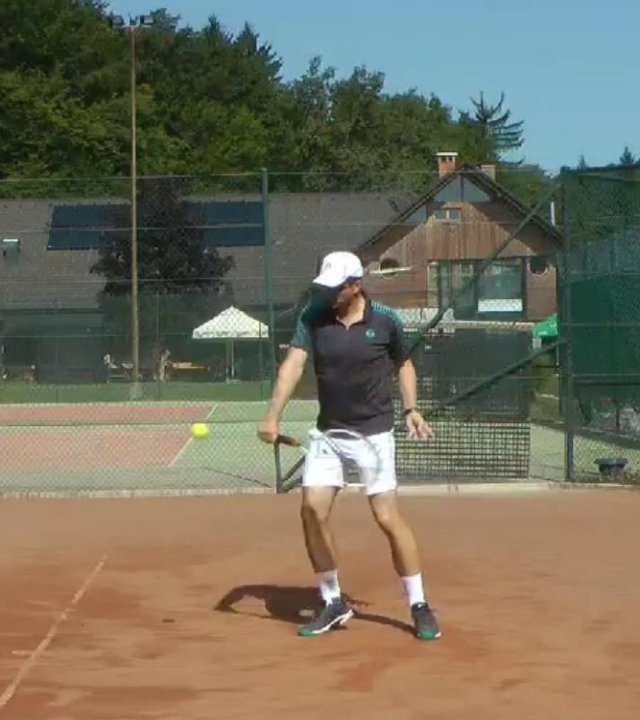
The arm is firm and extended throughout the stroke while the wrist remains stable.
The rest of the muscles in the arm just hold the arm firm.
We allow the wrist to move a bit, but it’s not loose at all and we don’t flick the wrist through contact.
The wrist is not stiff, but it is firm and stable since it needs to stabilize the racket at contact.
I have already shared the one-handed backhand backswing and other illusions when I analyzed Grigor Dimitrov’s backhand with the racket digitally removed, and I invite you to check it out.
The Two-Handed Backhand Backswing Illusion
Since you’re now familiar with the whole idea of visual misinterpretations and why they happen, we’ll skip the theoretical explanations for the two-handed backhand and just look at the images.
Because we hold the racket with both hands when playing a two-handed backhand, we have less range to move our arms around. As a result, the arm movement (without the body rotation) is usually even shorter than in the case of the one-handed backhand.
The cause for the illusion is again seeing the racket move quite a lot in space from the ready position to the backswing position, which players misinterpret as being executed with the arms.
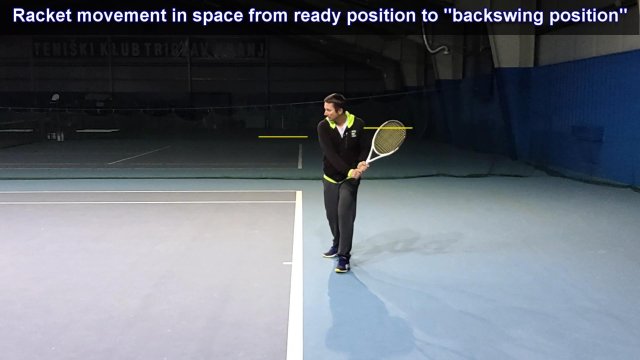
This whole move of the racket in space was done through body rotation.
As you have learned by now, most of that racket movement in space is caused by body rotation.
To show how much the arms actually move, I will move my arms but not rotate my body.
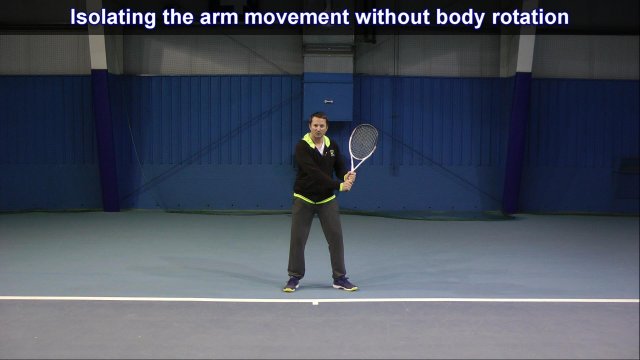
This short movement is all we do with the arms.
As you can see, I barely lift the racket a bit. In fact, my arms do not go backward at all.
They go slightly forward from the ready position.
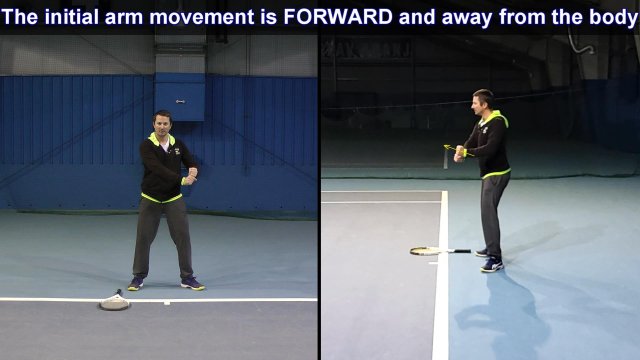
The arms actually go slightly forward as we begin the preparation.
You can see that, if I add body rotation, my two-handed backswing preparation looks just fine.
As with the forehand and the one-handed backhand, there will be a drop, or a small loopy swing, that happens after the initial preparation.
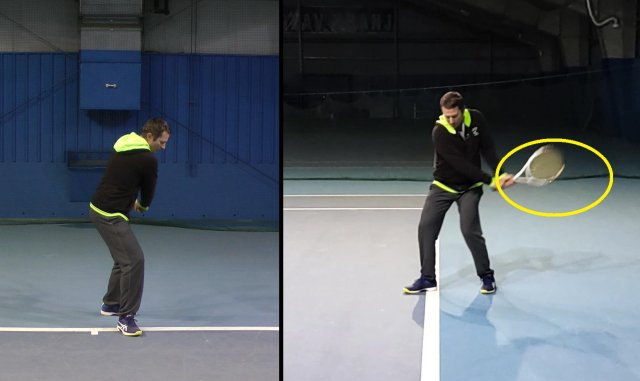
This loop happens, we don't do it.
As I’ve mentioned before, we don’t really “do” it. The drop just happens because we relax the arm and start engaging the body.
In conclusion, the goal of these illusion videos is to help you get a clear mental image of how a tennis forehand and backhand are executed because it’s very easy to misinterpret what you see.
Because body rotation and arm movements happen at the same time, it can be tricky to see what you should be doing with your arms when it comes to initiating the stroke.
In reality, most of the preparation and the so-called backswing of a tennis stroke simply happens as we turn the body to the side.
The arms simply lift the racket so that it can be swung downwards as the forward body rotation begins.
If you want to see more two-handed backhand illusions and observe how little the arms move compared to the racket in space, check out the Fernando Verdasco two-handed backhand analysis with the racket digitally removed.