
While there are many different footwork patterns in tennis, it is very common for players to do too much with their feet and, in the process, make playing tennis more challenging than it should be.
The foundation of proper tennis footwork is keeping it very simple and taking away all the unnecessary steps.
Top 3 Common Footwork Mistakes
The most common mistakes when moving to the ball are taking too many steps and not allowing the back leg to come through.
There are two main reasons that taking too many steps can cause problems in tennis:
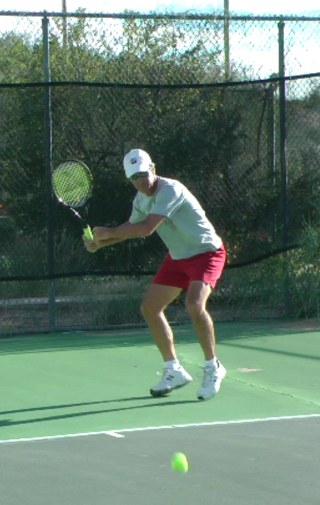
Too many steps when the ball is in your strike zone often causes rushed strokes and poor timing.
a. Quick shuffling of the feet while the ball is approaching makes the player anxious as he is aware of the limited time he has to make the shot.
The more time you use for moving your feet, the less time you have to perform your stroke. At least that’s how a typical player will perceive time.
It also works the other way—an anxious player will unconsciously move his or her feet a lot as this simply reflects his or her mental state.
b. It is more challenging to coordinate the stroke with legs if the feet are making a lot of movements.
For these reasons, it’s best to try to minimize foot movements and to keep them as simple as possible.
For now, we are talking only about simple footwork when the ball is coming straight to the player and he or she doesn’t have to move much. Even in this situation, most players make one unnecessary step, if not two.
So here are the main 3 footwork mistakes in tennis that you should eliminate:
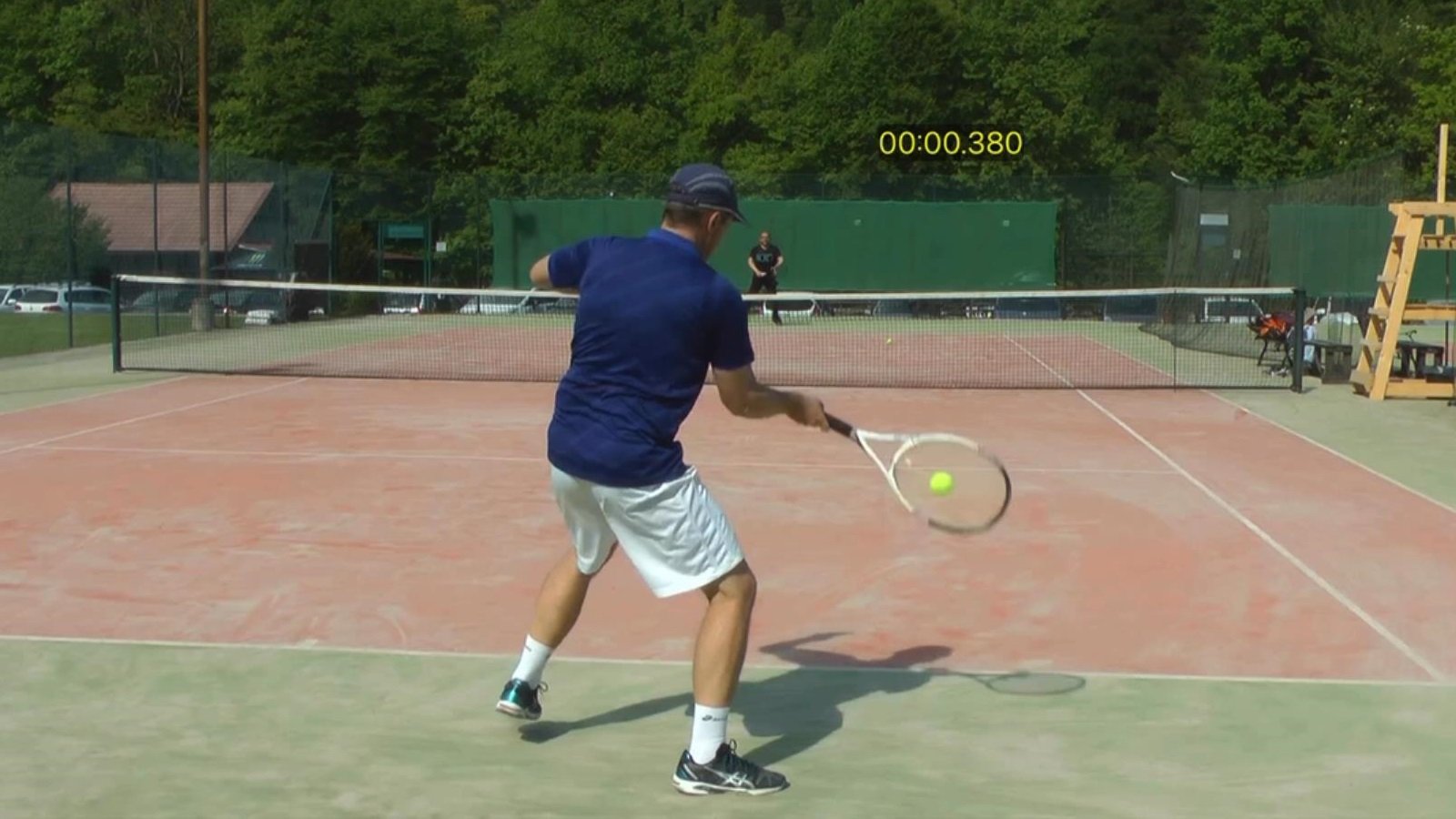
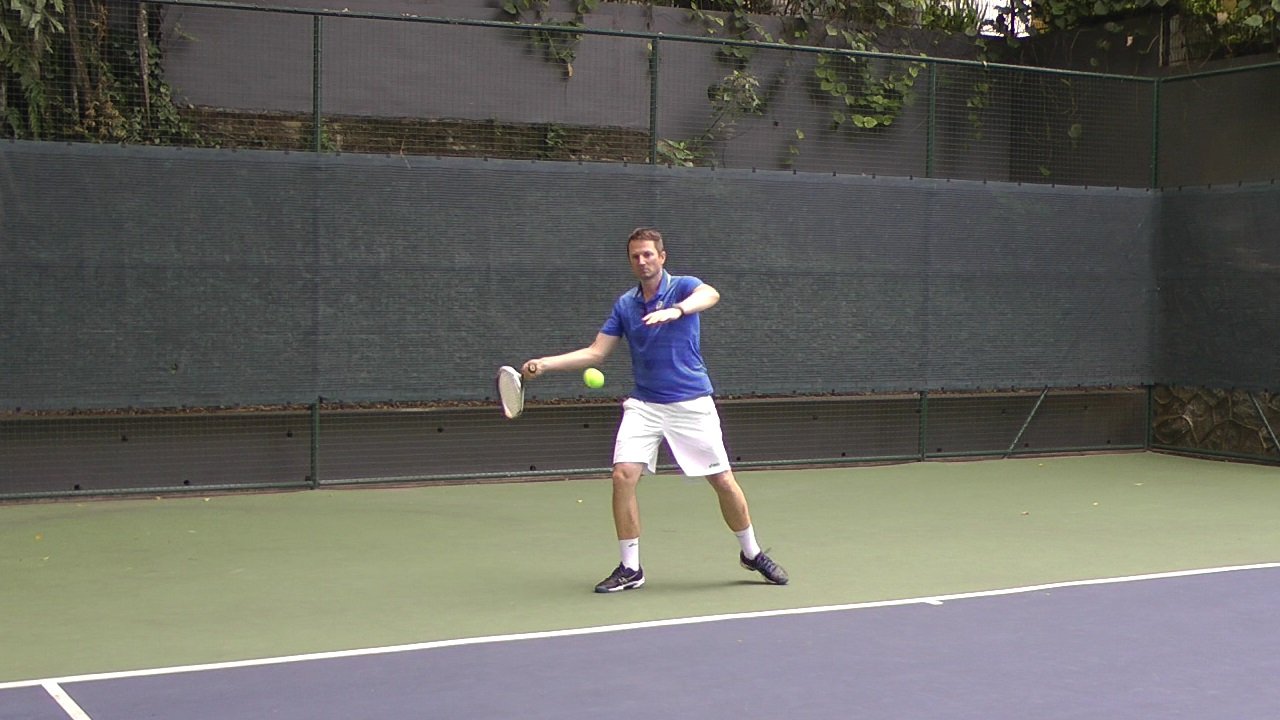
1. The first mistake happens when the player is about to play the open stance forehand (in most cases this happens on the forehand side), and he or she takes a few small steps, rather than simply either staying in his or her place and lowering and coiling himself or herself or taking a small step out to the side on the side of his or her forehand stroke (the right foot for a right-handed player).
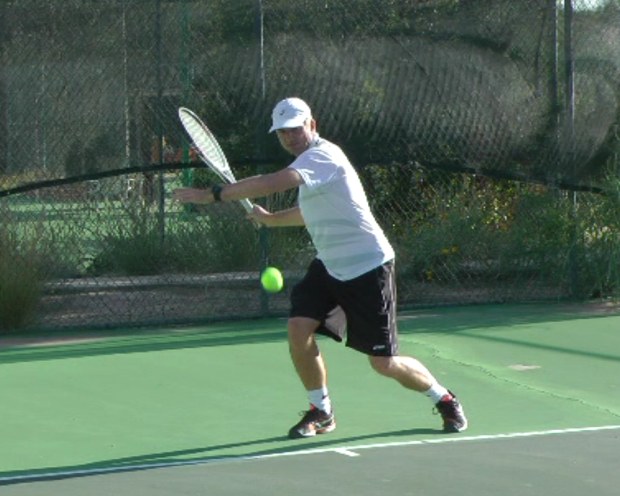
Just lower and coil yourself to play open stance forehands when the ball is coming at you.
There are many shots that come straight at your forehand side when you engage in a controlled cooperative rally, and you can simply hold your position, lower yourself and uncoil, or step slightly to the side and play an open stance forehand from that position.
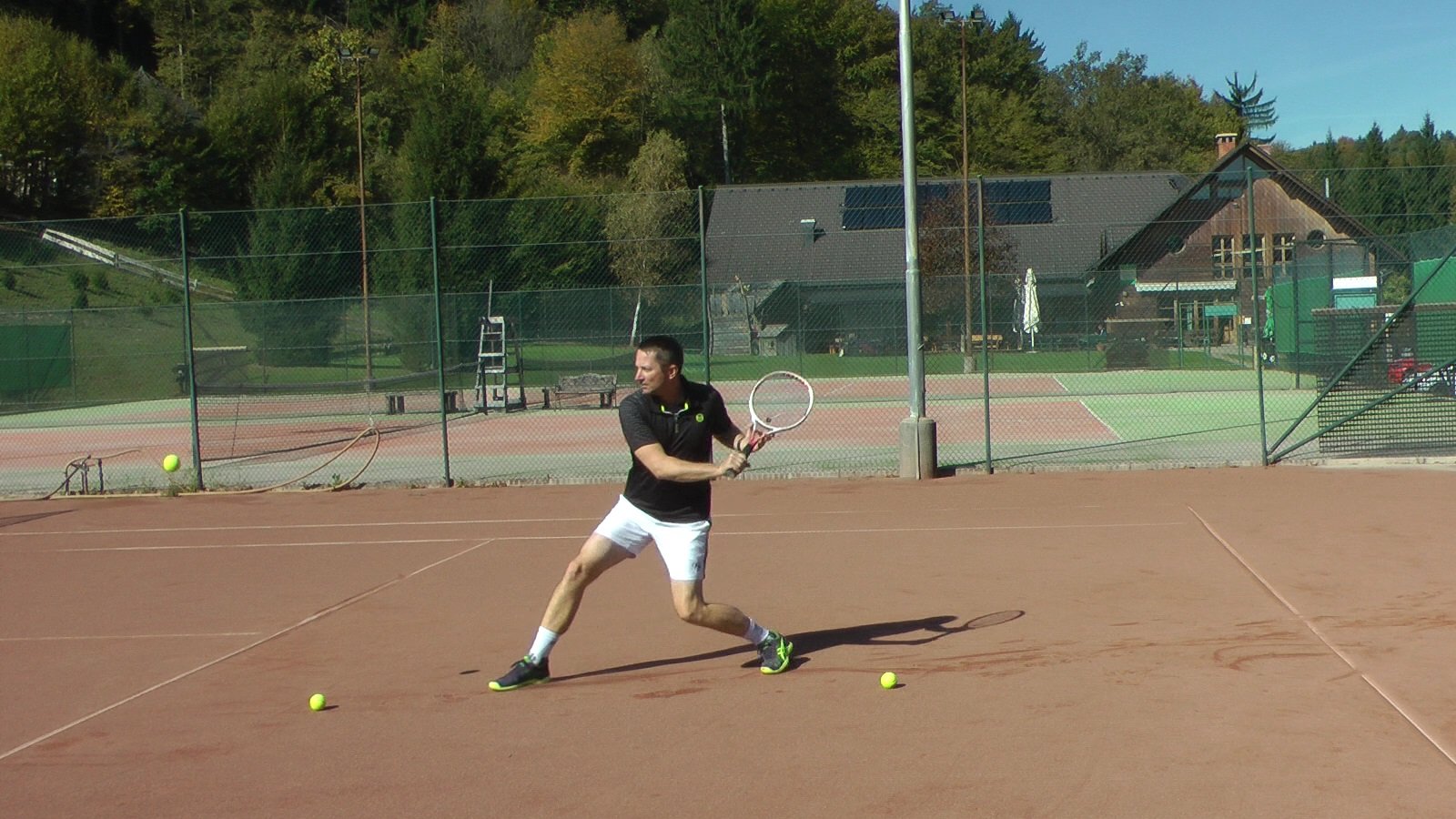
2. Another footwork mistake in tennis happens when the ball is slightly shorter and you need to step towards it in a closed stance.
Again, players often take three steps to adjust their position by only a foot or two, instead of just pivoting on the outside foot and stepping forward into the shot, thus taking only one step.
By simplifying the footwork on the closed stance, you’ll suddenly have a feeling of much more time to execute your stroke.
3. The third mistake happens when you hit a closed stance forehand (or two-handed backhand) and leave the back foot behind where it started.
The foot then prevents the hip from rotating fully towards the incoming ball, and you lose power as well as feel very unbalanced at the end of the stroke.
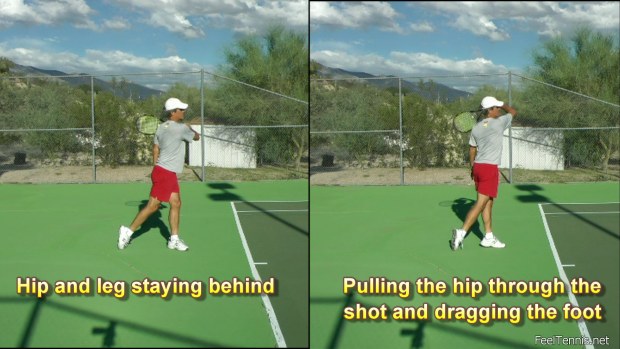
The hip must lead and move forward while your're hitting the ball and the back leg needs to follow.
The hip MUST pull the leg forward, and a good way to feel this is to drag your toes on the ground, which tells you that you have pulled the leg forward, following your hip.
You will need to get into the ready position very quickly anyway, so there is no point in keeping that back foot behind you.
How to Practice
You can practice these basic tennis footwork patterns in three ways:
1. Shadow swings with no ball
a. Open stance: Perform a split step, then just lower and coil and see if you can execute an open stance forehand comfortably.
Try adding a small step out with your right foot (for right-handed forehands), load and coil, and then uncoil while swinging your racquet.
b. Closed stance: Perform a split step, pivot on the right foot (on the heel!), and step forward into the shot while executing your stroke.
c. While practicing the closed stance, also practice pulling the hip forward and aligning your hips with the baseline while, at the same time, dragging your foot forward.
2. Easy tosses from your partner/coach or a ball machine
Follow the same procedure as above.
3. Rallying cooperatively with your partner/coach, and looking to minimize foot movements
See if you can wait for the ball to get to you sometimes or take just one step towards it, making sure that you pull the hip and back foot forward while hitting a closed stance forehand.
There is, of course, another side of the coin when it comes to tennis footwork, which is that you should position yourself as accurately as possible toward the incoming ball by making small adjustment steps.
This is correct, but it applies only to specific situations and not in general.
In most cases, you should optimize your footwork and take as few steps as possible before hitting the ball as that gives you the perception of having more time for your shot and makes it easier for you to coordinate your feet and arms while performing your strokes.
Hi Tomas,
In word and image all these lessons are little gems. Your feel approach has already helped my serve tremendously, and i’m sure this will help my footwork as well. Many thanks for all that!
On a side note: I’m late to the game of tennis (now in my mid forties), but my past as a soccer player as well as a student of music have helped me making big steps in only a few years. I don’t mind honing my strokes at the wall at my club, which I try to do for an hour each week, since it reminds me of my scales and studies (I’m the only senior at my club using the wall on a regular basis lol).
Actually studying an instrument and tennis have a lot in common (relaxation, the “economy” of movements, letting go of your critical self, focus, etc.). At conservatory 25 years ago we all read The Inner Game of Tennis (a big hit back then) even though no one played the game. Watching your videos somehow feels lke coming full circle.
Any thoughts on using the wall? Will you ever make a video on wall drills?
Greg from NL
Thank you, Greg. Having a good ear for music helps a lot with tennis because you need to “catch” the rhythm of the ball in order to time the shot and weight transfer against the ball.
Thanks for the wall drills suggestion, I’ll keep it in mind for future articles.
Thanks Tomaz, I’ll try those rhythm drills. The other day I found out how much tennis is a “sound” game when I played without a dampener and was completely at a loss. Just total discomfort. And much to my surprise a reflex test app just showed me that my reaction time to sound is way faster than to vision. Dont know if this is a general thing, but maybe instead of “watch the bal” we should say “listen to the ball”.
Hi Greg,
I’m also a musician and see constant parallels between learning music and tennis. One of the main ones is that relaxation is the key to good technique. I think it should be focused on very early on in the learning process.
I got rid of the anti-vibration thing a while ago and have never gone back. As I see it, it takes away valuable information you can get from the different sounds the ball makes on the strings when you don’t have it.
Hi Zac,
Relaxation is key, so true. Still dont know why I always tense up hitting that running forehand though.. 😉
You should be right about the cues the sounds of the ball on the strings make. As Im waiting for the arrival of my new Speed Pro racquet and don’t have a dampener for that one yet, I’ll try playing without one for a while. Thx for the tip!
We have all heard and used the the phrase, watch the ball. I would like to suggest the phrase, Track The Ball. Your eyes and brain are in sync and working towards the point of contact.
Great explanation. Do you use left arm to gauge distances?
How do we get a lesson from you?
Nick, the left arm may help me gauge distances but I am not aware of it right now. I definitely recommend moving it very similarly as I show in the video or how the pros do it.
I am in San Francisco until 26th but otherwise you are very welcome to meet me in Slovenia where I reside.
Too many steps may be why I’m feeling rushed on my 1hbh – not sure. How long are you going to be giving lessons in Arizona Tomaz?
Might be the case, JonC. We also feel rushed on the stroke that we don’t trust so much hence we move too quickly and too early towards the ball and often times get too close to it.
Being aware of that usually solves most of the problem. Meaning you need to calm down and slow down movement towards the ball and see how that works.
Just arrived to San Francisco, will be here until 26th.
Tomaz, as always: simple, direct, without complications, in order to administrate the body effort.
I discovered this web 1 month ago, I couldn´t stop to watching and reading. Is very important to me.
I have playing tennis for 35 years (I am 48 years old), but I have never received coaching like that.
Thanks a lot. From Argentina, Marcelo.
Thanks for the feedback, Marcelo, stay in touch.
Hi Tomaz,
I find your articles really good. I myself and my kids are into tennis and we find your simple drills and explanation very helpful. I personally have benefited from your tips on how to fine tune serves and now am in 100 club.
Can you just post an article and video of related drills on how to do ‘ever-rising’ kick serves? I have been to a Davis Cup match recently and was amazed to see how the pros manage to do 2nd serve which trajectory does not take a downward loop till baseline, although serve speed is about 70 kmph.
Thanks and regards,
Sanjit
Thank you, Sanjit.
The pros generate a lot of racquet head speed and therefore massive spin that kicks the ball up after the bounce.
I did a top spin serve guide some time ago on my older site, just follow the link.
Hi Tomaz,
I really appreciate how you have simplified tennis and the clarity of your explanations.
Do you have any suggestions as to the timing of the split step in general? Also, even during warm-up, the pros are shuffling and performing it for every shot.
How would you move to cover wide shots economically?
Thanks again, Miguel.
Thanks, Miguel.
I can’t tell you when to jump for split step but can tell you when to land. You must land just as you realize in which direction the ball is going so you can push off in that direction.
As to moving to wide shots – ideally you want to end up in an open stance so that you don’t have to do an extra recovery step. But don’t think how you get there. Only how you want to end up…
Thanks, Tomaz.
As I understand it then, you should be landing as the ball leaves the racket (in serve return or regular returns)? In serve returns it is almost a best guess.
As far as wide shots, the first move has to be some sort of pivot in the direction of the ball, then eventually get the outside foot where the ball is going to land in order to load and hit open stance. Getting there with some combination of lunges, cross-over steps, and small steps is the problem. It would be great if you could consider this in a future video.
Miguel – split step is timed the same for any shot – groundstroke, volley, serve return, etc. You want to land just as you realize the direction of the ball.
As for moving to the side, you do it without thinking exactly as you would have moved without the racquet and started to run there naturally.
All the footwork your mention shows me how bad online and other tennis instruction has become if that’s what you’re looking for.
No one has to tell you anything on how you run to the side, you knew how to do that very efficiently when you were 4 years old.
Just run there, slow down, hit the ball and get back…
Not sure about this given that the majority of recreational players I see are hardly moving on the court, let alone perform split steps every time their opponent hits the ball, then shuffle or cross over steps, small adjustment steps, step in (diagonals) hit the shot, immediately recover. When they take lessons (group or privates) they hardly ever work on footwork of any kind, they never do ladder footwork exercises, etc, etc.
Without doing it and assuming it should come naturally, everybody should have moved like a pro but the reality is that most rec players I see hardly move at all.
Now, if ball perception and anticipation would have been good without moving, then why waste the energy?
But the truth of the matter (at least for me and my hitting partners) is that ever since I stop obsessing about form and started to move my feet, my perception, anticipation, timing and rhythm improved a lot.
To summarize: not sure about the “too many steps”.
Some times too many steps are better than standing still and waiting for the ball.
Just my personal experience.
Thanks for sharing, Doron. The players who don’t really move on the court are not really interested in improvement in my opinion. They are not reading this blog or any other. 😉
The ones that I see almost daily which come to my lessons almost always do too many steps.
In other words, they do more steps than I do which means they are not efficient and those extra steps make them feel that there is not much time hence they are rushing their strokes and mishitting often.
It is often simply the anxiety from the approaching ball that makes their “legs nervous”. And by “calming their legs”, they learn to calm their mind and perceive the ball clearly, feel more time for the shot and hit better.
Tomaz,
As always, you have done a great job! And thanks for sharing your wisdom with so many! In this particular lesson, I loved the first part involving the open stance. Your student appeared to catch on to it quickly and easily.
As we both know, the old classical American style of hitting forehands still unfortunately lingers. Your student had a much tougher time stepping into the ball with his left foot. I believe it is because it is not as natural athletically, and mostly just a bad habit due to early American dogmatic teaching (racket back early, turn sideways, step forward into the ball, and hit through it). Would it be easier and better for the student to learn to just load the right leg with an open stanch when possible, rather than than to get sideways on a ball so close to get to? I understand that sometimes when we are sprinting towards the net to get a very short ball, that the left foot forward at contact may be necessary if it is the last step to the ball, and then the right leg accomodates as it moves forward allowing the right hip to move forward to open the body, taking pressure off the left knee, and allowing a more natural modern stroke and finish with optimal top spin and side spin for more lift over the net, more power, and better angles.
I totally agree that saving unnecessary steps is very good, but I believe that the spit step is important on every shot. I know that this was not the point of this teaching video, and that eliminating unnecessary steps was the point, but the spit step saves time and steps, as well as helping us keep our balance and allow quick movement.
I love your open forehand stroke, the way you bend your knees and lower your body while loading your right leg, as well as your excellent posture (straight back). I noticed that your student first bends at the waist. He would benefit by emulating your posture, but that may be another lesson! Bending at the waist is like taking unnecessary steps, and it can really wear you down in a long match.
Please let me know if you disagree. It’s easy for us students to question your work and offer our own opinions, but not very easy to come up with the excellent teaching videos you provide for us! So please forgive for doing so.
Thanks again for including me in your natural tennis teachings!
Larry Buhrman
Thank you for sharing your views, Larry.
I personally don’t find anything wrong with closed stance.
The “problem” appears if that’s the ONLY stance taught and then the player forces himself into a certain stance even though he doesn’t have the time or the balance to do it.
And same goes for open stance – if that’s the only stance taught, then the player will not position well on shorter balls or balls coming straight at him.
I’ve shared my thoughts on closed vs open stance in one of the previous comments (just follow the link) where you will also see top pros warm up and almost exclusively hit closed stance forehands.
As for posture, yes, majority of players are not having the right posture and many problems arise from that especially when hitting open stance forehand.
Will address those in my upcoming forehand course…
Hi Tomaz,
I had the chance to apply you hint about the close stance today, and it really sounds good.
Especially the 2nd serve return gains a lot of time when “pivot right and step in left” as it helps to antcipate the shot for creating advantage situation.
I’m looking forward to get our next mailfor improving my footwork.
Thank you.
Tib
Thanks for the feedback, Tib. Stay in touch…
Tomaz, great video, always looking for ways to expend less effort to get results. I was one of those students that was told years ago to take lots of little adjustment steps on the way to the shot – so I have some “unlearning” to do.
For the next video, I’m curious about how to take fewer steps but still be in balance for the shot when you get to contact.
Thanks, Mike
Mike, it’s easier to be in balance when you make bigger steps as your feet are more wide apart and that automatically helps you with balance.
Smaller steps are used when you have a lot of time to set up for the shot – for example when you receive a floating defensive shot that sits up in the middle of the court.
Tomaz, why even step into the closed stance? Doesn’t that “complicate” the shot with an extra step, which you must then add to by bringing the right leg around to open up the hips? Just hit open in the first place and you eliminate those 2 extra steps…great video!
Hi Lucy,
If I don’t step into a closed stance when the ball is slightly short, I will lose balance staying in the open stance.
If I want to move closer to the ball and keep an open stance, I will actually have to make two steps and not just one like with a closed stance. So that complicates things.
And lastly, closed stance is much more comfortable position to hit from than the open stance.
I commented on this before so just follow the link and take a look at Djokovic, Federer and Dimitrov warming up and how they mostly use closed stance.
Tomaz,
You talk about not leaving the back leg behind when you uncoil and hit the forehand. Recently I realized that in fact I was taught (wrongly) to rotate that rear foot in place as I pivoted, and that this indeed stopped my hips from rotating as much as they should. But is it better to let that right foot drag on the ground with the toe the way you show, or is it ok (and better or worse) to let that right foot naturally step forward as much as it wants to, such that it is beside the front foot at the end, or even a little bit in front. In a way, it seems to me that this gentle step is a slower and more gentle version of the jump and rotate in place that you see (more) pro players do when they hit open stance forehands sometimes. If I think about it, I can see however that the effect of dragging the toe versus letting that foot step naturally (as much as it wants to) is not going to be quite the same. If you are dragging the toe of the rear foot, you are naturally going to be a bit higher up and possibly a bit more centred on your front foot (or what was your front foot) at the end of the pivot.
Hi Colin,
The back leg can come forward as you rotate as long as it’s not part of the swing. It needs to be slightly delayed, and come through slightly after you complete the follow-through.
Thanks for the answer. That makes sense. I am not really moving the leg forward intentionally, but rather letting it do what it wants to do, after I earlier push off with that leg to uncoil and start swinging, wheras before I was trying to rotate that leg in place. I am sure it is not a surprise to you, but I have had good success just focusing on a few key things, whereas before I was focusing way too much on the entire sequence, and sometimes it worked great, whereas other times it became very artificial and all completely broke down. Now I am just trying to always stay calm, look at the ball the entire time, and make sure to brush up as I swing at the ball. Memory and muscle memory seems to take care of all the rest (e.g. unit turn & coil, uncoil started via the back leg, and swing forward including a nice racquet lag and snap because of where my racquet was). Letting the leg go where it wants to seems a cohesive part of this…
Thank you. Minimizing steps is seldom taught or mentioned. Most pros encourage lots of “happy feet”.
Thomaz, your insight (and clear explanations) are truly amazing. Thank you so much. Please know it is very much appreciated. You have not only helped me with my tennis, but also my golf (your posts on breathing techniques and keeping the head still at impact are very much applicable)!
Much appreciated, Sami, more tips on the way…
I find myself doing too many small steps. Often shuffling and dragging one foot to keep my balance anchored. Sometimes I think it’s my old boxing training instincts taking over, subconsciously forcing me to have my balance perfectly centred when I take the shot.
It’s probably affecting the quality of my shots, but it’s definitely causing me some unneeded fatigue on the court.
Any additional advice?
Hi Zach,
Play some mini tennis and look to minimize movement there. Ask your friend to play back to you and see if you can play some shots without any steps at all.
That will give you a good starting point for a similar principle on the baseline.
I totally enjoy your teaching videos. I have a question about open stand and close stand. Is it one better than the other?
Thanks.
Neither one is better, we use both in different situations. Open stance is better for high or fast incoming balls on the baseline, or when you want a lot of power, closed / neutral stance is better for shorter and lower balls and when you want more accuracy, for example when you approach the net or want to hit an accurate down the line shot.
Hi Tomas – Is there a structured way for not-as-agile kid to develop a better footwork. I have a 13-year old who has apparently very good hands but lacks the complementary footwork to create the right spacing. Consequently he ends up jammed for space or reaching and ends up trying to manufacture sub-optimal shots with his hands on key points. This is more apparent against opponents who strike the ball hard and flat. Is it ladder drills? Spider drills? Figure 8 drills? Is there a method/drill you can suggest where he can measure his own improvement over time? Thanks
Hi Sandr,
I see footwork development from two view points – structured and non-structured.
Structured footwork training is when the coach sets up a ladder and tells the player an EXACT footwork pattern to use.
Of course they use many different patterns but they are all defined in advance. Same goes for cones.
I believe this is way less effective than non-structured footwork training which is non-conscious – it’s when your son for example plays soccer with his friends.
Then his footwork patterns are not defined in advance and in fact have to adjust all the time to what he perceives around him.
That’s why former soccer players move perfectly on a tennis court having never done the tennis ladder drills.
My strongest recommendation to all tennis parents when it comes to sports development of their kids is to have them play as many other sports as possible.
Your son will naturally develop footwork playing soccer (basketball, hockey, etc.) without knowing that he is training and he’ll have fun doing that.
I think footwork develops to a much higher level than if you use only structured drills with pre-defined footwork patterns.
This all great stuff and thanks for the excellent presentation. pat downs USPTA 1.