
Your technique functions well only if it’s executed at the right time.
That’s the idea I want you to keep in mind as you read through this article and as you work on your strokes on the court.
While proper technique is the foundation of controlled and powerful strokes, it is not THE answer to most of your challenges on a tennis court.
I believe that hitting the ball in your ideal contact point is one of the most challenging parts of tennis.
Unless you deliberately work on that, it is very unlikely that you’ll hit the ball at exactly the right time.
And if you don’t, meaning you’re late or hit too early, your technique won’t work well and you’ll hit a poor shot.
Blaming The Technique Instead Of Timing
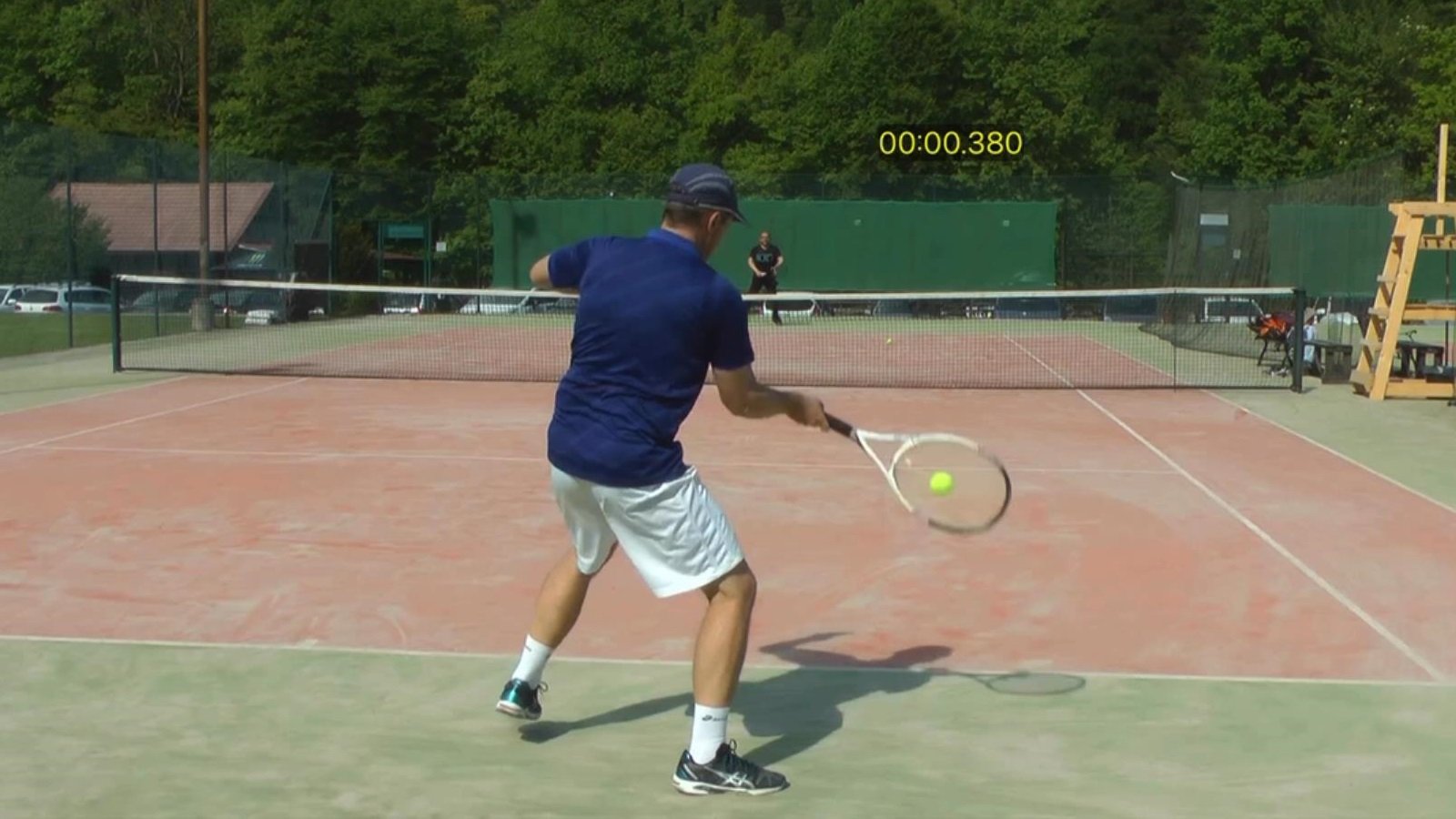
When you hit the ball late, your technique won’t look right.
You won’t be able to uncoil fully, you won’t be able to transfer weight into the ball, your arms will be bent and contracted, and whether you can see yourself on video or simply feel your stroke, you’ll know that it’s not right.
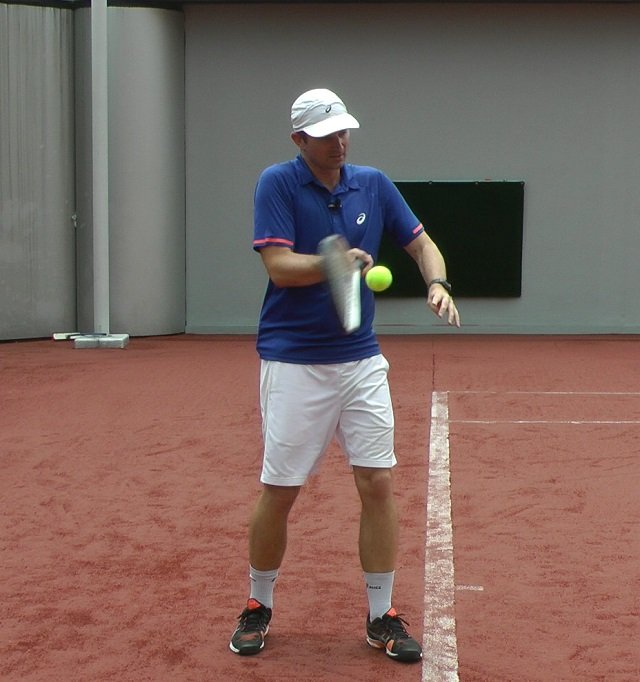
If you hit too late, your technique won't look right.
Unfortunately, you’ll probably look for solutions in your technique – because all the information you’ve learned about tennis is most likely about tennis technique.
If you only have a hammer, you tend to see every problem as a nail.
But you won’t find any solutions because the cause of your “poor looking technique” is not the mechanics of your stroke, but your mistimed stroke.
The technique part of tennis answers only the HOW:
- how do I prepare?
- how do I load my body (bend legs, coil)?
- how do I swing towards the ball (swing path)?
- how do I follow through?
None of the technical instruction tells you WHEN you need to do that.
The only instruction on WHEN that you may have heard is to “prepare early,” but even that doesn’t help you hit the ball on time in most cases – which is why your coach keeps repeating that.
So, the first step to making your technique work is to know the real culprit of your problems, and that’s timing.
When you time your stroke properly, you’ll hit the ball in your ideal contact point where your body’s kinetic chain and weight transfer will produce the most power with the least amount of effort.
It will also give you the most control because that’s where the racquet will naturally have an upward path for topspin strokes or a downward path for underspin shots without you having to force that path at all.
How To Find The Ideal Contact Point
While I am demonstrating the process with the forehand, these principles apply for all strokes.
They are merely principles and not technical instructions for strokes.
The first thing that you’re aware of by now is that you can find something only if you look for it.
You will find your ideal contact point more and more often if you pay attention to where you hit the ball and adjust based on that feedback.
You need to stop worrying about your technique for a certain period of time (5-15 minutes) and focus solely on hitting the ball in your ideal contact point.
Again, that applies to your groundstrokes, volleys, overheads and even to your serve to an extent.
Namely when you hit the ball in your ideal contact point, you will feel it.
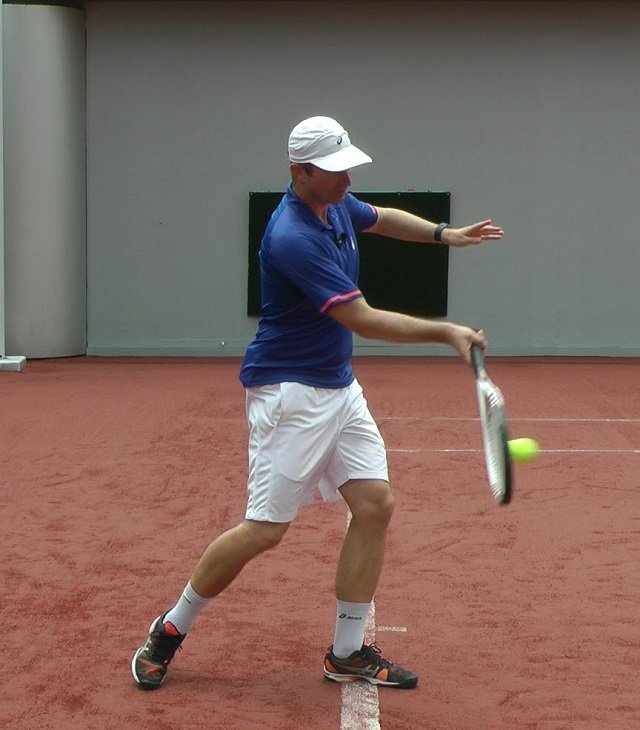
When you manage to hit in your ideal contact point, you will feel it.
You will feel much better energy transfer in the ball than when you hit late, for example.
You might feel some tension or contraction when you hit late or become aware that you didn’t fully uncoil in the ball.
You might feel that you were unable to transfer weight into the shot and that made it go slow and land short.
If you hit the ball late, try to hit it more in front.
And if you’re too early, let the ball come a little bit closer.
Simply through feeling and adjusting all the time based on the feedback you get from every shot, you’ll become better and better at hitting the ball in your ideal contact point.
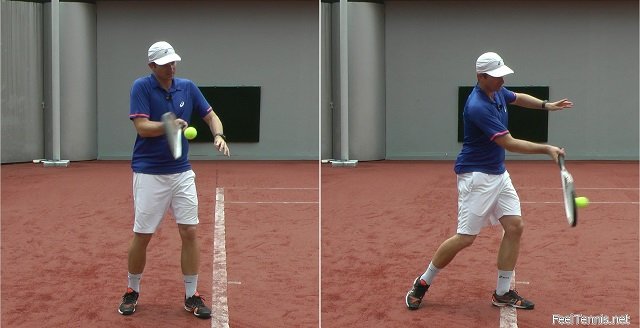
The cause of "poor forehand technique" on the left is not a mechanical issue but a timing issue.
Again, the process is not something revolutionary, but my experience working with hundreds of tennis players over the years has taught me that almost no one is doing that.
Everyone seems to know more about tennis technique than I do when they take lessons with me, yet they hit the ball poorly because, most of the time, they don’t hit it on time.
And even though that seems to be the obvious problem, I don’t see the players set aside 10 minutes of their practice session and simply try to hit the ball in the ideal contact point for a specific stroke they’re working on.
Or use specific drills for hitting more in front that I shared before…
So, that compelled me to share this article with you.
In my experience, hitting the ball at the right contact point is one of the most important elements of your strokes if you want to hit them with consistency, accuracy and power.
In fact, as I play tennis for myself hitting freely with my friend, all I am doing is trying to time the ball and hit it in the ideal contact point for that stroke. I also have a very clear intention of how I want the ball to go over the net. Article on that coming soon…
How To Hit In The Sweet Spot
If you’re looking to progress even further in your ability to hit quality shots and play good tennis, then hitting the ball in your ideal contact point is not the final answer, although it is a very important one.
The next level is when you hit most of your shots in the sweet spot of your racquet.
Surely you’ve felt the difference between hitting the ball in the sweet spot and hitting the ball close to the frame.
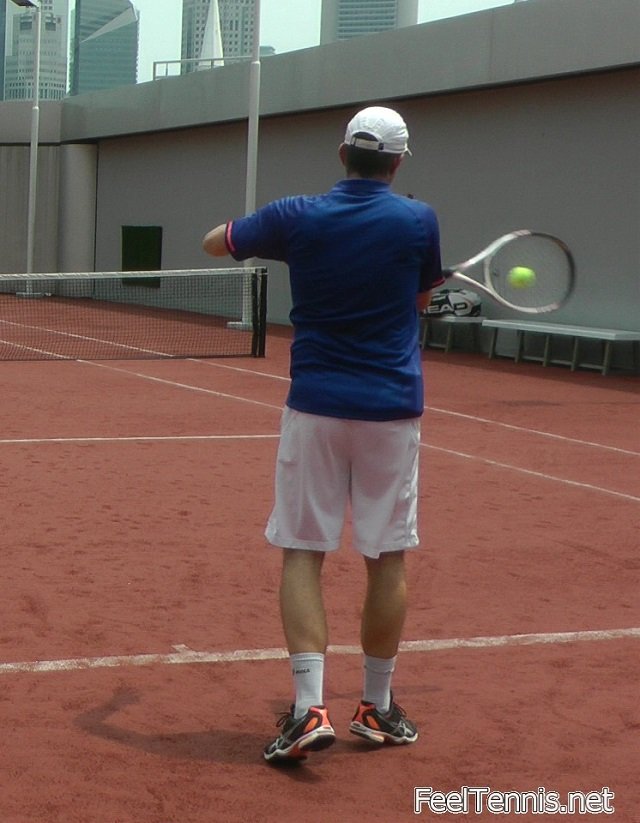
You KNOW when you hit the sweet spot, you can feel it.
While I don’t have scientific data on how much power is lost depending on how far from the sweet spot the ball is hit, my experience tells me that the power drops very quickly with each centimeter hit off the sweet spot.
I’ve often asked players when they hit the ball short if they knew the cause – and, in most cases, they didn’t.
They would say, “I didn’t hit with enough power” or “I hit too low,” but the actual cause of their short ball was many times that they hit the ball well off the sweet spot and the ball received much less power from the string bed.
The string bed acts like a trampoline – it bounces you the most in the middle, and the more you jump off the middle, the less height you will achieve.
So, while hitting the sweet spot of the racquet does improve in time even if you pay no attention to it – since your subconscious does register the differences up to a point – it improves much faster and to much higher levels if you actually work on hitting more shots in the sweet spot.
The process again starts by being aware of where you hit the ball on your racquet.
For that, you can call out the numbers by giving the sweet spot #3, hitting a little bit off #2 and hitting very close to the frame #1.
As you hit your shots, feel and call out or make a mental note of where on the racquet you hit the ball.
While you cannot consciously and deliberately hit the sweet spot when you want, you will improve your ability to do that by practicing this drill or by simply constantly being aware of how each stroke feels depending on where on the racquet you hit the ball when you work on other elements of the game.
As you feed your subconscious with more data, it will help you guide the racquet more accurately towards the ball and hit the sweet spot much more often – which will give you many more powerful shots and much fewer short balls.
Expanding Awareness By “Expanding” The Time Of The Contact Point
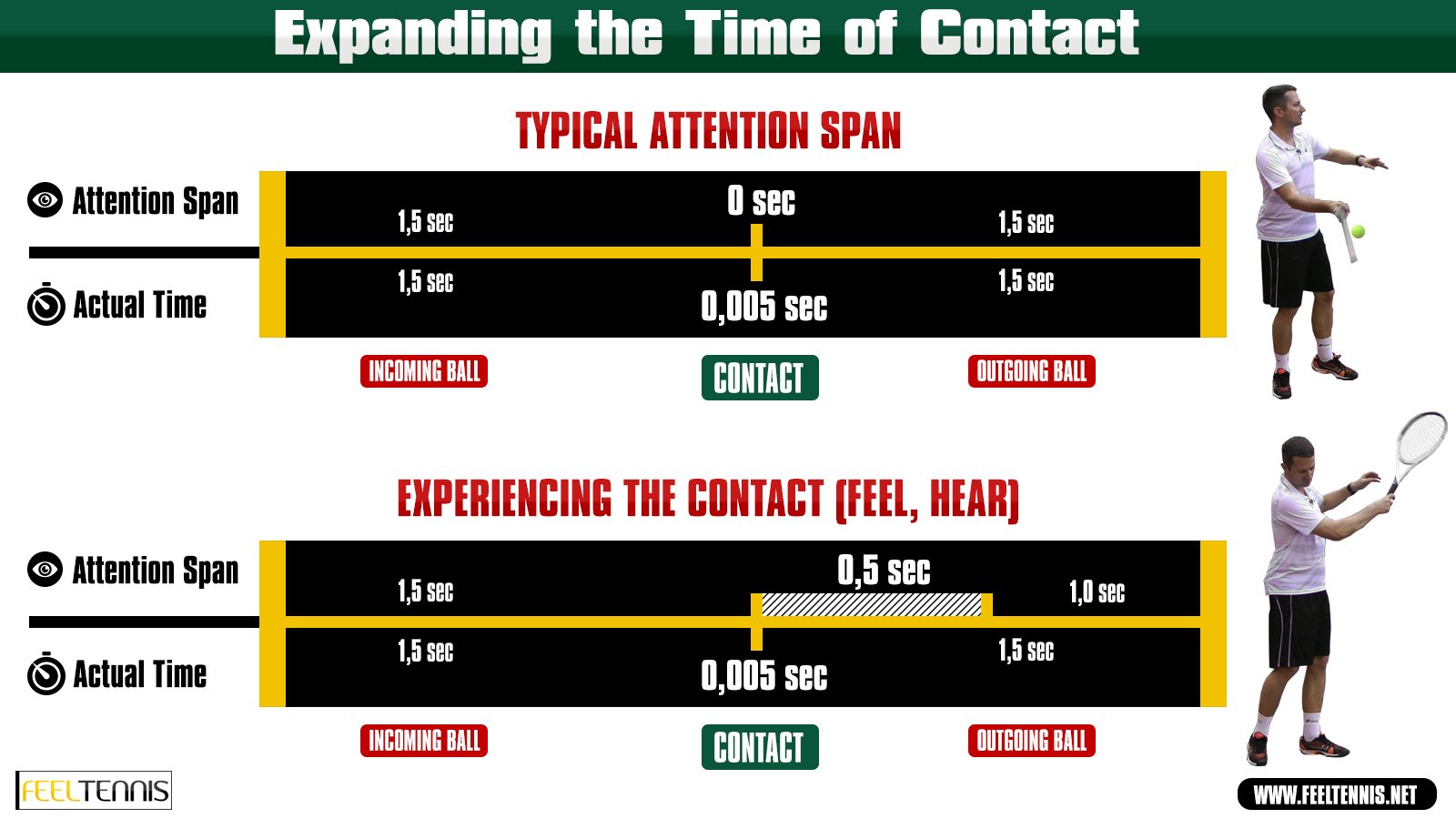
Let’s examine the time periods of one ball exchange.
First, the ball is coming towards you. In a typical recreational rally, the ball takes from 1.5 to 2 seconds to reach you.
Then you hit the ball, which takes around 0.005 seconds.
Then the ball flies towards your partner and reaches him after 1.5 to 2 seconds again.
Because the contact is so short compared to the whole time the ball is in play, we don’t pay attention to it.
The time period of contact compared to the total time is insignificant, so we often dismiss it.
And when we don’t pay attention to something, we don’t really get much information from it.
Yet, the moment of contact tells us so much – but only if we “listen” to it.
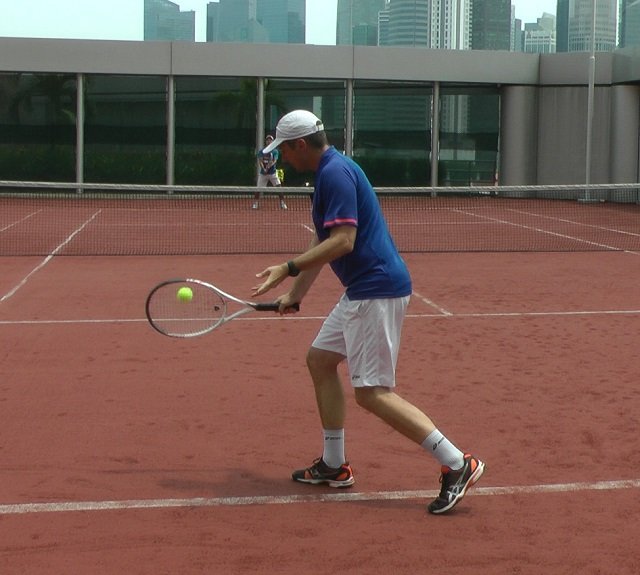
Paying attention to extremely short contact point in tennis requires practice.
We listen to it by “expanding” the time of the contact – and by that, I mean that we take some time from the outgoing time and “use” it on the contact – roughly about 0.5 seconds.
We simply feel, hear and experience what happened when we hit the ball by keeping still and balanced after the contact and absorbing the information we’re receiving.
While the contact point is very short, the feel of vibration that goes through our hand and arm takes longer and so does that sound of the hit.
By feeling the vibration fully until it dissipates, by being conscious of how your body feels through and after contact, and by hearing the sound of the hit, you’ll be much more aware of:
- if you hit the ball in your ideal contact point or not,
- if you hit it in the sweet spot or not,
- if you transferred weight well to the ball,
- if you were balanced through the shot, and
- if you saw the ball well before the contact or moved your head away too early.
The more you are aware of these elements of tennis, the faster you’ll adjust and correct them – and the higher level you’ll reach.
“Stay” longer in the moment of contact and “expand” it, and you’ll reap many benefits of this approach in the short and in the long term.
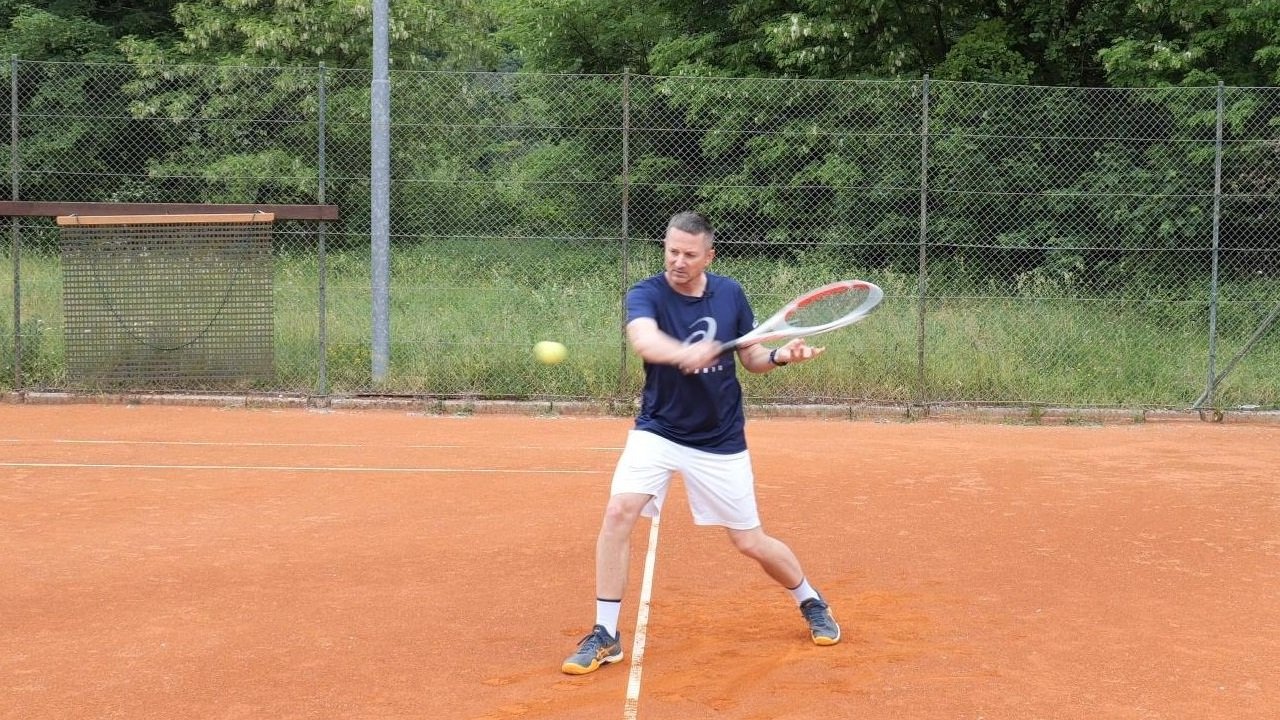
Click image to enlarge!
It might even help you really understand why the pros keep their head still for so long after the contact even when they play for points.
They’ve most likely been doing this for years unconsciously because their awareness level of what happens at contact is extremely high and they receive massive amounts of feedback from every single shot they make.
The differences between a shot that lands 3 feet from the baseline or 6 feet from the baseline are minute when it comes to the angle of the racquet, the angle of the swing path and the speed of the swing, yet that difference of 3 feet makes the difference between your opponent being on defense or attacking you.
And making the ball land 3 feet deeper is not something you fix by changing the mechanics of the stroke, but by having the ability to hit the ball at the right time in the sweet spot, which will make the ball go as you intended it to go.
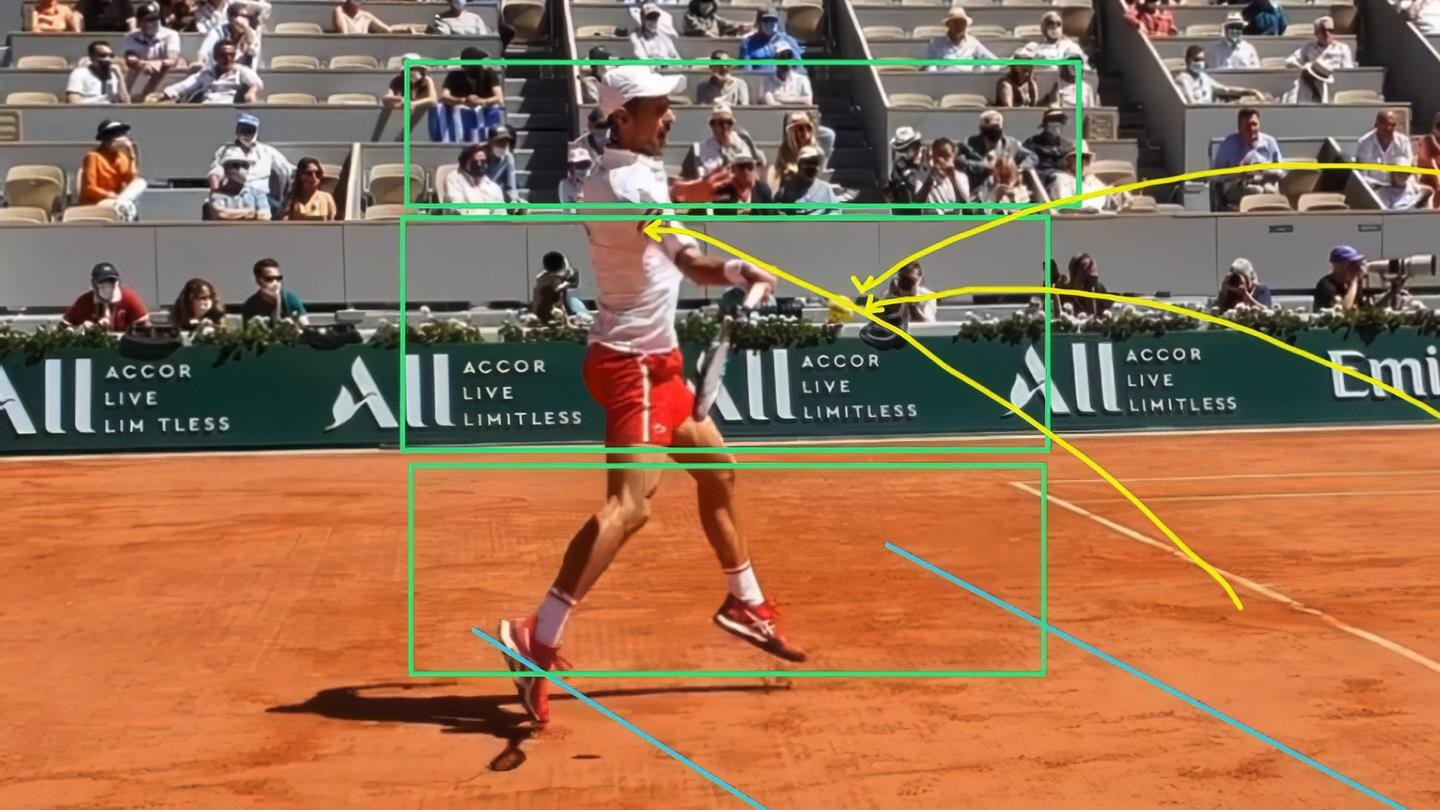
Hi Tomas,
I’m struggling with my timing vs technique. I cannot seem to get the proper spin on my ball, meaning a top spin when I hit a forehand. My spin rotates sideways and I’m wondering how I can correct this. I’ve watched all your videos and have practiced the drills, but I can’t seem to identify why this is happening. Can you provide some explanation and direction on what I need to focus on?
P.S. I love your website and instruction! It has been incredibly informative. Any chance you’ll be coming to Northern California to offer clinics?!!
Many thanks,
Cari
Healdsburg, CA
Hi Cari,
I would need to see you play to identify the cause for sidespin but I assume it also has some forward rotation too in which case the ball still dips and you have some control over it.
Send me a video if you can…
Tomaz, I am amazed at your skills. How do you hit so well using left hand ?
You once mentioned that the body takes way longer to learn than brain. Like
Nadal, you seem to be very good with both hands.
Regards,
Steve
Hey Steve,
As far as I know the brain scientists figured out that there is a transfer of information between left and right side so if you learn something well with your right hand, some information about that will “leak” to the other hand. 😉
It is also a good idea when working with juniors to spend a little bit of time teaching them the serve technique with their non-dominant arm as that helps them develop extra skills on their dominant side.
Love the awareness idea – BUT:
Point 1. There is a SIMPLE mechanical answer to where to hit the ball. The Law of 45 degrees shows that a preferably semi-open groundstroke (45 degrees to the incoming ball) should be hit on a line of 45 degrees to the body (where the hips should point at contact). Diagonal geometry is fundamental to tennis and most other sports (with curves coming later). Try it!
Point 2. The optimal place for hitting the sweet spot for virtually all strokes is not in the midline, but towards the trailing edge. E.g. Look at your own photographs above. Just as well the body learns to do this fairly automatically – must be awareness!
Love your ideas Malcolm, but I am afraid I will have to utterly destroy them. 😉
Point 1, a): The 45 degrees is a simplification for giving the student some guideline on where to begin looking for an ideal contact point. In reality, this can be 52 degrees or 37 degrees, or somewhere close to that.
Secondly, no one can know exactly where 45 degrees is EXACTLY in relation to their body as they play.
We don’t have a degree meter in our brain so the instruction “hit well in front and somewhere to the side” works equally as well without making the player anxious and tight because he tries to get the exact 45 degree which is almost impossible to do.
Point 1, b): Let’s assume a very slow incoming ball with only 5 m/s speed and a very slow racquet swing towards it with 5 m/s speed too. The combined speed is 10 m/s.
In my experience, the ideal contact point has a margin at most about 10 cm but let’s say for a slightly lower level where it would still be ok with about 20 cm margin.
How much “time margin” do we have to hit the ball in that short space so that we time the ball well and hit it in our ideal contact point?
T = 0.2 meters / 10 m/s = 0.02 seconds
If a player makes a timing mistake of more than 2 hundredths of a second, they will mistime the shot.
That is why hitting the ball in your ideal contact point is THE most difficult skill to acquire when it comes to the hitting part of tennis.
Your suggestion of 45 degrees is a guideline but since contact happens extremely fast and players swing through the contact and immediately rotate their bodies they have no proof that they really hit at 45 degrees. Their only proof is feel.
So to master hitting the ball in the contact point and making a timing mistake of less than 2 hundreths of a second requires years of practice with lots of attention to this exact process – and not a simple theoretical suggestion on hitting the ball at 45 degrees.
I really want to point out that there is nothing SIMPLE about it and I would never use the word SIMPLE in the same sentence as hitting the ball in ideal contact point.
Tennis players don’t know how extremely difficult hitting at ideal contact point is and when they don’t succeed often (even though they are told it’s SIMPLY at 45 degrees), they will feel bad about themselves and think they are clumsy or stupid or poorly talented because if it’s simple then most other players can do it and only they cannot.
So we need to be extremely careful how we present certain skills in tennis because for us coaches with 25 years of tennis behind us some skills seem simple but we mastered them through millions of repetitions and most players we teach are just somewhere at the start of the learning curve.
Point 2, a): Again, you’re going into theoretical explanations which the player doesn’t need.
In theory the racquet has 2 sweet spots, a best bounce spot and a Centre of Percussion spot (COP).
These are all potential spots for hitting the ball on the racquet but if I cannot hit the ideal spot on the racquet consistently after 25 years of tennis rallying nicely with my friend, how can I ask the readers of this blog to shift their hitting the point on the racquet by one inch for example? 😉
That theoretical knowledge only causes overthinking and disappointment when one cannot execute what they have read or heard from a tennis instructor.
What we CAN DO is become MORE aware of the vibrations coming off the racquet and realizing that sometimes the racquet doesn’t vibrate much and that the ball bounced off really nicely.
By paying attention to that we’ll get better at it. That’s all there is to know for a tennis player and that’s all one can improve up to a point in the long term.
Thank you for your comments and the opportunity to answer as I know many many players are lost in theory and analysis which does nothing useful for the real life tennis on the court.
Thanks for the effort in your lengthy reply.
Just one comment re “We don’t have a degree meter in our brain”.
Intuitively, we think the brain works in 90 degree coordinates i.e. up/down; forwards/backwards; sideways. But, in reality, it is calibrated in 45 degrees.
It is very easy (for the kinaesthetically aware) to close your eyes and put your arm out to point out to 45 degrees. You can use combinations of body parts in all sorts of 45 degree variations. Try this for one minute! Precious few people know of this secret.
I actually find the combination of Zen and Geometric tennis very practical.
Love the website, Malcolm
After reading this discussion of the “45 degree angle” and thinking about some of the issues involved I wanted to respond with a brief comment. The notion of the arm being at 45 degrees /- at contact itself is a simplification, or perhaps a reduction, of the principle. The arm angle is considered relative to the body, which is positioned in relation to the incoming ball. But that ideal 45 degree arm angle is also relative to another 45 degree angle, that of the hips, at contact. So really one is talking about 90 degrees, and that is a concept that could take us many places. And when you start aligning stroke technique with those positions, the process is no longer as simple and innocent as the 45 degree angle concept seems.
On the other hand, players like me, who grew up hitting a baseball with a bat at a contact point even with a point between our spine and front hip and whose initial (old fashioned) forehand instruction had us making contact at a similar spot, often need help to visualize where the modern forehand (and one hand backhand), with coil and lag, should meet the ball. That notion provides as good a means as any of helping us do that, perhaps superior to the idea of identifying some point in space X centimeters in front of the front toe, since the concept of arm angle is dynamically related to the body.
But then we all have to become able to time it up with the ball that is coming in, each one perhaps with different air pressure and felt characteristics at a different trajectory and different speed with different spin, and each rebounding from the court a different way. I think that is why the word “ideal” is used when we talk about contact.
Hi Tomaz,
I really love all of your videos and think you’re the best out there.
In our open skill sport technique is just the basis from wich we have to adapt, so I totally agree that timing (and feel) is crucial!
This time I haven’t another question but just a link to a video about the same topic you might find interesting https://www.youtube.com/watch?v=wqlqPVyAAMs
The best,
Paul
Thanks for sharing, Paul!
Wayne Elderton always has very clear explanations.
Love the contact point segment. You’re the best.
1. Hit the ball in front and to the sides of the body
2. Hit the sweet spot by marking the exact middle of the racquet with a black dot the size of a US Dime. that’s my 3-2-1!
3. Feel the exact hit of the racquet meeting the ball to increase the awareness of what is happening.
Do that in a match, and it will keep your mind focused and allow your body to do it’s job!
Trying it at 10am today!
Will keep you posted.
Again, much thanks.
Q
That’s going to be a good challenge, Q! Don’t let too many thoughts come in while you play though.
In a match I simply “wish” a clean contact with the ball and the rest starts to fall into place.
Hi Tomaz,
Great insight will try these out
Thanks
Tomaz,,
You never stop amazing me with your insight! I have been an admirer and student of your thoughts from the beginning of your website, I have both your courses and refer to them constantly.
Thank you for the great tips on truly understanding this game.
Mounir
You’re very welcome, Mounir! I am very glad these ideas help, I’ll try and share some more this summer.
Hi Tomaz,
Everything you say and demonstrate regarding how to play better tennis is so informative. I have learned a lot from you and it’s made a difference in how I approach the game of tennis.I try to remember all you say about hitting the ball in the sweet spot and I’m much more aware now
Thank you for all your coaching skills
Regards,
Anne Byrne
Thanks, Anne, glad you’re finding some new ideas to play with. Enjoy the game!
When I saw the profile of you hitting a late forehand, I realized how much I resembled that image. I’ve been practising a contact point that is much farther in front & my forehand feels much more comfortable . It’s much easier to develop power when we hit farther in front of our body since we feel much looser & not tied up. Switching to a semi western grip hasn’t hurt either since hitting out front seems more natural with that grip . Thanks very much for your great blog.
Dave
Great to hear, Dave. I always encourage my students to try and move the contact point more in front until they actually find what is “too much in front”.
But in all cases they are able to move their contact point more in front than they thought before was possible.
Simply brilliant…
Hello,
I love your natural approach to teaching tennis. I am finding I am resonating with what you are saying in my own coaching too.
Particularly how you emphasize the moment of contact and our bodies (self 2) natural ability to improve if we give it the right feedback and half a chance! : )
Tennis needs to be distilled down to the essential elements in order for us to put it all together in a successful way.
A lot of coaching teaches technical information that although theoretically correct doesn’t help players in a ‘real life’ situation on court when the ball doesn’t always come to them in a predictable way!!
Well done for presenting it in such a clear way.
Much appreciated, Michael!
I am always very grateful for any feedback from tennis coaches who really deeply understand the real challenges of tennis.
I fully agree with your statement that while technical information is theoretically correct, it’s not how we should learn tennis. It’s a only a part of a bigger and more complex puzzle.
I have rebuilt my game pretty much from the ground up over the last three years, and while I have made technical adjustments and refinements over the last six to eight months, most of what I have been dealing with has lain in the realm of contact point and timing. Even if your swing is as compact and dynamic as Nick Kyrgios’, it won’t help you much if you continue to make contact with the ball at the side of your hip or too close to your body. On the days when it is all working for me, I am managing contact well, and that is the difference. You are absolutely right that players like me who basically know what to do and why need to put the lion’s share of their focus on enhancing contact.
In the 4-5 miliseconds of contact time the racquet’s face are moving in a linear way and they must move without changing trajectory, which means:a. a well timed transfer of weight (the main way to gain linear motion) b. AT the same time (5 ms) the racquet’s face stay in contact withe ball. Therefore, I think, it is more a “contact area (or zone) than contact point. Am I right ?
Yes, Parmet, there’s more of a zone through which we swing but the term “contact point” is used more often.
You can see how I created a zone for one of my players to work on his contact point on the forehand and I also like to use the concept of sweeping through the contact area which makes the strokes more smooth.
I was hitting a wall and noticed I am lacking power when the contact point is well in front. When I hit more from my back, it feels easier. That shouldn’t be the case so I must be doing something terribly wrong.
Is it even possible to hit too front?
Hi Mik,
Yes, it’s possible to hit too much in front. That’s when you’re reaching forward and leaning towards the ball.
In that case you’re losing balance and your body is fighting to keep you balanced so you’re losing power.
Find ideal contact point through experimentation, see where it feels best…
Thanks, I think I may have been trying to reach the ball a bit forward. Will try to go more by the feel next time.
Hi Tomaz.Thanks for your good article.
Hit In The Sweet Spot,That’s what I have forgotten.
I have been playing tennis for 11 years.
I can’t wait trying drills you suggest in tennis court.
I really liked your explanation of the lag on the forehand comparing Roger Federer and Halep I got into trouble trying to emulate Roger, so your explanation was excellent for club players like me.
Thanks
Ron
Hi Tomaz – another great article. I notice in your infographic, that you look like Federer! He’s exceptional in holding the head position after contact. In fact, a Federer quote is very fitting here. “Tennis is a game of exceptional timing, thousands upon thousands of hours to prepare for that moment when the ball reaches you in less than half a second”.