
There is a difference between a measured time unit, like one second, and one’s perception of that time.
A typical ball flight time at the recreational tennis level is between 1.5 and 2 seconds, yet some players feel rushed while others move and execute strokes calmly.
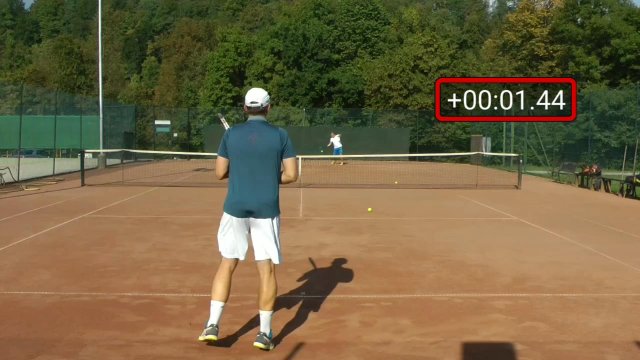
Most of my rally speeds are between 1.4 and 1.5 seconds ball flight time.
he ones that execute strokes calmly and therefore better control the ball and play with more precision, experience more time in that same 1.5–2 seconds of actual time.
The ability to perceive more time is developed through years of training starting in childhood, but there is a way to improve this ability to a decent level in just a single tennis lesson.
Ball And Time Perception
While you may think that you see the ball flight continuously with no “gaps” in your perception of ball flight, that’s not true when we talk about seeing the ball clearly, in focus.
And there are huge differences in how people perceive and track the ball flight.
I don’t have scientific data for that, but I do have more than 25 years of teaching tennis and seeing that difference quite obviously.
If a person has not spent a significant amount of time in their youth training their eyes and brain to track fast-moving objects (typically in sports with balls like table tennis, badminton, tennis, volleyball, football, basketball, etc.), then their ability to see and track the ball is very low.
Their perception of time will also be poor when it comes to fast-moving objects.
The brain is always learning. If we expose the eyes and the brain to fast-moving objects like tennis balls and let them adjust, these abilities will improve gradually.
But in my experience, the improvement will never be close to the level of someone who started with such activities in their childhood.
How A Tennis Beginner Sees The Ball
As you have seen in the video above, a tennis beginner sees the ball clearly in just a few moments of the whole ball flight.
They initially miss the contact as they are not trained or instructed to watch the contact of the ball and the opponent’s racket, so they will already be late to react.
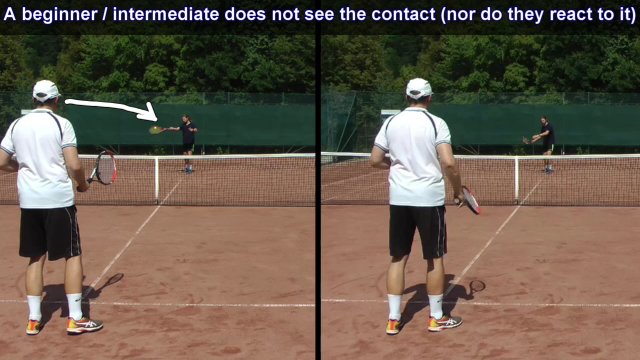
Since they are not tracking the ball from the contact, they need to “find” it as the ball is flying already, and that’s quite a difficult task for the eyes.
Once they do find the ball in space, they might focus on it for the first time. So that’s the first time they see the ball clearly.
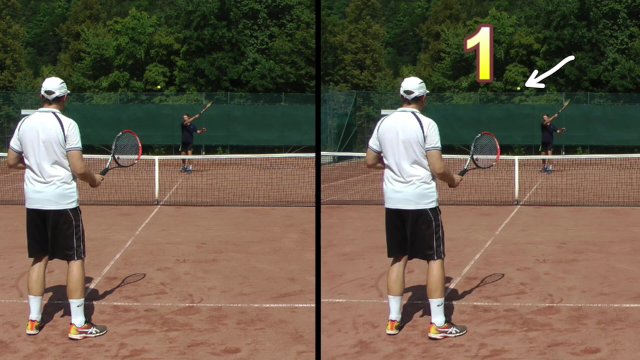
This is the first moment when a player sees the ball well.
Then they lose it and acquire it a bit later as it’s coming down over the net.
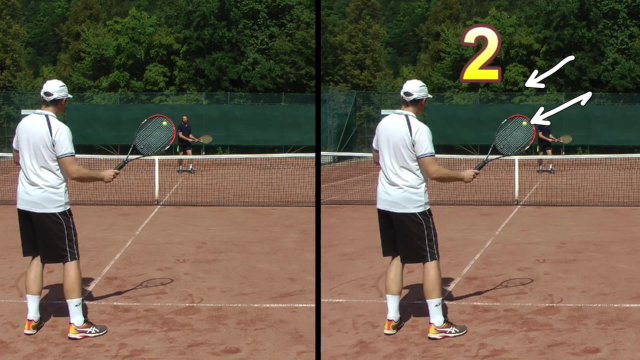
The second moment of clear focus.
That’s the second time they see the ball clearly.
After that, they lose their focus on the ball at the bounce (which is fine, an advanced player also has a blurry view of the ball at the bounce), and then they reacquire focus on the ball only one more time.
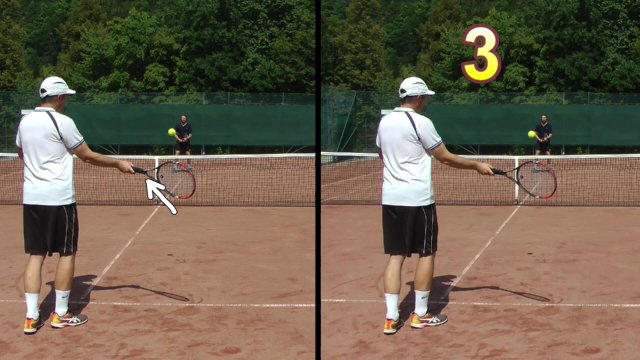
When a player sees the ball here that triggers their stroke.
That third time they see the ball gives them a trigger to swing at it.
An advanced tennis player will likely see the ball in focus 3 to 5 times after the bounce.
Their eyes and mind work like a camera shutter that quickly takes one picture after another.
A tennis beginner sees the ball only one time after the bounce, so it counts to them as one event.
That means they experience only one unit of time in the time from the bounce to the contact.
Because they experience just one unit of time, they feel rushed. They feel like they have no time.
An advanced tennis player sees the ball clearly in focus 3 to 5 times from the bounce to contact. Therefore, they perceive 3–5 units of time from the bounce to contact.
Because they perceive more time, they move slower and in a more controlled manner. As a result, they control the ball better and play more accurately.
Of course, they have better timing too because they are able to CHOOSE the ideal point of contact among the many they perceive.
A tennis beginner or intermediate tennis player is not able to choose a point of contact because they perceive only one event—namely seeing the ball once in focus—and that triggers their forward swing, which will in many cases be late.
How To Speed Up The Mind
A beginner’s mind works like a slow CPU with not that many cycles per second. They perceive only a small number of units of time.
We can speed up their CPU and its sampling rate with a very simple trick: the player needs to count as fast as they can.
They should use their own native language and use one of two ways to improve their perception of time and of the ball:
Drill #1 – Start counting from the bounce of the ball until the contact
The bounce of the ball should be the start. The player needs to say, “One,” at the bounce and then count out loud: “Two, three, four, five…,” until contact.
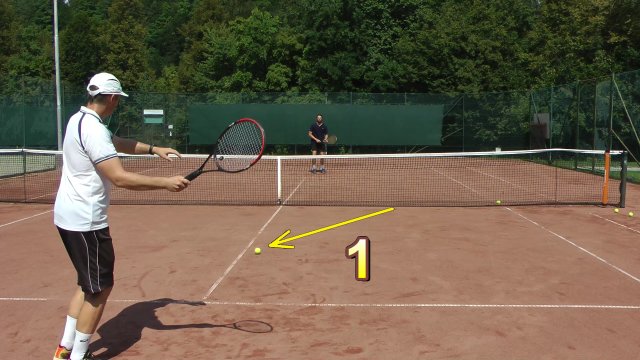
The contact with the ground is "One" and then keep counting fast until hitting the ball.
When playing mini tennis, we typically get to numbers between 3 and 5, but when playing on the baseline, you may get a few numbers more.
Drill #2 – Start counting from the opponent’s contact of the ball to your own contact
The player needs to say, “One,” when the opponent’s racket hits the ball and then continue counting out loud very quickly until the player hits the ball.
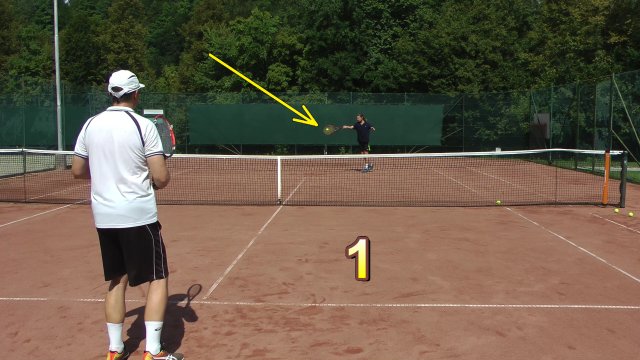
“One” is when opponent contacts the ball and then keep counting fast until you hit the ball.
At mini tennis distance, we can get up to around 10, whereas you may get above 15 when playing from the baseline.
It usually takes just 2‒3 minutes of counting like that before the player realizes that they now perceive more time.
The most common answer I receive is that the player “feels more time,” which is what I want to achieve.
They might not realize immediately that their movements have calmed down and are now much more smooth, but it’s very obvious to a tennis coach observing them play.
Because the player now feels more time and can move more smoothly, they time and control the ball better.
This is a very simple yet extremely powerful exercise that I have used many times with beginners and intermediate players with instant results.
Only in a small percentage of cases have the players not immediately felt the benefit of fast counting and speeding up their mind.
The player likely needs to spend a minute or two at the beginning of each tennis lesson counting and speeding up their mind—or raising their alert level and level of concentration.
They should continue doing that for a few weeks or months until this ability becomes permanent.
I invite you to try this exercise a few times regardless of your current level of tennis and see if something changes in your perception of time and your ability to control the ball.
If it does, let us know in the comments below. Thanks!
Tomaz the counting ‘drill’ is brilliant. As always.You are one of the best if not the best.
Hands down, THE best!
Tomaz incorporates the mental aspect of tennis into things normally treated as only physical or biomechanical, i.e. stroke preparation and stroke production.
Perhaps from his own experience as a beginner, certainly from observing the procession of his own beginner students, he understands the difference between what they’re experiencing and what an advanced player experiences. And somehow he devises drills that address that difference. That’s the genius part.
He is the Galloway of our time.
Oops! Gallwey. (I NEVER get that right!)
Excellent as usual. Nobody has explained this topic in such a clear way! Congratulations and Thanks!!
Great tool. I was initially thinking that you might have them just bunt the ball at contact. This would reduce preparation time and make them Realize they have more time than they think. You chose a cognitive approach. Is this the new think tennis approach? 🙂
Hey Arturo,
Well, I am just modifying an old rhythm and timing drill from Gallwey’s Inner Game of Tennis where he suggests the bounce – hit exercise.
The player should say “bounce” as the ball bounces on their side and “hit” when they hit the ball.
But when I look into my mind’s process, it’s not like that.
It’s the opposite – I pay full attention to the flights BETWEEN the hit – bounce – hit.
The shapes and speeds of those flights allow me to judge the ball well and time it well for the stroke.
So with these counting exercises I am directing the player’s attention to these ball flights and hoping that their mind locks on to them and starts making better calculations.
Sounds great Eager to try
Tomaz you are brilliant! You explain things so well
This is a very insightful and important observation. However, for me there is a significant difference in my time perception between rallying and playing sets. When I’m playing doubles, I’m nervous and I don’t see the ball. Also, my muscles tense up and I don’t move my feet, turn my shoulders etc. . I’ve actually done the counting when I’m practicing volleys and I’m surprised how much time I have versus when I’m playing competitively and the ball seems to be right on top of me immediately.
To use the CPU analogy, when I’m playing competitively the CPU is actually going much faster. But it’s spinning on processing lots of garbage data. I’m not sure if you suggest to do the counting while you’re actually playing competitively, but I would say the solution lies in the realm of relaxation and confidence. It’s easier said than done. So maybe a video on how to relax in competitive situations would be helpful.
By the way, I really like all your instructional videos and my friends and I discuss them. Our favorite line from one of them is “I don’t know what you are doing but it is not tennis”
Hi Bruno,
Yes, you perceive less time in matches because you are under stress. Stress is kind of like an interference running in your mind as it tries to process ball flight and send signals to the body how to solve that current problem.
You shouldn’t count when you play a match, you should try and focus on the task at hand. Calming the mind down during matches in any sport is what sports psychologists strive to help their players all the time.
So all general sports psychology tips apply: focus on the ball, stay in the now, calm down your breathing, focus on the current tactical objective, etc.
I invite you to check out my older website geared towards the mental game and see if you can find some useful tips there: https://tennismindgame.com/