
There is a source of power in a tennis serve that may not be obvious at first glance, and it may not even make much sense—but if you analyze the best servers in the professional tennis circuit, you’ll see that all of them use this source of power.
The video above explains the difference between the “broken body” and the “connected body”. It shows you the drills to help you feel the connected body and thus generate more power on your tennis serves.
Why Do We Break the Body in the First Place?
I believe tennis players break their body at the waist because they feel that they need to push and steer the ball in a downward path. Leaning forward with their upper body will help them find the angle under which they need to serve, but also give them additional power.
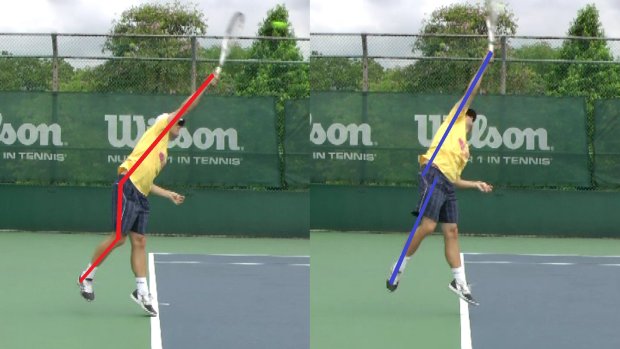
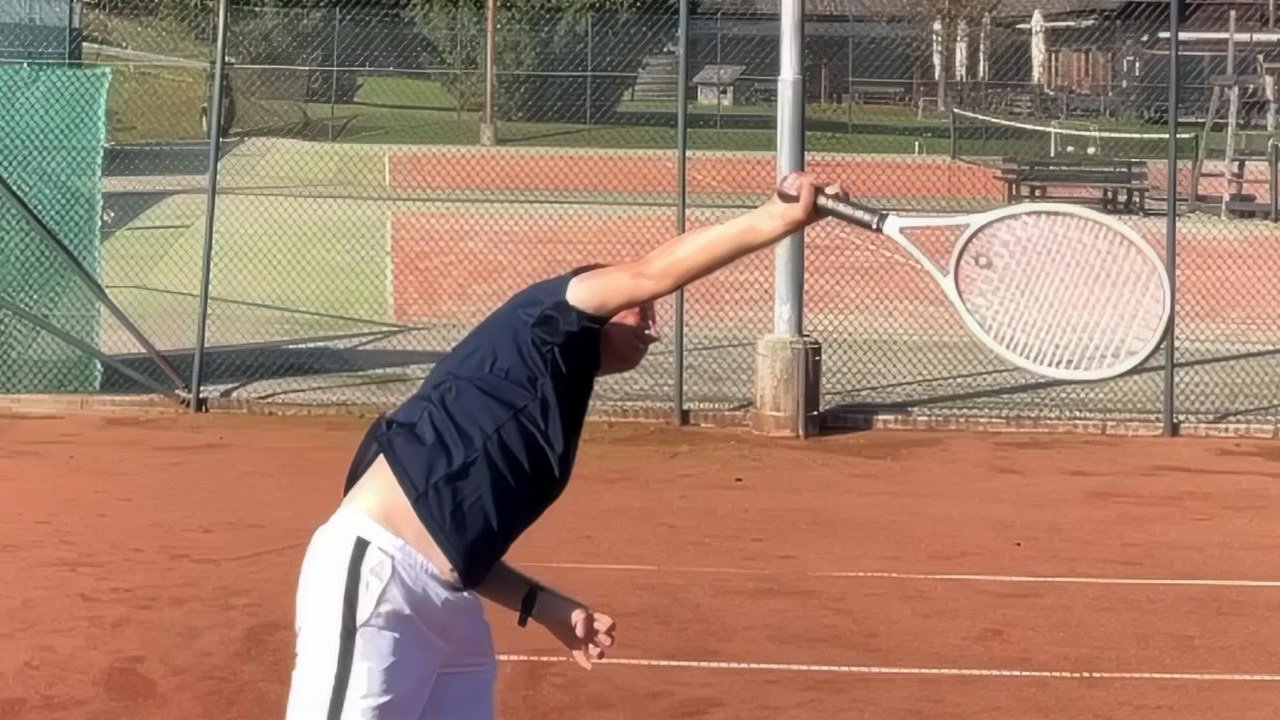
The "broken" serve on the left and the "connected" serve on the right
They are mistakenly looking for the source of strength, since they believe that in order to hit a hard tennis serve, you need to be strong and hit the ball hard.
Imagine how you would approach hitting a tennis serve if you read the above sentence before serving. Would you tense your muscles before and during the point of contact with the ball?
In order to hit fast tennis serves, we must look for smooth and fluid throwing action, through which we accelerate the racquet head and swing through the point of contact as if there is no ball.
Now imagine how you would approach hitting a tennis serve after reading the above instruction…
Let me know your thoughts in the comments below…
So in order to develop a connected body and incorporate it into the tennis serve technique, we first need to change our perception and mental image of how to hit a tennis serve.
Do not look for “strength” but rather for speed.
(I devote a whole section to this topic in my Serve Unlocked video course, and show you additional drills on how to serve with speed rather than with muscling the ball.)
Tennis Serve Technique of the Pros
If you analyze the serving technique of professional tennis players and know what to look for, you will quickly see that all good servers “connect” their body at the point of contact.
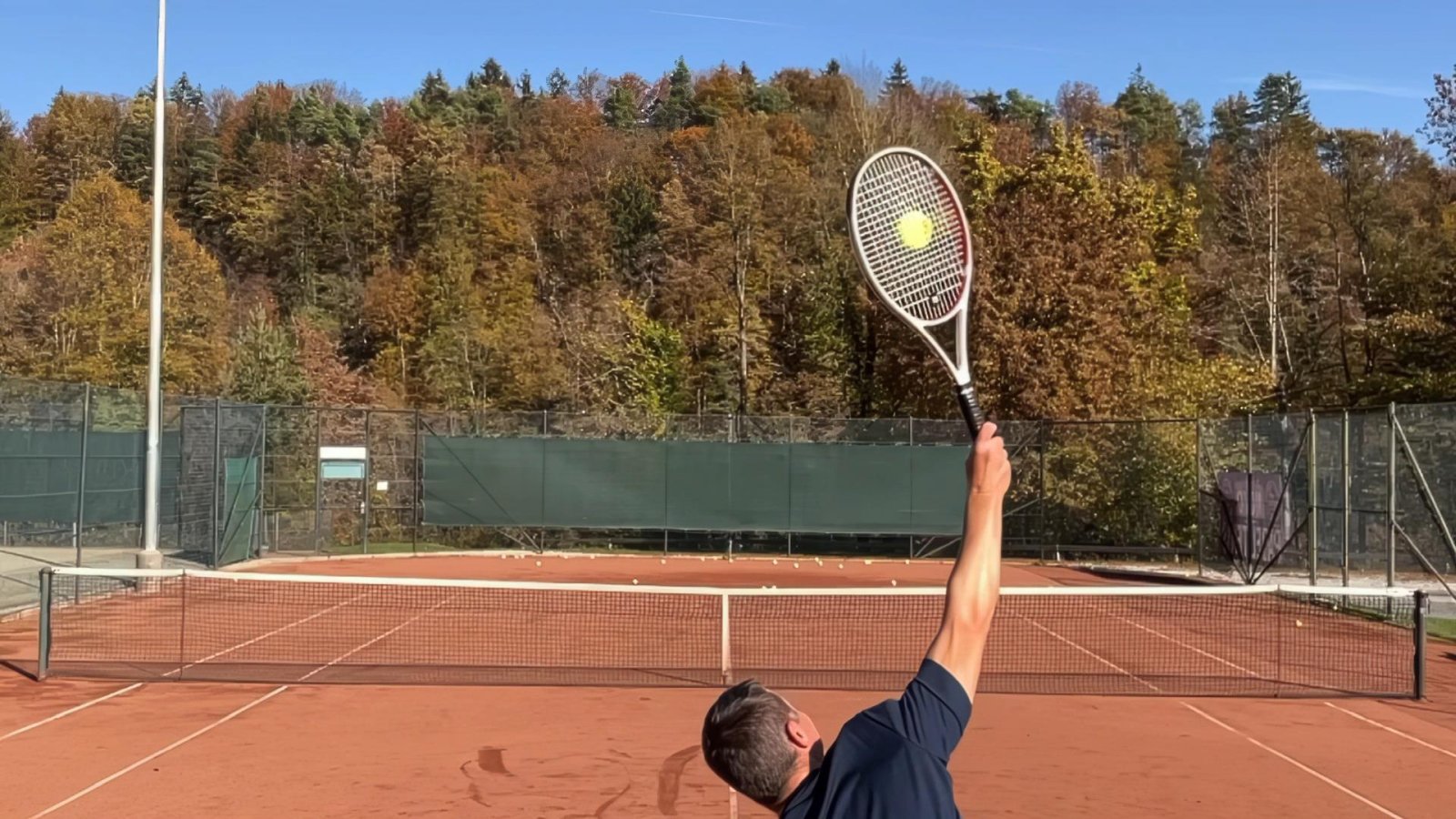
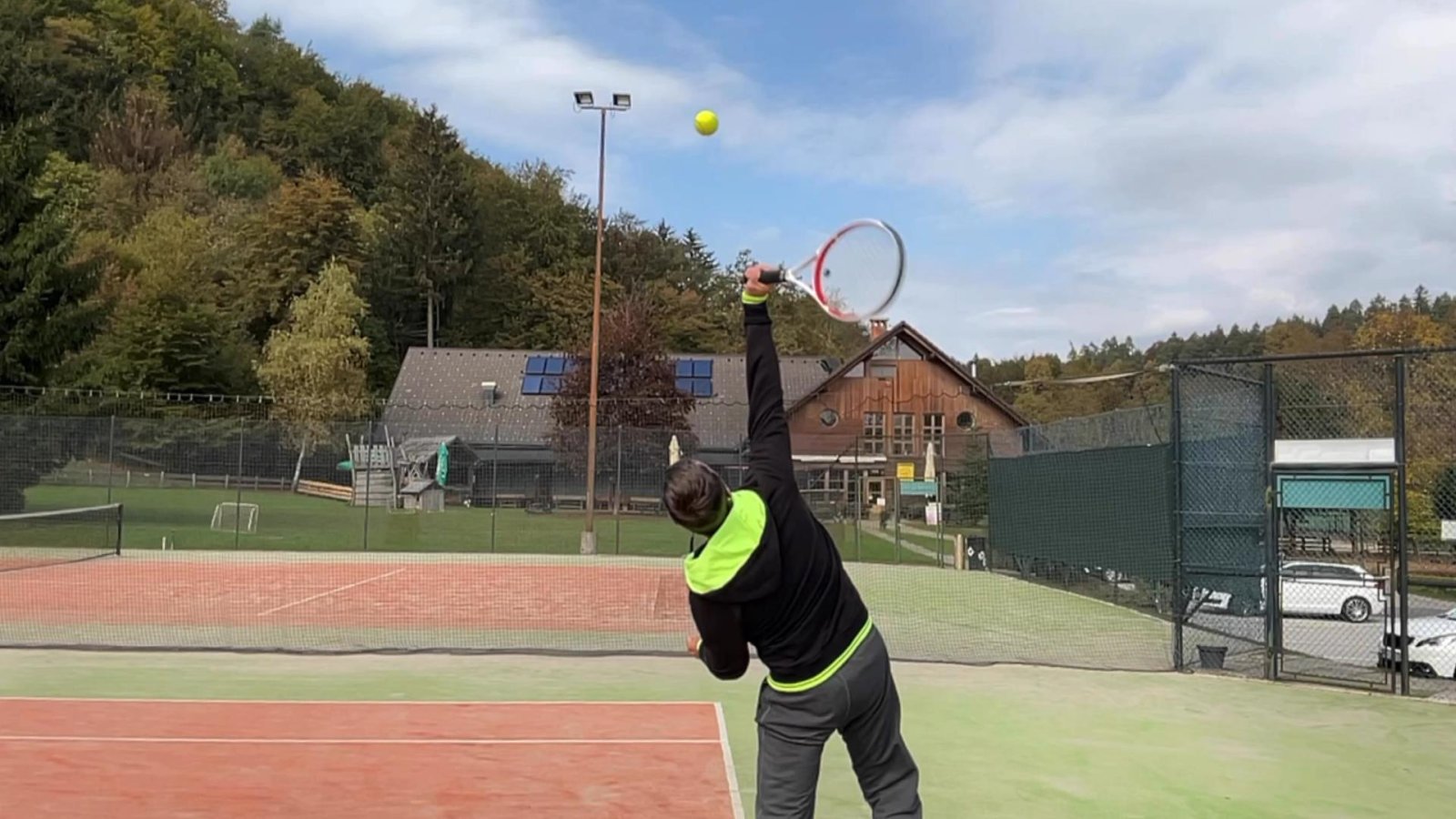
Connecting the body means that their body is aligned in almost a straight line that goes from their feet to the contact point.
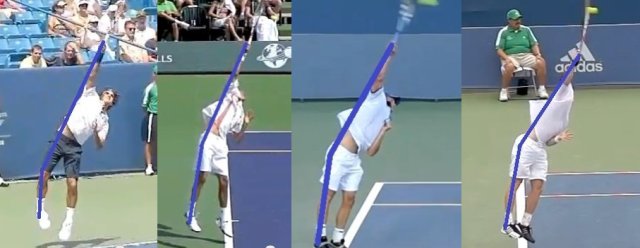
Roger Federer, Marin Cilic, Andy Roddick, Andy Murray
The less straight this line is, the more it is broken, and the weaker the serve is going to be, even though the player feels that with their forward movement of the trunk, they add power.
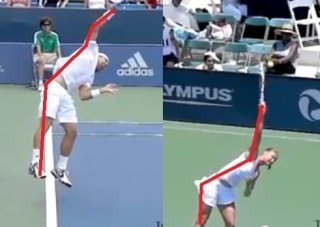
You can see this in the case of David Ferrer—he is not as straight to the contact point as Roger Federer, Andy Murray, Andy Roddick, or Marin Cilic are.
If you look at Dinara Safina’s serve at the point of contact, you can see that her body is even more broken, and that was definitely one of the reasons for her very erratic serve.
(Images credit: All images are taken from the videos of the TennisOne Youtube channel.)
So the key to more power and consistency in your serves is being more upright through the point of contact, and trying to feel the connectedness of the whole body.
How to Feel the Connected Body
The most effective exercise that helps you get the feel for hitting up and connecting your body in the point of contact is “hitting a fly on the fence” with a towel.
Just imagine a fly high up on the fence, and try to hit it with a towel. Pay attention to what muscles you use to do that.
In most cases, you’ll feel this firming up that goes through your arm, shoulder, back, and buttocks, and ends up in your calves.
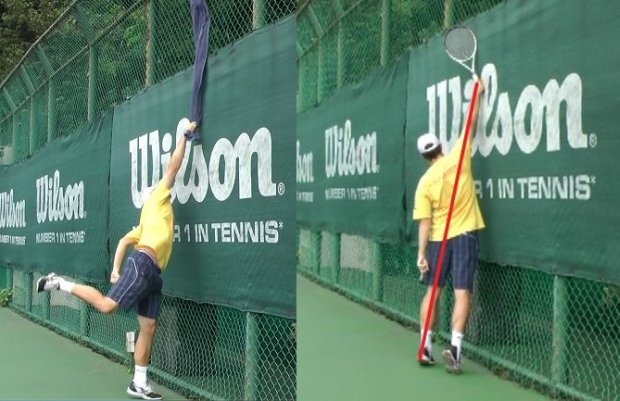
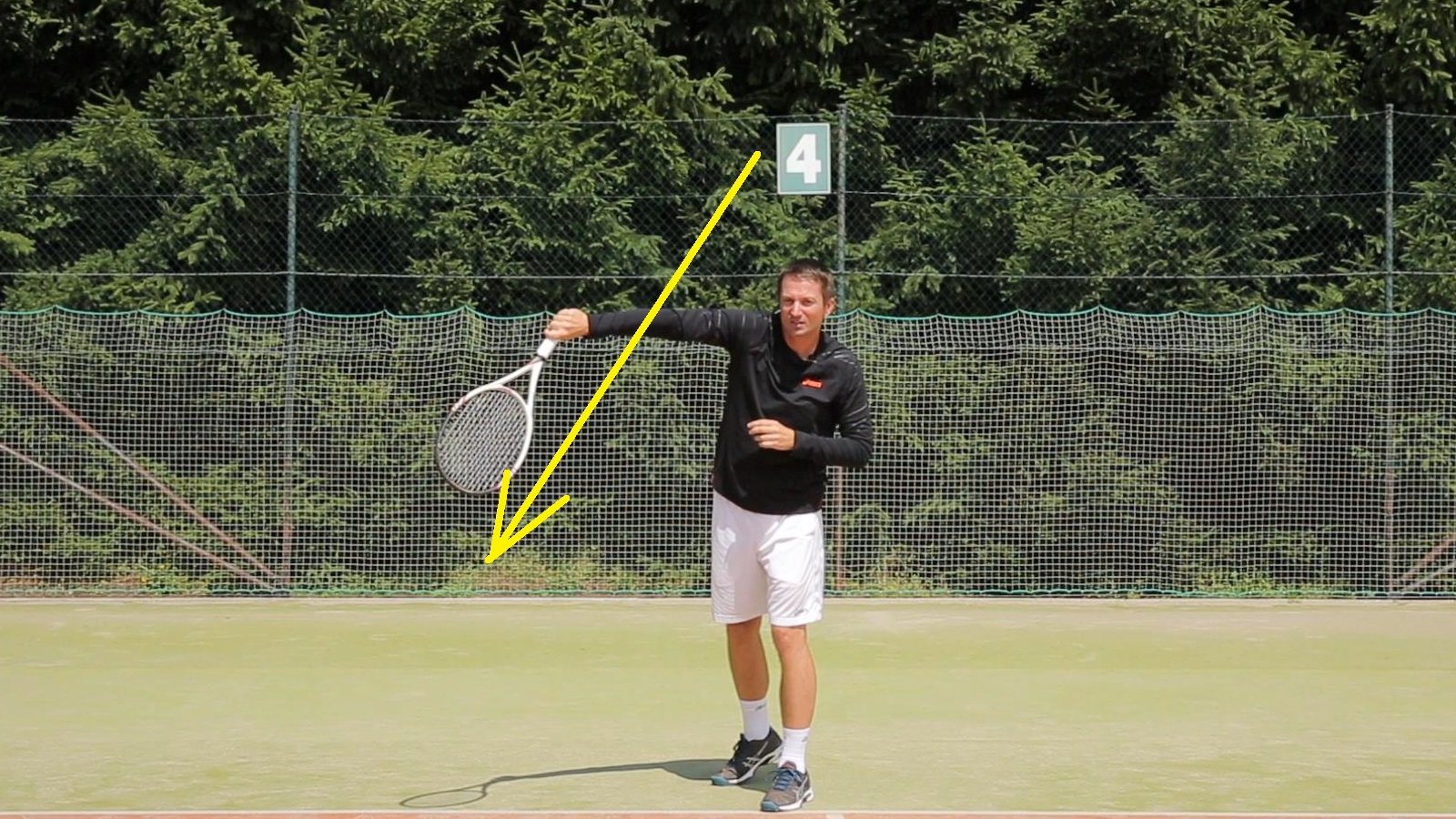
The towel drill teaches you to hit up and focus energy. Try to feel this diagonal line...
The right tension in this diagonal line will help you connect the body and transfer more energy into your hand, and thus the racquet head as well.
The second exercise is with the racquet.
Just push the racquet into the fence with the top edge and stand on your toes. You will feel this diagonal line going from your left calf to your right hand if you’re right-handed.
Press a few times so that you get a better feel for this firmness, and then hit a few serves in which you try to recreate that feel.
Don’t aim into the court, because that will probably make you lean forward again with your trunk.
Just hit the ball straight ahead, parallel to the ground, and try to connect your body in the way described above.
With some practice, you should be able to incorporate this technique into your tennis serve.
Let me know how it goes!
Great post Tomaz! I found the pictures of all the pros very revealing. Notice that Murray and Ferrer seem to be the most broken. Murray in particular is not known for having a great second serve. So I am wondering if the broken line leads to a paradox. For most players that can jump high enough or are simply tall a broken line generates a decent flat or even slice serve because they can come across the side of the ball. In order to hit a great kick serve you have to go up to the ball. So I am wondering if the great servers hit a more similar first and second serve. Or maybe a better way to ask it. Does the upright straight line give a player more options? It allows kick, topspin-slice and flat all from the same motion?
Hi Arturo,
Even though the second serve is hit slightly more behind and at a lower contact point in order to hit up on the ball, the player’s body will be extended in the same way.
He will only hit the ball when his racquet is more horizontal.
Pause this video at 0:25 when Federer is hitting a second serve and you’ll see what I mean:
But it is true that top servers like Federer can hit any type of serve from the same toss (which is not what happens in the above video) so they do extend into the contact and only vary what they do with the “hand” to the ball.
Federer can’t hit an extreme top spin serve (a kick serve) from that same toss but he can hit a decent spin serve…
That’s why when he wants a real kick serve, it will be very obvious from the toss like in the video above at 0:25.
As usual Tomaz your emphasis on simplicity and clarity in all your teaching methods puts you at the very top of your class of teaching pros, and that method is surely present in this video session. The comparison of the pros is most revealing. I would be interested in your response to Arturo Hernandez’s great question. I believe the pros bend their backs a little more on the second serve to get more to the inside of the ball and then sideways on contact but still with the “straight line” position. Am I correct? Many thanks again for your outstanding teaching video. Jack McGinty
Hi Jack,
When I check the videos of second serves, I see extended body and arm, only the hitting point is slightly lower so that they can hit up.
I notice the connection line for the serve practice against the fence is shown running from the hand on the racquet handle to the left foot. In the other still photos the connection line is shown running from the hand on the racquet handle to the right foot. To the left foot the line looks straight while on the right foot the line seems always to have some bend to it. When I am serving, which line should I try to visualize?
Hi Robert,
You will feel the connection to the left foot if you are a righthander.
I chose a side view for the pros and my demos because I also wanted to show that there is no bending in the waist. So yes, there are two lines possible – one to the right leg which is slightly bent and one to the left leg which feels more straight.
This is very clear to see in the image of Roger Federer – see how you can draw almost a straight line from his left leg to the hand…
Hi Tomaz,
Thanks for all the great answers! So would you say that the serve is much more up than most other throws we make at such a short distance. I have always visualized the throw as forward but the serve is much more up than we realize. Would you say that most people would be helped by exaggerating the upward component of the throw in order to serve better?
Just wondering.
Thanks,
Arturo
Hi Arturo,
Yes, the serve motion is very much an upward acceleration. Here’s a food for thought: the serve is everything up to the point of contact. After that the ball is gone, it doesn’t matter what you do.
So for some mental exercises you can look at a few serves of top pros and pause the video at the contact pooint.
Everything you saw from beginning until the contact is the “serve”. What you see after the contact is WHAT HAPPENS and not what we do. 😉
Tomaz, I think sometimes the broken structure helps, I solve the problems with my overhead in the in the mid court with broken body structure. The more I jumped up to maintain the connected body, the more its difficult to crush overhead
Hi Tunde,
The overhead is different because we hit the ball often in difficult situations.
Many times we may produce force for the overhead only with the pronation.
Hello Tomaz,
thanks very much for all of your insightful tennis instruction, as always.
This is an interesting video because I find that the best way for me to feel this “straight line” is to have my front foot go up on ‘tiptoe’ … but not actually leave the ground. In fact, as a recreational amateur level 3.5, I find it very difficult to actually have both feet leave the ground when serving. My front foot (at best) goes up on tiptoe during the contact phase.
You have mentioned before that leaving the ground is more a by-product of an upward action as opposed to having to consciously think about ‘jumping’. Nevertheless, I still struggle with this concept. For some reason, I find better balance if my front foot toe is in contact with the ground. If the toe leaves the ground, I have no more ‘reference point’ and I don’t know how high to toss the ball and my whole timing goes out the window resulting in shanking the ball. Any advice is appreciated!
Tomaz, Thanks again from Canada! — Philip
Hi Philip,
I suggest you don’t really think about being in the air and not touching ground. Just serve as you do, keeping your toes touching the ground and gradually increase upward force.
Swing upwards, perhaps try a few kick serves and really try to impart lots of heavy top spin on the ball and you may find yourself leaving the ground at some point.
Again, no need to think about it, it may happen. If it doesn’t, no worries, what matters is high racquet head speed. Legs drive contributes only a little bit to the power of the serve…