
If you’re and avid tennis player looking to learn correct one-handed backhand technique, then this analysis of Grigor Dimitrov’s backhand will hopefully point you in the right direction.
This is the second video released in collaboration with Jason Frausto from TennisUnleashed.net who has graciously allowed me to use some of his videos for this kind of video analysis.
The unique way to look at Grigor’s backhand is again removing the racquet from the video which may help you get a new and a better perspective on how the stroke is properly executed.
As I mentioned before, I believe that the racquet often times distracts us from interpreting correctly what we see because we unconsciously start to follow the racquet’s movements with our hands.
And because racquet’s path is longer than the hand’s path, we may end up doing way too much than it’s actually needed.
So in this one handed backhand analysis I’ve pointed out three situations where you may interpret the stroke incorrectly.
1. The Preparation
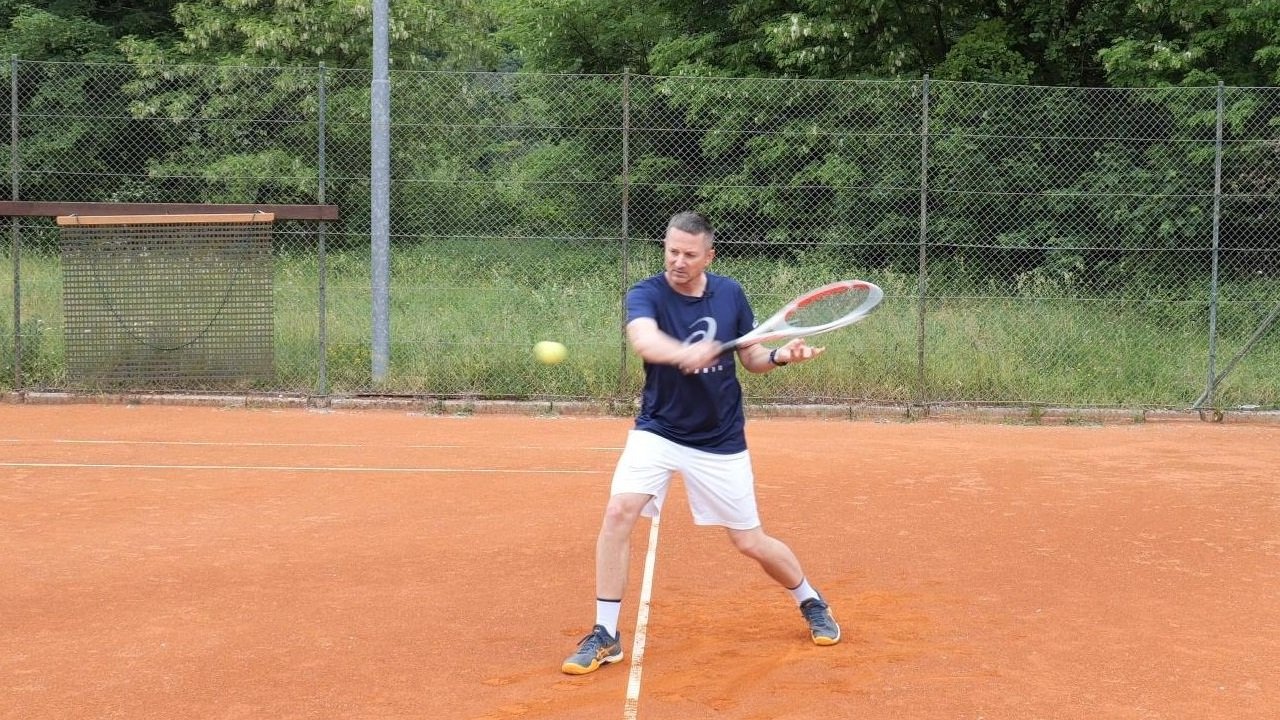
In this side view of Dimitrov’s backhand we’ll focus on the preparation.
So again, you may focus on the racquet head a lot and then subconsciously and unknowingly follow its path with your hand.
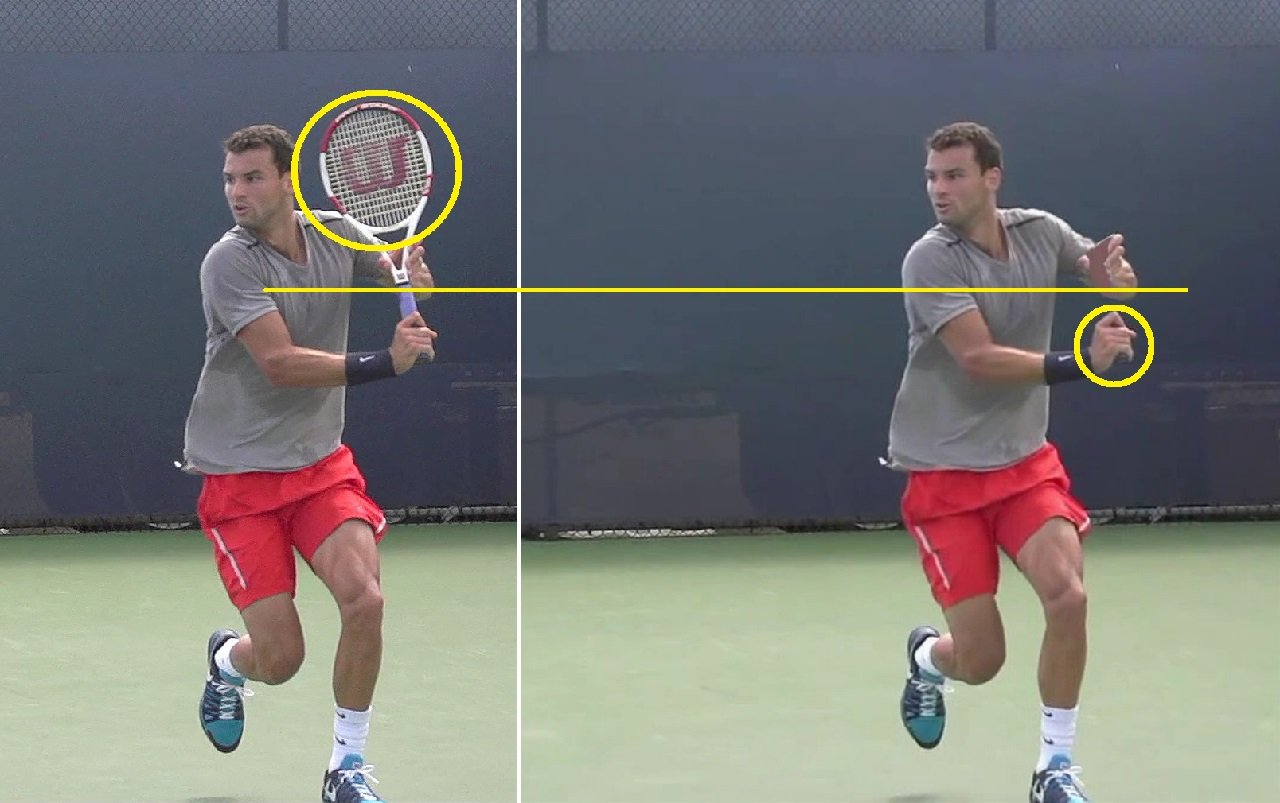
So it’s important that you see clearly that while the racquet head is quite high in relation to Dimitrov’s body, in fact the tip of the racquet is above high head, his hand has barely lifted up from his ready position and it’s still at a very comfortable height just below his chest.
You can see that clearly in this image when you observe how little has the arm actually lifted from the initial position in the ready position to its maximum height from where Grigor starts his downward swing.
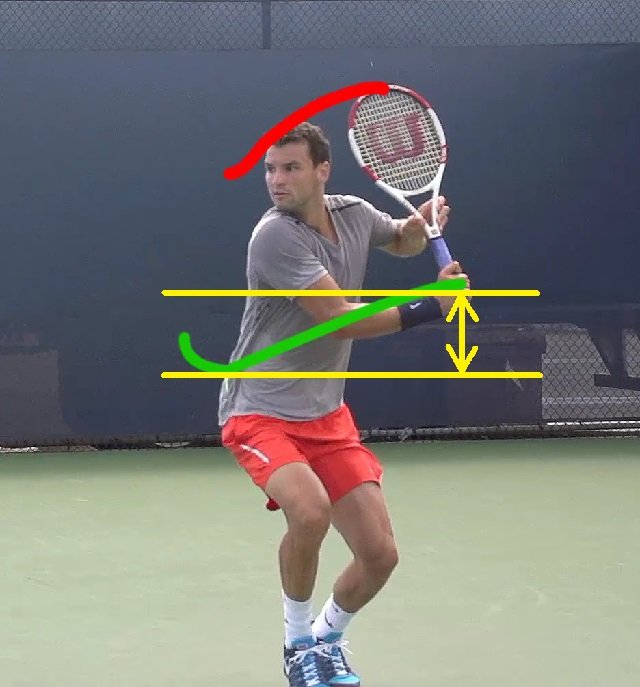
The maximum height the hand has reached starting from the ready position.
2. The Racquet Lag
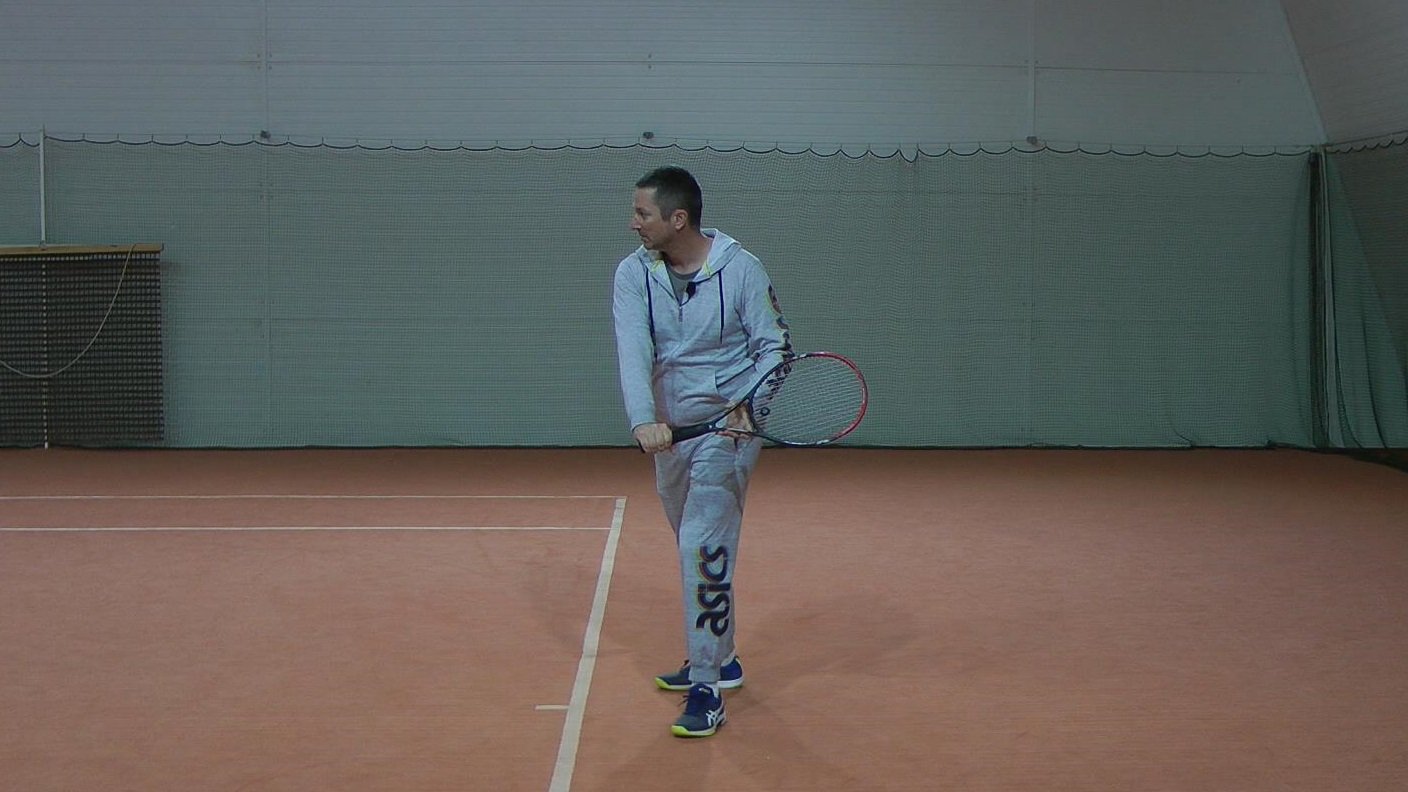
In this front view of Grigor’s one-handed backhand, the position that you might misinterpret is when the racquet is behind his body but the hand is in front of his body.
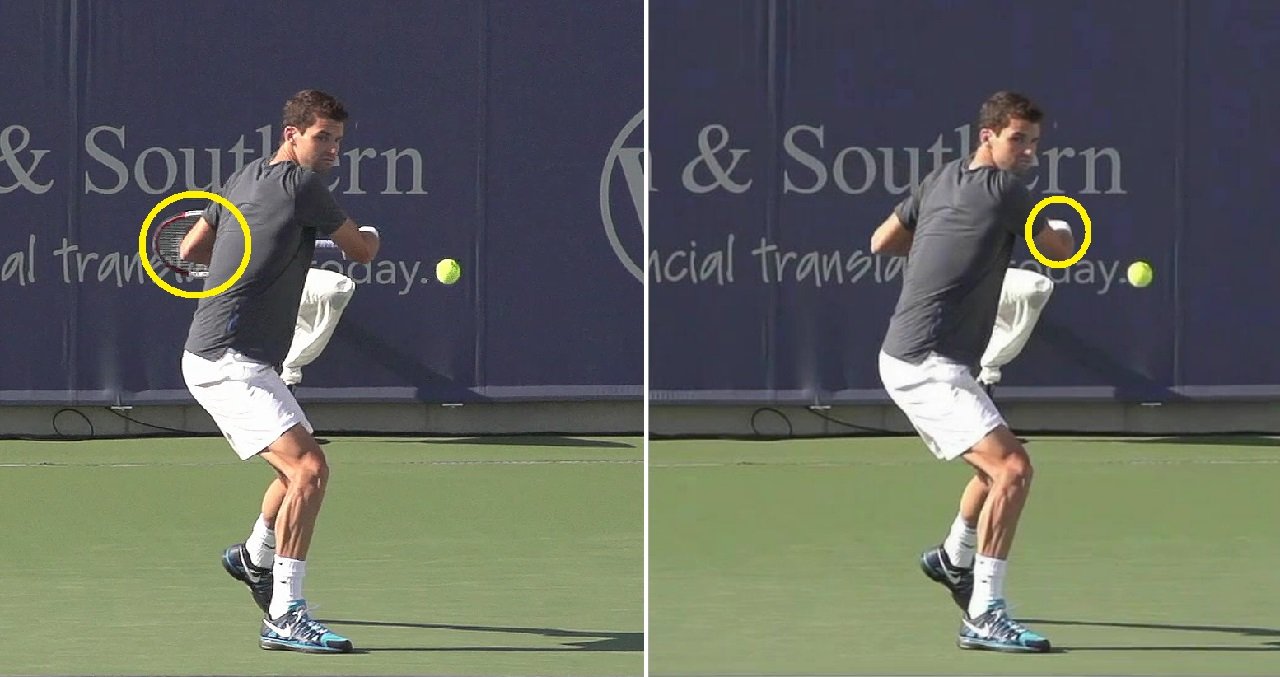
Racquet head behind but hand in front of body (Click image to enlarge)
If you focus too much on the racquet head, you may want to move your hand way too much behind you which will coil your body too much and make it difficult to time and control the ball well.
But if you focus on the hand too much and see that it’s in front of the body, you might not create enough lag of the racquet head as you’ll want to keep the racquet also in front of the body and therefore lose on power of the stroke.
3. Getting Under The Ball
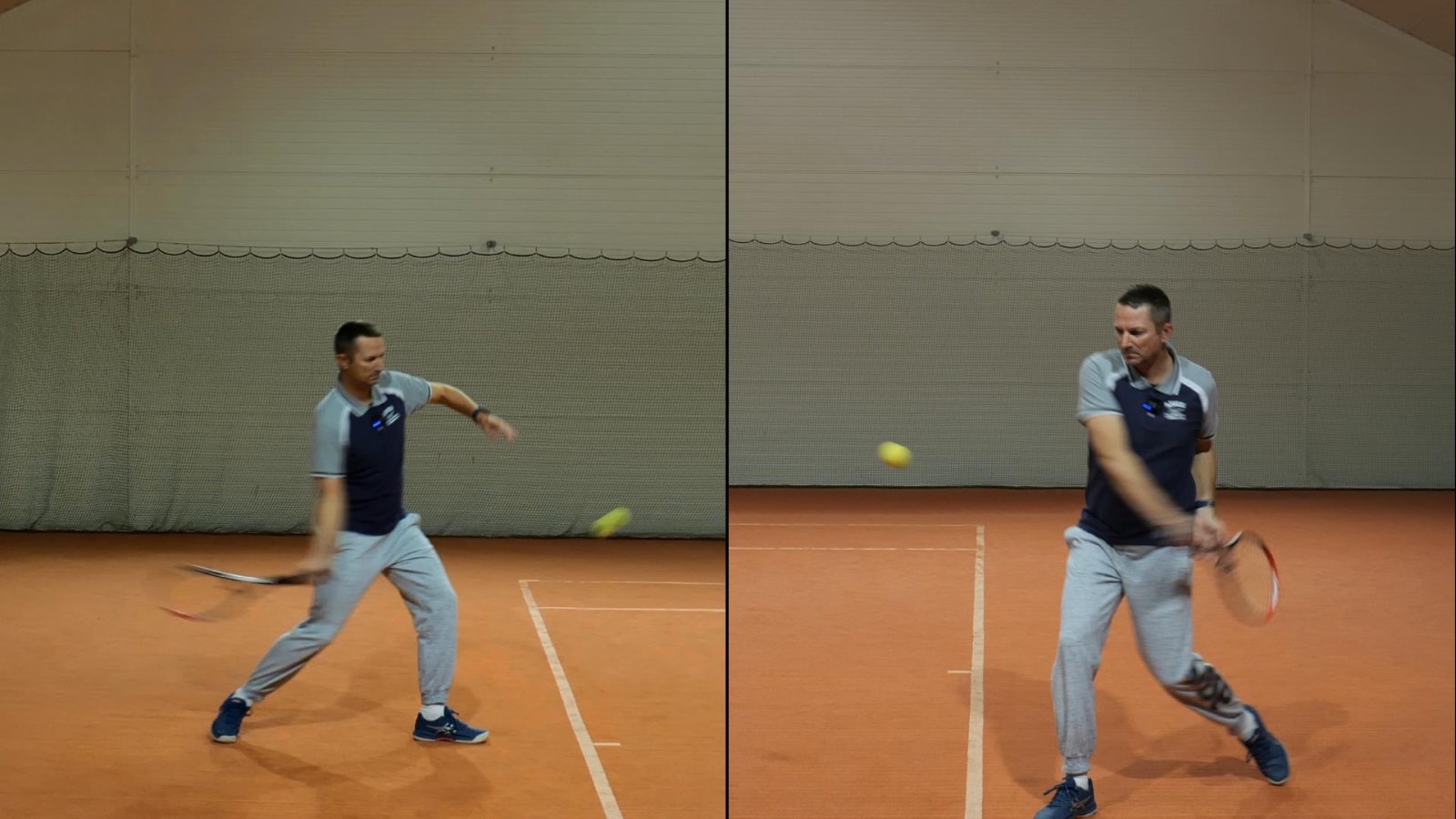
In the back view perspective of Grigor Dimitrov’s one-handed backhand this side by side image shows the difference between how much under the ball the racquet is and how much the hand is.
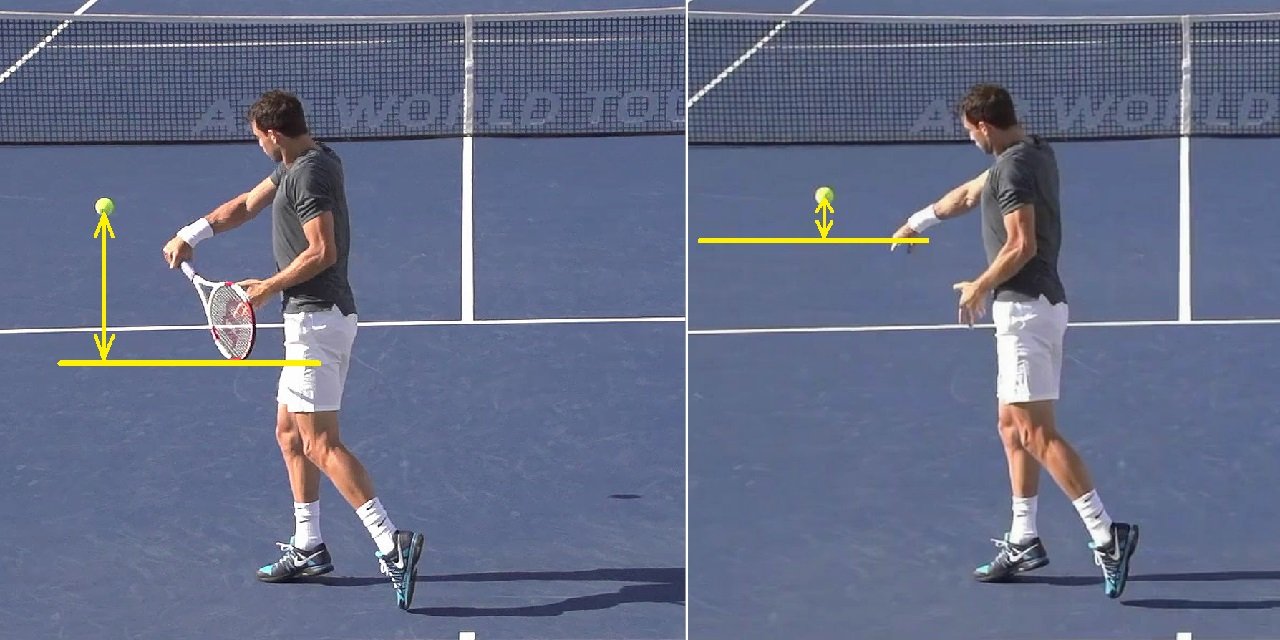
The difference of racquet vs hand getting under the ball (Click image to enlarge)
You’ve heard many times the instruction of getting under the ball, swinging low to high or something similar but what I’d like you to note here is that it’s not the arm that swings under the ball but it’s only the racquet head that’s dropping.
Yes, Dimitrov is hitting a more aggressive backhand here but he is still dropping the racquet head under the ball quite significantly whereas his arm hasn’t gone much under the ball.
What you may often do incorrectly when you hear about getting under the ball is to actually move your arm way too much under the ball and then having to lift it quite artificially and forcefully up towards the ball and in the process losing on the power and simply creating too much lift and too much slow top spin.
So just something to keep in mind the next time you hear your coach tell you to get under the ball.
Yes, it’s more about relaxing your hand a little bit so that the racquet head drops rather than actually moving your hand and arm way below the ball.
So have you noticed anything new looking at Grigor Dimitrov’s one-handed backhand technique in this different way of analysis when the racquet is removed from the images?
Very nice job again Thomas. This is very enlightening and will help a lot of players.
Much appreciated, Jorge, thanks for stopping by!
thanks, as soon as i start to own a forehand, I will get back to this. it looks good as I am using a one handed backhand for what it is worth for now. I will get there.
This kind of instruction is always useful, Tomaz. I use a two-handed backhand, but can apply the tip about where my hands are relative to “getting under the ball.” You also make me wish I lived somewhere in your vicinity so that I could employ your services and experience your instruction live. Be well and thank you!
Thanks, Joanna. Two-hander comes out next week, stay tuned.
Thanks Tomaz, wonderful anaslysis. would you be kind enough to a similar analysis on Wawrinka;s backhand top spin ?
Thanks again.
Dan
Hi Dan,
I don’t have access to Wawrinka’s backhand but there’s no need to because biomechanically and technically both one-handed backhands are almost the same.
You wouldn’t see any difference in preparation, lag or getting under the ball. The laws of physics and the type of ball you hit dictate the racquet path through the ball. It must be the same…
I find it very useful and intresting for lessons
Great video Tomaz, you always find new and simpler ways of teaching tennis, I love this idea you’re doing with Jason, you are very much appreciated!
Very interesting video and analysis. I appreciate your dedication to teach tennis from an innovative perspective. Regards.
Great write up(as usual!)to support some fascinating images Tomaz thanks. I have the tendency to hit soft often short shots with too much topspin-i think I now know why!
What would be the best way to go about correcting dropping my arm too low any thoughts would be appreciated
Hey Steve,
If you’re dropping your arm your shots have too much top spin and not enough pace which is what you mention too.
Now you may actually want to hit those shots because you’re afraid to hit deeper and faster since it feels risky. So your technique simply adjusted to your intention.
You need to change your intention first and secondly, imagine a less pronounced drop under the ball so that you change also your technique.
Wow! Your right, when i think about it, I do fear the ball will go long or in the net without loads of topspin.I see now a way forward-change intention and imagine a lower drop can’t wait to work on it. many thanks Tomaz
Great videos! Thanks a lot for posting them. Never realised how wrist can work when hitting backhand. Would really love to see one for forehand.
excellent ..also two hand..of Nole next ?
Jason will probably post something on Djokovic’s backhand, but here you’ll see Verdasco’s two-handed backhand.
Awesome Thomas I have never hit a backhand this hard before watching this video great stuff can’t wait to get back out on the court and hit some backhands cheers
Dear Tomaz:
Very good video analysis with excellent illustration of the backhand…
I frequently drop my wrist too much in an effort to obtain topspin on my backhand… my ball goes too high with insufficient drive or, it lands just long!!
I love your teaching videos & explicit verbal descriptions of how to approach good tennis strokes..
Thanks,
Anya
Thanks, Anya. If the ball goes too long, don’t correct that with mechanics thinking about your body and arms, but simply imagine it shorter.
You have speed, spin and height parameters that determine depth. Play with them…
I found the videos with the racket removed very useful. You are correct, I have been move my arm and hand to much! Thank you for this great new tool.
Bruce
Excellent video Tomaz!!!
Your videos help a lot!!!
I have a tendency to rise my elbow when hitting the backhand, while it should be closer to my body. What would you suggest to avoid this problem?
Do you have any plans to come to Brazil?
Thanks a lot!!!
Try playing with a choked up grip, holding the grip close to the throat and playing mini tennis. See if that helps when playing short distance first…
Sure, I’ll try that!!!
Thanks again!!!
Thank you for your excellent breakdown!! I am a big fan of one-handed backhand. Thanks to your tips, I am able to unleash one with considerable confidence and I do prefer it over my forehand – proud to say that. Lately, I have found myself unable to meet the ball up front and, instead, run into the ball or end up hitting the ball a bit later. I wonder how Grigor, Wawrinka and others are able to consistently meet the ball up front. Thank you in advance for your advice.
Hi Roger,
Meeting the ball well in front requires your constant attention to that – meaning that as the ball is approaching you are focused on hitting it well in front.
If you forget about that you’ll be likely late. You have to practice that awareness until you ingrain that process. It might take you a few months of doing that before it’s ingrained.
Hello Tomasz,
Nice video. What grip is Dimitrov using here?
I would say slightly over the Eastern grip, so a little bit towards the Western grip, maybe 2 millimeters change from Eastern grip.
I would say slightly over the Eastern grip, so a little bit towards the Western grip, maybe 2 millimeters change from Eastern grip.