
“Making mistakes in tennis is normal. Everyone misses; even the pros do.”
When you read this statement, you probably nod your head and agree with it. But when you play, you most likely react to every mistake you make.
Suddenly, you’re not so convinced that making mistakes is normal.
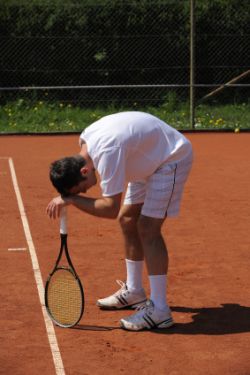
Do you react to missing a shot in tennis?
In fact, you probably react to every mistake you make with something negative – a sigh, negative self-talk, a frown or some other action that shows you’re dissatisfied with yourself, with your shot or with your shot selection.
If I asked you after the match (or simple free hitting lesson) which of your mistakes were normal, you would most likely find an explanation for each and every one you made, and none of these explanations would be “that it’s normal”.
You might say you “should have”:
- Bent your knees more
- Watched the ball longer
- Had better focus
- Put more spin on the ball
- Etc.
Every mistake would have an explanation, and you would believe that if you hadn’t made that error, you would have hit the ball in, right?
If you keep correcting yourself and eliminate those errors, you won’t make as many mistakes, right?
If you agree to the above statement, then you also agree that there are still some mistakes left. You probably didn’t say that if you eliminated all the causes of your mistakes, you would have never missed.
So, some mistakes are left there. “We all miss; even the pros do.”
Following this logic, if you’re a 3.0 player and you want to play like a 5.0 player, you believe that as a 5.0 player, you will miss less.
In fact, the better the player, the less they miss, right?
Well, not exactly!
In reality, something else happens…
The following video shows 3 very different tennis players:
1. A total beginner (my nephew ) who was on a tennis court for his second lesson with me. He had never played with a foam ball before, but he had played a lot of table tennis and badminton, so his hand-eye coordination is good, and he is able to rally well with a foam ball.
2. An older club player who was self-taught and started taking lessons a few years ago.
3. My friend and I – both have been playing tennis for over 25 years, and both are tennis coaches.
As you saw, the average rally in all three cases lasted about 20 seconds!
People think that when they fix their strokes, movement and timing, they will miss less.
That’s NOT really the case!
Why?
Because once you know how to hit a better ball, you attempt it – and that’s riskier!
Sure, I don’t have to miss if I rally like that club player. (you can see me in the background – I just gently played the balls back.)
But I don’t want to.
I want to hit higher quality shots.
So, now I miss. And I miss at about the same rate as a less skilled player – but when I hit in the court, my shot is better. (And I am able to play better shots from more challenging situations.)

I even miss the first "feed" shot of the rally sometimes... Perhaps 1 in 100... Should I expect not to miss when I play a rally which is much more difficult?
You’re traveling exactly the same road – the more skilled you are, the higher quality shots you’ll want to play – which means that you’ll play with the SAME risk of missing as someone not as skilled.
The same risk of missing means that you’ll miss roughly the same amount of balls.
So, there is no end to this journey.
You will never end by playing tennis so well that you won’t miss (except at a very low level of tennis which you won’t want to play – it’s not fun, not exciting and not rewarding!).
The idea that more practice helps you make fewer mistakes is WRONG.
It is true only for your current playing level.
As soon as you can make fewer mistakes at that level, you’ll want to play better. So you’ll play better, but you’ll still make a mistake every 20 seconds or so.
The final point is this – each time tennis players make mistakes, there is a reaction, meaning that the players would prefer not to have made those mistake. They believe they did something wrong, and if they fix “that” thing, they won’t miss the next time.
That’s an illusion. You will keep missing.
A certain percentage of mistakes are unfixable. The mind makes a mistake at calculating the ball trajectory, the body is not well-coordinated, the timing is slightly off – you name it.
These causes of errors are not fixable (since human mind and body abilities are not perfect!), meaning you cannot eliminate them. This in turn means you cannot eliminate mistakes completely.
Why Are Tennis Players Different? Tennis Is No Different…
Yet, this logic doesn’t seem to get to tennis players.
Everyone I know reacts to a mistake. They think they did something wrong. No one accepts mistakes as normal.

Do recreational basketball players react to missing the hoop as negatively as tennis players when they miss a shot?
Still, when I watch recreational basketball players play near our tennis courts, no one reacts negatively to missing the basket.
It’s normal to them.
OBVIOUSLY you cannot hit the basket every time.
However, this simple logical idea is totally strange to tennis players as EVERYONE reacts to almost EVERY mistake they make.
They say something, they frown, or they do something else to show their dissatisfaction – meaning they don’t think it’s normal and obvious that it’s just a matter of time before they miss.
Why are these expectations so different between basketball and tennis players when REALITY keeps telling us for years and years that we keep missing?
(I’d really love to hear your thoughts on this in the comments below.)
The simple reality is this: the longer you play tennis and the more you practice, the higher quality shots you’ll be able to make.
But mistakes will stay forever. In fact, the rate of balls in vs. mistakes will stay roughly the same throughout your life.
This holds true even for pushers – they will push a more quality ball when it goes over, but their rate of missing will stay roughly the same.
Therefore, reacting to mistakes and scolding yourself is totally illogical and useless.
You need to accept mistakes as a part of tennis in the same way that missing a basket in basketball or striking in baseball is something completely normal and simply a matter of statistics.
In fact, as soon as you start a rally, the clock starts ticking.
It is simply a matter of time before you make a mistake.
As soon as you start the rally, it's only a matter of time before you miss.
Can you rally for one hour without mistakes? Do you believe that if you do everything technically correctly you won’t miss?
If that’s true, then why do the top pros miss?
What’s your explanation for that? Should they work on their technique?
So, if you agree that it is impossible to rally for one hour without mistakes and that is impossible to play a match without mistakes, then which of your mistakes do you accept as normal?
If you’re brutally honest with yourself, you’ll see that you don’t accept any. (We’re talking just about unforced errors in this article, not forced ones.)
What you demand of yourself is impossible.
The reality is that you’ll keep missing shots for the rest of your life, and it’s better to accept them as a normal obstacle in your path toward the end goal.
To me, a mistake is the same as a red traffic light when I am driving a car toward where I want to go.

I see mistakes in tennis exactly as I see red traffic lights while driving a car.
Red traffic lights are normal, and they stop my journey temporarily.
They are unwanted events, but I don’t get upset at every red traffic light. I simply accept them as a reality of driving a car in a city.
That’s exactly how I see mistakes in tennis.
They are unwanted, but I accept them as a reality of tennis and simply move on to the next rally.
I do get feedback from the mistake, but I know that my mind and body are not perfect and that believing that I “wouldn’t have made that mistake if I did something correctly” is completely false.
At that moment with my current sports abilities and current mental abilities, I was not able to do that – and I never will have perfect body/mind abilities.
Therefore, I will keep missing.
The Reality Of Sport

Kobe Bryant misses roughly 1 out of 6 free throws!
Here are some stats that reflect the reality of any sport – and this is from elite athletes in each sport:
1. Kobe Bryant (basketball), season 2011-2012:
- Free throws: 84.5%
- Field goals: 43%
- 3 points: 30.3%
2. Tiger Woods (golf), season 2012:
- Putting from 3-5 feet: 92.11% (missed 8% of putts from this distance – which is roughly 1 out of 12)
- Putting from 5-10 feet: 61.06%
3. Second serve statistics of tennis players in Grand Slam finals in 2012:
- Australian Open: Novak Djokovic – 66 / 68 (97%), Rafael Nadal – 62 / 66 (94%)
- Roland Garros: Novak Djokovic – 46 / 50 (92%), Rafael Nadal – 41 / 45 (91%)
- Wimbledon: Roger Federer – 38 / 41 (93%), Andy Murray – 68 / 69 (98.5%)
I chose the second serve statistics in tennis because the players have an extremely safe second serve. In the case of Djokovic and Nadal, neither of those two wants to risk anything on the second serve –yet neither can serve at 100%.
Sure, it may happen in a match here and there, but the point is that the mistakes are unavoidable.
Of course, none of the players had 0 unforced errors in those matches either.
The reason that you need to look at the above stats is to SEE that, no matter which numbers you look at in the long term, none will show 100%.
Even the best, most talented athletes in the world are unable to make 100% of shots in situations where they are not disturbed and simply need to hit a target that they have been practicing on for more than 20 years.
Kobe Bryant cannot make 100% of free throws, Tiger Woods cannot make 100% of putts from only a meter away and Roger Federer cannot make 100% of the second serves in the long term even though his service technique borders on perfection.
What are your expectations then?
Why do you demand of yourself not to make mistakes when it is in fact impossible to do so?
When it comes to tennis, it’s not really that you’re not disturbed. In most cases, you’re trying to hit a small moving ball with your moving racquet while your body is moving – and direct it into a target.
Sure, you may say, the court is so big – but in most cases, you weren’t just trying to hit the court. You were aiming close to the net, close to the sideline, close to the baseline or maybe even all of those.
Additionally, your target was extremely small, and you were trying to hit it in a very difficult situation.
To complete this thought of how difficult tennis is and how imperfect the human mind and body are, here’s a short collection of missed shots by top pros:
Why Do We Miss Then?
If you accept that mistakes are unavoidable, then what are the reasons we make them?
1. You didn’t know what to do exactly.
This is, in my opinion, the #1 reason for missing in tennis.
Most of the information about tennis is technical instruction, yet I believe that tennis technique is the last and the least common cause of mistakes in tennis.
The most common cause is mental.
Before contact, you must have a clear image of the trajectory of the ball you’re about to play.
In addition, this imagined ball flight has to be there early enough that your mind can calculate all the needed data and your body and limbs have enough time to adjust and adapt to send the incoming ball into this desired trajectory.
Simply put – in order to hit the ball in, you need to KNOW exactly how you want the ball to fly, and you need to KNOW that in the first half-second the ball leaves the racquet of your opponent.
Note how Rafael Nadal sends the ball in a trajectory over the net every time. He is clearly aware of the height he wants to play at. Also note that he misses shots in a simple free hitting rally…
For most recreational and junior tennis players, the game goes too fast to be able to decide correctly in each situation what to do and do it early enough in the incoming ball flight so that the body and limbs can adjust to the ball.
Combine that with the lack of high-level coordination needed to hit a tennis ball, the lack of timing and the lack of the ability to track and see a fast-moving ball clearly just before the contact, and you wonder how on earth club and junior tennis players are actually able to hit the ball in court at all.
In my experience, most club players and juniors simply think of the direction of the ball and have very little idea of the depth they want to play and even less idea of the height they want to play at.
Then they wonder why they hit into the net.
When I ask a player who hit into the net whether he knew the height of the ball before he hit it, 95% of the time he will say no. He knew only the direction.
Height seems to be an extremely difficult variable for many people to include in their decision process of how they want to send the ball over.
Therefore, before you start fixing your technique when you miss, ask yourself first if you had a clear imagined trajectory of the ball in your mind before hitting it and whether you knew at what height you wanted to play it.
If you didn’t know that, forget about technique and make sure you’re programming the flight path correctly first!
That will significantly decrease the number of errors you make.
But you’ll still make some because…
2. The sport is too difficult.
Simply put, every sport is designed in a way that is too difficult for a human being to control it or to master it with 100% certainty.

The hoop in basketball is designed small so that a human cannot score with 100% certainty.
If, for example, in basketball, the hoop were 10 feet around and the free throw line 2 feet from it, then it would be possible to make 100% of free throws.
It is within human ability to do so.
But the game of basketball was designed in a way that it is impossible for a human to hit 100% of attempts; therefore, a chance of missing exists.
Because of this chance for missing, the sport is exciting and unpredictable.
In tennis, if the server could stand 3 feet from the net and aim his serve into the service box, he would be able to make 100% of the second serves. But, the rules of tennis are designed differently, and therefore we cannot control the outcome.
We are all very limited in our skills. Although tennis looks fairly simple if you look at it from the outside, it is one of the most difficult sports overall.
If you take two normal adults with no special sports training and ask them to play table tennis or badminton, they can rally and occasionally make mistakes.
If you put them on a tennis court, they can’t make 4 balls over the net from the baseline for the whole hour – and probably not for the next 5 hours either.
In order to control a tennis ball, you need extremely good ball judgment skills, timing, movement skills, feel and coordination. As soon as the speed of the ball increases, you must play within a certain probability of missing, and it is simply a matter of time before you miss.
It is the same as driving through the city with a car – it is simply a matter of time before you will be stopped by a red light. Wanting to get through the city with only green traffic lights is a ridiculous desire – yet in tennis, almost everyone has a desire that they won’t miss.
I personally know that I’ll very likely miss in the next 20 seconds of the rally unless my opponent does it first.
The way I see my mistakes is that “I” didn’t miss – because it is not “I, Tomaz” who is:
– calculating the timing,
– sending commands to my 650+ muscles in the body,
– coordinating them in the exact right sequence in a very limited time and
– attempting to make contact with the small moving ball that needs to hit almost the center of my small sweet spot on the racquet (which is also moving)
– and attempt to direct the ball with the margin of error of just a few degree and a few kilometers per hour towards the other side
– while at the same time maintaining the dynamic balance of my body.
No, that’s not “me, Tomaz” doing it. I am completely uncapable of performing such a complex operation.
It is my brain doing that. (click here to read more on how complex this process is)
Timothy Gallwey called it Self 2.

Cerebellum is responsible for learning motor skills, not "you". (Image credit: http://neuroskeptic.blogspot.com)
But we can now call it in a more scientific way – it’ is the cerebellum.
It is responsible for movement, coordination of muscles and balance. It learns by trial and error – not by conscious thinking.
It learns by feel and by receiving feedback. When a baby learns to walk, it keeps sending signals to the cerebellum. The baby wants to walk and the cerebellum wants to help.
But it doesn’t know yet which signals to send when to which muscles. So it keeps trying and it learns by trial and error.
Every error gives the cerebellum the suggestion on what to try differently. And in time, the baby learns to walk and eventually to run.
The baby didn’t learn to walk – his cerebellum did.
In the same way, “me – Tomaz – my conscious ego”, didn’t learn to hit a tennis ball well.
My cerebellum did – or let’s call it simply “brain”.
My brain actually performs all those complex functions just to keep me upright, let alone coordinate all muscles and time them to almost perfection so that I can hit a tennis ball over the net.
Therefore, when I miss, “I” didn’t miss, my brain did.
And that’s why I don’t take mistakes personally.
I only see myself missing when I realize that I didn’t programme the trajectory and clear target to my brain. Then it was mostly “me” that caused the mistake.
I know that:
- My brain had perform extremely difficult calculations in a very short time and that the more complex the system is, the greater the chance of a mistake is.
- I didn’t start playing tennis at 4 years old so I don’t have the best skills installed in my brain. No one stimulated my cerebellum with complex exercises at the age when the brain is the most plastic and can learn the most.
- I don’t play tennis every day in difficult situations and therefore my cerebellum is not stimulated to remain at the peak of its performance. Its calculations are not as good as they were when I was younger and when I played 3-5 hours per day against good opponents.
- I am not 100% motivated to give it everything I can for every single ball I play therefore I am not alert enough to keep my brain working at the 100% of its current capacity and I am not willing to exert so much effort in movement and positioning just to hit the ball over.
To give you an extreme example, if someone held a gun to your head, would you be able to give it more to that current shot you’re making? Probably yes.
Therefore, you’re always holding back slightly and you’re not willing to do what it takes to hit the ball well – so you increase the chances of missing again.
Knowing all that, I see no reason to get upset when I miss.
In fact, it is quite a miracle that I am able to hit that many balls over and hit them so well while my cerebellum is working overtime just so that I can have fun on a tennis court.
Missing in tennis is one of the common things that happens and will continue to happen all the time.
Did you know that if your racquet face changes by only one degree and you hit from the baseline, the ball will land 41 centimeters (1.35 feet) away from where the first ball landed on the opposite baseline?
Chech the “One Degree Error” article for a more thorough explanation…
How Being Negative About Mistakes Hurts Your Game
The worst thing that happens to your tennis if you blame yourself for mistakes is that you lose confidence in your strokes.
What you may have never thought about is that you’re not responsible for mistakes since you cannot control the outcome – meaning playing the ball in.
If the outcome could be controlled, then someone would have learned to always play the ball in. No one has and no one will…
Sure, we CAN put the ball in if we loop it over the net. But as soon as you hit a shot lower over the net with some speed, there’s immediately an element of risk and a chance of missing.
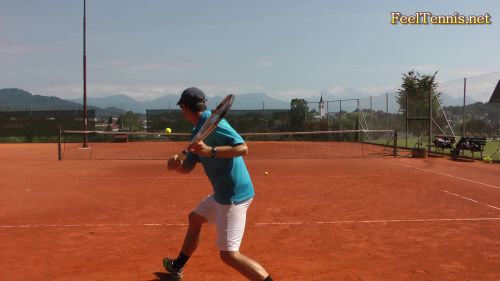
As soon as you're playing a ball with some speed and direction, you're dealing only with a probability of hitting the ball in. You DO NOT control the outcome.
It’s just a matter of time and statistics before you miss.
Thefore you do not control the outcome – hitting the court is only a probability.
And so you cannot be responsible for missing the shot if you cannot control the outcome.
And yet so many players blame themselves for missing. It’s very painful to watch and totally illogical.
By blaming yourself for mistakes you’re losing confidence in your strokes and in yourself. You bring down your self-esteem and cause doubt and hesitation when you’re about to hit the ball.
And this now is the cause of the next mistake!
While the first mistake was most likely just a matter of statistics, the consequent ones will be actually caused by your negative mental state.
Do not allow yourself to fall into this vicious spiral of negativity!
Conclusion
Making mistakes is unavoidable and happens all the time to everyone who plays tennis – from total beginners to the finalists of a Grand Slam.
It is as unavoidable as missing the hoop in basketball, missing the ball in baseball or missing a putt in golf.
And it as unavoidable as red traffic lights on your drive through a big city.
Yet, for some reason, this FACT of tennis is something tennis players do not want to accept as a reality of tennis.
They believe that you miss because you did something wrong – and that this thing can be fixed. Additionally, they feel that, if one trains long enough, he will have eliminated all causes of mistakes and will therefore make no more unforced errors and no more double faults.
If this is what you believe, you will suffer through playing tennis for the rest of your time spent on court.
The reality is this – we make mistakes because the game of tennis and its rules are designed in a way that human beings (in other words, our cerebellum) cannot control them.
In the same way that in basketball one cannot always hit the hoop, so a human being cannot always play the ball into a tennis court – even though it seems he could.
The reality stands firm in its fact – everyone misses, and everyone will keep missing. Therefore, why do you get upset when you miss?
Your expectations are obviously not aligned with reality, and reality always wins.
Fighting this battle with reality is futile, and it only causes you emotional pain.
See mistakes as part of tennis, and don’t take them so personally.
It is only a matter of time before you miss again. It is just the statistics of tennis.
Focus on how well you’re hitting the ball when it goes in and give much less attention to mistakes.
I personally am very sad to see almost everyone so negative on a tennis court, while so many people have fun playing basketball or beach volleyball or any other recreational sport.
Why can’t tennis players be the same?
Please take a few minutes to ponder on the logic I tried to present in this post and videos. Then look at your beliefs and expectations and determine whether you can adjust them to better fit the reality of tennis.
If you do, you’ll find the game of tennis to be pure joy. I do.
Much wisdom in what you say. On the basketball question, I think a big difference is that in hoop play continues after a missed basket, you can rebound and get a put-back, or your teammate can. A missed tennis shot ends the point. A missed hoop is a little like a shanked shot that lands in, play continues so you focus on that and don’t worry about getting mad. Most people get angrier at missing by inch what would have been a great shot for them, than at totally mis-hitting and having it happen to fall in somewhere. Still, even thought the effec ton the score is the same, people are much less upset losing a point on a good shot by their opponent than on missing a routine shot themselves.
I agree, Mack. That’s why it’s important to keep the drills going when the student makes a mistake or if you’re playing one to one, immediately think:”Give me another one…” – to shift focus from a mistake to the next ball and how you want to play it.
What a superb article.
I loved the “visualisation of the flight path” as being how our shots are successful because that is so right! The shots I am good at doing – my serve – I have the time to visualize the exact flight path and sometimes it amazes me how accurate I can be.
Other shots – like trying to hit a deep volley when coming to net after a serve – my “visualisation of the flight path” is very poor – Ive got less time and my brian isn’t programed enough for it to be automatic. I consistently hit short volleys for exactly this reason – I know where I want the ball to go – but have “visualised the flight path” to aid it’s progress.
I also loved your point that most players think “direction” and not depth of shot. Again, this is bang on, especially as its mostly doubles I play – where a return of serve can land short or deep as long as it’s fairly low over the net – so the depth isn’t a huge factor, but then when you play occasional singles, your short return of serve puts you in immediate danger of losing the point very quickly.
And of course your “everyone makes mistakes” is so true – mistakes are how we learn, and switching off your reaction to them is something Lendl has helped Murray improve on.
A refreshing slant on the oldest problem in tennis – excellent! Well done.
Iain, yes, I guess lots of training is needed to have the full flight path in our mind before the shot – even when there is little time.
Sometimes the full path is not needed though; I often hit simply with my normal rhythm – meaning normal speed – and I know that I am hitting upwards – as Nadal is doing consistently in that video clip.
Those two variables are enough for height and depth control…
Excellent article – loved it. A lot to learn from this. Tomaz, you are a great coach.
Your observation about “negative” tennis player reactions pales in comparison to people who play golf. I’ve never met a happy golfer. They never hit a good shot. If they shoot par for 18 holes, they flog themselves up for not making that put on #X.
The golf comment made me laugh but also embossed the concept for me. I am a happy golfer. And it’s all mental. I play a few times a year and as expected have some good shots, some bad shots, some terrible shots and maybe even one or two great shots. I have fun because it’s very clear to me mentally that “I don’t play golf.”
But in tennis I play at least once a week, take some coaching, play matches. So mentally I think “I play tennis, I shouldn’t be making so many mistakes.” Don’t get me wrong I every minute on the court but mistakes can get me down. This article is very good and (along with more informed practice) a good step along the path to enjoying the game even more.
Well reasoned article! I went over many of the concepts with my junior player since we are always trying to explain to her that (a) in the end it’s just a game, and (b) there’s always another ball coming. I think she understands and she handles loss very well – maybe too well, sometimes I wonder if we should push harder (or at all) and be more like hte typical tennis parents! So how do we help her understand the distinction between not sweating the mistakes – and pushing yourself a bit harder on those really important points in a match? I don’t really want her to accept mediocrity, I’d like to see her discover her potential. Maybe that is competitive instinct and the difference between a true champion and just a great kid who loves tennis?
I’m definitely inspired to go easier on myself and not attempt to place any blame when I don’t like the outcome of a ball I hit! Instead of rationalizing, I’m just going to say ‘it’s my cerebellum acting up again’ – I may even put that on a t-shirt! Thank you!
Leanne,
Accepting mistakes is not the same as not trying hard and simply giving up.
You may accept red traffic lights on your journey and yet still drive with total focus looking to get fast to your destination.
You can give it 100% effort when you play a match and accept mistakes as normal when they happen.
The key is to see which mistakes “you” are responsible for and which are just a matter of statistics. This seems to be hardest part for most players.
For starters, I would suggest that you ask your player to analyze mistakes after a practice set (or even every game) and determine which mistakes happened because she didn’t program the trajectory correctly and which because tennis shots are played with an element of risk. (you can do the same when watching a match)
In time, you should both have a better perspective on that.
Good article.
I see tennis as a sport of two obtables, the first is the net, the second one is the court. So in general I complain a bit when I leave the ball on the net (when it goes to the middle) as I could not even pass the first obstable. I also get frustatred when i aim for a fantastic shot (a too much) when the risk is not worth (I see it as bad played). I get frustated with these mistakes.
In relation to the other, ball wide or long, well, I don’t complain much about those. Prabably a long ball is more acceptable than a wide one.
Does anybody see it this way?
In theory it should feel worse to miss a ball in the net. It’s the same as a putt in golf when they say “don’t miss short” because if you get the ball to the hole it has a chance to go in. In tennis it’s even more true (again in theory) because not only might the ball that clears the net be in even if it’s not the other guy might hit it (especially at the net.)
Having said all that the theory doesn’t feel like real life. Missing a ball long or wide seems to feel the same as hitting into the net. That’s my 2c.
It is natural to be disappointed when you miss shots that are well within your capability. Almost everyone has experienced being in the zone and being able to hit almost all makeable shots without errors. So 99% of the time when we are not in the zone we are disappointed. As you say, almost everyone is like that. Keeping it from wrecking your game is the worthy goal.
When you say that, ” Me Tomaz, my concious mind” did not miss because tennis is the job of the cerebellum, I disagree. You Tomaz and your concious mind probably interfered with the cerebellum and caused the unforced error. It happens more often in the tense moments of a match because that is when you Tomaz, your concious mind and ego get concerned about the outcome and hijacks the game from the cerebellum the same way the basketball player can knock down 10 straight 3 pointers in practice and then miss them all in the game.
Realizing what the process of the unforced error is helps me stay emotionally balanced after the errors. My technique was bad on the shot because I mentally interfered with or blanked out on a stroke that my cerebellum can easily execute a very high percentage of the time. So I work on occupying my mind with helpful tasks, watching and judging the ball, timing my grunt with impact, etc. so it won’t bother the stroke and don’t bother with trying to correct the technique. Sometimes this works, I am human so a lot of the time it doesn’t.
Even in the zone mistakes will happen but rarely on the easy shots. We are flawed emotional beings so trying to be a robot doesn’t work for many of us. The trick is to experience your displeasure at the error , realize the mental cause and put it behind you so you have a chance to play better………………..LP
Good points, Larry. I agree that “I, Tomaz” miss when my conscious mind interferes with the cerebellum (Self 2) when I play a match.
The point of the video I made where I play with my friend though is to show you a bunch of mistakes where I am not under pressure and my conscious mind DID NOT interfere at all.
I was in the zone and enjoying tennis very much. I still missed at least once per minute.
And so will everyone else.
You say:“Even in the zone mistakes will happen but rarely on the easy shots.”
That’s just a belief – and it will cause you to react to mistakes since you believe that they are rare and that when you miss – “in this case you did something wrong”.
My belief – based on reality that I measured in the video above – is that I will miss once in 20 seconds on average even if my mind is totally clear. (if of course I play quality shots and not moonballs)
The danger is trying to find reasons for these mistakes in yourself (mind, technique, movement, etc.) and constantly be conscious of them.
Now you are too conscious and you’re not playing tennis anymore – meaning not tracking the ball that well. Now you miss even more.
What I suggest is that you don’t try to fix mistakes – they are random (in a free hitting rally and some in the match) and simply a matter of statistics.
We cannot eliminate them so trying to do that is pointless.
Excellent article. I really appreciate you posting all of those missing by the top pros. After a while I had to laugh with them all strung together. The next time I miss I’ll laugh and think of your article! Thanks !!!
Tomaz thanks for a very well written and insightful article which summarises something that is so illusive, in tennis as in life, i.e. “the part which we play in our own downfall”.
As tennis players we need to learn to be stoical like rugby players and accept a certain level of discomfort they don’t stop to lick their wounds between points but enter “the zone” , find your rhythm and your continuity which accumulates during a game.
One of my most frequent errors is that when I have almost won the point and reach that moment that I could probably, play any shot I like and take the point, clumsily I then hit the ball long or into the net.
It’s a form of panic which is then followed by self retribution both of which are negative! Those emotions then linger into the next point!!
So it’s uneconomical and “literally pointless”! 🙂
Look at Davide Ferrer or Roger Federer if you want to see someone who has this pretty much under control. They don’t fuss and act all embarrassed after messing up. Tennis is apart from anything else “a game of errors”, error is built into it unavoidably and I think that patience with ourselves may play a huge part in becoming more successful on the court.
Thankyou for writing such concise articles which I am reading with increasing interest,because of the way you write they are easy to relate to.
Best regards Danny Cummings UK
(I know, it’s been five years) but, I’m right there with you buddy. I often warm up with an opponent like a 4 then engage in match play like a 3 under the very circumstances you described.
Hey Danny, I have a tip (or a “trick” if you like) for you on those easy shots you have all lined up and then miss: don’t focus on where you want to hit it. Focus instead on putting LOTS of spin on the ball. That way, your nervous energy goes into spin (generally, top but occasionally backspin, in the case of a drop shot) instead of into over-hitting and sending it long. This works for me. It also works any time I’m nervous and tightening up, as on a second serve on a big point.
Hi Tomaz
Thank you for such a fantastic article. All my juniors are going to get this emailed to them. Thinking back to my playing days and even my occasional team matches now I am most at peace when I make a pact with myself that I will strive to do my best on all shots,try to fight nerves by playing positively in pressure moments so I can top up my mental toughness memory bank to use in future tough moments,BUT at the end of the day WHEN I make a mistake I will ACCEPT that I didn’t do it on purpose ,I’m not a robot I’m HUMAN. All I can do is try to glean what information I can from the mistakes I make and keep Trying.
I also think that this goes to the heart of our search for “the Zone” Anyone that tries to explain this state always mentions a words like “calm” and “quiet mind” I believe that this State can only stir when you have truly accepted the truths you have highlighted in your article.
Thank you Tomaz for your contribution to teaching and sharing your passion for this beautiful game called Tennis.
Kind Regards
Mark
Good Day Tomaz,
I have read your article a few times and definitely will read more because it is so full of good stuff and well-prepared. Not the answers, but, even the questions put forward are very interesting and informative. Thank you for the effort and Bravo. It will surely help me a lot to help others.
Tomaz
First to all, congratulation for your brilliant article. This is a truly “wake-up” call for all recreational tennis players. I cannot tell you how many times I felt frustrated and angry with myself for each “easy” ball missed at the point to hurt myself with my racquet. Most of the time, tennis coaches are focused on teach you the “right technique” to hit a ball and not the “right feeling” of hitting through the ball. My behavior changed at the moment of realizing mistakes is part of the game. As you said, it is matter of time to make it. From my point of view, tennis player in general have less level of tolerance to miss a ball because a match fact “the winner of a tennis match is the player with less errors” but sometimes do not realize ourselves that we are human being and perfection is not part of our “package”. Thank you very much for your lines and fully agree to move on and do not think in the last missed ball, focus in the next one.
excellent article.the flight path is the key in reducing the errors(not eliminating),as you rightly explained.I hope my teen age son takes this article to heart & is at peace with himself on the court.
Tomaz! what a brilliant article indeed! So true So true my friend! You have really hit home on a very crucial factor of tennis and coaching for me personally. Loved it from the get go and couldn’t stop reading every word of it completely…Loved the wonderful analogies so much it almost brings tears (true)..so many young tennis players miss this very point and later end up being miserable not just in tennis but in life as well generally speaking..You know I am a small time tennis coach currently coaching my two young talented daughters but I hope they will read this article and become better players someday! This kind of stuff cannot be taught and that’s why it is so precious. I also loved reading your previous articles and cannot wait to read the future ones! keep the good work going, this wisdom is good for tennis!
Yep! It’s all so damn obvious but we forget it all the time. An excellent article – one I want to store on my desk top to read regularly.
Graham
South Africa
Tomaz its a great write up. It really is. I agree 100% that one should expect that mistakes will happen and that they are normal. Negative human reactions to mistakes are normal though, even at the pro level. I refer Djokovic as an example because with him you can see immediate negative body language reactions to mistakes but he’s good enough to let it out and regroup to play the next point. I think that’s the key that all level’s of non pro players are looking for. How does one do that? I don’t think its simply a matter of accepting that “Its Normal”. Sometimes.. a lot of times actually mistakes happen because Rec players have lazy movements and aren’t in the right position quick enough and letting out a yell or a NO or a disgust lets their adrenaline flow again and then their body is actually ready to react and move quicker. Another reason i think that rec players react negatively to their mistakes is that they want to give their opponents an impression that they are indeed trying and that they do care about how they hit. Specially if in that session one player is trying to hit high level shots but is spraying it everywhere and the two players are performing a cooperative rally yet still at a high level, which means the opponent is expecting not being able to reach most of the balls because they are either long or too short, or miss-hits. Just my thoughts. Would be interested to hear what you think.
Hi Sean,
The whole cycle of reacting to mistakes starts when one starts to learn tennis. Most of the mistakes are being fixed by the coach.
That’s when the player starts to connect missed shots with him being responsible for them. In my opinion, there’s too much correcting in tennis and not enough explanation of how normal errors are.
When kids play alone tennis and have basic skills to rally, they don’t really get upset when they miss. The same happens if they play basketball alone (without coach or parent) – they KNOW that missing happens all the time.
Tennis players are taught to react to mistakes in the same way as a child learns that after making a “mistake” (like accidentally bumping a glass off the table) there comes a critique.
While in fact it is completely normal that small kids break glasses and do other things “wrong”.
The other part that I didn’t mention in the article is the question of EGO.
Ego wants to be so madly deserving of every good shot you make that you don’t see that there is often an element of luck when you hit a good shot.
And when the ego controls the person so much, it also doesn’t want to be responsible for missing.
That’s why everywhere around the world you hear:“How could I have missed that!”
The person’s ego is saying:
How childish is that? 😉
Tomaz,
That’s fair enough. I can understand the benefits of being calm about mistakes when practicing. We have seen plenty of video’s of pros practicing during warmups and making a lot of mistakes and staying perfectly calm, but during a match situation what are your tips for controlling those emotions. I ask because when one is in a match situation with points at steak the pressure is a lot higher, the stress is higher and the adrenaline is higher and today’s modern style of tennis requires that one be operating at maximum aggressiveness in order to win all this in turn leads to cry’s of frustration when missing shots. We see it happen at the pro level all the time, the only difference is that they learn to hit reset mentally within the alloted 25 seconds between points.
Thank you, Tomaz for this article! This is my first one to receive and it couldn’t have come at a more perfect time. I am one of the people you have described here to a tee! My mental game causes so many problems for me-okay, I admit I’m the girl who cries fairly often because of my “mistakes”. I became so worked up in January of this year after missing a few of what is usually my monster forehand and the shot literally disappeared for me. I have spent the last 6 months trying to get it back. I have had to go back to basic mechanics I learned back when I was 6-that was 35 years ago. You have given me a whole new outlook and I’m using it tomorrow! No more crying over mistakes-
Thank you so much!
Great article Tomaz… well researched.
In reply to Sean above…
If you watch Roger Federer, you’ll see in 99% of the cases no reaction to a mistake he makes.
I believe he is not hiding the reaction – he actually understands what I am saying here: that every shot you play in tennis has only a probability of going in and none have certainty.
Therefore when you make a certain amount of attempts you hit some and miss some.
So when you miss you simply chalk that one to the “missed” stat.
You simply expect to miss shots in a certain amount of attempts.
Most tennis players who have not thought about this deeply DO NOT expect to miss any shots.
They mistakenly and subconsciously believe that you can KNOW how to hit the ball in if you’re not in trouble. (meaning you’re not forced into a mistake)
That’s is not the case obviously – and therefore when reality is not what they expected, they get upset.
Watch some pro basketball and try to see if any of the players reacts (frowns, gets upset …) when they miss a basket.
Perhaps one in 1000. 99.9% “get it” that it’s hard to hit the basket even from free throws.
Most tennis players don’t “get it”.
That is the only difference.
It has nothing to do with practice and match play difference.
It only has to do whether you “get it” that every shot you play will miss sooner or later.
If you understand (and I mean really understand) that, then you won’t react on a mistake.
You’ll know it’s normal and expected and you will save all your mental energy and focus for the next point.
Superb advice!
Tomaz
Thank you for spending the time to compose this article, you clearly have a great understanding of the “pure joy” aka tennis. I agree with many of your observations and reminds me of a between-points strategy I provide to pupils based on the the acronym A.L.T.I which represents ACCEPT (the last point) as we simply cannot change was has just happened so detach and move to LEARNING value (consider what I would try to do differently if I lost the point i.e was it a case of failing to see the trajectory of the ball, was it an oustanding winner from my opponent which is unlikley to be repeated as it was such a low percentage shot(drop from beyond the baseline, or if I won the point was it a pattern of play that was well executed on my behalf (extreme topsin deep on the weaker backhand and an easy short cross court volley)which leads to TACTICAL approach for the next point (don’t change a winning formula or if losing what represents the weakest aspect of my opponents game and how do I start to exploit that) which leads to IMAGING, use your minds eye or your 2ndyou to visualise the next pattern of play you seek to execute. A.L.T.I and variations of this theme are used by pros in all sports to keep intensity levels high and focus point on the court.
Wonderful advice, I’ll definitely work with A.L.T.I. concept next time I coach on court. Thanks for sharing!
Great article. I think I will change my approach to playing as a result. I focus too much on never making mistakes so I am very very consistent. But my shots lack power. When I do make a mistake, I am energized to figure out how to correct it. Mostly I’m playing doubles, so the “mistakes” are usually because my partner and I got out of position. So I often visualize a “correction,” and then feel quite happy. The corrections are mostly better communication, earlier split step, guarding the middle, etc. Actually, I think this approach is probably good especially in thinking about improving position and strategy. Sometimes I try a low percentage shot, and when it fails I think, “OK that was fun, but maybe you shouldn’t try to pass down the line when the net player is right in front of you. (etc.).” I think that reviewing the missed shots to see if they indicate a “weakness” which can be improved has been very helpful for me. I also find that it keeps me very excited and happy about my playing, because I either have a successful shot or I have an idea (if I miss) about how to improve. No matter what I’m focusing on the positive. In the future, however, I’m going to play in a more risky way and not get too worried as my mistakes increase.
Hi Diana,
Thanks for sharing! Yes, with no mistakes there are also no winners.
What matters is the ratio between them…
What do you think would happen if you didn’t correct mistakes?
Imagine two kids who for example take some (soft) balls on court and play mini tennis for an hour for the whole week. (How about for a month?)
Do you think there would be no improvement since the kids don’t know these technical corrections that they need to apply in order to “correct” mistakes?
Risky play is the only fun way to play because it is the only way to learn to hit high level shots. I go straight at the person strength to start a match with. I feel that is a bigger challenge than going to their weakness and winning easy points. Persist on attacking one’s strength and it will break down. After that you win the mental battle and the match. No matter how “At peace they are with their mistakes”. I haven’t seen a player yet who does not break down to this approach. Rec or Pro level!
g-r-e-a-t article!!! i had broken my tooth to read….. “self 1 and self 2” of galwey which is great. but i just fall in love by your simplicity so clear and truth reality i would be very happy if someone like head master of the isreal tennis will read it. i will put it in FB. thank you much and keep make us see all the colors with love yossi
Great article with so much depth. I have a club match tonight and will take the advice into it with me. I have seen so many players beat themselves up over mistakes that after one or two their opponent doesn’t have to try to hard to beat them. Be kind to yourself and swing freely. I’m sure you will win more matches and enjoy this fantastic sport even more! Keep em coming Tomaz.
I have more comments because this article raises so many issues. I played yesterday trying to change my approach based on your article.
1. Mistakes are normal
2. Since I avoid all mistakes, I probably should take more risks and elevate my game.
The article really affected me. I had far less worry–especially noticeable when playing doubles. If I played with weak partners, I didn’t care so much.
But it also affected me in other parts of my life. I am a computer programmer and I normally worry a great deal about bugs which exhausts me. I found I was more focused on creating good programs and less focused on trying to avoid any mistake whatsoever. I figured I will focus on catching the bugs (since they are unavoidable in development) rather than scolding myself in a vain attempt to avoid any mistakes. (Think about trying to write without any errors whatsoever–that might result in writer’s block!)
QUESTION: Are there times when mistakes need to be addressed?
I played with a partner who was just getting back to playing after several years of inactivity. She was making mistakes every other ball. I was unconcerned and felt happy (because of your article). I figured that she needed time to get used to playing. She mostly made mistakes by over hitting. I figured she was used to playing with a fast swing and needed to get her timing back.
I made very few mistakes. I enjoyed this so much that it was hard for me to to take more risks. Yet I did take more risks–but mostly in strategy. For example, I am 69 (one reason for lack of power) and I played singles in our group lesson against a 25 year old 6 foot tall male with extremely powerful ground strokes. I noticed his net play was very inconsistent. So I hit a short slice bringing him to net and rushed up to volley his weak return for a winner. I figured my lack of power on the ground strokes is only going to result in defeat if I try to rally from the baseline. I made several mistakes trying to hit drop shots in pursuing this strategy, but figured that was fine since I don’t own that shot. But I did think since all my mistakes landed into the net that I needed to put more forward momentum into the shot. It’s ok to think about correcting mistakes, isn’t it?
Hi Diana, great to hear that you accept mistakes as a normal part of the game – and life!
And it’s really good analogy with the writer’a block! In the same way we get “tennis player’s block” when we think about all mistakes and how to fix them instead of accepting them and getting into the flow!
As for addressing mistakes, I believe your friend kept missing exactly because she didn’t address mistakes.
She has preconceived ideas of what is “correct” in tennis which in her mind probably meant hitting the ball hard.
If she “addressed” mistakes with feedback and feel, she would realize that the ball is long and she would adjust.
We address mistakes with feedback and feel (the goal is to hit the ball in of course) and not by technical instructions (or rarely).
And in your case, when you played drop shots short, it’s the same thing – if you see the ball short, aim deeper.
There is no need to go through analytical Self 1 and actually describe that as “put more forward momentum”.
That kind of focus takes you off the ball and into the thinking brain (Self 1) and you also try to tell your body what to do which will result in very gross mistakes.
Attempting to play deeper puts all your focus on the ball and your mind/body (Self 2 or cerebellum) will adjust the feel needed to hit the target.
I saw this research in a book, “Art and Fear,” by David Bayles and Ted Orland. It supports your approach to mistakes. A ceramics teacher announced on opening day that he was dividing the class into 2 groups. Group 1 would be graded solely on quantity. 50 pounds gets an “A”, forty pounds a “B”, and so on. Those being graded on “quality”, however, needed to produce only one pot–albeit a perfect one — to get an “a”. Well, came grading time a curious fact emerged: the works of highest quality were all produced by the group being graded for quantity. It seems that while the “quantity” group was busily churning out piles of work–and learning from their mistakes– the “quality” group had sat theorizing about perfection, and in the end had little more to show than grandiose theories and a pile of dead clay. Art is human: error is human; ergo, art is error. Inevitably, your work (uh, like the preceding syllogism) will be flawed.
Great article, without mistakes no knowledge is gained. mistakes should be accepted as part of life. take sensible risk and accept the outcome. No body language afterwards. Do not pump fist for great winnners , also do not drop your head and shoulder for missing an easy sitter.
with the above you will stay longer in the zone and enjoy the beautiful game of tennis
Hear, hear! Especially the fist-pumping by pro players– MUST they do this after *every* point won? And for the doubles teams: MUST they hand-slap after *every* point, won or lost? Put bluntly, it’s gross.
The pro’s of the 50’s and 60’s did not exult in victory. They simply got on with the job. In my humble opinion, that is much more powerful. They were professionals and they acted professional.
Thx for this article! The analogy with the red light is very good!
The ‘brain’-conditioning for kids, that I use is something like this:
You are brave if you dare to try
There is no trying without mistakes
There is no learning without trying
So, making mistakes is necessary for learning
Be brave and make many mistakes
“Do what you like and like what you do”
Hi Tomaz,
First of all, very good articles. I always enjoy reading all of them.
I agree for the most part, but have some comments. I agree, that one should concentrate on how to hit the ball. I agree, that frustration with mistakes can lead to worse consequences and loss of self-confidence. I, also, agree that mistakes are unavoidable.
So, at the end, it all comes to one question: “how to work on your mistakes?”
I don’t think that to not take mistakes personally, is the only answer. I think one should take some responsibility, too. The question is what exactly to do to concentrate only on hitting the ball? How to train your brain (not only cerebellum) to accomplish that?
The answer to that is probably very personal. We are all different, with different abilities and cerebellums. So, saying do not take them personally is right, but is very general instruction.
It’s like if you are directing an actor, you can’t just give him/her a general direction: “now you are acting frustrated”. This is a very general state of mind. You can act this in 50 different ways. You have to give specific tasks, like your are frustrated, because you forgot something at home, or can’t find something in your purse, or remembered something from your childhood e.t.c.
Again, for a talented actor (in tennis let’s say Federer) you need minimum instructions, for another you need to be very specific.
That’s why, I think technique comes to play. From a good coach it’s specific instructions, based on your abilities, character and talent.
Without proper technique I don’t believe you can hit the ball in the right way. It could be done in finding personal, natural way of training (in your case), or more mechanical, but also very specific way.
Mental aspect, of course, is important in both methods. At the end you have to have it in your brain (or they also called it “muscle memory”). Then you stop thinking to much and concentrating more on the shot itself.
Concerning mistakes, you probably need the same platform. A series of specific, personal exercises to get rid of frustrations and to help concentrating on the ball.
Please tell me if I’m wrong.
My last point is about human nature and our emotions. Is in also natural to be upset or disappointed when you loose, or when something goes wrong? As one inevitably looks on the line instead of the ball, when it is close to the line. Same way one is inevitably frustrated with him/herself when looses. Maybe the question is not how to eliminate this, but how to turn into positive energy? Because disregarding mistakes is not natural, it takes mental strength to overcome just that.
Look at the bad and good examples such as: Baghdatis, Djokovic, Azarenka, S. Williams, Verdasco e.t.c., or Sharapova beating her left leg to get herself up in the fight mode, or Bartoli talking to herself, or Nadal shaking his head or pumping his fist with famous “Vamos”. Sometimes you can draw something positive from the negative, too.
Good points, Misha.
Technique is usually not the answer if the player is able to hit the balls over the net consistently. He hits the balls well obviously and here and there mistakes happen.
They are then not based on technique (in most cases) since technique is already there – otherwise the shots before the mistake wouldn’t have gone in well.
They are caused in most cases by the reasons I described above: not having a clear trajectory in mind, not having enough repetitions and simply by playing a difficult sport.
Yes, you can say that accepting mistakes is not normal because no one has been taught that way – every parent has criticized their child at some point. We learned that making mistakes is bad – because parents did not realize that kids will make tons of mistakes.
The same happens in tennis – only someone who has played tennis competitively for 20 years and has reached a high level of awareness and tennis wisdom will understand the mistakes their student / child makes in learning tennis. 99,999999% of parents are not there – therefore they criticize children in some way and these kids COPY this same attitude towards mistakes.
They see them as bad – and yet everyone makes them and they will keep happening – no matter how long you train. It’s a belief system that has been ingrained so deeply into everyone that no one questions it all. My article here shows that this belief is false and that can be disturbing to read on some level.
And yes, the top players you have listed there are still far from what I suggest. I think only Federer really accepts mistakes in a way I suggest – at least most of them.
I again asked a club level lady the other day when we had a lesson the question: do you agree that everyone makes mistakes and that it’s normal? She agreed.
I asked her: which of the last 10 mistakes you did do you feel as normal? She couldn’t answer that.
For every one of them she believes the did something wrong. And that if she corrects that she won’t make them any more.
So there’s the first paradox she faced.
Then I said: “If that’s true, then someone must have fixed all those things by now and can rally for 10 minutes without mistakes. Do you know anyone?”
So obviously she doesn’t – and faces the second paradox of her belief system and her thinking.
She believes that mistakes can be fixed and yet when asked what the eventual reality will be with these “fixed mistakes” she realized that such a reality doesn’t exist.
It then takes time for a person to adopt a new belief system – hopefully based on reality now.
I love the article, I learned a lot from it, I should never stress out about unforced errors, your article taught me to be calm and enjoy my game.
Thanks again.
Hi, a short practical tip to all our tennis community: on the throat of my tennis racquet I have some small notes I stick on , my favourite is: FORGET IT – NEXT SHOT. After every point, won or lost, I glance at it and get ready to play the next shot. It keeps me focused on the NOW, and helps my concentration. Try it guys and see if it helps you, cheers, Charlie, from rainy London.
Great Advise. A Must read article.
[…] you really need to get down on yourself after missing a shot or can you perhaps be more understanding see that it’s not always your fault but that the game of tennis is somewhat […]
This is really great stuff, and now is my second time around on the article. I took it strongly to heart and concluded — and I had suspected this all along — that much of that post-error reaction was a means of avoiding the reality of the situation — poor footwork, late preparation, looking away from the ball. After that, I very naturally noticed,”Oh, stepped in too early on the BH and got off balance,” which led to working on the footwork to take a little adjustment step instead, and “That is the third reverse forehand this set, I’m late getting prepared and pulling the trigger,” which led to working on making my turn much earlier.
The result has been more improvement, more consistency, and as you put it better quality shots.
Somewhat late to this site and it may not be updated any more, but this is such a good article that I can’t help but add a comment.
One question that Tomaz posed was why do tennis players get so down and not so much in other sports. I think it is partly the timing: a bad shot we notice usually ends a rally and you then have 30 seconds or so to reflect on it! Think of basketball – miss that free-throw and the other team is up for the rebound and you’re back on defence. Same with football – a miskick may result in loss of possession but rarely in a goal (not for goalies of course, and you’ll see them sitting cussing after a goal – familiar?). Badminton and table-tennis will be more akin to tennis but I think the next point is still played quicker due to court size and less service preparation.
The nature of those sports automatically forces the brain to move on, concentrating on the next moment without that long moment of reflection. The more we can quiet the mind and observe rather than actively chastise, the more we can rely on our practised ability to get it right (probably) than trying to correct ourselves. The mind of an observer also helps with that adjustment as Tomaz mentions in his comments, in that a ball that goes into the net may need to be played deeper or higher, rather than a thought of “I need to change my swing” or whatever.
Just need to put this into practice now… 😉
You are correct, Pete, there is almost no time to think about your missed shot since the game keeps going on immediately.
But upon reflection when one is at home on a sofa and thinking about mistakes in tennis and comparing them to other sports, one can realize that there is no difference.
I often teach adults in private lessons and everyone reacts negatively to missing shots. I explain to them that mistakes are inevitable and part of tennis and that they will be missing forever – except with better shots. 😉
Thanks for taking the time for sharing your thoughts.
I’m also trying a new way to start my on-court in-my-head observations by starting sentences with “The ball was… ” or “The ball needs to be…” (a request).
Attempting to keep the focus on the ball and not analyse or improve technique. But it’s actually quite tricky!
Just wanted to say thanks. Loved this article. Will remember: mistakes are normal, and don’t require an emotional reaction or explanation/excuse. Focus that energy or desire for improvement on next shot instead. Also, work on visualizing the return path very early, including depth and height not just direction. Thanks again!!!
Nice summary, Dawn! Enjoy the game.
I think tennis players get angry with mistakes because it automatically results in a point for his opponent. In basketball if you miss a shot it doesn’t mean a score for the other team, specially if your team gets the rebound.
thank you Tomaz. That’s a great arrival and has helped me as my partner was giving me a hard time last night for errors and even though he makes the same number of mistakes it knocked my confidence. Your piece has really helped put it in perspective. By the way we did win in the end anyway!!
Tomaz – I really like this site, but on this particular issue I think you’re missing something important.
It is absolutely true that no matter how good you are, you will make mistakes – even some mistakes on easy balls. And no matter how good you are, your performance will fluctuate and you will have bad days.
But I do think it is important what KIND of mistakes you are making. If you look at top players, they miss – but it’s normally by inches. They rarely put a shot into the back fence or the bottom of the net, or spray a serve ten feet long. If your shots are great when they work but you frequently make wild errors, surely that is something to be concerned about?
Surely, Marco, that’s something to be concerned about. What do you perceive this article is saying to you and what I am missing?
On the basketball question, I think it is because when making a mistake in tennis you automatically loose the point: a very negative outcome, while in basketball the outcome is still 50-50 (more neutral).
If in basketball you miss an important shot (let say the last 3pts that could give your team victory) you would definitely wonder why you have missed that shot you make 9/10 times in practice.
I believe it is only a matter of outcome that brings this type of reaction.
Excellent article, I feel the thought we can control our errors leads to tightness and eventual paralyses when we play league or tournaments in front of friends and colleagues. If we can accept that errors are normal no need to feel inferior and question are right to be in a certain league or tournament. Thanks Tomaz!
Thanks for the videos and articles. They are tremendously helpful.
Hi,
Imo, the disappointment in missing a shot in basketball and tennis is different because in tennis you lose the point, and as a result, often a game, a set, or the match, in basketball you don’t. I.e., in tennis a miss is a loss and in basketball it is just no gain. However, if a basketball player misses a shot in the last second of a game and loses the game because he misses, he will feel terrible and negatively about himself. This is normal. And I struggle mightily with it.
It also depends on the quality of the opponent, the higher quality their shots, the more you miss, so the frustration becomes greater when you miss more than usual.
Kevin
Hi Tomaz,
Thanks so much!
Hi Tomaz – love your insights as always. But there’s one flawed premise in this article in my opinion – that you don’t see basketball players doing the same negative reactions on court. That’s because of the type of player you are watching. In my experience as a former competitive basketball player there’s plenty of negative reaction following a mistake – choice language, fist pump, and so on.
What’s most important in my view is not so much eliminating negative reactions – that’s a part of passionate, competitive play – but rather quickly letting go of that reaction and moving on to the next play.
That said, I don’t disagree with limiting negative reactions as a general rule of thumb. But I’m also not a fan of too much constraint. Sometimes the venting can be a healthy way for the player to loosen up and get the tension out – whichever court s/he is on.
Thank You!! I am a 53 y/o 3.0-low 3.5 player and really needed this article. My frustration has been at an all time high, because I could not get over making mistakes. I’m not used to making mistakes( at all), but I have never been an athlete. Tennis is a game that I love to play competitively in league, but I don’t like making mistakes, win or lose. So thank you, my attitude will adjust.
And thank you, Belinda, for this kind feedback!
this article was very helpful to me, i am on the tennis team for my high school and i use to injure myself by hitting the racket on my knee but when i read this it made more sense to me about the statistics of making it over the net or hitting the white paint on the net
The reason why we react so differently in tennis (or table tennis for that matter) than basketball or football, is that tennis is reward & punishment game, while basketball is only a reward game. You don’t get punished for losing the ball in basketball, at least not directly, which makes the big difference in our heads.
We don’t like to be punished for our mistakes. The extra risk we’re taking for the reward of a winner, when we improve, does not make us realize at the primitive level that the punishment is to be taken along with the higher risk.
You may want to read the fantastic book “thinking fast & slow” by Daniel Kahneman, which explains many irrational behavior by humans, like why we fear loss more than we appreciate gain.
Your site is amazing btw.
I enjoyed the article. I like working on perfect practice and find when I miss the shot – it is my shot selection (risk /reward / location ) more than anything else.
As for hitting 100% in basketball; I like the way Tom Amberry teaches how to shoot a free throw, and his aporoach to practice (he shot 2,750 in a row over 13 hours without a mistake – 100% in the basket from the free throw line – World record.) He did it through perfect practice!
Really enjoy your articles and videos. I played the futures in Yougoslavia 1980’s and loved the country!
Brian
Wonderful article! Much wisdom. Being too hard on oneself and striving for perfection, most often leads to frustration and unhappiness. It is much better to relax; do the best that you can; and enjoy the activity.
Hi Tomaz,
Thank you very much for this very informative,structured and documented article. To your question about the different attitude we have over failures in tennis and basketball, I would suggest that between the obvious individual / collective difference, we have the way point are counted: when I miss a shot in tennis, the opponent gets a point, while in basket to materialize his advantage (my error) he has to score the net shot, which take some of the drama of my error and gives me one more hope, or chance to correct my error. At the same time, the uninterrupted game, keeps me busy and with no time to complain about my error.
Pierre
Exactly, Pierre. So as you said there is a drama in tennis but not in basketball. It’s all in your mind.
The goal is to discipline your mind so that it works as if you’re playing basketball. No drama…
Tomaz,
I’ve been enlightened.
I was on the verge of quitting tennis because it started to be not only less fun but even painful.
I’m obsessed with good technique and rarely play freely and I always blame (or even insult!) myself for committing mistakes.
When I play poorly for a couple of days in a row I totally loose confidence. As a consequence I become tentative and a couple of bad days become a long streak of frustrating losses to less skilled players. I really want to enjoy the game, just letting go of the judgmental thoughts, the problem is I don’t know exactly I to do it.
Any other tips beyond visualization of trajectories? Tried bounce hit, seams of the ball, humming a song, feeling the weight of the raquet, you name it. Nothing has worked consistently so far.
Anyway this article had something clicked in my mind. I’m looking forward to try to let go.
Best Regards
Carlo
Thanks a lot for the feedback, Carlo, I am glad that something clicked.
What works for me to let of judgmental thoughts is to watch the pros how bad they are.
Yes, you read that right.
If you pay attention to their mistakes and not to their winners, you will see plenty.
I also see how mentally weak they are, all of them. They lose key points in tie-breaks and break points because they make unforced errors.
For me the mental toughness of current top players is nothing compared to mental toughness of Sampras, Edberg, Becker, Lendl and here and there Agassi.
As you realize how difficult tennis is and how everyone is as “bad” as you, then you don’t judge yourself so much.
Hope that helps!
I look at it this way; some people fake that they are enjoying it or smile when they’re actually sad. Tennis is great because it can be expressed in anyway within the laws. So there are rules to follow.
I find that learning comes from being negative so I try to teach students to focus on the mistake and correct it either by coaching or repetition. And that will truly fix frustrations and keep tennis players on the court and positive. Contact point and racket face are key points I use to generalize a lot of the questions that students have. And with technique anything I see that can make their natural swing either faster or more efficient so he can do the Contact zone and face correctly. Plus for high performance becomes more about speed and doing things quicker and longer.
I just recently found Feel Tennis but I already like this site a lot. Not only are the technical instructions good but I also like about the psychological coaching!
I have played many different team sports before starting tennis. As I have reached a point now where I have started to play competitive matches I feel the mental side of tennis totally different to most of team sports. The feeling of being totally alone on tennis court is something new to me and I hope that these instructions will also help me on the mental side of the game.
Tomaz, you are simply the best. I have a problem with this. I dont express my frustration but inside me, I feel a fire storm. But after read this article I know that this feeling have no sense. I will start to enjoy my game.
Thank you, thank you, thank you.
Great article!
Tomaz, I’m curious what your thoughts are on how risky one’s shots should be. On one hand, you can play very safely and hold out for long rallies and wait for your opponent to make a mistake. It seems to me, it’s hard to ever progress in your tennis game in the long run this way since you’ll never develop a feel for what it’s like to try riskier shots in a game. On the other end of the spectrum is the ‘go for broke’ and keep hitting risky shots and most likely loose the game because of unforced errors.
Keep up the good work and thanks again.
Rod
Hi Rod,
The truth is in between there. You shouldn’t play safe and you shouldn’t go for broke.
You need to find the optimal risk ratio which is what really separates an experienced tennis player from a not very experienced one.
In the most simple way I can say that your goal should be to “apply pressure” to your opponent.
Your opponent must be uncomfortable playing with you and we mostly create this discomfort for them by moving them around with good pace of the shots.
At a higher level we also vary our shots so that it’s even more difficult to adjust to them.
By doing that we increase the chance that our opponent will miss a shot and sooner or later that will happen.
So your main goal in a tennis match is to try and force errors – and not try to hit winners or wait for an opponent to miss off your easy ball (which you’re trying not to miss).
Thanks for the and all the content you share with us!
Why do we get crazy when we make a mistake in tennis?
Personnaly, being a long time team sports player (footbal club player and recreational basketball player), I was amazed about the fact that I was overwhelmed by my negative emotions after each missed shot.
I put a lot of thought to it before coming up with two reasons that make perfect sense to me:
1) In contradiction to team sports, in tennis the responsibility of a mistake is not diffused.
In all team sports we learn very early by our coaches and also by our experience, that the best thing to do is cheer him up and go for the next play.
So by transposition we realize that it’s “no big deal” to make a mistake and we also know (and often see it in action, when a mistake is very big) that the whole team is supporting us.
The fact that our teammates can live and continue to play with a mistake of ours, make it easier for us to overcome it: first we see acceptance and secondly we have to do our best to help them recover our silliness!
2) Tennis is a sport without contact.
In contact sports, there is a lot of emotion released during the contact primarily with the oponent, but also with the teammates.
Check how the volleyball players come and get in touch all together after every single point of the game.
This is to counter the fact that the net and the rules do not allow them to make contact with the opponent and empty a bit their feelings.
Believe me, they know very well what they do.
Good points, Dionysis!
I played volleyball since the age of 12 and yes, we were taught by our coaches that we must never criticize our team mate for a mistake and that we must always encourage them no matter what.
So having been taught that and executed that thousands of times I then transferred this same mindset to tennis.
But since there were no team mates I encouraged myself and I never criticized myself.
Imagine the advantage I had in tennis matches here 99% of my opponents would get down on themselves for missing shots…
Excellent comments on how to accept ‘mistakes’ in tennis. Mind control is more important AFTER you have had good technics to hit all kind of shots.
I will try this ‘mid’ game tomorrow on the court.
I am basically singles player and when I play doubles match my serve goes to 35% from 65%- your read tells me ‘ I have fix the ‘ball trajectory/height/depth’ every time my opponent sends his ball to me. If I practice 100 serves I get 80% of my 1st and 2nd serves in; but not in a doubles match. In singles it drops to 60%.
vasu
I read the “inner game” because you mentioned it in another article. It was extremely interesting as is this whole article on the subject.
Clearly accepting one’s mistakes is something very difficult to achieve. And since you mention how the top pros do mistakes fairly regularly I would like to point out that them too have a hard time accepting their errors.
You can see it by the way they mimic “the good gesture” after they made an unforced error or the way they frown or even yell when anger starts to kick in.
Not every top player behaves like Andy Murray and overall they accept the mistakes they do way better than recreational players.
But still, if even the top pros have such a hard time accepting their mistakes, how can you not expect recreational players like us to have a recreational behaviour in that regard? 😉
Hi Gregoire,
I don’t expect anything. My goal is to show how one can look at mistakes from a different angle and realize that they are inevitable especially in such a difficult sport as tennis.
What I would like to happen is that someone reading this starts to think about what I shared and gradually over time accepts mistakes more and more, bit by bit so that in a few years they’ll be unaffected by them most of the time.
Thanks Tomaz !
What I find very difficult to achieve that, is to create a peaceful cohabitation between accepting errors and the desire to improve. Because we want to improve we want to understand what is going on and change what we do wrong.
In fact I think I am happier when my ball is out but my technique and feel for the shot was good (so what lacked was a small adjustment) rather than when my ball is in but I was totally unbalanced or the feel was horrible (and I was just lucky my ball ended up in).
In my opinion it’s also very difficult to separate what we could call patterns of errors (for instance placing oneself consistently too close to the ball) and we want to correct those, from errors that occur because we didn’t understand the momentum or trajectory of a specific ball since all balls are specifics.
When we miss it can feel at times like we don’t know how to play tennis anymore and it can be very puzzling having anticipated a specific shot and trajectory when the ball was coming toward us to discover than the outcome is totally different.
We want to improve so we want to know why. I think one of the reason for which I can get frustrated is the feeling that I am making the same mistakes over and over and I can’t seem to find a solution and correct them.
There is probably a misunderstanding when I miss a shot between what I should do overall to improve my game(better timing, leg work you name it) and all the reasons that my shot was out for that specific shot.
I’m not sure I was very clear.
I really like that part when you mentioned basket and why the size and height of the basket were specifically decided to make it a challenge illustrating how our expectations are way to high compared to what they should be (if there should be any).
Hi Grégoire,
You want to understand what went wrong so that you can fix it, correct?
Well, how are you going to fix being late 0.02 seconds?
How are you going to fix incorrect racket angle by 2 degrees?
How are you going to correct hitting the ball 5 cm too much in front of your ideal contact point?
There is NOTHING you can do consciously to fix these mistakes once and for all or even correct them on the next shot.
Our conscious mind is too slow to track such small errors – and yet these small mistakes in the timing and racket angle produce big mistakes on the other side.
Check this article:
https://www.staging.feeltennis.net/one-degree-error/
What we can do is keep trying and go through trial and error and give our subconscious mind enough feedback so that over time it gets better in judging the ball flight, etc.
It’s just that the amount of practice required for such precision is huge.
I used to play 3-6 hours per day, 7 days a week. I would say I would play on average 25 hours per week – for about 6 months per year for about 8 years.
How much do you play?
That is truth about higher level tennis. Massive amounts of repetition, massive amounts of training.
Go to any tennis academy and you’ll see that 90% of the time they just do drills. Stroke correction is maybe 10% of the time – the rest is just hitting balls in different situations.
That’s why you’re still missing – you’re not even close to the amount of repetition required to fix these small mistakes.
Bigger mistakes in biomechanics can be fixed in about a week. I do that every week with adults.
But I can’t fix their timing and ball judgment in a week. They need to hit thousands of balls to improve that over the course of months and years.
Also, ball judgment and timing of adults improves very little over time so you really need a lot of repetition.
Hi Tomaz ! And thanks a lot for your long and very interesting answer as always. I’m going to keep that in mind the best I can on the court 😉
For me, there’s a dichotomy depending on weather I am winning a match or not.
Unforced errors seem acceptable to me if I am winning. (well, maybe I have won half the battle)
When I am losing, the unforced errors are causing two things>
Negativity and
Frustration.
You addressed the negativity issue very eloquently, and the line you draw between probability and the reality of unforced errors should help everyone with the negativity. The probabilities are a force of nature.
Unfortunately, my frustration also causes some negativity, and sometimes I wonder my I play ! (for the joys and other benefits)
Dealing with the frustration may be more of a psychology thing: how to break out of the spiral ? It’s important to address, because it is absolutely hurting my game and the experience for both my partners and I.
It looks like there’s much around to read on this; just wondering if you have anything specific to match frustration to say.
Cheers,
Hi Rob,
Unforced errors will never go away. You are just hurting yourself not accepting them whether you’re winning or losing – and in fact you will play worse if you get upset because of them.
You need to choose whether you want to win the match more and let go of them or whether you would like to wallow in those emotions, feel justified and lose the match.
As for frustration, try to think what is the cause, because frustration by definition is “the feeling of being upset or annoyed as a result of being unable to change or achieve something.”
So what are you unable to change or achieve?
Oh, I am very annoyed that I cant get the ball over the net, or keep it from sailing long, and i’m losing because if it. I’m annoyed because my lift works, and one day it doesnt. One set it clicks, the next it’s a disaster. And on those occasions the frustration builds…
And I’m annoyed that despite all my work in courses (recently) and in playing 3x per week, sometimes my progress goes into reverse.
(I’m reading Inside Tennis, by the way)
Thanks for all your ideas, you have helped already by getting me thinking about causes.
It seems that you have too many things on your mind, Rob.
If you get too analytical when playing then always first revert to having a clear and early intention.
Technique or “lifting” or spin don’t put the ball in the court, “you” do.
https://www.staging.feeltennis.net/intention/
OK, will try. Very nice video. Wish I had seen it before playing this morning.
I wonder how it would work (consistantly) when responding to heavy balls in a match.
By the way, I have experienced good intention at times during matches, and it is very powerful and beautiful. Almost like just hitting a button, and getting the desired result.
Nice article!
– I love watching Ostapenko, as she is clearly accepting that her game includes LOTS of mistakes 🙂
Tomaz,
Thanks so much for this. I applied this mindset today and was a lot calmer and more deliberate with my shots. Usually, I used to become irritated. However, after reading this article, I realized that the brain is not easy to control and it’s already taking on a lot of work, so I try not to get mad anymore. Please keep on sharing your awesome tips.
Loved your article. I was wondering why I was makeing so many mistakes when playing against a much weaker player (and winning clearly at the end!) I was unsatisfied. After I read your article, it totally makes sense.
Hello Tomaz and thank you for enlightening my game with your conversation.
Tennis was my favorite activity from childhood until 30. Then I went into handball and basketball as a player and later as a coach.
Now 47 I both play tennis (and your videos are helping a lot) and coach a handball team, I have some thoughts to share —as you asked— about how one could react differently after missing a shot in tennis or in a collective sport.
When you play tennis, you are on your own: no teammate to cheer you up or argue when you miss ; no coach to give you a technical advise, call a timeout (or call you back on the bench), when things don’t work.
And tennis is, indeed, very difficult.
You can as a junior or recreationnal player have fun in a basketball team even if you don’t shoot the ball or dribble well. If your tennis backhand or serve is bad, you will be frustrated, I think.
And you don’t know how long your game is going to last: one hour? Two? More? More pressure and anxiety to deal with.
Handball is 2×30 minutes, Basketball 4×12 etc.
If things go wrong, you know when it will end. Torture has an end, sort of comforting. It’s easier to “have a purpose”.
Well, in facts, handball, basketball, football players can blame themselves and express frustration too when they make mistakes.
It never lasts too long because:
1. They don’t miss alone.
Some teammate passed you the ball and some others might have worked hard to put you in a finisher’s position. Everyone suffers the consequence of your mistake. A good shot is a gift to the team (and to you) ; games are won and lost as a team, some values learnt very young. So the team says: each one of us can miss, no need to be upset.
2. The game doesn’t stop because you failed. In tennis it does till the next serve.
In basketball, there is no time for crying, even less in handball after a missed shot, the clock won’t stop. You have to play attack or defense and all the players around you are running, what are you gonna do?
I’d say it that way: the moment following a mistake in tennis feels silent and terribly judgemental. After a mistake in basketball, it’s game, precious playing time because the clock is ticking.
Playing time and team spirit.
Just look how it feels better in tennis when you play double. Made a mistake? Instantly talk with your partner, cheer him up, make a plan on the next serve and so on.
Thank you again, keep going. (Maybe I’ll come to play in beautiful Slovenia someday;)
Thanks for sharing your views, Sylvain, always good to hear from a fellow coach!
Hello Tomaz,
I am a recreational and club player starting tennis at the age of 60 (4 years ago). When I was young I played basketball for more than 30 years.
Thanks a lot to you Tomaz providing great learning videos which helped much to improve technique and skill, beside of course having local trainer sessions. I agree 100% that tennis is a highly difficult sport especially single as you alone have to deal with your emotions.
I do a lot of workouts with friends, using the ball machine and thus could catch up technically to most experienced players of my age and even younger.
“Be at peace with mistakes” is in my opinion the most important skill to become a good tennis player. I would say at least 90% of the players in our club, independently of age/skill, behave as you describe, react on mistakes but not on good shots.
Before I read your above article I still had 3 mayor problems to struggle with:
– impatience and over-expressed ambition
my skill improved a lot, in my team I play meanwhile as point one. Thus I expected to be able to reduce errors but as you wrote the number of mistakes will be the same however on that higher skill. YES, so I asked me now, why then beeing negative!!! No reason for it.
And I have to accept, that tennis requires time and one cannot learn all at the same time. As you explained, exercise only one skill at a time. YES
– watching the ball
Mostly I can deal with mistakes and errors but still a big pain is not beeing able to focus the ball. When hitting I watch more the opponent, look at the target area and as a result mishit the ball.
Saw your video on this matter and think, I will need at least 6 months or more to improve and have to accept this unsatisfying reality.
Thanks you very much again for your professional feel tennis instructions.
Hi Werner,
Thank you very much for sharing your feedback. I am really glad that you feel now you’re on the right track, but yes, it is a journey that takes time.
It makes tennis so interesting and challenging that’s why we like it so much.
Tomaz, I began looking at your videos a while ago and will continue to visit your website – I find that my main impediment to progress is how I perceive each tennis situation, and you address this aspect of the game magnificently. Thank you for your guidance. Ed
Glad to hear that, Ed, thanks for the comment!
Thank you for this. I started playing later in life, and recognized that I was carrying childhood jealousy and embarrassment into tennis. My brothers were both athletes (for life) while I was an artist from a very young age (retired illustrator now) who did not work through any competition frustration as a child. After years of telling me how much we would love tennis, my younger brother finally convinced me to try. Now I play much better than I expected, but I fight these old feelings of embarrassment much of the time. I want to win, but only against people who play very well, so I usually play with people who are more experienced who I am unlikely ever to beat. My guess is that I am a 2.5 and I know I these are 3.5-4.0 players who just like me enough on a personal level that they will play with me. (I do know what a bonus that is.) I also drill with my husband, who is faster and stronger than I. All this improves my game but makes me anxious and frustrated sometimes. I have tried playing with people I can defeat, but it’s no fun. I start playing down, hitting softer, standing in one spot rather than moving all the time. My brother has told me to stop slumping when I am discouraged, put my shoulders back, don’t give in, and to always “move without the ball.” I know I will get the tennis basics if I can get my emotions under control, but there are times when I wish I didn’t love tennis, the feelings are so rough.
Thanks for sharing your experiences, Pam. I am sure quite a few readers can relate to your situation and will find it easier to identify what can hold them back.
Tennis does feel like a rollercoaster ride for a while, just hang in there and it will become more steady…
tremendous advice. Helps me put things in perspective. Now if I coudl onyl get 100% of my keystrokes correct 😉
Very insightful article on accepting mistakes as part of the learning process. I first came across your work on YouTube, then came to this site because your coaching style has been extremely helpful. I’m happy to support your valuable work in my little way by making all my Amazon purchases through your affiliate publisher’s link to Amazon. It’s not an easy link to find on your site! For those interested…click the “technique” menu button at the top of the page; scroll down a bit to locate the funny cartoon orange/yellow head with a big thumbs up in the right hand column that asks-“Enjoying Feeltennis”? CLICK!
I look forward to learning more from you.
Tomaz, GREAT article. I heard a maxim from a ski instructor years ago that helped tremendously: “If you’re not falling, you’re not getting better.”
Djokovic should be reading this article. He would have saved atleast a dozen rackets. Not that he cares but still… Loved the article. Very complete. True. and Profound. I tried the serve technique as you’ve described today. And keeping my eye on the ball as I hit my ground strokes. Hit more first serves in than my regular and I could feel the ground strokes improving. Definitely feel i’m gonna improve my game with your thorough and meticulous instructions. Thank you!
Excellent advice ( now , to be at peace with my wife’s mistakes in mixed doubles….. )
Great way to start the year, Tomaz. There’s a lot of transactional analysis pyschology in this (fashionable when Timoth Gallwey wrote his book). Best advice I ever got from a US lady tennis partner 20 years older than myself ” Terry, you have to stop recriminating against yourself”.
Hi Tomaz
My frustration with myself comes when I make the same mistake over and over, even after I’ve been shown how not to make it. EG:
I know I’m supposed to look at the ball. But when returning a critical serve (say at 40-30) I look to where I want to place it instead of at the ball.
Or I know I’m supposed to follow through but on an important ground stroke I don’t and it sails out and I lose the game.
That’s when I’m frustrated with myself. When I keep making this mistake – for years.
Your thoughts?
Thanks
Guy
Hi Guy,
I understand the frustration but it originates from unrealistic expectations.
As an adult you CANNOT learn to keep your eye on the ball well. In my opinion and experience it is not possible.
Watching the ball close to contact and keeping the head still is one of the most difficult elements of tennis to master.
And unless you practice that 3-5 times per week specifically for a few months you will NOT ingrain it. You can just improve a bit.
So the problem arises when you underestimate a certain elements of the game. Of course, it’s not your fault, you just cannot possibly imagine that it is that difficult to acquire or that in fact it is not possible to acquire at all any more at adult age.
It really isn’t. You have to give up trying to master it, accept that here and there you’ll do it only a bit better than usual and accept that you don’t practice these elements enough to master them.
So again, from my experience, it took me daily practice of just trying to see the ball well after the bounce and not moving my head and I spent 10-15 minutes doing just that in every session.
I played mostly twice a day. It took me 6 months to get some noticeable improvement.
If you just remember to keep your eye on the ball here and there during rallies and points, it is not enough, it will not work.
That is what years of not succeeding at it is telling you. The reality is always right.
As for follow-through, it has nothing to do where you ball goes. Follow-through happens after contact.
You should have NO THOUGHTS whatsoever about stroke technique in a tennis match, especially on an important point.
It takes you away from paying attention to the ball and having a clear mental image of how you want the ball to fly.
https://www.staging.feeltennis.net/intention/
You WILL NOT improve your technique during a match. It is what it is on that day.
DO NOT work on your technique during points. No one in tennis clubs and academies does that.
If you want to work on more smoother strokes so that you swing more smoothly through contact, you need to work on that regularly on the court, in your living room, in your mind.
https://www.staging.feeltennis.net/universal-swing/
You need to focus only on this element of the stroke for 10-15 minutes at a time when rallying in non-competitive situation for a few weeks at least.
Otherwise you will not reprogramme your movements.
Hi Tomaz, it is a given that you cannot think of two things at once. How do you focus totally on the ball and remember the score at the same time? When I see kids arguing about the score after fatigue has set in during the second set, I think that they “learn their lesson”. They learn that it is more important to repeat the score to onesself than to focus on the ball.
I always think that is why “keeping score” is not tested by the coach accreditation people. Best just to ignore keeping score.
Because arguments are very unpleasant, children want to avoid arguments. Not focusing on the ball does not lead to an argument. Not focusing on the score either leads to an argument or embarassment. I look forward to your comments.
Hi Lynne,
Yes, kids have trouble keeping score at first but in time this improves.
We don’t think of the score while we play, we “store” the score in the memory and recall it when the point is over.
All coaches who worked with juniors have experienced this but once kids grow up to around 12 years and older they will not have trouble keeping score if there is no umpire.
Your passion to help people is immense. Thank you very much.
Great article, wish I could have read it yesterday or even a few hours ago… I’m on my first tournament after almost a year of practicing tennis — wasn’t a stranger to using a racket as I have played a similar sport since I was a kid for several years, I lost my first game yesterday 6-4 6-1, and today’s 6-2 6-2.. the most frustrating thing is that I know I could have beaten both of those players.. but mentally I wasn’t strong enough…
The categories are different here in Mexico so I think I entered the tournament as a 3.5 level player — I might be wrong — and my coach advised me to try 3.0 or lower before, win on that category and then move on to the one I “think” I’m at…
Anyway, my shots are good when I’m confident, during practice I usually have a 75-80% of balls in the court, but on this tournament this has dropped to 60% or less… I know what you mean in your video, about punishing myself over a mistake, and losing even more confidence as the game develops… I know why I’m missing, either I didn’t do the follow-through correctly, or didn’t swing upwards to apply topspin, or I hit moving backwards, but each one of those makes me try and hit “softer” shots, and even miss those, because I lose all confidence in my game…
Tomorrow I have my final match in the tournament, I don’t think I’ll make it to the next round unless there is some weird combination between the other players’ results, so I think I won’t have as much pressure and will try to play as I would during my practice..
I will try to apply the mindset you suggest in this article, and try to hit the ball more confidently even after I start making the — unavoidable — mistakes
Thanks, I enjoy a lot all your videos and have learned a thing or two 🙂
Greetings from Mexico
Thanks for sharing, Andrew.
The one part where you’re not doing the right thing is assessing your strokes TECHNICALLY during the match.
You’re saying you missed because of incorrect follow-through, not swinging up enough, hitting while moving backwards, etc.
These are all technical issues.
You CANNOT change technique during the match!
It is ingrained, automated. It is what it is.
You cannot change that in the match since you are focused on PLAYING – meaning tactics.
You will constantly keep forgetting about your technical cues and constantly keep missing.
Your technique IS WHAT IT IS on the day that you play a match.
You woke up with a certain technical skills and you will play the match with those skills and NONE BETTER!!!
Stop trying to correct yourself during matches as it will never work.
Never.
You can ONLY FOCUS ON TACTICS during the match and you have TO ACCEPT YOUR IMPERFECT TECHNIQUE for that day.
It is what it is.
The less you worry about it and the less you think about it, the better it will function.
Reminding yourself what is wrong with your technique is the worst thing you can do as you immediately remember that your technique is not so good.
Imagine how you would play a match if you happen to never remember that your technique is not so good?
How would you play?
In what mindset would you be and how would that affect your play?
Very likely better.
Then do that.
No one’s technique at 3.0 or 3.5 level is very good.
Your opponents struggle with very similar technical problems as you do and therefore they will GIFT you as many free points as you will GIFT them.
So this part of the game is equaled.
You are both making unforced errors here and there because of imperfect technique.
So now since that is equal, where CAN YOU GAIN ADVANTAGE?
In TACTICS and the MENTAL GAME of course! And the PHYSICAL GAME too – meaning you may have more speed or stamina than your opponent.
But similarly you cannot improve your physical abilities on the day of the match so they are what they are.
Therefore you are left with tactics and the mental game and that’s what you should FOCUS on.
Try to outplay and outmaneuver and outsmart your opponent while keeping a positive and encouraging and “never-give-up” mindset.
That’s what will win you matches and not correct follow-throughs.
Tomaz, I just read your reply and I have to tell you I did exactly that in the morning, and I won the match 7-6(4) 6-4
It’s incredible how just playing the moment and letting go of the previous mistake improves the score in your favor!
I honestly had to rely on my slice since it’s the shot I’m better at, and through patience — there were some really long rallies! — and keeping focus, I was able to beat the other guy, who had beaten the guy who beat me yesterday
Thanks again for the article and the video, it really put a smile on my face yesterday when I was watching it and felt immediately identified.
Cheers!
Great to hear, Andrew, thanks for sharing your feedback! Enjoy tennis and keep in touch!
Since you asked for feedback I will say this. I played baseball infield so errors are no stranger to me. And I was pretty good. But in baseball practice, frustration at lack of good technique does happen. Bad hops can be coped with using good technique. Not really the case with tennis. But the point I want to make is easily explained using golf as an example. Shots that don’t go, exactly, where you planned on them going does not bother me. But shanking the ball or some other egregious mistake does. But even shanking, once in a while, will not spoil your enjoyment. It is the repetition of egregious errors that elicits a cuss word. The amount of errors that’s annoying. And until some level of competence is reached that annoyance will continue. And this is normal. Because if you don’t reach that level of competence the message will, and should be: DO SOMETHING ELSE!!!
Tomaz, great article. I lived my whole tennis life with frustration (and outside tennis, frustration for red light in traffic!) because of my mistakes.
I made a lot of reasoning on this very argument, why I get angry in tennis while, for example, during karate combat I don’t.
As someone else already pointed out, one of the reasons is because tennis is not a contact sport. In karate (that is another one-to-one sport, and maybe the comparison is more correct than team sport) you can aggressively attack and grab the point, in tennis all is mediated by raquet, ball, ground, net, etc so is less immediate. I hope you get the picture.
But in my opinion THE big big big reason is that, unlike many other sports, mistakes in tennis give the point to your opponent.
If you miss a shot in basketball, fine, you don’t make two points but neither the other team do.
Try to imagine this: you did a fantastic 20-hit rally, you moved left-to-right and right-to-left your opponent, you moved him like a puppet, you constructed very cleverly your point; finally he gives you a very easy ball on middle court, and, with your opponent completely off the game, you miss the court by an insignificant 1 cm (maybe less). You don’t make a point, while your opponent, without any merit on this, makes a point. Is’nt enough to get angry as hell???
This fact is, in some way, a “bug” in tennis pointing system. This fact encourages conservative play vs aggressive play, particularly in recreational play, where technical ability is much less, with the famous “hated pusher” phenomenon.
If mistakes was somehow “neutral”, with only winning to be rewarding for points, maybe a more aggressive (and spectacular) way of playing was encouraged. And mistakes more less frustrating. I see lot of brilliant player losing their matches, while doing the best points in the match, against people doing only a destructive, less spectacular play. From many points of view, I felt they better deserved the victory. What do you think about?
Thanks for sharing, Roberto.
Yes, tennis scoring system punishes you for mistakes but so does table tennis, squash, volleyball and many others and yet people don’t get that upset.
And yes, you did a 20 shot rally and at the end you lost the point because you missed so it seems getting angry is a normal response.
But this will keep happening for the rest of your life.
Players don’t accept mistakes because they (falsely) believe that one day this will stop.
They naively expect that somehow one day they will not miss any more after a 20 shot rally.
It will not happen. Every now and then you will miss after a 20 shot rally and this probability will never go away.
So if you have that probability and percentage in mind already as you play, for example “I will miss 30% of the shots after I have outplayed my opponent.”, then when the miss happens, you accept it as it was already expected.
Perhaps in one way this is too harsh of a reality to accept and players keep avoiding the harsh truth and imagine a nicer reality.
And when it doesn’t happen, it upsets them.
My suggestion is this article is to look at reality, realize what percentage of shots you miss and learn to accept them as normal, since they keep happening.
We are not as good in tennis play as we wish we were. Once you accept your real level, you are more at peace with yourself and mistakes.
Wow Tomaz!! This article was just what I needed to read! I had been really frustrated and low spirited (depressed) after losing so many matches this season. I was almost thinking of quitting!! ( I know I wouldn’t though because I love tennis!!) Then I came across your article and was fascinated by all your amazing theories about making mistakes!!! My favorite one is the idea that our mistakes are like red lights and that they are unavoidable but we must accept them!! Thank you Tomaz, I now apply all of this knowledge to all my matches and I feel more at peace!!!! Thank you thank you!!!
You’re very welcome, Diana, thanks for sharing your feedback!
Thank you so much for providing us with such a clear and detailed analysis of the illogical approach we tennis players have towards the game we love. I particularly found the comparison with our approach to basketball cogent. I can’t wait to get out and play a match now with this new insight, and get back to enjoying the process and the moment, without beating myself up for missing.
Thank you.
Question: Why do you play Tennis [or Table Tennis or any other similar sport]?
Answer: For Enjoyment.
If you are upset [or frustrated, angry etc] because you made a mistake – you are NOT Enjoying the play.
Therefore the goal is to enjoy even the mistakes.
Watch kids playing. They are enjoying the play.
Win or lose, they are having fun. As an adult you have forgotton how to have fun.
So – how to ensure you are enjoying even your errors? This is how.
Fake it till you make it.
When you overshoot a ball, net it etc – don’t curse, don’t get annoyed, don’t knock yourself out ‘I shouldn’t have done that!’
Your subconscious will believe whatever you tell it. If you admit to being upset even the slightest your subconscious will believe it and make you miserable. It will also make you miss next time, too.
If, on the other hand, you smile [yes when you are inwardly screaming!] and insist to yourself that you are having fun – your mind will accept that too.
And you will be happy.
Furthermore your play will improve because you have a positive attitude.
This philosophy will not work overnight. You will have to persist with it. You are looking for a Transformation.
It will come in time. It worked for me. I estimate it was about 2-3 months of ‘kidding’ myself before my mind accepted it. But it was worth it because now I enjoy every game I play regardless of winning or losing, which has become of academic interest only – although because I am enjoying play more I am more relaxed and therefore tend to win more anyway.
Try it. You will be amazed.
I am writing this purely because I am bored. What do I care whether you are enjoying your games or not? You are very lucky to get this advice. But if you do try it and it works for you drop me a line.
I’ll read it if I’m bored.
Very good article Tomaz. However to be able to beat someone who is playing high-percentage moonballing topspin to the middle of the court and good depth with 99.9% you have to be very careful when to take your chances. These are players from the “upper-middle” amateur level who seem to make very good results with this tactic. At the end of the day it’s the result that counts. Against those players the line between going for to much to soon is very thin. Regards, Rok.
Thanks for sharing your views, Rok.
I am not sure where in the article I would suggest taking high risks against pushers which is what you argue against…
So somehow you understood this article as if we can hit shots with high risk, making poor decisions, and still accepting mistakes as normal.
That is not what this article suggests.
There is no tactics mentioned anywhere in this article.
Thank you Tomaz. This has been so helpful. I’m hoping it will help me to just relax on the court.
Hi Tomaz, very insightful article!! I will be reading this over and over and over again. I took my very first tennis lesson in 2006. From day 1 I have learned to love the sport. From 2006 to this day I still take lessons because my goal is not just to play but play like a pro even though I am just a recreational/club player. I am not in my teens but I have put a lot of hours on the court and spent big bucks on private lessons to get where I am now. But now it is not just the executions, shots, or performance on the court but the game becomes mental. To serve or return a shot I have millions of steps in my head and in the end I accumulated more errors than points! If I return a shot and it wasn’t performed as was “taught” in my lesson, I am not happy about it. I have high expectations from myself that the end result is me getting tight on the court and my opponent is no longer the player on the other side of the court but ME! I get stuck in my thoughts “how could I make such a stupid mistake like I’ve never learned it?” My friends would tell me “don’t think too much” or “relax”. But that is just one side of the story. The other of the story is in your article. This article! Great article Tomaz!
Thanks for the wonderful feedback, Nancy!
Tennis is a very tricky sport the way it looks quite easy but it’s actually very difficult. So we have to see it is very challenging and not put all the blame on us.
A very useful article to me, Tomaz. Lots to think about. I especially liked learning about my job (job of conscious brain) to program trajectory and target. I think elsewhere you call this “playing each shot with some intent”. That thought alone improved both my serve and my overall game. So, thank you.
I came very late to the game, picking it up at age 55, but with great enthusiasm. One thing that struck me as a newcomer to the game is that the language of tennis has all these kinds of “errors”, forced and unforced. The implication of this is that you win by making the fewest errors, or you grow by eliminating your errors. I believe this is an unfortunate choice of words and leads to just the kind of thinking you are trying to correct in this article.
Keep up the great work!
Cheers from the USA.
Thomas
I told my Dad, who was a coach, when I was eight years old that I hated tennis and wanted to stop playing. He refused to let me off the hook. Five decades later, I’m on the court five times a week and hope to keep playing as long as I possibly can.
I can only say if my dad had explained the game of tennis in the way you have in this article I would not have had so very many frustrated moments where I told myself I was rubbish as a player and questioned why I bothered playing at all.
No one was harder on me than I was and now I realise I was my worst enemy on the court and that I beat myself far more often than I have been beaten by my opponents.
I’ve followed your channel for a long time and it has helped my understand more of the technical side of the game.
But this, this has absolutely changed the way I think about the game and how I play it. Thanks so much!
And thank you, Robyn, for sharing your feedback!
Yes, tennis is one of those sports that look deceptively simple and yet it is in my opinion the most difficult sport to master.
And because we fail to see the difficulty of it we blame ourselves.
Stay tuned, I plan to release a series of videos this year to demonstrate this “invisible” difficulty of tennis and make it visible and obvious.
Excellent. I really enjoy your videos. This was great!
Dear Tomaz…I could cry having read your article; I have loved tennis for a long time and decided to try and learn it at the ripe old age of 60! I had regular coaching for a couple of years but I never got to practice in between coaching sessions; then we were hit by the Pandemic and I have only just found a club where I can play social tennis. I am now 65, relatively fit and still eager to be a good club level player…but I think that might be a goal too far. Growing up I played badminton but my hand eye co-ordination has always been poor. So, I have stopped coaching sessions and am trying to simply enjoy playing tennis with other humans and getting the occasional ball over the net! I have given up trying to improve my strokes because it was frustrating me so much, I wanted to give up. Thank you for all the videos you post, I love watching them because I think tennis is ballet on court…
Thank you very much for the wonderful feedback, Diksha! Improving is always nice but enjoying our current tennis skills is also something we must not forget.
When we focus on good hits and not pay much attention to mistakes then our experience of tennis can change to the positive.
Thank you very much for the wonderful feedback, Diksha! Improving is always nice but enjoying our current tennis skills is also something we must not forget.
When we focus on good hits and not pay much attention to mistakes then our experience of tennis can change to the positive.
Very excellent blog and post. Thank you very much
I am a research mathematician so I have a tendency to think too much.
The best match I played in junior ínter-club tennis in argentina was with 5 hours sleep, and with 5 hours sleep I can’t think much
Thanks, Martin! Math skills are great for tennis, stay tuned for more topics on math and probability in the future as I start to tackle more the tactics part of the game.
Very excellent blog and post. Thank you very much
I am a research mathematician so I have a tendency to think too much.
The best match I played in junior ínter-club tennis in argentina was with 5 hours sleep, and with 5 hours sleep I can’t think much
Thanks, Martin! Math skills are great for tennis, stay tuned for more topics on math and probability in the future as I start to tackle more the tactics part of the game.