
While various devices are available to help you feel the topspin of a tennis stroke like a forehand or a backhand, they are relatively expensive and might be used for only a short period of time before you don’t need them anymore.
In addition, while you can experiment with trying to feel the topspin, you don’t really know how that should feel when a more skilled player hits topspin.
This raises two questions: How should a topspin feel, and what are the different variations and adjustments you have to make during the game in terms of topspin to control the ball well?
There’s a very simple way to demonstrate that without any need for special tools. Your coach or a higher-skilled player can easily help you feel how they hit a topspin.
Feeling And Understanding The Topspin And Its Variations
I help players feel the topspin by simply hitting them on the back of the shoulder (gently, of course).
(Special thanks to Julio for helping demonstrate this concept.)
I first hit them directly, which we call “flat” in tennis, so that they can feel what a flat or direct hit feels like.
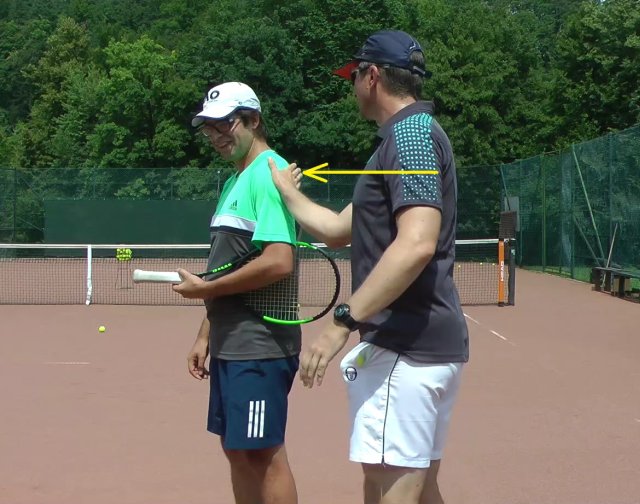
This is how a flat shot feels like...
Then I hit them at a slight angle. That means I hit them “partially”.
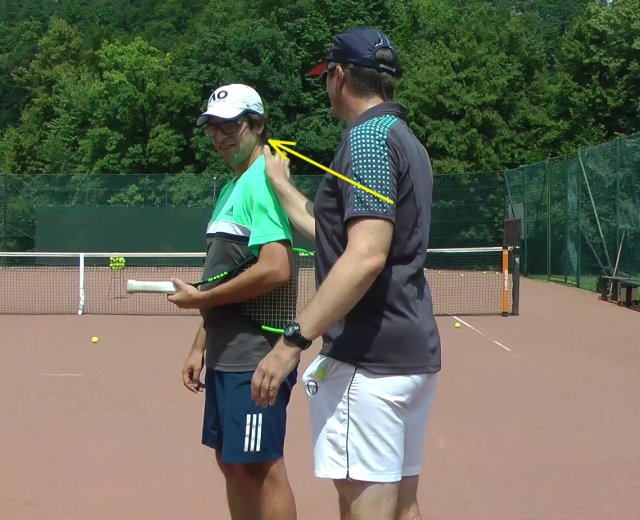
... and this is how a topspin stroke feels like.
That’s actually how we hit topspin on a more advanced level.
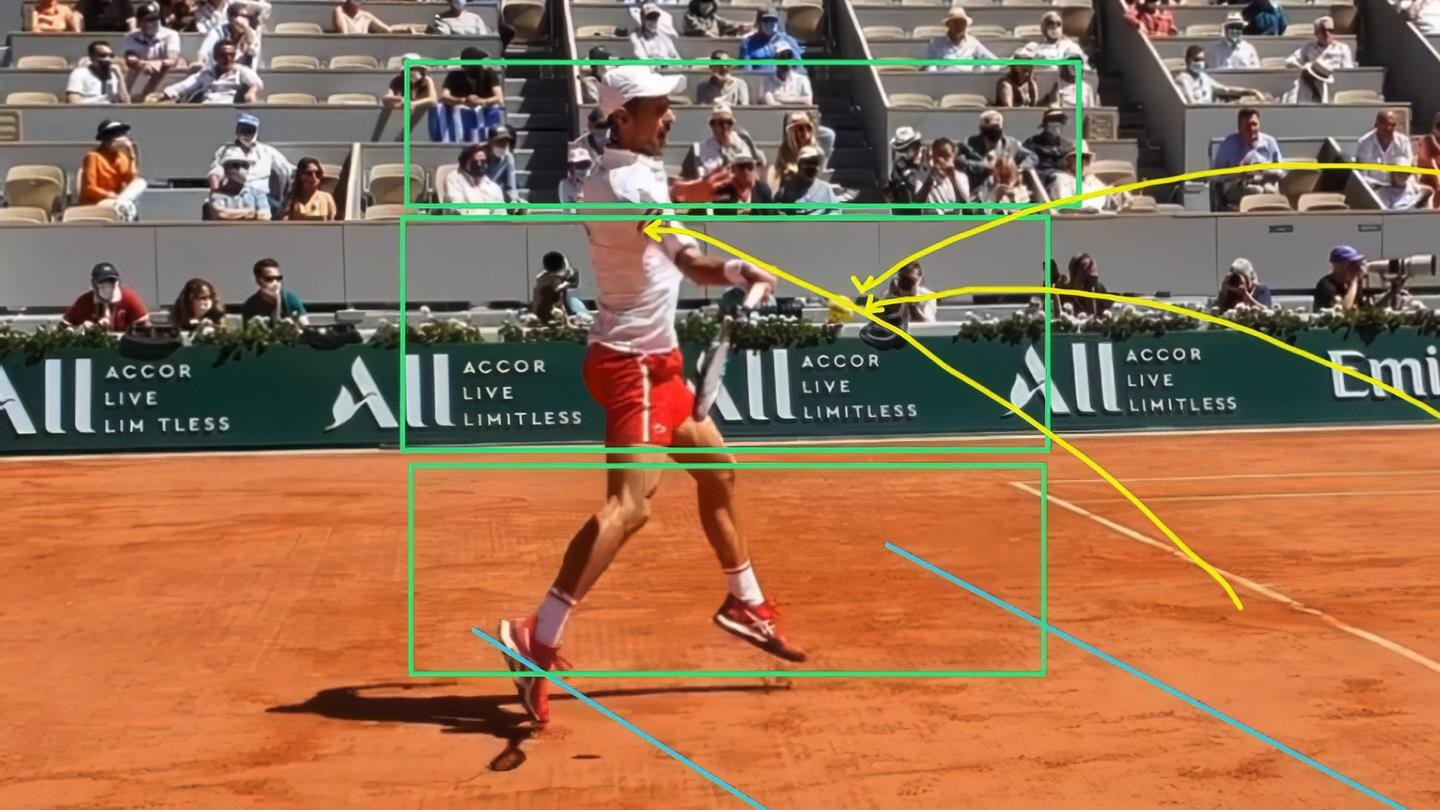
We don’t “brush” the ball, but we “graze” it.
The idea of brushing the ball is fine for a total beginner to give them a really clear mental image of topspin and get them started.
I like to use the idea of “rolling” the ball against a wall or a partner’s racket.
You can even do it yourself, as you can see in this video (also, you can see that I am not the only one teaching topspin with a rolling idea):
But, once we play at higher speed on a higher level, the idea of brushing or rolling doesn’t apply very often when we want to hit the ball with topspin. (Note, however, that it applies on heavy topspin shots like a topspin lob or loopier balls, perhaps from defense.)
A much better idea and feel is to imagine grazing the ball.
Here’s the dictionary definition of the verb “graze”:
verb (used with object), grazed, graz·ing.
1. to touch or rub lightly in passing.
2. to scrape the skin from; abrade:
(The bullet just grazed his shoulder.)
When we graze the ball, we don’t slow down the racket.
In fact, we just partially hit the ball with the same or even an accelerated racket head movement.
In contrast, the idea of brushing typically causes players to slow down the racket in order to execute the brushing motion.
By doing so, you’re losing the speed of your shot and the amount of topspin since you’re slowing down your racket at contact.
(I explained this same idea in another way in one my previous articles on advanced topspin technique.)
Another thing to keep in mind when it comes to grazing the ball is that the more we are inside the court (closer to the net), the less we need to hit the ball directly and the more we have to graze it.
Consider a situation when we’re well inside the court attacking a short ball.
If we hit the ball too “fully” (too flat), we’ll give the ball too much power, and it will fly long because we have way less court to hit into.
Therefore, we need to hit the ball partially (graze it) in order to apply lots of topspin but not lots of power.
As you now see, hitting a topspin forehand or backhand is not just one simple task or movement but a skill that requires the ability to hit the ball very precisely.
Developing The Skill Of Precision When Hitting Topspin
One of the biggest challenges of the game of tennis is adjusting your stroke according to the incoming ball (high, low, topspin, slice, fast, slow, etc.), your position on the court and the direction you want to hit.
So, when it comes to topspin, you need that skill or precision in order to adjust the RATIO of hitting fully into the ball and partially hitting the ball.
In other words, you need different ratios of flat and topspin – meaning hitting straight into the ball (horizontal vector of the racket path) and hitting the ball partially (vertical vector of the racket path).
If you’re far behind the baseline hitting a defensive shot, you need to hit well into the ball with some topspin because you need the ball to fly far.
But, if you’re inside the court attacking a short ball, you need a different ratio of flat and topspin vectors.
You need to hit the ball less directly and more just graze it.
This skill cannot, of course, be developed by you reading and theoretically understanding this article and consequently being able to play with different topspin ratios.
It requires specific drills that develop the skill of precisely hitting the ball with the right amount of topspin.
The most fundamental way to begin are by completing mini tennis drills (playing within service boxes) because hitting the ball with topspin and keeping the ball in the service box requires you to hit the ball very precisely.
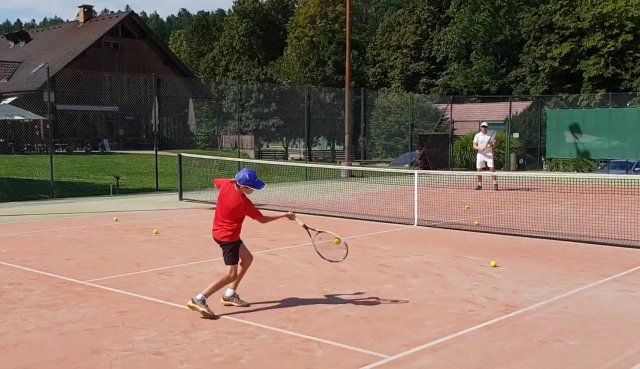
Various mini tennis drills develop better precision of hitting the ball with topspin.
If you are not precise, you’ll immediately hit the ball too long or into the net, and that gives you instant feedback on how to adjust on the next shot.
Playing full court, of course, gives you a much greater margin for error, and you may be hitting the ball quite imprecisely while still landing it in the court.
If you play this way, you may not realize that that same stroke won’t work well at higher speeds.
I will post more ideas in the future on how to develop the skill of spinning the ball in tennis, but for now, you can just experiment with these 3 drills (players play cross court):
- The coach plays a slow, floaty slice, and the player hits topspin.
- The coach plays a topspin, and the player has to stop the ball with slice and then play topspin.
- The coach and the player both play topspin.
I invite you to experiment with the idea of grazing the ball (instead of brushing it) when you hit topspin shots (especially inside the court when dealing with short balls) and let us know how it works for you in the comments below.
Hi Tomaz:
I have been continually taught to “brush” or”roll” the ball for topspin & have minimal success achieving good topspin especially when I am trying to execute a short ball stroke.
Thanks for your “grazing” tip…I will try this tomorrow a.m.
I really like your method of tennis instruction…
Anne
Thanks, Anne, give it a shot 😉 but start easy, with less than 50% power at first. Also, don’t take the instruction completely literally.
None of the instruction we can give in words or video can explain what actually happens in 0.004 seconds that the contact lasts.
Yes, that’s 4 thousands of a second.
So with every instruction the player must experiment and try to find and feel the concept that the coach was explaining.
Hi Tomaz,
I like the grazing idea ALOT. As you have written (said, recorded, shown!) it is much easier to feel something than it is to say what it feels like. I suppose we could get into a long conversation about how this leads to all kinds of problems in human relations. But that digression is perhaps more appropriate for another forum. 🙂
The interesting thing is that you are proposing that we make someone feel what you are doing to them. In this case they feel you creating topspin as if they were the ball. Then that person will feel what they should do to the ball. One of the realizations I have had recently is that topspin feels to me as if my whole body is producing it. I really have started to feel this in my serve but also feel it in my groundstrokes.
Have you thought (or written) about how people transfer an image or feeling of themselves moving into what happens to an external object?
Is this like a fusion of the self and an external object?
Does this question make sense?
Hi Arturo,
I agree that the more skilled you are the more you feel it’s “you” hitting the ball and “you” applying topspin and not feel the arms or even the racket disconnected from you.
At high level the racket is simply an extension of one’s body whereas on a lower skill level the racket is a tool with which player wants to hit the ball. 😉
As in all sports, it takes time and practice to reach such levels.
Tomaz, great, great explanation, for all but especially for beginners.
As always very didactic, but poor Julio !! LOL
Thanks for your tips.
Greetings.
Thanks, Marcelo!
The sound of hitting here in the video is quite strong but the actual hits in reality were really gentle. 😉
Communicating tennis concepts verbally is difficult. Your use of the term “grazing” was very useful. As a senior play who has taken a lot of lessons and looked at a lot of tennis instructional videos, I have found that many coaches’ terminology is usually vague.
Thank you.
Thanks for the feedback, Thayr. I think we need to constantly look for better ways to teach…
Tomaz – interesting concept. Would this grazing action also be “representative” of what happens on the serve?
Yes, grazing applies to serves too – meaning topspin and slice serves.
We can teach initially brushing in order to give the student a clear idea but eventually one needs to accelerate the racket head faster and “grazing” is probably a better trigger word to use.
Thank you for good article, Tomaz.
So Compressing and rolling is outdated?
No, Osamu, compress & roll is a simple concept to get someone started with topspin – so it’s targeting beginners and those who are not skilled in topspin.
Grazing the ball is a concept for advanced players as it requires very precise hitting of the ball in order to impart the right amount of topspin and the right amount of forward force.
Hi Tomaz
What do you think of the TopspinPro for improving topspin? Thanks
Hi Stephen,
One of the most common problems at recreational tennis level is the lack of body rotation into the stroke, especially in the pelvis.
When one starts to use the TopspinPro, they will likely not rotate the body but keep it still and just use their arm in order to precisely hit the ball.
Therefore they are reinforcing the major biomechanical flaw in their technique.
If the player is taught to engage pelvis and body rotation and then try to spin the ball, that’s better.
But that brings us to the second problem of TopSpinpro which is the angle of the plane behind the ball.
It’s way too steep!
If you keep swinging at such steep angle to spin the ball you are again learning a movement that normally does not happen in a normal ball exchange.
The angle you are swinging at only happens when you hit a topspin lob but not when you hit a topspin groundstroke from the baseline or from inside the court.
So another bad habit is being reinforced.
The only positive effect is then spinning the ball and getting a feel for topspin.
In my opinion the disadvantages are way greater than the advantages.
To get the feel for topspin is takes you maybe a week or two and then you can throw the device away.
You now need to get the feel for topspin in a real ball exchange to get to the next level.
Very good stuff!