
Is there a simple way that can help improve multiple elements of your tennis game? Yes, and it’s called “just in case” and it can improve your split step, early preparation, movement and recovery.
Let’s start with two of the biggest challenges in tennis: reaching and hitting the ball on time.
Recreational tennis players tend to reach the ball too late as they don’t always split step and move quickly enough toward the ball. They tend to hit it too late since they don’t prepare the stroke early enough.
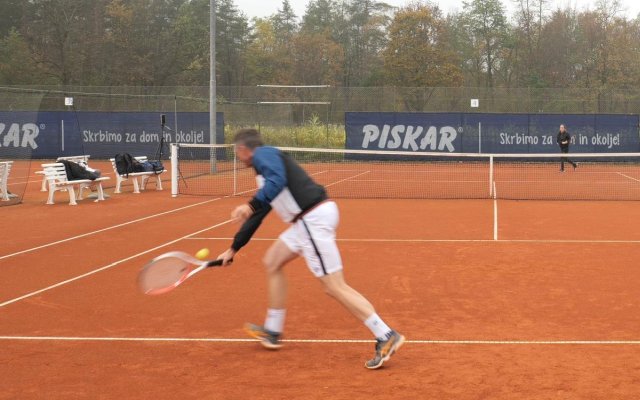
Reaching the ball on time and hitting it on time is very challenging in tennis…
At first glance, it may seem that there is no solution as the game is simply too fast for a non-trained tennis player.
But there’s always room for improvement, and what’s really interesting is that we can improve your tennis game with just one single concept called “just in case”.
If we look at one hitting cycle in tennis, we see that we are in a ready position with some kind of light movement of our feet, and as our opponent is about to hit the ball the hitting cycle starts.
To complete one hitting cycle we need to:
- split step,
- prepare our stroke,
- move quickly towards the ball and hit it,
- and recover to the ideal recovery position.
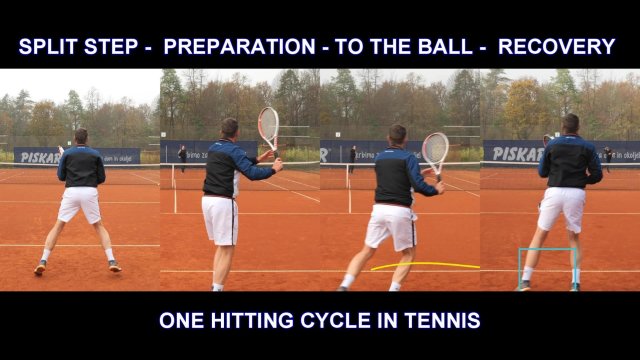
In this simplified hitting cycle I did not include anticipation and also the obvious hitting of the ball.
The split step, movement to and from the ball are the keys to reaching the ball well and being in position for the next one, and early preparation is the key to good timing.
What’s really surprising is that we can improve all 4 elements of the hitting cycle with one single idea called “just in case”.
1. Why You Should Split Step Just In Case
While most of you are aware of the split step in tennis, you may not be aware of why it’s so important and why we actually do it.
In one of the comments I received, one player told me that they do a split step because “it helps them get into a groove and improves their mental patience of waiting for the ball.”
That’s great, but that’s not the true purpose of a split step in any sport.
The purpose of landing in a split step is that we store energy into our leg muscles as we land in the same way as a spring loads with energy when we compress it. That spring is now ready to explosively release the energy when we let it go.
The legs work with the same principle and are ready to release the energy explosively IF NEEDED!
Observe the split step in this soccer goalie training as here it may be more obvious what the purpose of the split step is. Video credit: Goalkeepeer Footwork
What happens in the game of tennis, especially at the beginner and intermediate levels, is that there are not very many good shots hit fast and away from the player. Therefore, the player will easily get to the ball, even if they didn’t split step before.
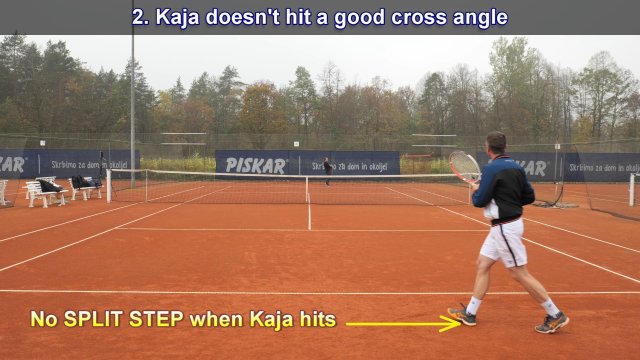
I did not split step when Kaja hit the ball and …
They really didn’t need the maximum explosive power of the legs to be released in order to reach that ball.
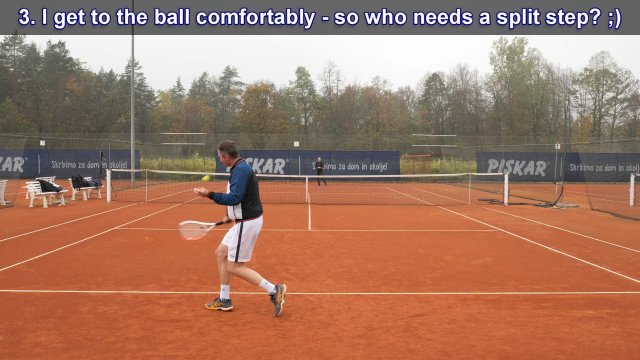
… I got away with it hitting the backhand slice comfortably.
In fact, at the beginner and intermediate recreational levels, the player has to move at maximum speed toward the ball less than 50% of the time.
In the video above, I show an example where in a typical rally there were 4 shots hit not far from me that required no acceleration or running to get to the ball and only 1 shot where I had to move quickly toward the ball.
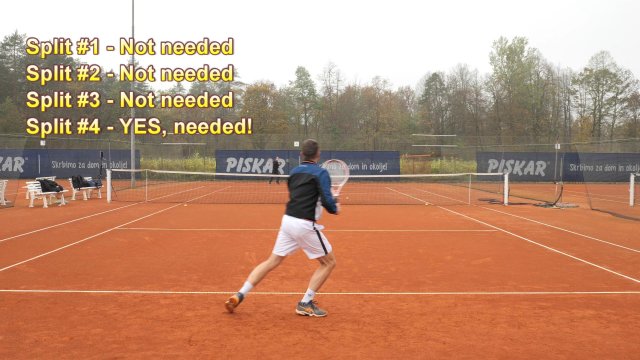
The only time in this rally when split step was really needed and helped me move quickly…
The unfortunate result of this pattern is that the player doesn’t really feel the effectiveness of a split step since in most cases it’s not really needed. That’s why they stop doing it.
This process is mostly subconscious because the player is not really aware of what I just described, but the subconscious mind is constantly looking to preserve energy as that is a basic survival mechanism.
Playing tennis (or any other sport) makes no sense to the primitive part of the brain that is concerned with energy preservation ;).
It’s just trying to do its job of not wasting energy while we consciously push ourselves to play a sport for various reasons like ego gratification when winning, social status, acceptance, having fun, health benefits and others.
So, the primitive part of the brain will quickly realize that doing the split step is mostly wasted energy. It will stop engaging your legs to do all that, but you won’t realize that you stopped split stepping because you’re so engrossed in the match.
What the conservation of energy part of the brain does not realize is that we will be too late for those difficult shots from the opponent if we didn’t split step just in case.
In other words, the split step happens before we see how the ball was hit.
If you time the split step correctly, then you are:
- at the highest point of your jump when the opponent makes contact with the ball
- and just landing and having the legs well loaded with energy just as you are able to read the direction of the ball.
Therefore, we cannot wait to do a split step only when a good shot is hit and conserve energy when a mediocre shot is hit toward us.
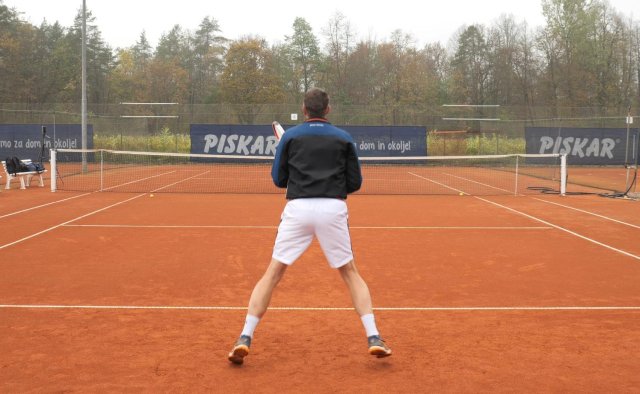
Always perform the split step just case the ball will be hit away from you.
We actually need to do a split step every time JUST IN CASE a good shot is hit so that we have all the maximum energy stored in our legs available to explode and push us quickly in the direction of the ball.
Yes, when the ball is not hit that far away from us, then looking back in time we can say that the split step was not really needed for that ball, but obviously we can’t see the future.
Therefore, we need to do the split step every time because that prepares us for the worst case scenario, which is when a good shot is hit away from us.
That way, we’ll have the best chance of getting to the ball as well as we can, which increases our chances of hitting it well back across the net.
2. Why You Should Prepare Early Just In Case
Now that you’re using a split step just in case and you can react quickly with your movement, you also need to prepare your stroke early enough.
Tennis players tend to prepare their stroke too late – meaning they usually wait until the ball bounces before they start preparing.
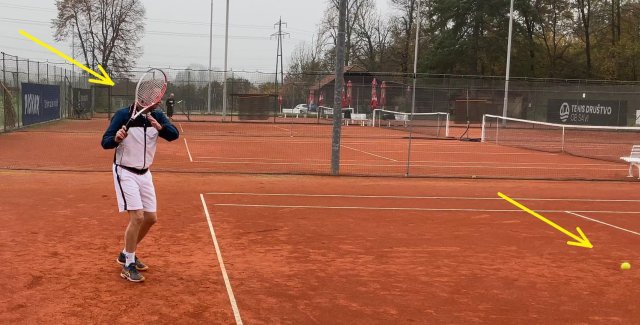
Starting to prepare when the ball bounces is WAY TOO LATE…
When they receive a slow ball, they can get away with it. Unfortunately, again, they don’t realize there’s a problem since they did put the ball back in play.
When they receive a faster ball, they usually miss it or play it way too short. Since those situations don’t happen that often at the beginner and intermediate levels, they again don’t realize how critical their flaw is.
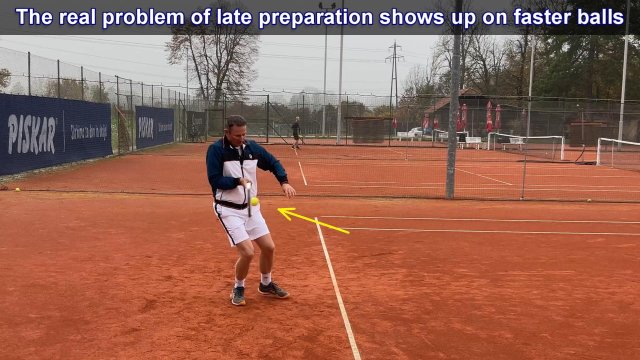
Late preparation results in a late contact which results in poor power and poor ball control.
So, players tend to prepare slowly when they read that the ball is slow, and they tend to rush their preparation when they read that the incoming ball is fast.
Rushing the preparation will cause tension in the arm and the body, but it will still result in a late contact point. Not only that, but since they are rushing the movements, they are speeding up the racket towards the ball that is coming in very fast!
Can you see a problem with that?
They will very likely over-hit and lose control of the ball.
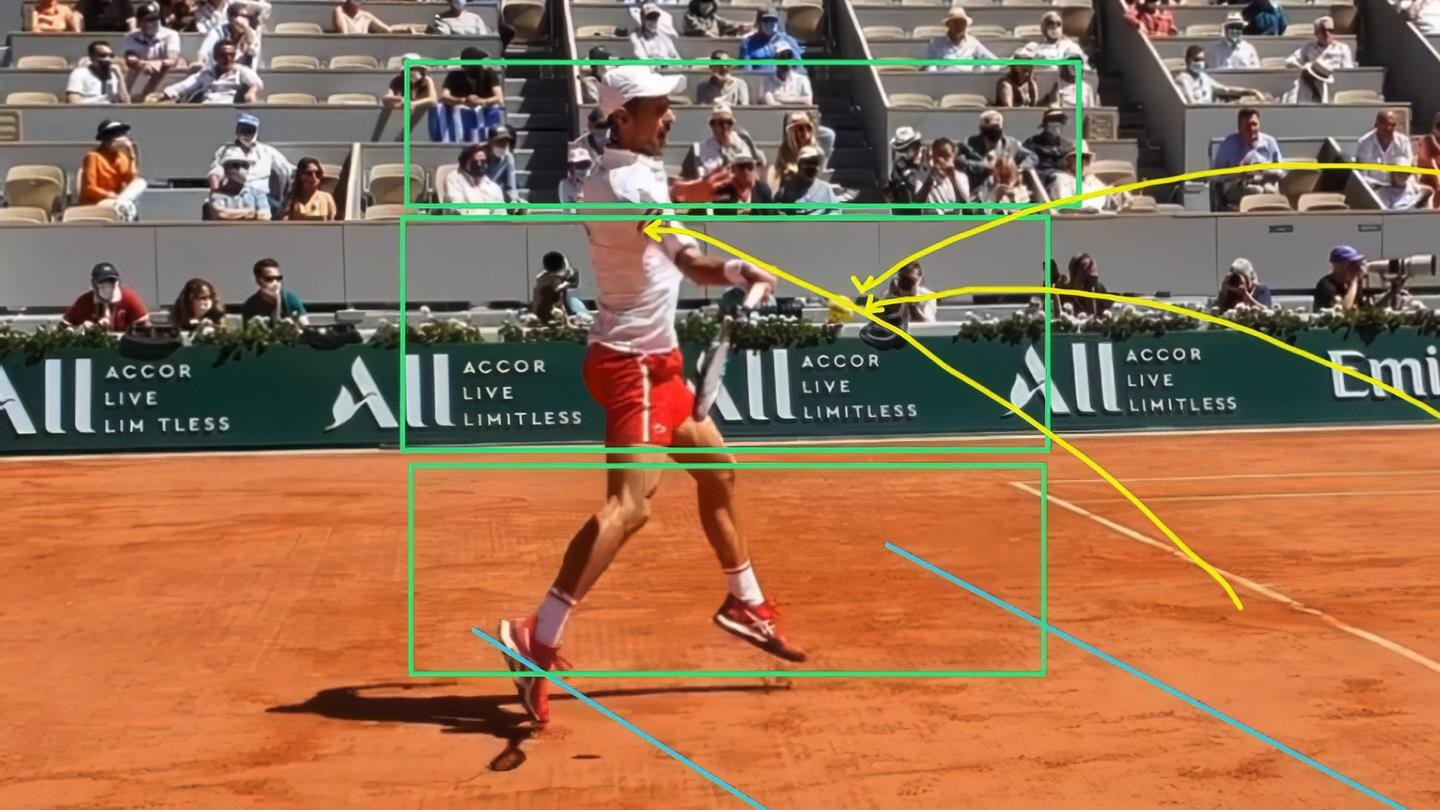
If we receive a fast ball, we should swing slowly toward it so that the resulting speed of the slow racket and fast incoming ball is a moderate speed shot that we can control well.
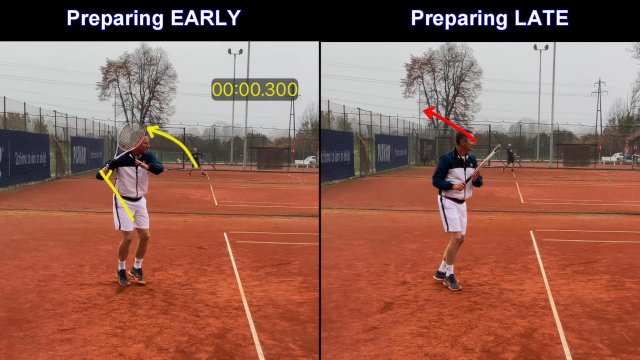
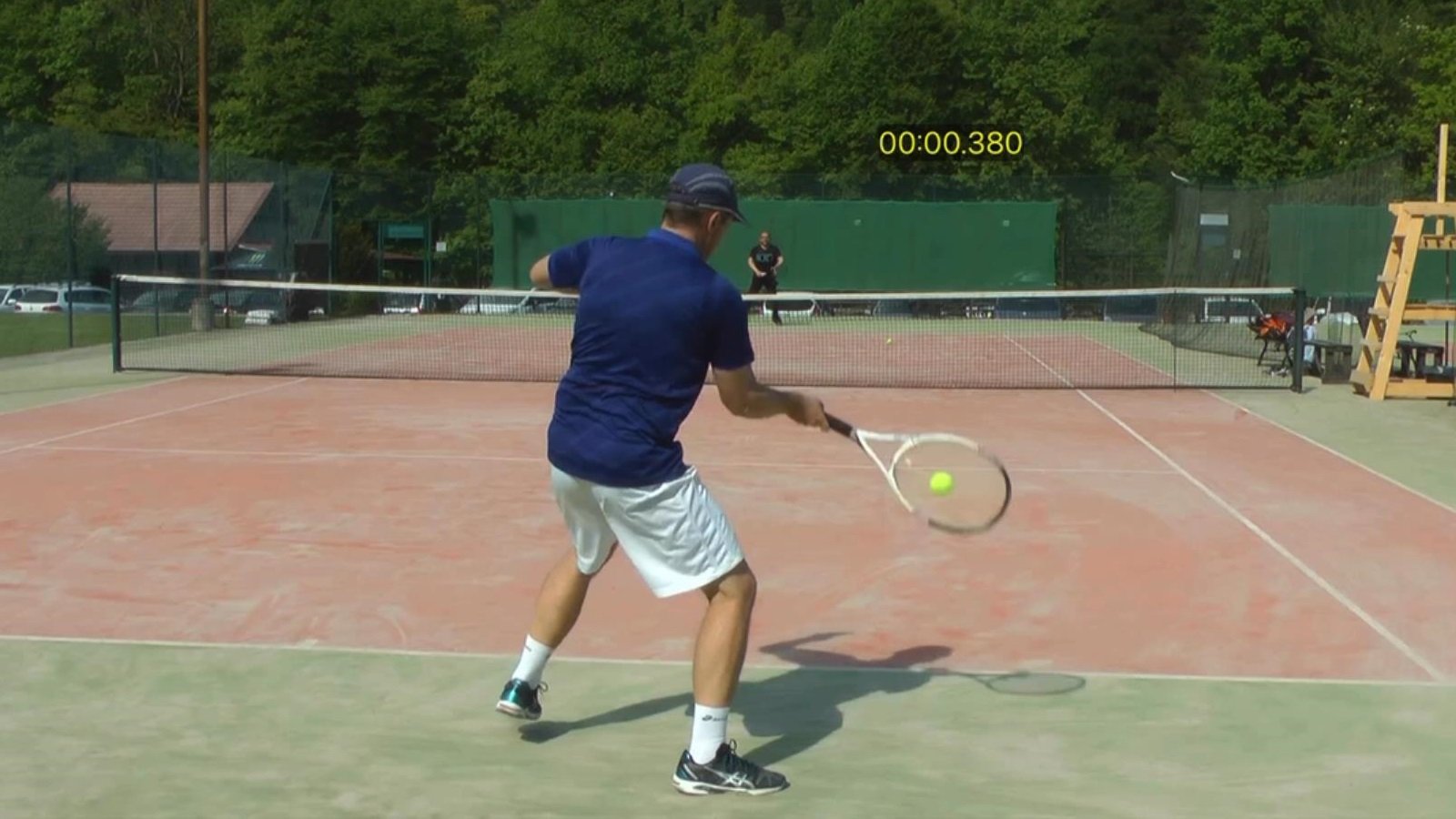
Note how much earlier I prepare on the left on the same speed of incoming ball.
Therefore, we cannot wait to see what kind of ball we will receive and then prepare accordingly.
We need to prepare early just in case we receive a fast ball. In that case, we won’t have to rush our stroke, and we’ll still hit the ball in the ideal strike zone, which gives us good ball control and easy power.
So, just like with the split step, we use the same principle: we are preparing for the worst case scenario, meaning just in case we receive a fast ball, we want to be ready for it.
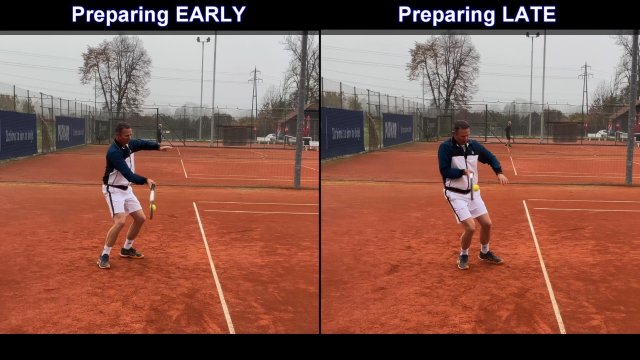
Early vs late preparation and the resulting early vs late contact point on a fast ball.
If we happen to receive a slow ball and we have prepared early, that’s also very beneficial to our stroke.
Now we can slow down the backswing and downward swing, which leads to contact that allows us to relax our arm, get easy power through gravity acceleration and form a good wrist lag, resulting in good stability and ball control.
3. Why You Need To Move Quickly Toward The Ball Just In Case
Now that the split step and early preparation have taken place, you need to move toward the ball that was hit away from you.
The same problems arise again if you wait to read how far and how fast this ball is really going and then decide how fast you’re going to move.
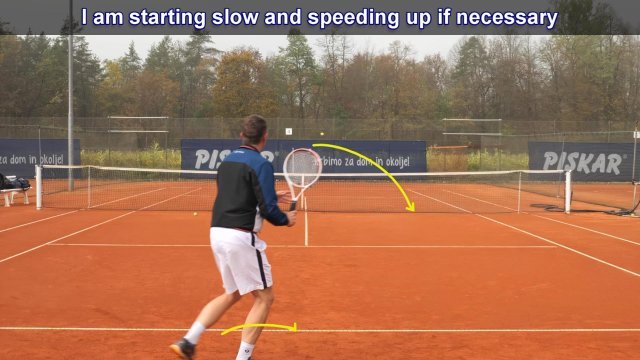
This approach is very intuitive and energy preserving but you must learn to override it.
Unfortunately, this process of judging the ball and adjusting our speed to the ball’s movement is intuitive and happens subconsciously.
But it doesn’t work in tennis.
Because if the ball is hit fast and away from us, it takes us a few tenths of a second to read that. By then, it’s too late to reach the ball well, even if we sprinted toward it.
In other words, there is no time to read the ball’s speed and precise direction before deciding how fast we will run.
We need to move as quickly as possible toward the ball as soon as we see it going away from us, even though we don’t know exactly to which spot the ball will go and how fast it’s going.
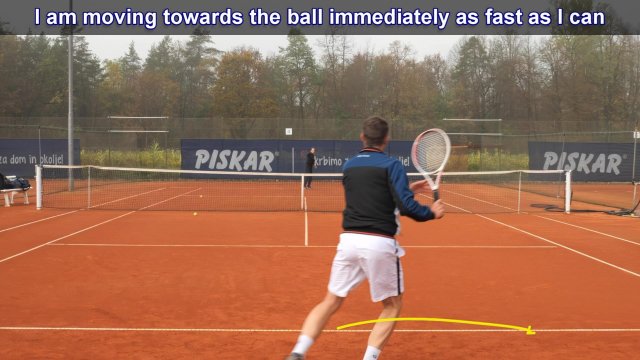
I move towards the ball as fast as I can just case it’s difficult to handle.
If we start moving from the beginning as quickly as we can toward the ball, we will do the best we can on difficult shots and have the best chances of controlling those difficult balls.
Just as in the case of the split step and early preparation, we start moving toward the ball quickly in case the worst case scenario happens – which is a fast ball hit far away from us.
If we start moving quickly and then realize that the ball was not hit that fast or far away from us, we then have time to “beat the ball” to the hitting point, which is exactly what we want.
When we “beat the ball” to the hitting point, we have enough time to position ourselves well, to stabilize well and to execute our stroke in a calm, relaxed manner.
If we can accomplish all that, then we have the best chances of hitting the ball clean and controlling it well.
4. Why You Need To Recover Quickly Just In Case
Now that you’ve hit the ball, it’s time to return to the ideal recovery position. That’s the position from where you can cover all the opponent’s possible shots equally well to each side, whether they play left or right.
The first scenario in the video above showed what happens when tennis players don’t really recover correctly but don’t realize that since their opponent didn’t hit a good shot.
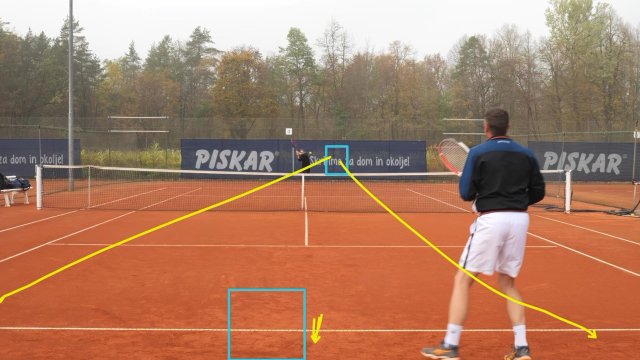
I should have recovered to the blue box by this time…
When my assistant Kaja hit my hit down the line shot with a poorly angled cross court shot, I got to the ball comfortably even though I did not recover quickly (just in case) to the ideal recovery position.
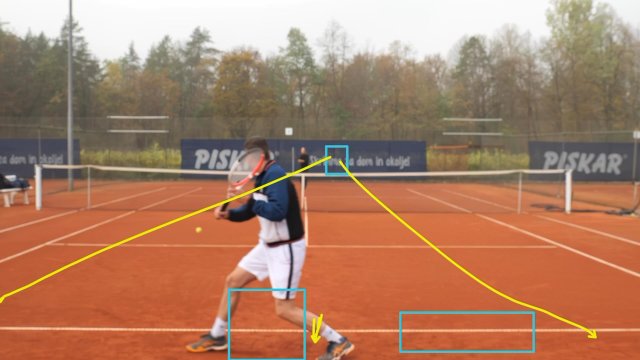
I got to the ball comfortably and I don’t realize my prior poor recovery position.
Because I got to the ball comfortably, I did not realize anything was wrong.
At the beginner and intermediate levels of tennis, your opponents are not good enough to regularly punish you for poor recovery, so you get away with it most of the time.
Unfortunately, you also don’t learn anything. Those accurate punishing shots are too few and far between for you to realize that you’re constantly doing something wrong.
If you’re motivated to improve your tennis game to another level, then you need to become aware of the poor recovery that you’re doing now and improve it.
That means that you need to return to the ideal recovery position just in case your opponent hits a good shot away from you.
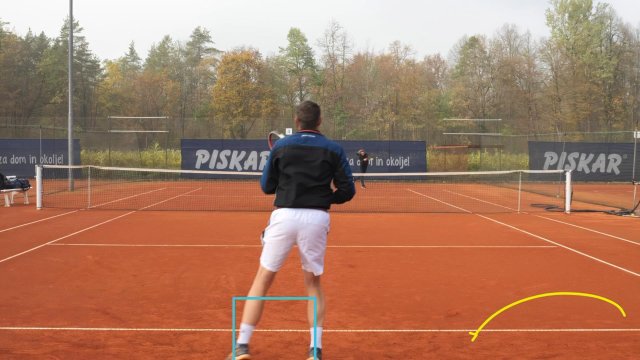
I moved quickly from the side of the court and I got to ideal recovery position in time.
Even though you will move quickly and expend some effort to get to the ideal recovery position, you will realize that at the beginner and intermediate levels you’ll rarely need to be there so early.
But when your opponent does hit the ball well and far away from you, that’s when you’ll be best positioned to get to it.
At higher levels of tennis, players quickly learn that they really need to hurry up recovering and try to get to the ideal recovery position because many more balls are hit accurately away from them and they need to increase their chances of getting to them well.
Summary
Tennis is a game of space and time. We need to manage the space that we cover and the time that we have at our disposal the best we can if we want to play tennis well.
Even at the intermediate recreational level, there is only 1.7 to 2.0 seconds of time on average at your disposal from the moment your opponent hits the ball to the moment the ball reaches you.
If you waste even just a few tenths of a second of this precious time, you’ll quickly run out of time in terms of reaching the ball and hitting it well in front in your ideal strike zone.
To complete one cycle of hitting the ball, you need to:
- split step,
- prepare your stroke,
- move to the ball and hit it,
- and recover back to ideal recovery position.
What’s personally interesting to me is that you can improve all these 4 elements of tennis game with one single concept: “just in case.”
Apply “just in case” concept to all 4 parts of the hitting cycle.
Not every shot from your opponent is so good that it would automatically teach you to split step, prepare, move and recover at your maximum ability, but since you can’t see the future, you need to prepare for the worst case scenario.
The “just in case” approach simply means that we are reacting, moving and preparing the stroke for the worst case scenario so that we’re ready to handle it to the best of our ability if it happens.
If the worst case scenario doesn’t happen, then we have plenty of time to position perfectly for the ball and execute our stroke in a calm, relaxed manner, which greatly increases the chances of hitting it really well.
While the “just in case” approach expends more energy than waiting to see what happens and then reacting, it is the price we have to pay in order to play tennis well.
My question to you now is this: have you recognized yourself in any of the 4 situations where we need to apply the “just in case” concept? If so, which one(s) were those?
Let us know in the comments below and share how you’re going to improve your tennis game in your upcoming sessions…
Awesome series! Thank you for knowing what we need and showing us what we need to do to get to where we want to be!
Wonderful feedback! 😉