
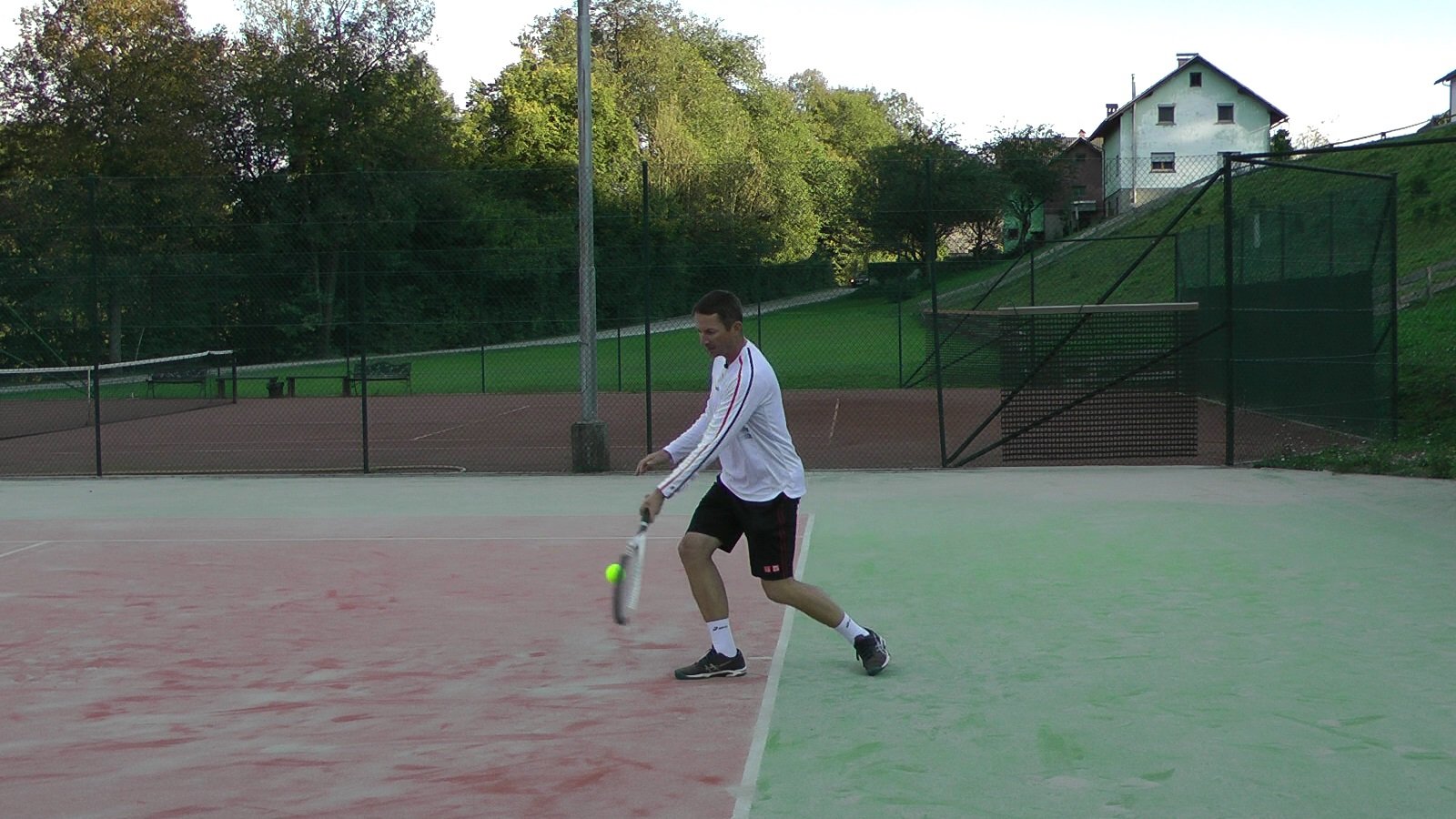
You may have admired some pros hitting the ball with very smooth strokes and at the same time generating powerful shots with high consistency – all with seemingly no effort.
Just to clarify, by “smooth strokes”, I mean that the player’s movements are fluid rather than jerky.
These strokes also don’t look that fast, yet the ball almost always flies off the racquet extremely fast.
So, what is the secret behind very smooth strokes, and why should you look to develop them?
Why We Don’t Have Smooth Strokes And How That Hurts Our Game
The main reason you may not have smooth and fluid strokes without any jerky contractions is that you associate the word “hard” with hitting a tennis ball.
You may also interpret tennis strokes as hitting hard because you observe other tennis players hitting the ball.
But that interpretation and the idea of hitting the ball “hard” will most likely trigger a very jerky response of your body and arms.
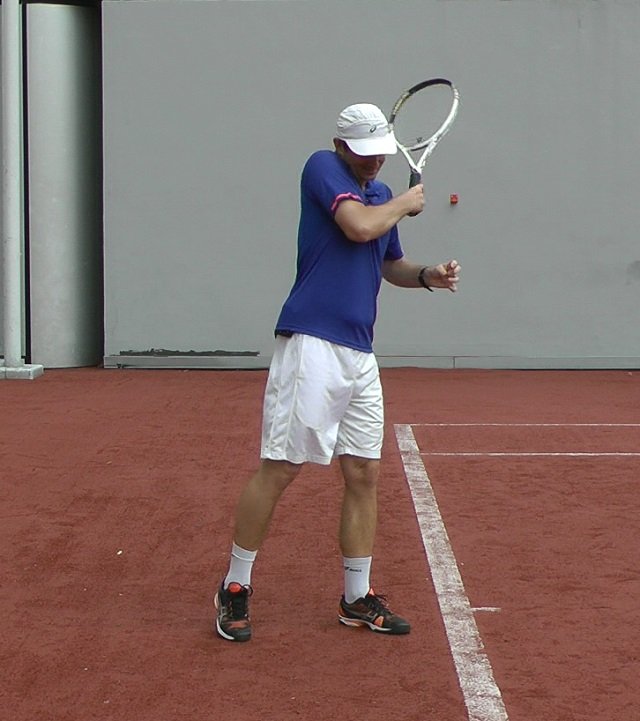
Very tight arm as a result of wanting to hit the ball "hard"
As you swing towards the ball, you will contract many muscles in order to produce a “hard” or “strong” stroke.
While it may seem very obvious that that’s the way to hit a tennis ball and make it fly fast, it is in fact not the case.
A tennis ball weighs less than 60 grams.
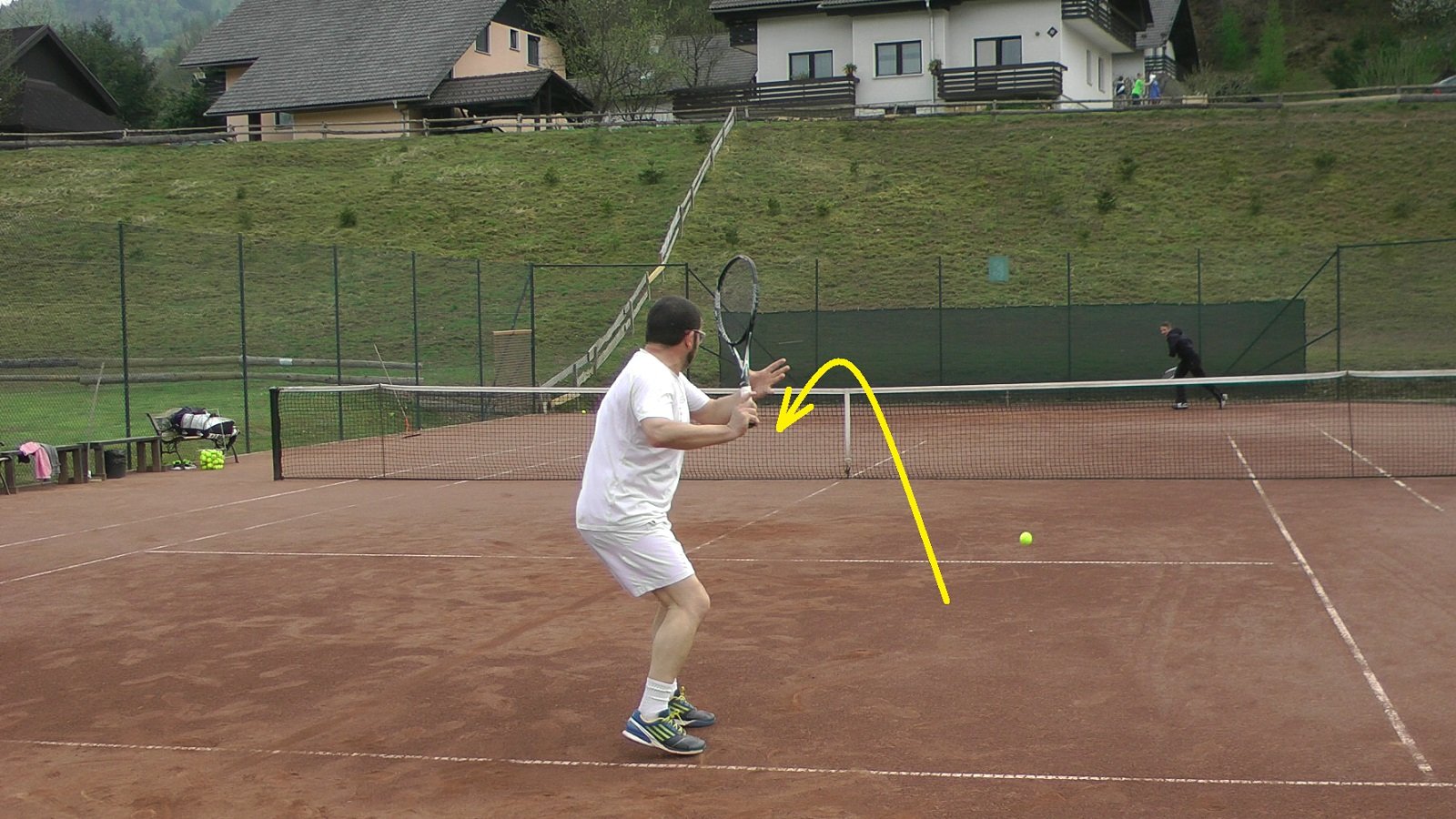
Even when it’s flying towards you with a certain speed and therefore carries more energy, it is very easy to hit it back with almost no effort if we transfer our weight (which is typically 1000x more than the weight of the ball) against it and hit it in the ideal contact point where the kinetic chain of our stroke produces the most force.
While it is easy to hit the ball back when we time the weight transfer and our stroke properly, it’s not easy to achieve that accurate timing, which takes a long time to master.
But, even if you do hit it at the right time, if you are still thinking about hitting it “hard”, you’ll probably tense up too much during your stroke and make it very inconsistent.
There are two main reasons we’re very inconsistent if we have a jerky move in our stroke:
1. As we line up for the shot and our brain calculates the timing and the swing path to the ball, we may tense up or contract during our swing.
In response, we will pull the racquet slightly off its ideal swing path since contraction literally means making something shorter, in this case our muscles – therefore, the racquet is pulled slightly closer to our body.
That’s why we keep slightly mishitting the ball and lose consistency in the process.
2. As we contract our muscles, not only do we pull the racquet closer to the body, we also change its angle.
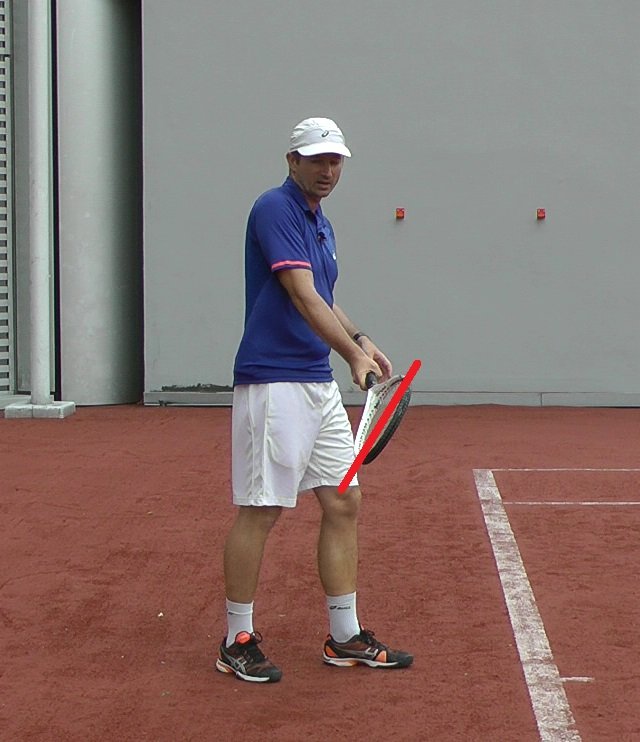
Tight grip typically closes the racquet down
There are many muscles in our arms. When griping the racquet more tightly, muscle contraction and tension change the racquet angle during the stroke.
Most of the time, the racquet actually closes down and the resulting shots end up in the net.
Therefore, we must try to avoid contraction and jerky movements during our strokes in order to maintain a steady swing path through the ball as well as the proper racquet head angle that will direct the ball over the net.
How To Develop Smooth Strokes
Most professional tennis players have developed very smooth strokes through massive repetition.
They are also extremely athletic and coordinated. They know how to use their bodies very efficiently in order to produce power in their strokes; therefore, they are able to relieve their arms of a lot of effort.
That automatically makes them swing much more fluidly.
While we will never have the same amount of practice and same skills as the pros, we can significantly improve our ability to swing smoothly and eliminate jerky movements in our strokes by simply being aware of this process and by looking to make our strokes smoother.
As with many of the topics on feeltennis.net, this one doesn’t include any revolutionary exercises but simply requires you to become aware of any jerkiness in your strokes and attempt to get rid of it.
You need to feel how tight your stroke is and look to make it more fluid and smooth.
The first step in doing that is slowing down your stroke and seeing at which speed you can actually achieve fluidity.

Slow down your stroke and see if you can make it smooth.
Once you do that, you gradually increase the speed of your strokes and look to stay “tension free” even at higher speeds.
This process is quite a challenging one especially if you’ve been used to tensing up very hard when hitting the ball.
You may realize that you’re able to swing fluidly, for example, at 50% of your usual speed. However, as soon as you increase the speed to 60% or more, the jerky movement may reappear.
One of the most obvious and common situations where you realize that something is wrong with your strokes is when you’re trying to finish off very slow balls from the middle of your court, the so-called sitters.
Because that ball doesn’t give you much energy and bounce of your racquet by itself, you must generate more power to hit it fast towards the other side. If you tense up in the process, you will make a lot of mistakes or hit the ball in but without much speed.
You’re trying very hard, yet the shot is really not fast. The slow speed allows your opponent to reach it and possibly pass you at the net.
If that’s happening to you, then that’s a sure sign that you’re tensing too much when hitting your strokes.
Looking to make your strokes smoother should be your priority in the near and long-term future.
What you’re basically looking for is to hit the ball fast (and not hard!) with a very smooth and comfortable stroke.
Remember that the ball weighs 1000 times less than you and that it’s no contest when “you” and the ball collide.
Imagine hitting “through” the ball rather than “at” the ball. Remain very comfortable while swinging smoothly and breathing out.
Remember to “smooth” your strokes also in the warm up before competitive tennis matches.
Match pressure will surely affect your body and make it more tense. As a result, your first line of defense against that is immediately getting the feel for very smooth and fluid strokes at the beginning.
In summary, while proper stroke technique is the foundation of good tennis strokes, it IS really just a foundation upon which you need to develop higher level skills such as timing the ball well, being on balance and making your strokes smoother.
It is something I’ve personally been working on for years, and it has helped me play with high consistency and very little effort expended in the process.
Thomaz, Excellent explanation as always, truly masterful and from a point of view that coaches do not usually use.
The major complication that I see look for the ideal contact point is the physical training to enable us to reach that ideal contact point and ball speed of our opponents (not controlled by us)
Thank you very much as always for your excellent contribution. Greetings.
Dear Tomaz:
What superb advice you give on “trying too hard”..
Normally I am a fairly good 3.5-4.0 player..
We have just transitioned from hard indoor to clay outdoor courts for the summer and my tennis game has now disastrously changed!
I am late & I over-hit almost every shot!
This morning I told myself to relax.relax etc, but every ball I hit seemed out of my control… even the easy shots..
I can see why that coach was envious of easy way that you hit a tennis ball..
Any advice on transitioning from hard to clay & indoor to outdoor is very welcome..
i love your ‘feeling” way of teaching tennis..
Best regards,
Anne
Hi Anne,
That’s a process we all go through at various levels of difficulty. Conditions are different, timing is different, the bounce is different and it takes us a few sessions to get used to it.
Don’t fight it, accept it. Then you’ll adjust faster…
I began listening to Tomaz’s advice about 8 years ago when I was in Germany and bought his mental manual. I can say that his advice on the serve is the best. At this point I have learned that I can barely grip the racket when I start my serve and hit very nice smooth serves. I know they are going fast because they hit the back fence. I know they have a lot of spin because my opponents at times hit their returns out. But they do not feel like I am hitting them. I cannot really feel the racket anymore.
So Tomaz, is this your sense that when we loosen up completely and hit smoothly we lose conscious control of the shot. This makes us very nervous so we would rather tighten up than let go.
Hey Arturo,
Yes, loosening up and hitting smoothly is in a way letting go, similar to what I mentioned in the throwing & pushing article.
And this is so difficult if one plays for points too much.
In order to let go and in the process make your strokes smooth you need to be allowed to miss with no consequences – except the need to take another ball out of your pocket.
So I highly recommend lots of free hitting and working on higher level tennis skills such as the ones I posted recently.
As these skills improve (timing, balance, contact point, relaxation, looseness, comfort, having a clear intention, etc.), so will your win-loss ratio.
Tomaz,
Just when I thought your videos can’t get any better, you came up with
another amazing video. Excellent lesson. Loved it.
Thanks,
Steve
Tomaz, Terrific explanation of “letting go”. Separately, are you in Singapore at this time? Where would I find your travel schedule? Thanks. Vishnu
Thanks, Vishnu. You can find my whereabouts in the sidebar of this blog under my pic and short bio.
“…currently living in Slovenia…” is the current status. 😉 Might return to Singapore in the winter.
Hi Tomaz, I have heard several times on broadcasts that the pros”use the speed or power of their opponent” to overpower on returns of serves or groundstrokes. I have tried to feel this, but I lose control and get overpowered easily. I wind up cutting everything back when the ball is coming powerfully. Can you help with the feel on this idea?
Hi Don,
We use the power of incoming ball by hitting it well in front, in our ideal contact point and with our weight transfer going against it.
If we manage to do that in time, and not grip the racquet too tight but allow it more to swing against the ball, then the ball will fly off the racquet quite easily.
These are the principles that are fairly simple but the actual timing of the stroke and keeping a quiet and calm mind despite seeing a fast incoming ball and therefore not creating tension are more difficult to master.
I can’t express in words how much I appreciate your approach to tennis and your ability to convey the principles of the game through video and words. Your lessons are practically supernatural in their subtlety and wisdom. That praise might seem over-the-top but, like I said, I can’t express in words…. I’m a 60 year-old rec player who started tennis way too late in life but I always find encouragement and a deeper understanding in the lessons you share (for free!!!!) online. I have been struggling with my two-handed backhand and just the other day came upon the idea of just slowing my stroke down so that I make solid contact rather than trying to muscle the ball up to speed. And then your lesson appears! Supernatural. Thanks, Tomaz. All the best.
Much appreciated, Ted. And videos on two-handed backhand will come up too at some point!
Dear Tomaz,
I wanted to ask how to develop smooth strokes when you face a player who likes to blast a forehand and knife his backhand when you practice with him. I am asking as this is one of my hitting partners and while I was hitting smoothly at first, the heavily underspun backhands or slices as they are called, started to pull me out of my smooth hitting more so than the blasting forehands and I use a two handed backhand. Let me know what you think.
Ryan
Hi Ryan,
The challenge is greater then. I would step back a couple of feet to buy myself some time and see the ball better and then attempt to keep my strokes smooth.
If I can’t do it after a few sessions, then this challenge is too much for your current skill level and it would help you if you could practice with someone who plays slower and steadier.
I completely agree with you on the importance of relaxation to achieve smooth strokes. During weekend play at the club I almost always never know who my partner is going to be; in the beginning we are tight and stiff with all strokes and can see the frustration with my partner who is not happy with his strokes. Then I walk over, tell a joke, we both laugh, then like magic we are relaxed and start hiting very nice strokes and have a enjoyable game.
Anjan (San Jose, CA, USA)
Absolutely fantastic and insightful instructions!
I definitely have a tendency of trying to hit to the ball hard or trying to force the ball rather than just swinging the racquet.
One problem that I face is in judging the distance from the ball while swinging. I tend to come too close while hitting and then I end of contracting and just using my arm rather than use the full unconstricted weight transfer.
Any thoughts on what can I do to fix this tendency?
Thanks and hope to see you soon in Singapore!
Hi Raj,
We usually have problems finding the correct distance from the ball if while the ball is approaching we think about technique – like some part of the stroke. Then we actually observe our movements in mind’s eye and not really track the ball.
Once we do start tracking the ball when it’s closer, we realize we’re not at the right distance.
See if that applies to you and stop thinking about anything for a while but just observe the ball flight all the time and look to find the right distance.
I have been thinking and practicing a lot on this. I believe one of the keys to smoothing out your strokes has also a lot to do with how we prepare our body to receive the ball. It is so much easier and smoother to hit the ball if we shift our weight in the proper way. We need the opposing action in order to move our bodies properly. Try sitting bolt upright in a chair and move your torso forward, now try sitting in a chair lean back first and then move your torso forward. I think it feels much easier and requires less energy. The same thing should happen when we hit the tennis ball. If we shift our weight in the proper way we should feel no tension in our bodies.
I have especially noticed this on serve. If I dont fully shift my weight back, the motion is not smooth, it feels tight, and is less effective. Once I started picking up the toes of my front foot and fully leaning back and weighting the back foot as I toss the ball everything became so much easier. My serve feels effortless, and I don’t even think about what my arm is doing.
Hey, Tomaz! Your “intention” and “smoothness” pointers are probably the two I need the most. Your presentation is superb and very helpful.
Hope all is well with you. Will you be in Tucson for the Tennis Congress this year?
Bob
Thanks, Bob!
I won’t be at the TC this year, perhaps next one.
What I’ve tried to do when I start warming up is to see if I can hit the ball at the same speed as it is coming to me, and that alone relaxes me.
You once said that most rec. players are always trying to change the speed of the ball and thus make errors.
To me it’s because the people we are playing we think are good! And in truth, if they were REALLY good, they would be playing somebody ELSE!
Keep up the good work! YOU are the only video teaching pro who looks and feels something different in tennis.
Best,
Q
Just found this article..Appreciate all your lessons on youtube..U truly make playing tennis the best part of my days !!