
You may have noticed that you’re often late on your forehand or backhand when the ball lands deep in the court on your side.
You may also believe that this is just part of tennis as it is a challenging game and that there’s not much you can do about it.
But, there is a solution to this – although not that easy to achieve. You’ll have to learn to swing “blind”.
Why Two Timings?
The reason I mention two timings is that the “first” timing is what every tennis player is used to and what makes the most sense: you prepare for the shot (forehand or backhand) and WAIT to see the ball AFTER the bounce so that you can hit it.
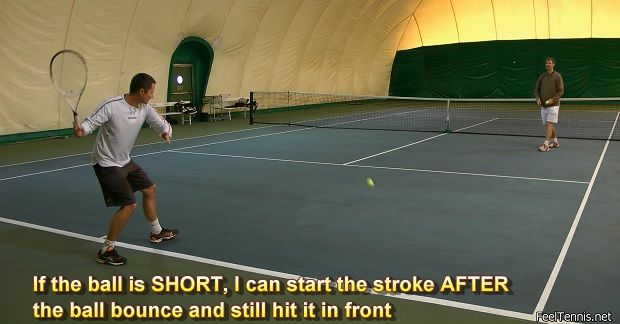
There's enough time to initiate after the bounce when the ball is short
In other words, you want to see the target (ball) before you swing at it. You are aware consciously or subconsciously that this small, bouncy, fast-moving object is not easy to hit with the sweet spot of your racquet; hence, you want to see it really well before you swing your racquet at it.
That works ONLY when there is enough space and therefore enough TIME to initiate the weight transfer, trunk rotation and the swing and STILL hit the ball in front in the ideal contact point.
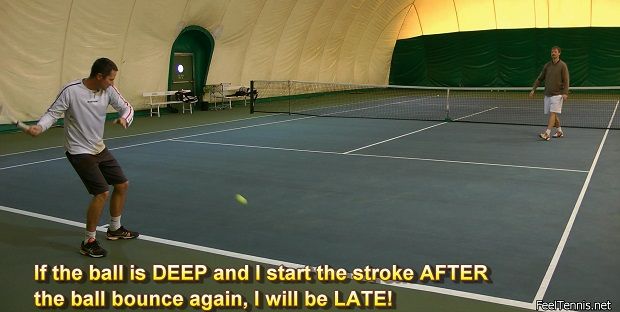
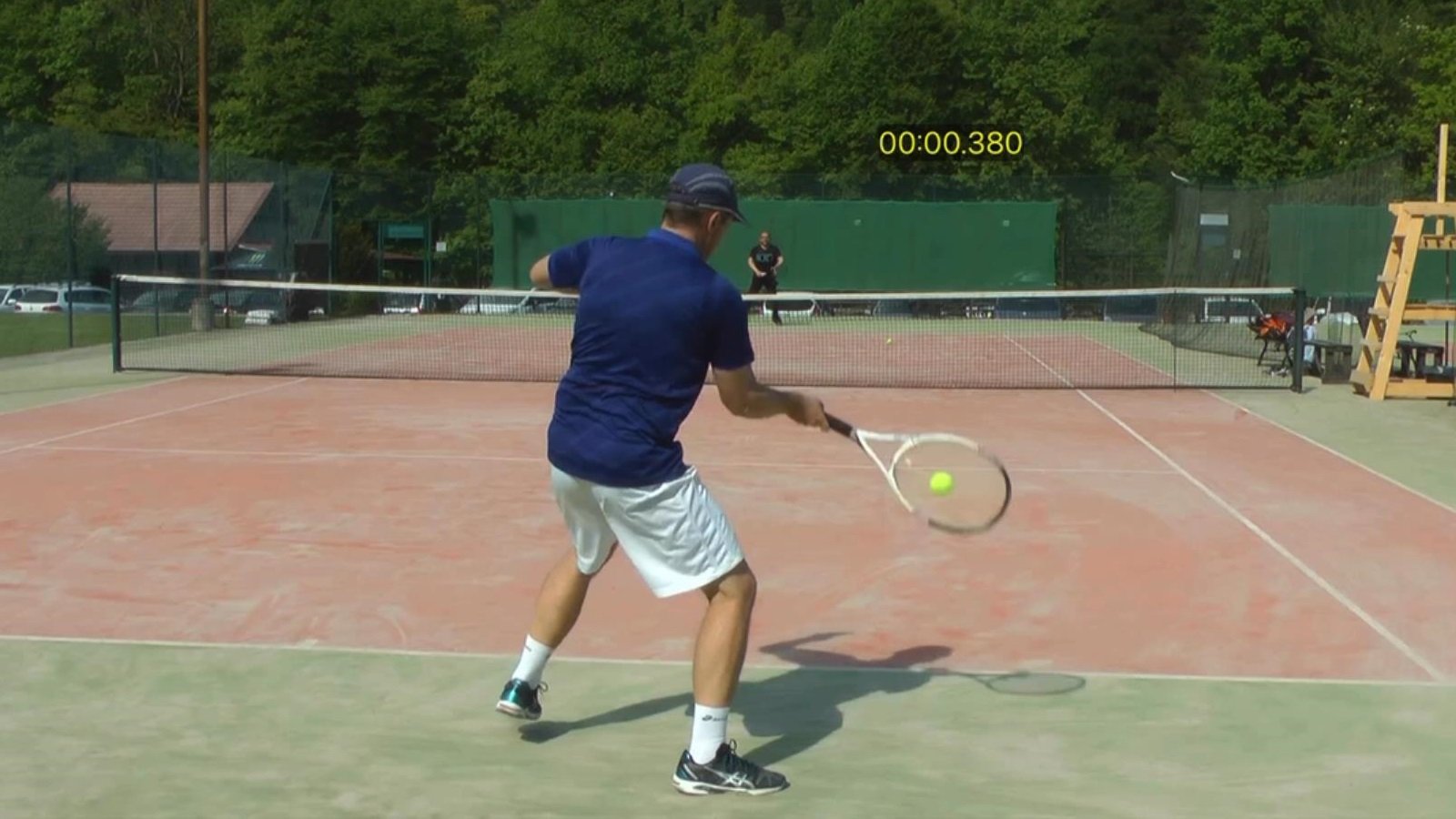
There isn't enough time from the ball bounce to contact point if you initiate the stroke after the bounce
When the ball bounces closer to you, there won’t be enough time from the bounce until your contact point for you to execute the stroke from the preparation (from the end of the backswing).
Therefore, you will need to INITIATE the stroke BEFORE the ball bounces and simply complete it in that short time period you have from the bounce until contact.
For most players, this is very difficult to do because they don’t see the ball yet but need to start the swing forward.
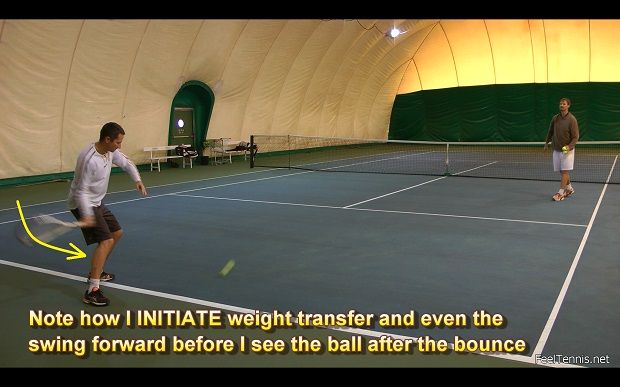
You need to initiate the stroke "blind" when the ball is deep
That’s why I call this sensation hitting “blind”. At first, it feels very strange and uncomfortable – and that’s why so many players can’t do it.
In fact, I will go so far as to state that 99% of recreational players under 4.5 NTRP are unable to hit the ball in front with good weight transfer if they receive a deep ball.
I have been observing recreational tennis players all over the world for 20 years, and this is the #1 problem I see that they cannot solve.
Again, the reason for that is quite simple – their logic says that they need to see the ball before they attempt to hit it.
It sounds logical, but that’s NOT how a more advanced player handles a deep ball.
WE DO initiate the stroke before we see the ball after the bounce.
Once we have been playing tennis for a while, our brain can calculate where the ball will be after the bounce. We have seen thousands of balls, and we have a pretty good idea of where the ball will bounce based on its trajectory and speed before the bounce.
Of course, we may find another cause when I mention this: I have asked many players if they pay good attention to the ball flight before the bounce and they have said that they DON’T.
They are simply watching the first part of the ball flight somewhat sloppily/superficially and are waiting for the ball to bounce so that they can see it and hit it.
And that’s why this universal problem exists all over the world for almost every club tennis player.
A more advanced tennis player watches the ball flight like a hawk and calculates the ball flight after the bounce ahead so he can swing the racquet early if necessary and always hits the ball in front.
As we discussed this with Sašo in this and other lessons, I told him that I am never late. I will never (almost) let the ball go past my contact point/zone, and I will do everything in my power to intercept the ball there.
If I do, I have good, effortless power regardless of where the ball bounces.
Because my technique has been automated by now, this is the only thing I “do” while I am playing – I am simply trying to hit the ball at my ideal contact point on EVERY groundstroke I make.
Of course, before that I also know exactly at what trajectory I want to hit it, meaning I have a very clear intention of the shot.
How To Practice
1. Initiate First – hand fed drill
For coaches who work with players or with players whose partners are willing to throw them some balls, I found the “Initiate First” drill to work well.
This is a drill that exaggerates the point I am making in this article, which is needed for the players to break their habit of waiting for the ball to bounce before they initiate the stroke forward.
The procedure is simple: the player has to initiate the stroke forward first, before his partner feeds him the ball.
I usually stand on the same side of the court and hand feed balls. That way, I can control the depth and speed of the balls very accurately.
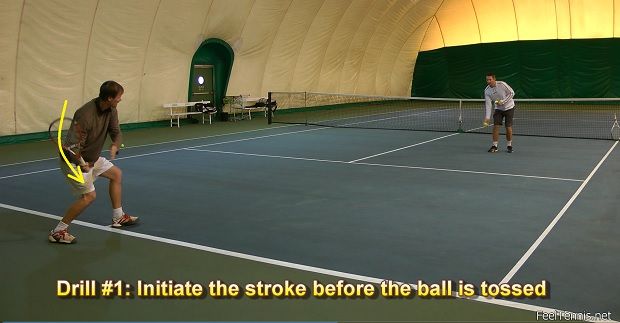
The player starts moving the racquet down / forward first, then I toss the ball
The goal of the player is first to be too early so that he experiences what it means to be too early.
Most players I see on the court have been early on their shots maybe in 0.01% of the swings they have made and have been late on 30% to 60% of the shots they have made.
So, they basically have no experience of what early actually is.
ONLY when you have a good experience and feel of what too early is and what too late is can you find the correct timing.
I suggest hitting at least 50 but ideally 100 to 200 balls like this per session in order to start finding the right timing and to be able to initiate the stroke before the ball bounces.
So, initiate first, and as soon as you do, your partner should toss you the ball deep and close to you. Try to hit it in your ideal contact point. You will feel when you do.
With some repetitions, you and your partner will find the right timings of tossing and hitting.
You can also move to both executing at the same time – as the partner tosses you the ball, you immediately start the weight transfer forward and also approach the contact point with your racquet.
2. Playing on the Rise – from mini tennis to baseline
The second type of drill I really really recommend you do often is hitting the ball on the rise.
Just by playing LOTS of balls on the rise, you force yourself to initiate the stroke early without even knowing it.
In fact, most players will play half-volleys better than deep shots landing close to the baseline that jump to hip height or even higher.
The reason is again the same: they want to see the ball before swinging at it. And if you do that, you’ll always be late and hit with no power and little control.
But, on the half-volley, they are aware that they cannot see the ball clearly and they do go against it well before the bounce.
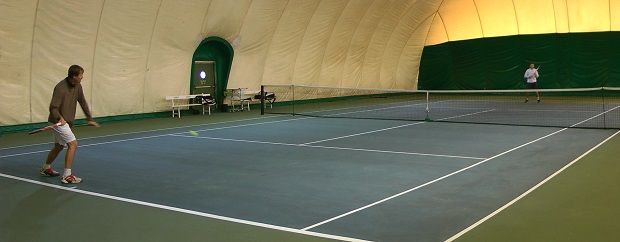
Playing the ball on the rise - and trying to hit in front - forces the player to initiate early
So, progress from playing mini tennis for a few minutes to mid-court (midi tennis) and eventually playing inside the baseline.
Retain that same rhythm and timing which is to go against the ball early with your weight transfer and your body and to make sure that you hit well in front, which is where your ideal contact point is.
You can also play a variation at the end where one player plays inside the court while the other one plays at his usual position behind the baseline and tries to play the ball really deep.
After a few minutes, switch roles.
How To Hit The Ball When You Don’t See It Clearly
When the ball lands short and you can swing at the ball after you see it (timing #1), you are typically trying to hit the ball, meaning you can see that small object and you swing through it.
But, when the ball bounces close to you (timing #2), DO NOT try to hit the ball as you can’t see it clearly. You will make a very jerky stroke when you try to “find” the ball there.
That’s what Sašo also told me while he was doing the exercises mentioned above.
The trick is not to try to hit the ball, but to swing or sweep through the BLUR of the ball. Since all you see is a yellow blur, you simply sweep through it (check the article!) and TRUST that the ball will be hit well.
It takes time to develop that trust. That’s why you need to work on this often.
Until you develop trust in your ability to sweep through the blur of the ball and actually control the ball well, you will have some twitches in your swing and that will cause mistakes.
Keep at it often, and improvement will follow.
Two Most Common Technical Mistakes
1) A very common mistake here is that players RISE up too quickly.
The quick, blurry ball causes them to panic somewhat, and they lift their head and extend their legs too quickly and often times frame the ball with the bottom edge of the racquet.
You need to stay down longer through the shot and rise after the contact.
2) The same goes for your racquet path: do not go steeply up on the ball trying to hit it with topspin, but extend longer through the contact zone, trusting that you will sweep the ball on the way in the same way as the broom sweeps the leaf off the ground even though you are not aiming at the leaf.
The Challenge Of Perfect Timing In Tennis
To conclude, I see two timings in tennis when it comes to groundstrokes: first, you may initiate the stroke forward after you see the ball bounce, but that works only when the bounce is far enough from you that you still manage to hit the ball in your ideal contact point.
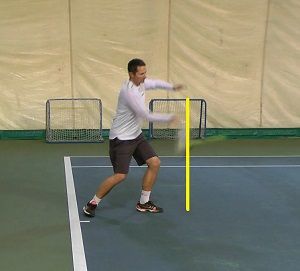
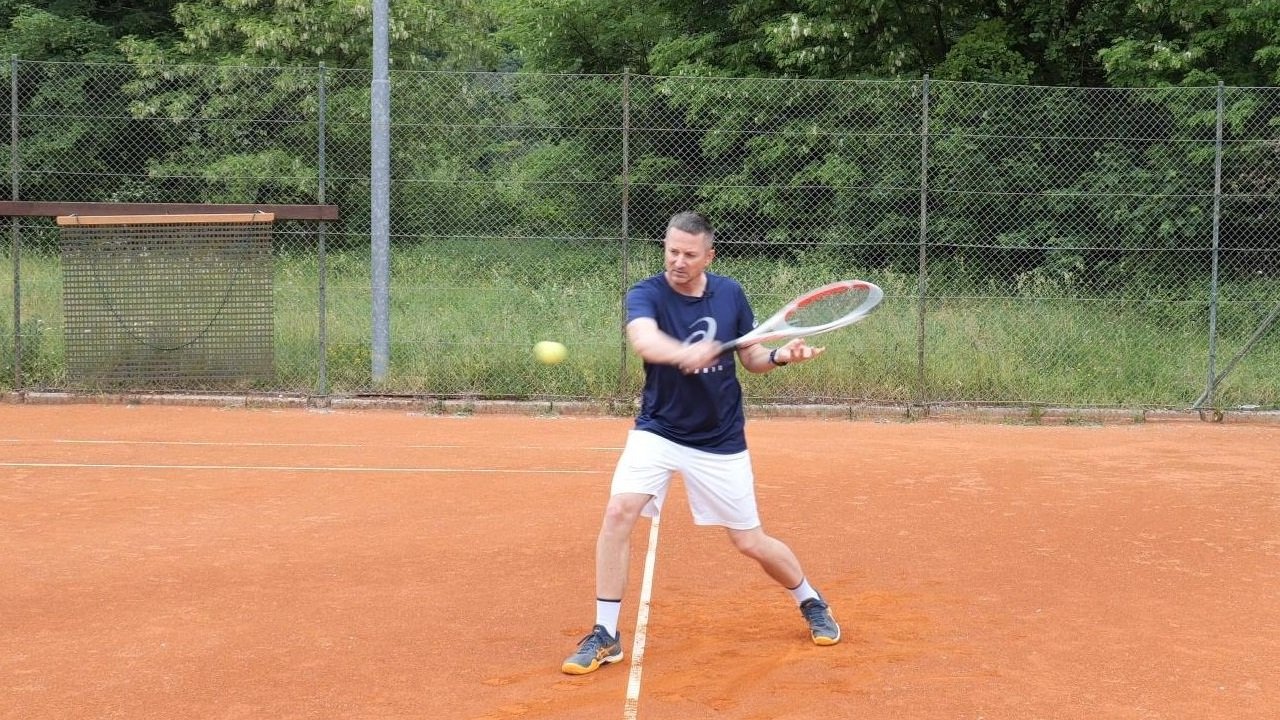
You can hit every ball in front but only if you're able to initiate your stroke "blind"
The “other” timing is when you initiate the stroke forward before the ball has bounced. This one is very challenging as you have NO CUE on when to actually swing.
You need to calculate your swing so that the ball will be in the ideal contact point just as you swing through.
I often say players need to INTERCEPT the ball rather than wait for it to get to them. Do not allow the ball to come close to you before initiating the weight transfer and the swing.
Experiment how EARLY you can start the weight transfer against the ball.
I personally feel that, when the ball is going toward me, I can start the weight transfer BEFORE the ball coming from my opponent crosses the net.
What About Preparing “Early”?
The usual “prepare early” or “racquet back early” suggestions from coaches have developed over time exactly because other coaches see what I see – most recreational tennis players are constantly late on deep or fast balls.
They are not late when the ball lands short on their side and when it’s slow enough. Only when it bounces deep or comes in fast.
Preparing early is not the solution for a simple fact – you are NOT late on the ball because you prepare too late but because you INITIATE the stroke towards the ball too late.
And the reason why you do that is NOT because you prepared too late but because you want to see the ball after the bounce before you initiate the stroke.
It is the reverse that is actually true – when you are able to initiate the stroke before you see the ball, you will also prepare much more EARLY.
[thrive_text_block color=”note” headline=””]The early preparation is a consequence of your intention to initiate the stroke before the ball bounce.[/thrive_text_block]
Read this again if needed to really understand how things work.
It is NOT the early preparation that will somehow make you swing blind when you need to. You will still wait to see the ball after the bounce even if you prepare early – if you have not developed the skill of “swinging blind.”
Therefore it is CRUCIAL that you develop this skill of initiating the stroke before you see the ball after the bounce when that is needed, meaning on deep or fast incoming balls.
One final point – this “other” timing is very challenging. It is NOT easy to master, and you will have to put in a significant amount of shots on the rise, being fully aware of the timing of your shot and practicing this over and over again.
I personally think that this is the most difficult thing in tennis to master besides correct advanced serve technique.
It is doable, though, and I hope this article has shed some light on why you may be hitting late with your forehands and backhands in tennis and how to go about fixing that.
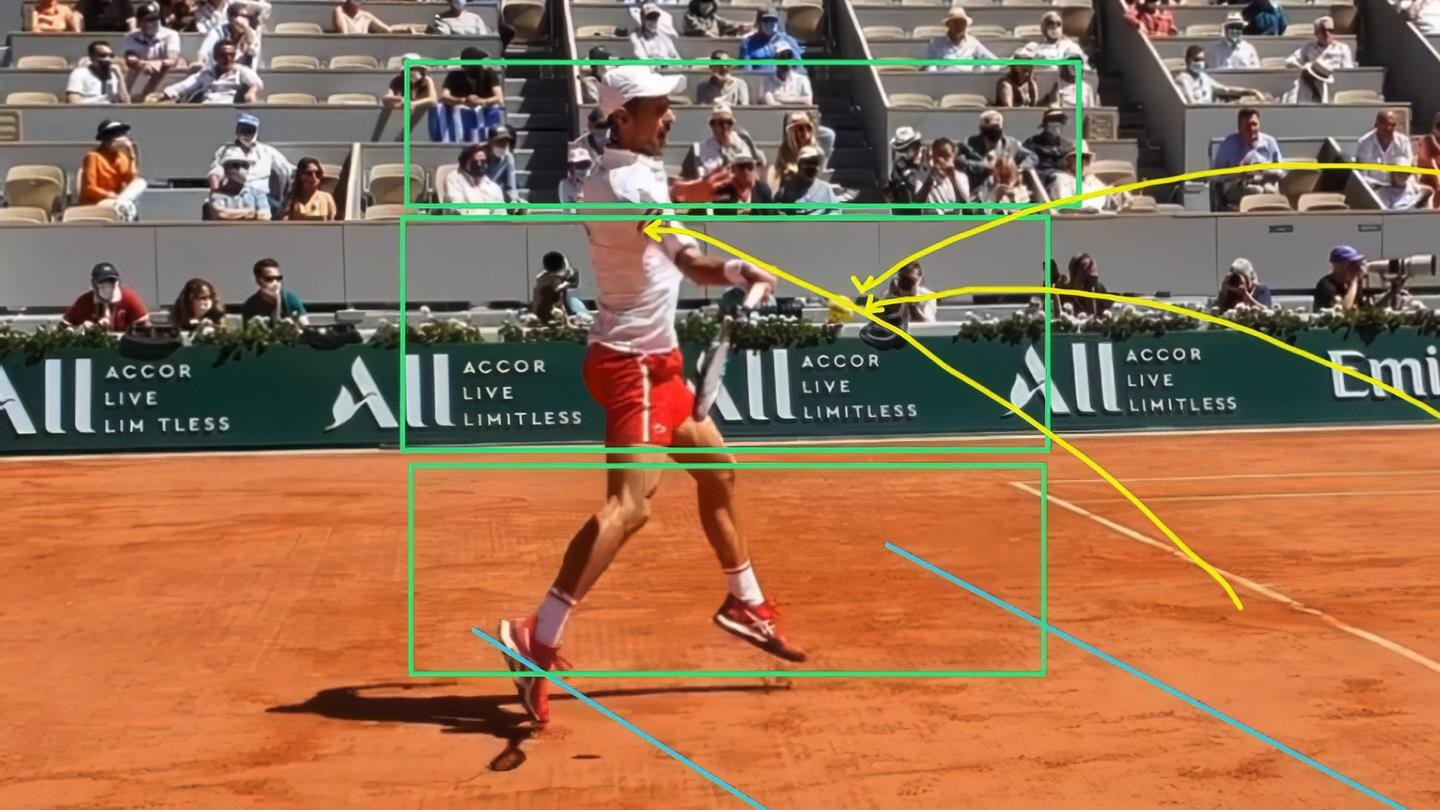
Excellent article, Tomaz. Really good explanation of timing the forward swing to synchronize with the trajectory and speed of the tennis ball.
Synchronizing is exactly the right word, Mike. You reminded me of an article on general timing in tennis I wrote before so just linking to it for anyone to refresh their memory…
Thanks nice reminder to be conscious of the fact that blind start gives better body balance on stroke play.
May I say that Tomas Mencinger is best tennis analyst ever? There I said it without your permission. Your unique approach to analyzing tennis stokes places you in that category. Thank you for all your wonderfully insightful suggestions. I’ve played tennis for a long, long time and one thing I’ve discovered is that it’s impossible to fully concentrate on the game 100% of the time. Perhaps 85% of the time you are very fortunate in properly watching the ball. Anticipating a ball in a late fashion happens to all of us particularly at club levels-even very rarely at the pro level. Is it possible that when you forget to follow correctly Tomas’ suggestions here, “just hang in there ‘patiently'(i.e..don’t overreact by quickening your stroke) so that you still can see the ball and “punch, push or shovel it back? It won’t look good but the ball goes back in play. Emergencies only. What do you think Tomas?
Thanks for the kind words, John, really appreciate it.
And sure, most players find a solution one way or another to keep the ball in play even though they hit it late – pushing more, hitting up high, spinning a lot, etc.
The key message I want to share here is that the player is not even aware that there is such a thing as “swinging blind” and that it’s the only way to hit the ball in front when it lands close to them.
Thank you for your clear instruction. God bless you.
As always, I find your analysis and insights to be quite unusual and brilliant! I’m generally troubled by late hitting, especially on the backhand side. Now I see a way to counteract this. Thanks a bunch!
Thanks, Jerry. It often happens that we are even more late on the weaker side or the side that’s technically weaker.
Saso, the player in the video above, is very rarely late on his backhand as it’s technically better than his forehand. But he is often late on the forehand.
There is also an element of eye dominance where we don’t see the ball as well on the non-dominant eye side as we do on the dominant eye side.
It is so challenging to hit the ball on the rise, so I nearly always try adjust my positioning to hit when the ball is falling. Now I am going to try your suggestion on initiating earlier and try to hit more balls on the rise. Thank you for an excellent article.
You’re welcome, Gary. Try the live ball progressions shown in the video. It can take you just 5 minutes per session to go through them and in the long term that will add up.
Also, you progress from easier situation to more challenging one so it’s not straight jump to baseline and hitting on the rise where mistakes might accumulate and discourage you from working on those types of shots.
fantastic explanation ! it clears my mind . staying on the baseline and go for a sort of half volley .
Hi Tomaz, I really like these concepts of two timings and “hitting blind”. They just seem to cover what I have been pondering about. This morning I played against a much stronger player and found myself being late on many balls (interestingly mostly when I just hit a good serve, those came back to me with interest; I didn’t suffer from this when we played minitennis as warm up like in your clip though). More than placement or hitting hard, my “lateness” seemed the key difference between our levels of play. Would you agree with me in saying this ability of hitting blind and two timings in match play is the ticket to higher level play?
I would definitely agree, Greg.
I can tell in one minute (or less) how good a tennis player is able to hit balls based on how he / she handles deep shots, meaning if he / she is late often or not.
I can’t tell yet whether that’s a player that wins many matches though. Then there are lots of other factors in play…
Excellent article and video! I am ALWAYS late on deep balls or i always have to move waay back. I always have the intention of hitting the ball on the rise but only now do i get how i should actually be doing it. Thanks for this video!
It’s best if you start with the mini tennis to baseline progressions, they will make you more comfortable very quickly, Jim.
Great info..I always tried to do the blind and was not sure if that was correct..many times I did late as well..now I see blind is the only choice.
another q is should we back up? But I dont see pros doing that
Hi Siby,
Yes, you can back up if the ball travels slower so you still have some time to balance yourself. The pros back up a lot on clay courts but not so much on hard courts.
Safe types of players like Nadal and Murray do back up a lot even on hard courts but they don’t lean back. 😉 So their shot is still very heavy. Topic for another article…
Is this instruction telling us (actually) how to hit the ball on the rise ?
In spite of nice presentation I was missing the reference point,
the moment when the ball hits the ground, in order to see positions of
the rackets. Thank you Tomaz !
Isn’t this the “feel” approach to hitting on the rise, which is a mechanical term, while two timings or hitting blind describe what happens (or might happen) inside your head?
Yes, Greg, I wanted to show the reason why players are late on deep balls – or balls on the rise.
Telling them to prepare early is pointless as they will still wait to see the ball bounce. I have seen countless players like that who were ready very very early and yet always late on a deep ball.
So unless we address and fix the CAUSE of being late – which is wanting to see the ball before swinging at it – we will not correct our problem of hitting late.
Great Tomaz, because you do this by coming up with new concepts, ideas or frases. We need those because our thinking and way of perceiving things is very much language based. They clear your mind as one poster said. One might even use them as mantras.
Yes, Milivoj, you could say that this explains how to hit the ball on the rise. But again, the key point for me is the intention to hit the ball well in front in my ideal contact zone.
Even though the preparation happens before the contact, it is a CONSEQUENCE of the desire to hit the ball well in front.
Tomas, once again, very insightful.
This concept may be more readily recognisable in our part of the world (here in Australia) in connection with the game of “cricket”. In this game he hitter of the ball, called the “batsman” is involved regularly in the most “swing blind” activity seen in any sport. The ball comes at 90mph, weighs 180grams but has the most unpredictable trajectory both through the air and after contact with the ground so that it can fly any height. Indeed, although it is extremely sad, for the first time in first class cricket a batsman lost his life last week because of a freakish momentary lack of judgement with respect to the possible “contact point”, which in this instance just was not there.
Anyone who had a go at this game will probably pick up Tomas’ perceptive analysis of the late ball quite easily.
George from South Australia.
Thanks for the analogy, George. Yes, initiating the swing early or “blind” also happens in baseball but there at least you can strike twice and still be in play.
In tennis players don’t want to miss the ball completely but the principle is very similar.
That’s why it’s so important to work on many of tennis skills when just rallying freely with no points and no pressure allowing ourselves to miss here and there and push the limits of our skills.
That’s how they can jump to a new level.
“If you always do what you’ve always done, you’ll always get what you’ve always got.” – Henry Ford
Hi Tomaz,
Your description o “sweeping through the BLUR” and trusting that the ball will be hit well reminds me of the feeling I’ve had when doing half volleys at the net. I’m not a very advanced player, but as I’ve started working on my net game I’ve noticed that I’m able to hit some impressive half volleys on balls that are supposedly more difficult than higher “put-away” volleys. It seems that when faced with these low balls I’m able to just let go and let instinct kick in. I’v been surprised at the success I’ve had with these shots, especially since I’m a big believer in the importance of seeing the ball well (and in these situations I don’t).
Now I’m going to try looking for a similar feeling on deep balls at the baseline. As usual, thanks for your excellent advice! Zac
It’s funny because I use the same technique in table tennis! Haha! Didn’t know I could use it in tennis, too!
Yes, Ludwig, perhaps that comes more easily to me since I played lots of table tennis as a kid.
I like your approach to the problem of timely hitting. This allows you to play the ball from the back line. Only i can’t understand why Sasha begins to meet the ball in “dead rack” (standing on the soles of both feet). I think, so his maneuverability is lost and therefore he is forced to make mistakes (watch the start of video)
Hi Tomaz,
Very interesting. It reminds me of an article written by the now deceased Mark Papas. (http://www.revolutionarytennis.com/federervisiontechnique.html). In it he claims that even pros tend to look for the ball in front of the racket and hence are blind. Papas’s argument was that Fed seemed to watch the ball from behind the string bed. To do this he actually moves his eyes away from the ball early and then waits for the blur you talk about behind the string bed.
Your post is interesting to me because it suggests that even the pros are still trying to locate the ball in front of them even though they cannot see it. In the article, Papas suggests that Bjorn Borg may have done the same thing.
Have you ever played around with Papas view on Federer? Maybe there is a greater discussion of this in the literature? I know there is something called the Quiet eye (http://www.pbs.org/saf/1206/hotline/hvickers.htm) which must be discussed in tennis.
So I am wondering if initiating the movement of the body before the ball bounces could also be coupled with initiating eye movements toward the contact point before the ball arrives there.
Hopefully, the question makes sense to you.
Great post! Please keep them coming!
Best,
Arturo
Hi Arturo,
I am quite certain we can’t really see the ball when it’s bouncing very close to us – at least not consciously. But from my own experience I am sure that my eyes and brain to receive some information about the ball flight even though I am not conscious of that.
So I just keep staring at that yellow blur area until I follow-through and then look after the ball. I’ll show more in the next video on how to deal with fast incoming balls.
As for initiating the eye, yes, there is that too of fast or deep balls as we cannot track the ball when it changes direction so abruptly bouncing off the ground.
So we predict (the more balls we’ve hit, the better we predict) where the ball will “appear” after the bounce and look there to see the ball at least a little bit before we make contact.
The instinct we have to fight though is looking away or forward which is what we tend to do when we feel we cannot track the ball.
We don’t like looking away from the target nor do we like looking at blur. 😉
But that’s what needs to be done to help the brain time the shot well in such a challenging situation.
Interesting you mention not looking at the target. I read more on the quiet eye in basketball and golf. It seems to be focusing on a different point but in the target area. But in tennis we are always focusing on contact and just imagining the target. So it is really hitting blind in so many ways. Maybe it is more like baseball in that sense. The ball comes at 90 mph and the hitter has to simply hit the ball. No time to think. The problem in tennis is to do this all the time.
Thanks again for a great article!
Best,
Arturo
Tomaz, Great, great explanation, as always, thanks a lot.
The best technical tennis website without doubts.
Early preparation in my case is perhaps the key point. Now, I can complement with the blind swing concept for deep balls.
I try to prepare early, when I see the stroke of my opponent and I discover the direction (drive or backhand), I prepare the backswing, when the ball cross the net I begin to transfer the weight and the transition of the stroke, always pointing with my left hand in case of drive.
An then try to concentrate in the impact moment, but it is possible when the ball is short, now I can add your concept of blind swing.
Thanks a lot Tomaz, from Argentina.
Thanks, Marcelo!
I would suggest you don’t think anything else except that you want to hit the ball in your ideal contact point regardless of where it bounces.
All the elements you mention above: preparation, weight transfer, swing and contact are the consequence of that intention.
I know that they happen before contact but they will adjust and speed up if necessary to accommodate what you intend to do – which is to hit the ball well in front even though it’s bouncing close to you.
Hey Tomaz, what if the ball lands deep and kicks high? I always have problem when returning hig kicking and deep balls. Hope to hear from you soon!
Lee
Hi Lee,
The principle is the same – your goal is to hit the ball in your ideal contact point and swing smoothly through the contact zone even when you can’t see the ball that clearly.
You will need to develop trust in your skills in order to really “sweep” comfortably through the contact zone and to develop trust, you’ll need to practice that.
Hi Tomaz,
Thanks for your most insightful observations. It clears up a huge point for me in terms of understanding timing. I first came across timing when learning tennis from Oscar Wegner. He advocates waiting until the ball bounces before taking moving the racquet forward. This seems to be timing 1 which works for beginners. However when I watched professional tennis I noticed that most of the time the players use timing 2 (of course I didn’t call it that at the time). This made it difficult for me to reconcile the two as I didn’t realize there were 2 timings. This really helps to make it clear and avoid any confusion. Thanks for that. Finally it would also make the methods of Scott Ford consistent with timing 2 especially if you think of it as sweeping through the zone with yellow in/ yellow out for the blur of the ball. Once again thanks for your insights.
Lionel
I’ve never heard this instruction as to why I am late on balls. I am really going to try to incorporate this swinging blind, starting my weight transfer early, into my game. Its funny, I can take the ball very early, short hop or half volley type shots with my continental grip(kind of McEnroe style, but in my case, only underspin volley type shot, cannot hit topspin with that grip like McEnroe) but I really want to incorporate my regular topspin, stronger grips into my game. You have given me some great insight into this.
Hi Jonathan,
I thought I would chime in on hitting topspin “blind.” I have experimented a lot with this thanks to Tomaz’s advice. Basically, I really loosen my wrist and make sure that my racket is pointed toward the side fence when I am preparing for the shot. Then I simply swing at the ball. I used to try and position my hand facing down but now I find that imitating Rafa works best (Tomaz’s tip!).
http://www.tennishead.net/userfiles/images/Rafa 1.jpg
From here you literally swing blind with a pretty loose grip (again subject to experimentation to get the right feel). Surprisingly, the ball can carry a lot of topspin. It feels like a very loose swing which at least to me appears to accelerate after my swing. But because it is very hard to time the shot consciously it ends up accelerating just before contact.
Again, play around with it but the key for me was to deliberately prepare like Rafa and then let the rest play out on its own.
Maybe Tomaz has more expert tips!
Best,
Arturo
Auturo, thx for the suggestion. Surprisingly, I have been working on relaxing my wrist into contact on the forehand with I think positive results. I think one has to relax the grip, have a loose type grip, to relax the wrist. I am going to try the strings to the side thing(a la Rafa). That should shorten my swing. That along with Tomaz’ swinging blind gives me something tangible to work on. I totally agree with what Tomaz says about guys below 4.5 struggling with this concept. I am 4.0 and have always wanted to “see the ball”. I am going to really try and swing blind.
I meant Arturo, my mistake
No worries about the mistake. People often use the word letting go. Also emphasize swinging as slow as possible to really feel the ball. Tomaz is big on feel and I often practice very slow just to feel the ball on the strings. I do this a lot with my kids since they don’t like it when I hit at full speed. The funny thing is that I have found that I can do this on a regular stroke and then accelerate little by little. I do this now more regularly in matches than I used to and the ball still accelerates as much or more than it did before with a more muscular stroke.
The only warning is that you will miss some balls and it takes a while to trust that your “body” can do it all on its own.
But it can!
Dear Tomaz:
Many many thanks for so clearly illustrating this point..
The big issue with me is the continual accurate tracking of deeper balls as they fly towards me!!
I am great on shorter balls but late on fast deeper balls, especially those hit by the stronger male players in my group..
I cannot wait to try your suggestions tomorrowa.m.
Do you ever run clinics at you home base for tennis maniacs out of country?
Thanks.
Aine
Hi Aine,
Often times we have trouble tracking the ball because we think something else, usually something about technique.
Sure, there is a time to work on that but when you work on timing, that’s all you’re doing. No other thoughts. You cannot multitask here. 😉
And yes, I do run clinics in Slovenia for anyone who is willing to come over.
Although I’ll be in Singapore in January and February shooting some videos and keeping warm. I will be giving lessons there too…
Hey Tomaz,
I hear my friend’s voice in my head from a lesson he gave me many years ago: “Racquet back before the ball bounces!” I believe that ties into what you’re communicating here.
I also think hitting the ball against a wall is a good way to practice this skill, especially if one hits the ball hard to increase the speed of return.
Great insight and tipsmfor improved technique. As always, I thank you!
I tried this a few days ago and it worked beautifully. Thank you for the excellent tips.
The interesting thing is that I think I have already been doing this when I try to be aggressive and take second serves on the rise, but I had not connected the idea to balls landing deep near the baseline.
Nik, it often happens that we hit the right way but things happen so fast that we don’t even know how we did it. 😉
Now you know so keep it up!
As you described the situation it occurred to me that the same thing can happen in reverse on the floating sitter type ball when we have all day to set up and start our swing, and perhaps experience some anxiety and then go early or late. Finding the good contact point is about the pace and flight of the ball.
Hi Tomaz! I think thats one of the reasons why my backhand is not working. Do you think that this drill can be adapted to work on the wall? Man, thank you for the tips. You are great! Greetings from Brazil!
Sure, Tiago, this can be applied to any groundstroke as it’s just about contact point and how to work on that and not really about technique.
Hi Tomaz, Greetings from San Jose, California. Just now I enjoyed your video on how to hit deep balls. All your pointers are good, and I will try them next time I am on the court. During your rally with Sasha I noticed that few times you did not let the ball bounce, and hit it like a swing volley; I too have similar tendency to not let a deep ball bounce, and move forward to swing volley the ball while I can see the ball in front of me. Your thoughts on this strategy?
Hi Tomaz, During practice over the weekend I think I answered my own question. Two things can go wrong trying to swing volley a ball that is deep in my court: i) In a game situation I may hit a ball that was going to land outside and give me a point, thus losing an opportunity to win the point; ii) It is not easy to swing volley from baseline and retain good control of the ball, my opponent can take advantage of a weak return from me to score a point winner.
Correct, Anjan, I just play the ball in the air so I don’t waste it. 😉 But it is a really good drill actually to learn to control the forehand.
So have someone toss you balls while you are on the baseline and you hit them in the air and make them land over the service line on the other side.
In other words, hit a drive volley from the baseline…
Thanks very much for the video. I struggle with timing my shot a lot and hopefully your video will help a great deal.
My question is how do you judge where the ball will land?
Thank you!
You’re welcome, Lisa.
You judge the ball by paying attention to the first part of the flight as that helps the brain calculate the point of the bounce.
It’s not a conscious process. But by paying attention to the ball flight and playing a lot, you get much better at it.
I got hammered by a guy doing low at my feet deep shots last night watching your video and reading your article has given me the the information i need just got to pactice it now great article thanks
Experiment how EARLY you can start the weight transfer against the ball.
— this is the single best tip I’ve ever had. Thank you!
tried to start my swing early and for me, if I have my racquet back and waiting before the ball bounces, I was in good timing!
Thanks
Q