
Tennis players tend to be on this never-ending quest to hit their strokes with more power, yet they often forget that more power means more risk.
So what speed allows you to play tennis well and consistently?
While power or speed is very tricky to measure if we don’t have radar guns, we can measure the time the ball travels from one player to another quite easily.
Most smartphones now have a good enough video camera to record a few ball exchanges, and various apps like Coach’s Eye allow you to put a timer on the analysis and measure the ball flight time.
In this video article, I’ll show you how fast I play when just rallying, how fast I play during a match and how fast the pros play.
The Average Flight Time In A Free Hitting Session
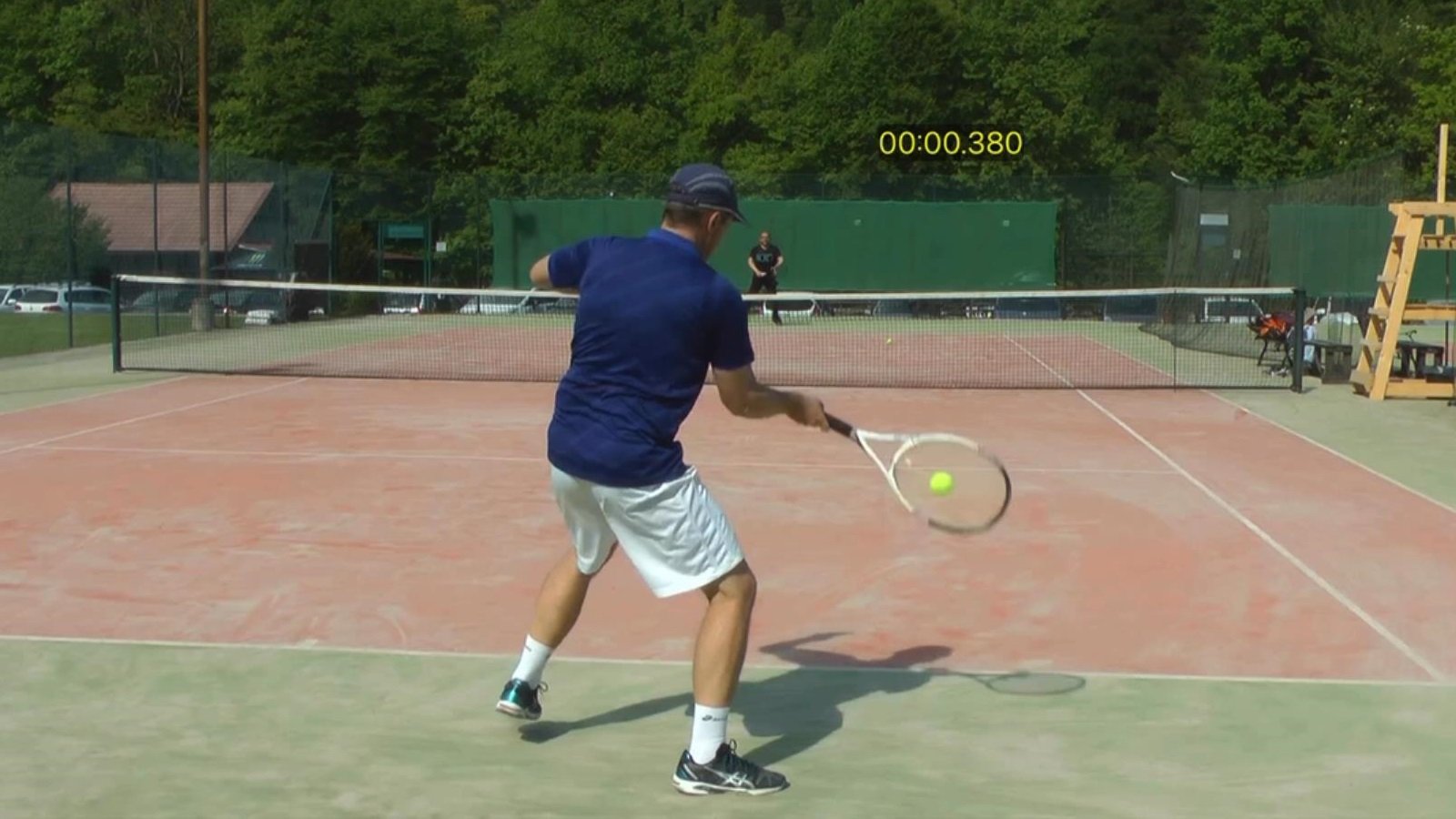
When I analyzed a forehand from one of my members, I realized that he was hitting the ball really fast. He said that his forehand was not consistent, but when I looked at his technique, I did not see any major technical flaws.
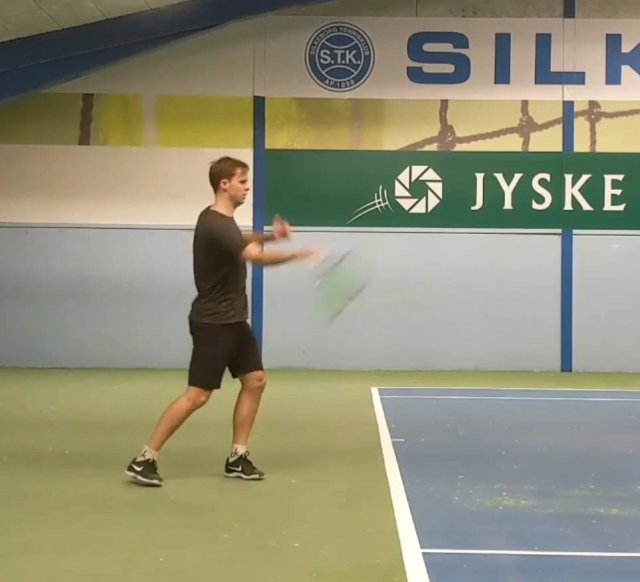
This forehand stroke doesn't have any major technical flaws that would cause inconsistent hitting.
The most likely reason was that he was attempting to play too fast and therefore too risky.
The faster the ball flies, the smaller the window above the net through which we need to hit it.
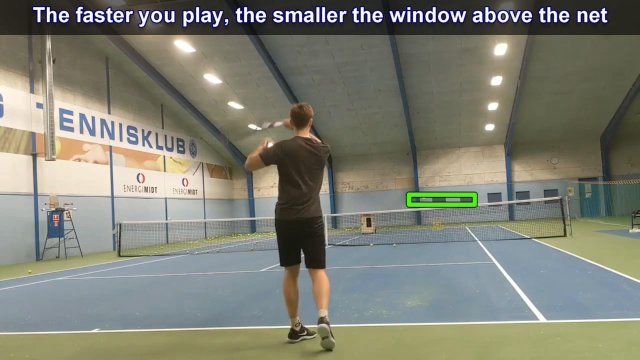
It simply becomes more and more difficult, and the shape of your backswing, your grip and where you finish the stroke have very little to do with this.
A simple analogy would be that the farther you are away from the hoop in basketball the harder it is to score. That applies to everyone, even to the best basketball player with perfect shooting technique.
As I measured the player’s ball flight, it turned out that it took the ball less than a second to reach the other side after he hit it. That’s a really powerful forehand.
That raises the question: how fast should a good recreational tennis player play?
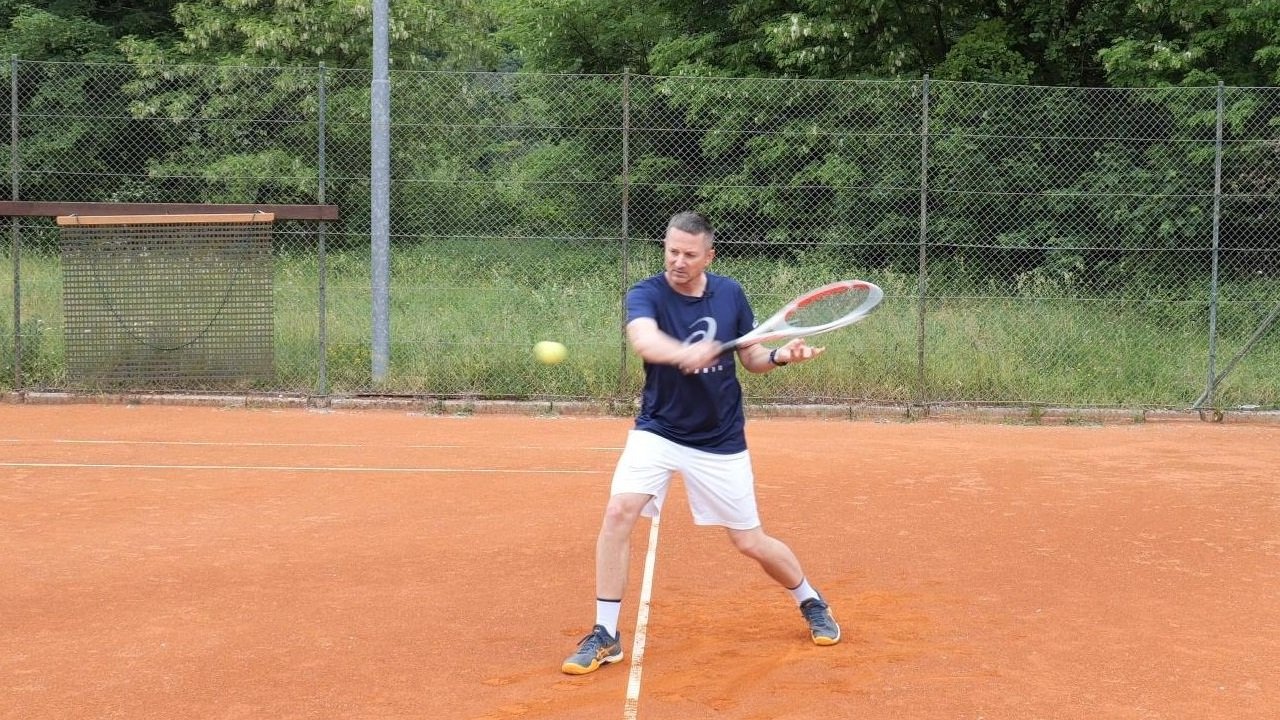
When I measured my own hitting speed, the average ball flight time was around 1.5 seconds.
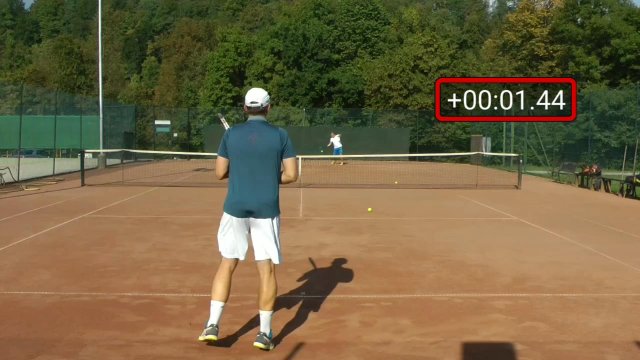
Most of my rally speeds are between 1.4 and 1.5 seconds ball flight time.
Another way to look at it is that the average rally length when hitting with my buddy Urban was around 3 seconds.
Does that speed change if I play a match?
The Average Flight Time In A Recreational Tennis Match
I have footage where I play some practice points with another friend, and I recorded the ball flight times of a few strokes in 3 different points, each of which lasted 4 strokes.
The average ball flight time of the first point was 1.49 seconds, of the second point 1.54 seconds, and of the third point 1.39 seconds.
In the last point, I was attacking more with the forehand with no neutral rallies, and that caused the average time to go down.
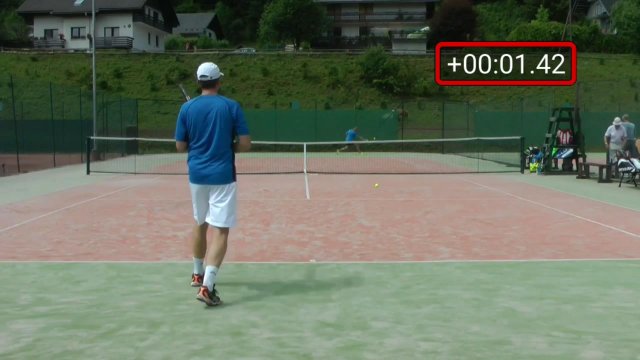
The ball flight times in matches are very similar to speeds in my free hitting sessions.
As you can see, even when I play points, my ball flight time is still around 1.5 seconds. In some cases, I hit with more power to around 1.4 seconds, which is only 7% faster.
I do put more topspin into strokes but also more height in order to be more consistent, and that’s why the ball flight times are basically the same as when I rally and hit flatter and lower above the net.
So there are 2 mistakes you could be doing:
1. You could be the player who hits very fast in practice and doesn’t care much about mistakes, but when you play a match, you play significantly slower because of the fear of missing. If so, you’ll be mostly on defense as you cannot dictate the rallies playing very slow.
2. Or you could be the player who plays very slow in practice without putting much effort in moving and adjusting to each ball.
When the match comes, you feel you need to hit with a lot power in order to dictate the rallies, but that results in making tons of unforced errors because you’re not used to that speed of hitting.
In both cases, you play worse in matches than you play in practice.
Therefore you need to discipline yourself to practice and play matches with roughly the same speed of hitting.
Finally, if you’re not at the skill level of tennis that Urban and I are, your ball flight time should be more than 1.5 seconds.
While you may be capable of hitting the ball as fast as a pro in a baseline rally, you will not be very consistent. The smallest error in a racket angle at contact, a mishit, loss of balance or a slight mistiming of the stroke will result in a missed shot.
So the key takeaway is to find your optimal rally speed at which you are very consistent and stick to it as if it’s a speed limit that you respect when driving a car.
You can try over a long period of time to raise your own speed limit, but the process must be very gradual, adding only a few percent of extra speed to your shots and seeing if you can still control the ball well.
The Average Flight Time In A Professional Tennis Match
So how fast do the pros play?
I analyzed a practice match between David Ferrer and Andy Murray and measured the times of the ball flights in baseline rallies (excluding returns).
The ball flight times varied from 1.06 to 1.5 seconds with an average time of 1.3 seconds.
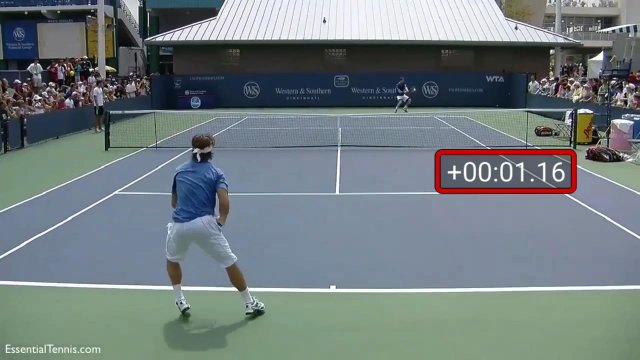
The pros play much faster and it takes years of training to achieve consistency at those speeds.
While that’s approximately only 15% faster than my playing speed, I could never get to those speeds in my lifetime and play consistently.
It is of course possible to hit the ball at such speed if you have good technique and timing, but playing points is a different story.
Hitting a nice ball coming from the ball machine all the time with the same speed, height and spin is very different from playing a tennis match.
There is a lot of movement in a match, and you’re receiving very different balls that require many different adjustments of the fundamental technique.
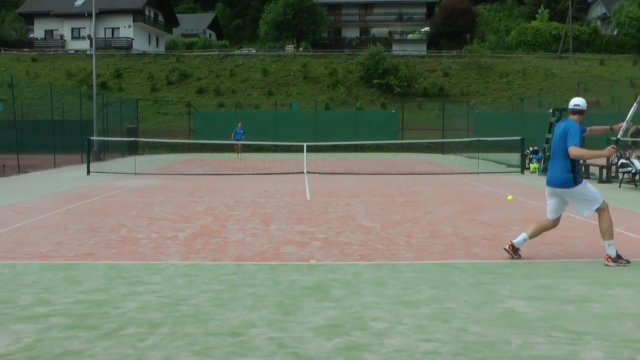
Playing a match requires constant adjusting to different balls.
Combined with additional decision-making processes, these variables make hitting the ball consistently much more difficult.
Therefore we have to play at lower speeds in order to have a bigger window above the net to hit into.
So the ball machine can deceive you into believing that you can play faster than it’s actually possible in a real match.
I would like to thank professor of mathematics Igor Getman for sharing with me some calculations about the ball speeds and times. These are of course approximate calculations but they give you a good idea of actual speed of hitting and how much speed the ball loses by the time it reaches the opponent.
A ball flight time of around 1.5 seconds at a distance of 26 meters (both players at 1 meter behind the baseline) means that the ball left the racket at 81 km/h (50 mph) and it arrived at opponent’s racket at around 49 km/h (30 mph).
Summary
Tennis is a very complex game, and there are many reasons why you may not be able to rally consistently from the baseline.
Players tend to become too focused on stroke technique and look for explanations of inconsistent play in technical flaws of the stroke.
They forget that one of the main reasons for missing strokes is playing too fast. (for their current skill level)
Just as speeding is one of the most common reasons for car accidents (where drivers lose control of the car) so is “speeding” one of the most common reasons for missing a shot in tennis (where players lose control of the racket and the ball).
You can now compare your skill level with mine and realize that, if I play well and consistently at ball flight times of 1.5 seconds, then you should be playing slower if you’re not at my level yet.
By the way, I am a tennis coach and have been playing tennis for more than 35 years.
The ball is in your court now: try to record your rally speeds in a match or even when just hitting with a friend and let us know what the average ball flight time is.
Update!
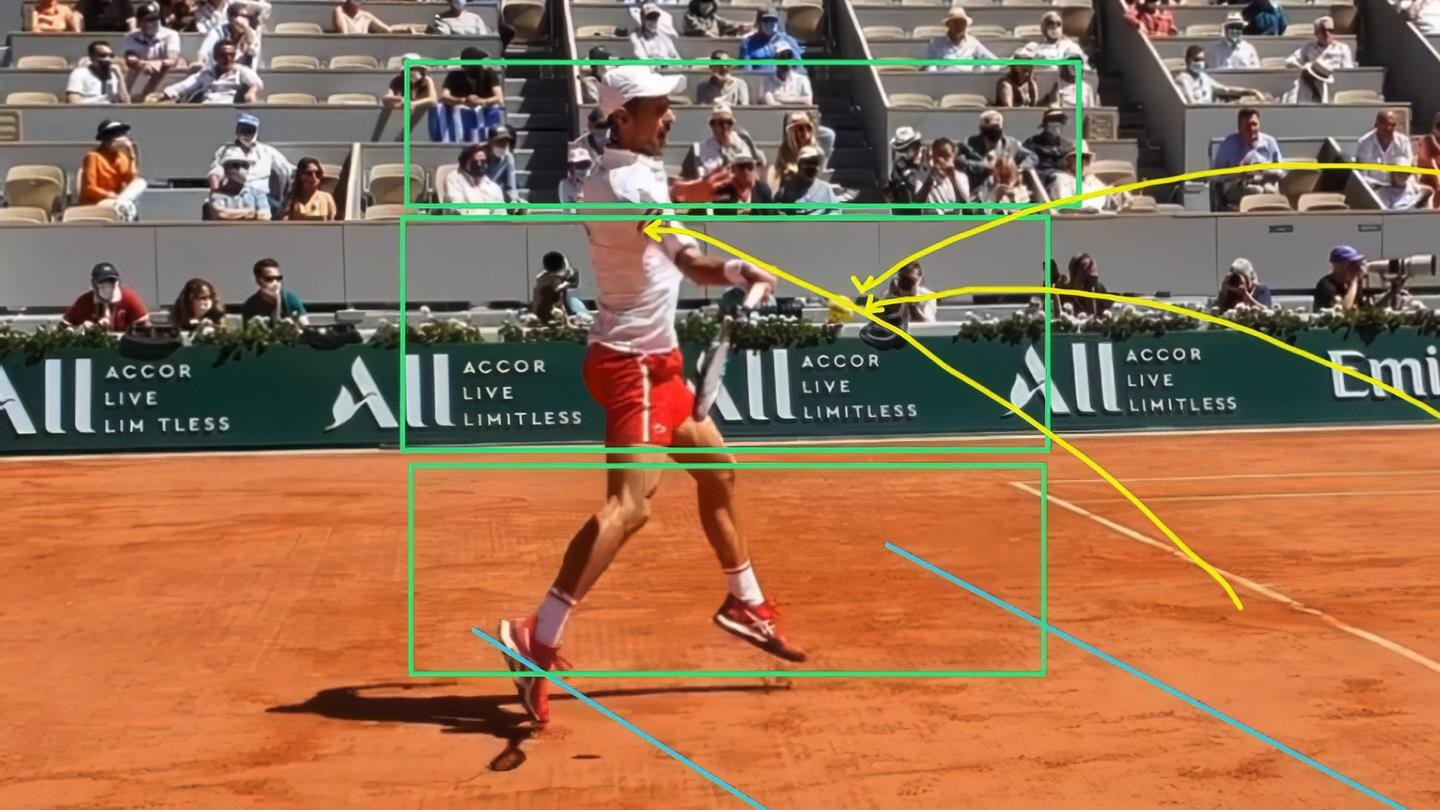
This is the latest video related to playing speeds and it explains one key reason why you are hitting the ball too hard.
Thanks. Excellent insights. Funny, I was just thinking I need to hit harder. After reading this, maybe not….
Excellent analysis, definitely agree. It’s a mental challenge for me to play a competitive match and not unconsciously (or consciously) want to hit the ball harder to win more points. And of course that usually leads to more errors, not exactly the outcome you’d want. To stay in a rally, hit at 70% and not force things is not an easy thing, especially for impatient folks like me.
Hi Greg,
Try to figure out why you’re impatient. It could be a fitness issue, meaning you don’t want to stay in a rally long because you feel running out of steam.
It could be based on some belief, like “I should be finishing the point in a few strokes”, or something similar.
Also, the more you lose the easier it is to let go of impatience (since it doesn’t help you win).
Great analysis, Tomaz. Astonishing to see that professionals often actually don’t play at max. speed at all.
I guess most of us have the urge to score and fall into our own trap, ending up losing the point.
The instruction and intention “not to force yourself and not to focus on scoring points but to concentrate on consistency and effectiveness” we often try to bring into practice, now gets an analytic proofing.
Take 30-40% off the speed and concentrate on good rythm, good length, good placement, and the result will be enormous…
Hi Willem,
Pros typically rally at around 100-110 km/h and their top speed when hitting a winner is around 150-160 km/h.
Which means they rally at around 2/3 of their maximum speed.
In reality many winners and good shots are hit when the player “misses” a bigger target. But no one tells you the truth.
No one can hit a winner at will with high probability. If that was possible, there would be no rallies.
So most good shots are “misses” of a bigger target, and you can play aggressively into a big target until by chance you hit to the outside and stretch opponent.
That’s where you should aim most of your strokes when playing from behind the baseline.
The O.P. (Karl, was it?) doesn’t have a good forehand, he has a GREAT FOREHAND! If I could hit the ball like that, so effortless and powerful, that’s all I would do all day long.
If the ball goes out/in the net, I don’t really care, I just want to hit the ball as HARD as I can! Then again, I lose all lot. I mean A LOT. I can doublefault entire games away. I am not proud of this fact, it’s just that hitting an ace or a winner means more to me than winning. Is that so wrong? Should I change my outlook/objectives for the game?
Caveat: In tournaments, however, would kinda like to win a few matches. I don’t like paying the entrance fee and then sitting down for the rest of the day after losing in the first round. I think I’d like to say “bye bye” to being a by(e).
Question: One possible solution might be eliminating my backswing, i.e.starting my swing (with a “wrist flip”) from the lowest position. Without any momentum, I have to generate all the power myself. It does give me the satisfaction of really forcing myself with every shot, and at the same time I’m actually hitting the ball at a reasonable, more reliable speed. It also tends to generate more spin for some reason (?!).
Your thoughts?
Hi James,
Hitting the ball hard is probably very enjoyable to you so you do it.
For other players winning is enjoyable.
In my opinion, you cannot have fun enjoying hitting the ball hard and winning at the same time.
These two exclude each other.
Winning matches is all about playing with high probabilities of hitting and making the right decisions.
No one can tell someone else what is right for them.
If you enjoy hitting ball hard, do it and don’t play tournaments.
I don’t play matches for more than 15 years now, I simply don’t enjoy competing anymore and working so hard to win a match.
I rather just hit balls in free hitting sessions and enjoy.
And I do not recommend you change your stroke technique when playing matches.
If you do go on to play matches, find a speed with which you are consistent and go for the targets I mentioned in the comment below.
Thank you Tomaz. I have a question. Why when you play with the opponent of the next level and he puts more speed and spin in his shots, according to your calculations it can be just additional 10-20% but you start to feel a big difference and it becomes much more difficult for you to hold the neutral rallies?
Hi Vlad,
Yes, now we’re getting deeper into tactics and the mental game.
If I play a good player I will lose approximately 50% of the rallies. 😉
That should be normal to players but I know it isn’t. Check this article for stats on winning points:
https://tennishead.net/expert-analysis-winning-just-52-of-your-points-should-be-your-goal-says-novak-djokovic-tactician-craig-oshannessy/
The player would like to have some sense that he is doing the right thing, some kind of confirmation.
Most of the time there isn’t any. You could be at 4:4 after 45 minutes of tennis.
And yes, you may be doing everything right. In many cases players will “break” mentally in the last crucial moments of the set or match.
Only then you will realize that you were doing the right thing.
So only if I am clearly losing most of the rallies, then I have to change my game.
Hitting harder is usually not the answer because I don’t have the skills to control the ball at higher speed.
So my usual answer was to charge the net and get out of rallies. You need to have good net skills though.
So I would serve & volley a lot and look for any way to come to the net or disrupt opponent’s game with drop shots, etc.
Well, I do not have net and volley game. But I am fine to run a lot. My current coach (former Division 1 college player) says that we (adult recreational players) are not hitting the ball fast enough. He has crazy acceleration on his shots, by being former semi professional player. But he is putting most of this acceleration into the spin, so he is not losing control on the balls at all hitting with all his power.
Tomaz,
I’m a little starstruck that a well-known YouTube personality would sit down in Slovenia and write me a personal reply – thank you!
Truth be told, I _would_ like to learn how to play tournament matches, but I free hit nearly 100% of the time. I don’t have much experience playing conservative, high percentage tennis.
But my problem goes deeper than that (as most problems do, I imagine). Simply put, I am overanxious. On the arousal/performance curve, I am so far to the right, I’m off the page. So short of a tranquilizer dart and/or Transcendental Meditation…
HOW CAN ONE LOWER THEIR ANXIETY LEVEL ON THE TENNIS COURT?
What advice do you give anxious students, and how often would you say they actually improve? Or do you see this as a personal struggle, i.e. one either succeeds or fails entirely on their own? Or worse, do you believe it is a fixed personality trait that you were, or were not, born with?
Hi James,
Well, I try to answer to everyone and I am just a regular guy who happens to pursue his passion of tennis and share ideas online.
So quite a few questions, let me try and be concise:
1. I would start with a question whether you really need the mental stress of competitive tennis? I used to play for many years until I had enough.
I don’t play for points now for more than 15 years and I am just happy when I play tennis and hit balls freely.
So really question yourself whether you really need all that suffering. And realize that it’s only our ego that drives us to compete.
Do we really need to fuel it?
2. Yes, there is good success in controlling anxiety in sports in general. There are a lot of techniques that work over time.
I shared a lot of tips on my older mental focused website and I suggest you start on this page and then check the links / topics that are interesting to you:
https://www.tennismindgame.com/tennis-psychology.html
There are also a lot of other mental tennis articles on the website.
3. There are always more and less predisposed players / people for any part of the tennis game. Some are mentally better initially, some are better learners, some are very hard working, etc.
You always deal with some stronger sides and weaker sides of the mental game so you always have to work on it. Anxiety is just one of many issues and it’s completely normal.
4. The one thing that always troubles recreational tennis players is lack of practice matches. They typically either practice with 0 pressure or play serious matches with 100% pressure.
They don’t have matches in between where they would keep score but this wouldn’t be a real tournament or match.
So they don’t get used to pressure.
With juniors we try to give them many practice / sparring matches where they get used to pressure. So your goal is to find some tennis pals and play some points with them to get used to competing.
Hi Tomaz, could you please make a video of yourself hitting at your normal speed (1.5 seconds), so that we can see how fast that is. Thank you.
Sure, here’s one free hitting session:
https://vimeo.com/202487299
At the start we play slower since we just started rallying but after a few minutes we’ll get to normal rally speed.
Dear Tomaz,
Excellent analysis! Most club players want to hit the ball as hard as possible. How does hitting with less power and more control work for doubles?
How will this work in doubles?