
If you’re struggling with a certain stance in your tennis game – for example, an open stance forehand – it’s very likely that you’re missing one fundamental piece of the puzzle.
It’s very easy to get too analytical and therefore confused with different tennis stances because there are neutral (or squared), closed, open, semi-open and a few other stances that you may have heard about when learning about footwork in tennis.
But, if we go beyond the complexity of stances and look at the fundamental biomechanics, we see that they are all based on just one of two abilities: pushing off your left leg or pushing off your right leg.

There is always one leg that's more dominant from which we push off
If you’re struggling with a certain stance, then take a step back and first diagnose the source of the problem and then practice the drills that will help you overcome it.
The No Stance Fundamentals – Hitting Off Left And Off Right Leg
Whether we play a forehand or a backhand, we always use one leg more to stabilize and push off the ground than the other.
Using both legs equally at the same time almost never happens.
That’s why you must first check whether you’re comfortable hitting off either leg.
That means that you feel balanced, stable and coordinated, and you can hit with good power while feeling comfortable.
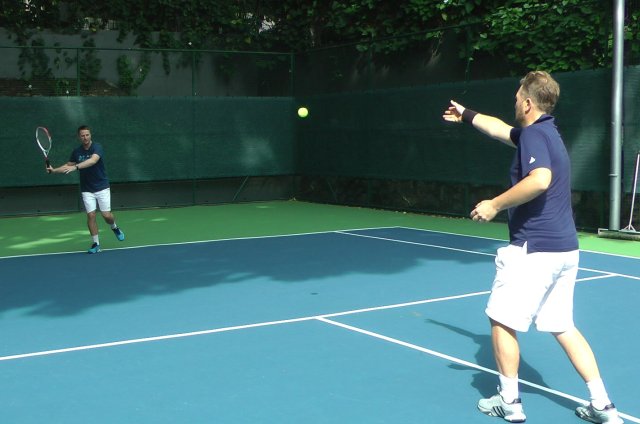
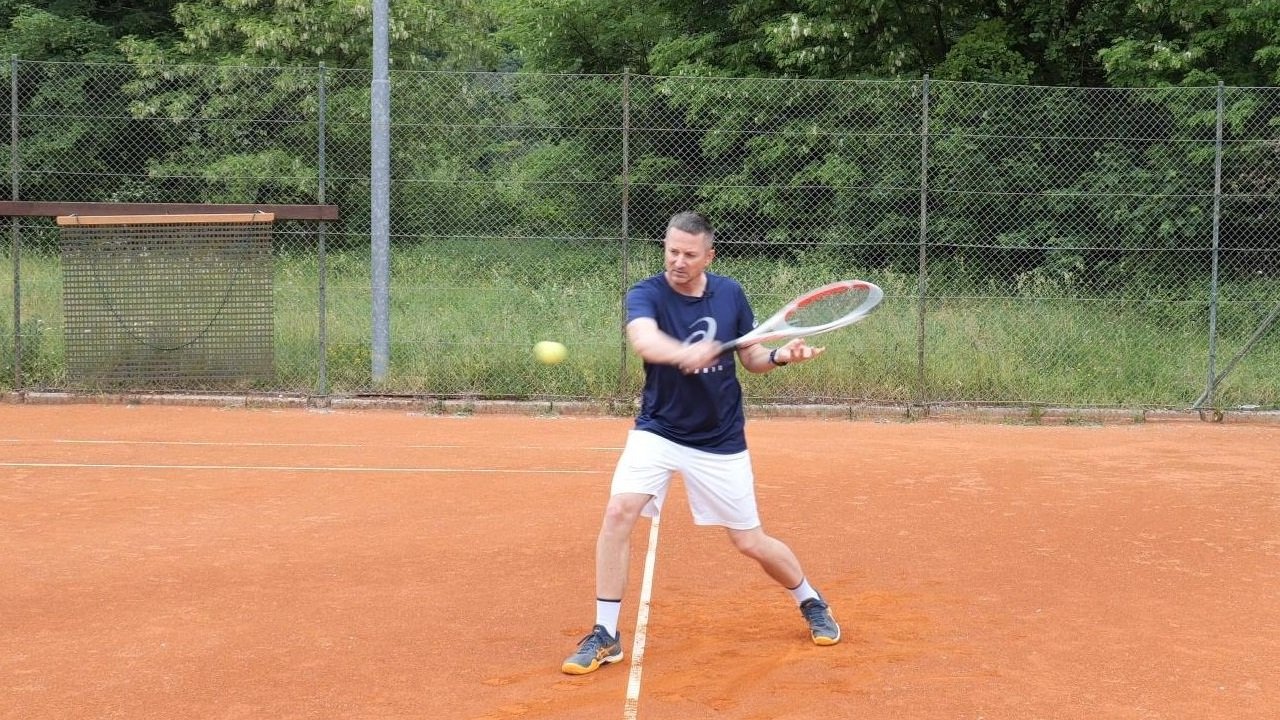
Your first drill, which is also a diagnostics test, is to just drop hit the ball and hit it one time from a neutral stance forehand and one time from an open stance forehand.
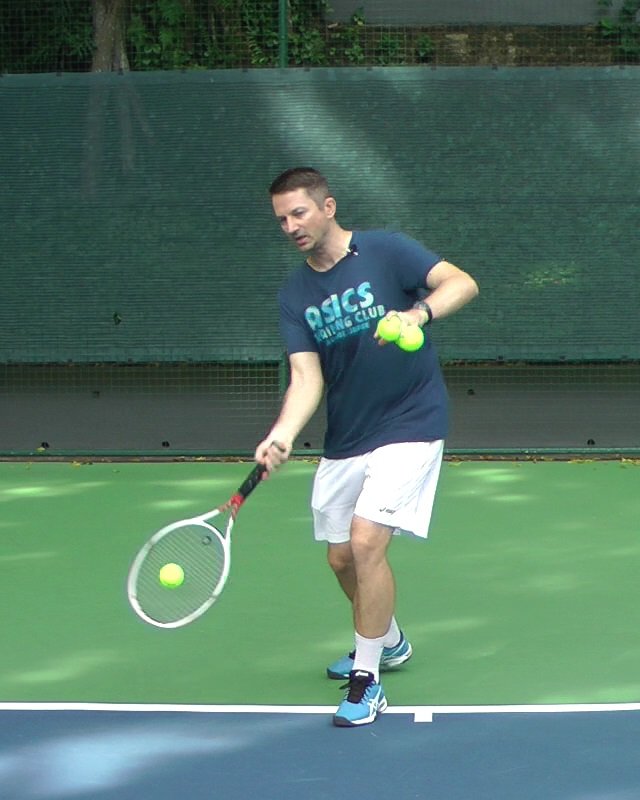
Hit a neutral stance forehand and then...
You can keep alternating hitting off these two stances and compare how you feel and how well you can hit the ball.
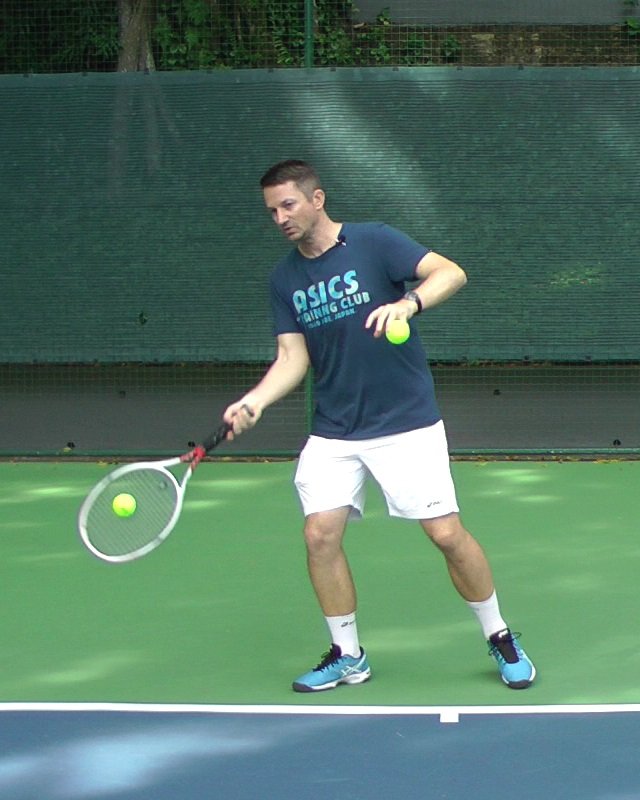
... hit an open stance forehand and compare how you feel.
It is likely that you will feel more comfortable hitting off one stance than off the other one.
I most often see players being more comfortable hitting in neutral stance than playing an open stance forehand, so I will concentrate on that example. However, the logic of this article applies to all stance combinations.
If you’re not feeling comfortable hitting in open stance when just dropping the ball to yourself, then surely you won’t be comfortable or able to hit with efficient power when you’re stretched out wide and having to play an open stance forehand.
So, your first step is really to learn how to engage that outside leg and use it well to hit an open stance forehand.
Basic Drills For Improving Leg Drive
The following drills will help you first become more aware of which is your dominant leg for each stroke. Second, they will improve your ability to push off each leg and maintain good balance while hitting a stroke.
1. Call Out Your Dominant Leg
This drill is best done first during mini tennis where you just rally with your partner and your goal is to call out the leg off which you’re playing your forehand now.
By “playing off,” I mean the leg on which you transfer your weight and stabilize while hitting your forehand.
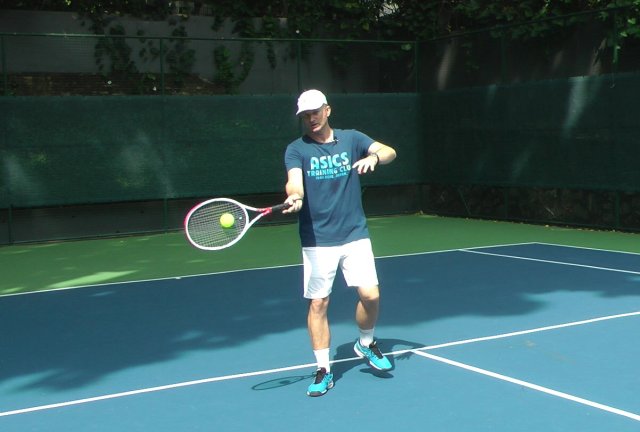
The first "step" is to just become aware of the dominant leg
This drill may seem too simple, yet I have found many times that adult recreational tennis players are not well aware of their dominant leg when I ask them to call it out when they rally with me during a mini tennis match.
It takes a minute or two for them to really become clear on what it means that one leg is always more dominant than the other.
A variation of this drill is to have the player lift the non-dominant leg when hitting the ball, which will make it very obvious to them which is the dominant leg.
Again, try it and you’ll see whether this is really clear to you or you are trying to lift one leg in the air without knowing why you’re doing it.
2. Catch And Throw On One Leg
This drill is best done with a medicine ball (about 2 kg is usually enough). Your task is to stand on one leg and catch and then throw the medicine ball in a dynamic manner so that your leg bends when you catch and extends when you throw.
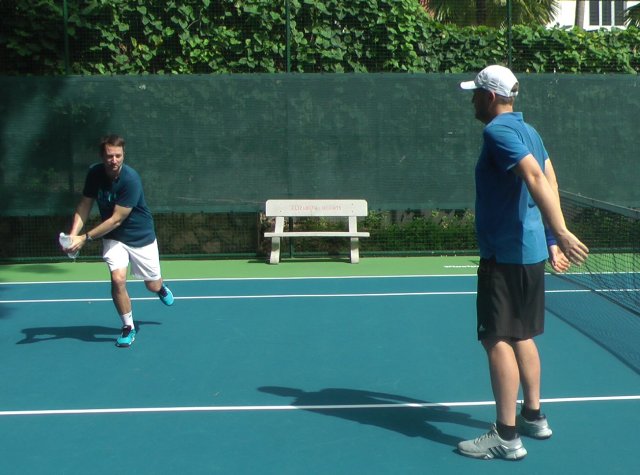
This drill will teach your leg really quickly what it means to load and push off
If you don’t have a medicine ball, you can also try with a full bottle of water which will weigh around 1.5 kg.
I recommend 5-8 repetitions on one leg before switching to the other one and in total 3-4 sets.
Make sure that you don’t just bend down when you catch the ball. Your back should be straight and your upper body should rotate back and forth while you load and extend the leg.
You can use all 4 leg variations (forehand & backhand + left leg & right leg) if you’re working with a junior or working in a more long-term developmental approach.
Otherwise, just focus on hitting off the leg which you don’t feel so well.
3. Step On A Stair, Push Off And Swing
This is one of my favorite drills that develops the leg drive and coordination of legs and arms for tennis strokes because it literally forces you to execute it correctly.
Your task is to step on a stair and push off and extend your leg while coordinating that with your swing.

One of my favorite drills to work on "stances" and leg drive
I suggest you start first with a neutral stance, which means a right-hander playing a forehand will step up on a stair with his left leg.
Once you feel good coordination between your legs and arms and really understand what it means to push off, then switch to the open stance variation where you’ll step up on the stair with your right leg and swing your forehand as you extend it.
You can again use all 4 combinations for your legs and even find creative ways of combining them in order to keep the exercises interesting.
4. Hit Off One Leg
Hitting off one leg – meaning that your other leg is off the ground – really exaggerates the idea of using one leg as a dominant one and again forces your body to feel what it means to engage one leg more when hitting a forehand.
You can just drop feed to yourself while standing on your left leg first (for right-handers). Then hit your forehand and see if you can stay balanced.
Hitting off one leg develops balance, leg drive and legs / arms coordination
Your goal here is not to hit with full power but to feel that you bent and extended your leg while hitting the forehand and were able to maintain balance.
Hit 5-10 forehands like that and then try the open stance where you stand only on your right leg.
Check how it feels and whether you are comfortable and able to hit with efficient power and still maintain balance.
If this is your weaker shot, then just focus more on that.
I often ask players to hit a few forehands off their “better” leg too so that they have a reference “feel” and can compare how the stroke should feel when they play off their “weaker” leg.
You can also have a coach throw you the ball. This is a bit more challenging, but it helps you work on your timing of the loading and unloading in relation to the incoming ball.
Summary
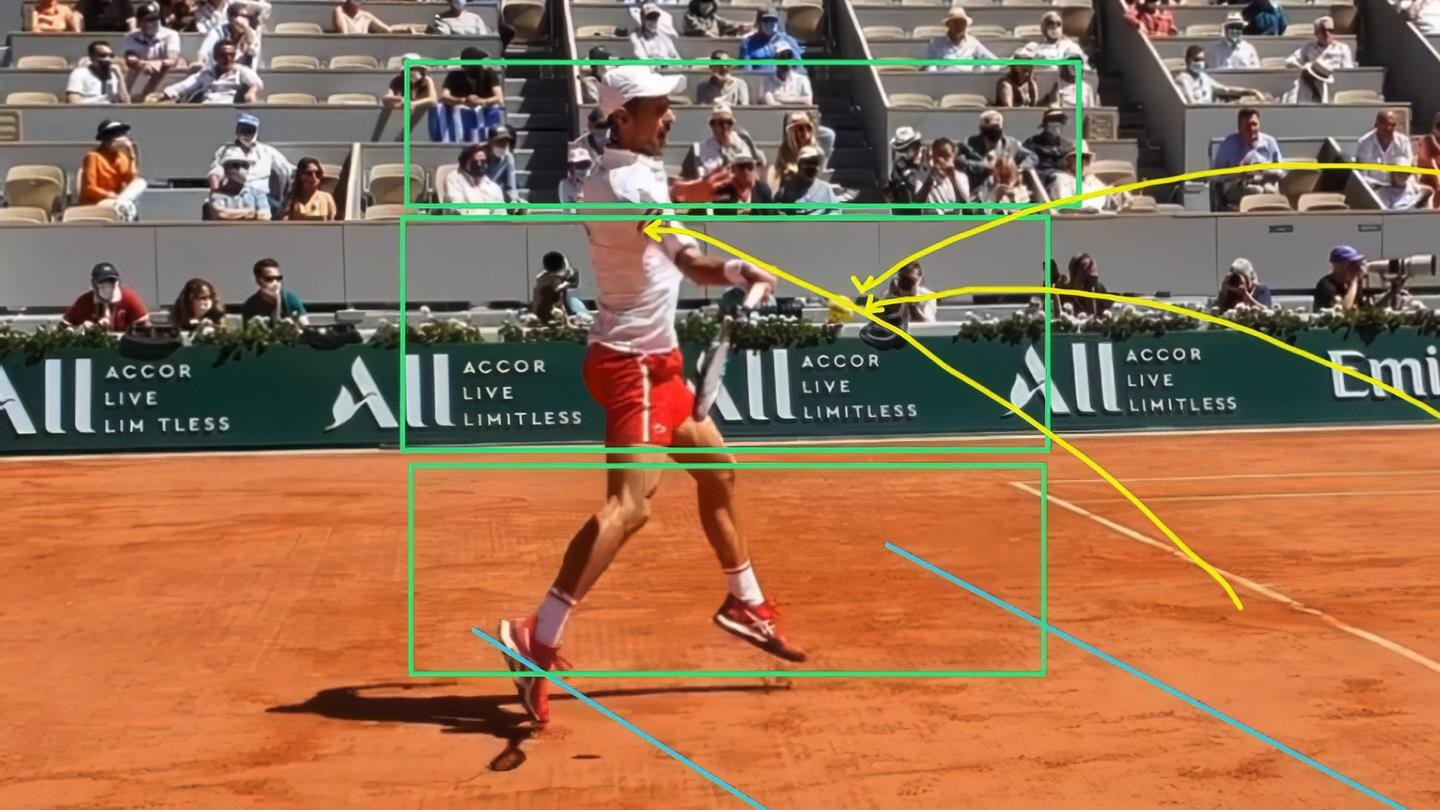
Playing an open stance forehand (or backhand) can be challenging for some players because there is no real weight transfer, so the players don’t feel how to transfer energy from their body into the ball.
In neutral and closed stance forehands, we load the right leg first.
Then we transfer weight to the left one and we also push off the left leg – so the weight transfer into the ball is very easy to feel. It’s similar to how we walk.
But, in a typical open stance forehand, we load the right leg and then we push off that same leg. There is no weight transfer but rather a load and unload process which is not so easy to coordinate with the arm on the same side of the body!
I have found in my working with adult recreational tennis players that most of them do not execute the open stance forehands well because they don’t feel this loading and pushing off with the outside leg and they have trouble finding good coordination with their upper body and the hitting arm.
While players do play an open stance, their legs are usually very straight and they get no power from them.
I have found that using the fundamental drills often used with juniors that develop basic biomechanics of the body also helps adults develop those abilities in a relatively short amount of time.

Drills for improving biomechanics of juniors work really well with adults too
So, if you feel that an open stance forehand doesn’t feel very comfortable or powerful and that you are often leaning back or losing your balance, then make sure you practice the drills described above regularly until your brain and body learn how to generate efficient power off that outside leg.
This will improve your open stance forehand considerably better and faster than watching a video of another coach analyzing to the smallest detail an open stance forehand of an ATP tennis player.
VERY NICE SUGGESTION
Hi Tomaz – as always your videos/text on everything is so well done.
But can you just confirm to folk out there reading this – when you use the different stances…I know this but think it would be great coming from you..
Regards and keep up the good work – your info is 100 times better than other tennis instructional sites out there.
John
Thanks a lot, John.
When I use stances? Consciously I do not make any choice and you shouldn’t either.
We can only say when certain stance happens more often:
– neutral stance – lower and shorter balls, when approaching the net or when going down the line if you have time to set up
– open stance – faster and higher balls, deep balls, when moving to the side or backward, or when running around the backhand to play a forehand
Is this what you had in mind?
Great instruction (as usual). Your ability to simplify and highlight the fundamentals is impressive.
I love your comments and videos; they are all well done and easy to understand. My 2 favorite websites are yours as well as Jorge Capestany and also my local Dir. of Tennis. Both of your approaches are no-nonsense and to the point with no hype. I am a PTR certified tennis instructor and appreciate your concise explanations. I got hooked on your site because I wanted to develop more finesse shots and not all power game which I already have. Keep up the good work. – Jorg
You are an amazing teacher and I learn SO Much from you.
I look forward to every video.
Thank you for giving us this gift of your knowledge and wonderful teaching ability so it’s easy to understand and make real changes in our game.
I really don’t have words to tell you how much I appreciate it.
Sincerely
Jeanne stasny
DALLAS Texas
Thanks for the wonderful feedback, Jeanne!
I’ll do my best to post more interesting tennis ideas!
Dear Tomaz:
Thanks for your excellent tips with regards to hitting off both legs…
Most important in improving my ability to prepare for different types of incoming balls.
Anne
Yes, Anne, if you can push of either leg and hit a good shot then you can handle all types of balls from all types of stances.
Cheers.
Tomaz-
My problem occurs when a semi-open stance ‘happens’. Where is the proper axis of rotation? Equally between both feet? If I continue pushing/pulling my weight over my left foot, the result is often pulling away from the ball. Advice?
Hi Tom,
Semi-open stance allows you to transfer weight to your left OR play it like an open stance and rotate around your right leg. (for right-handers)
So you need to choose which one is it and whether it’s the right one for that specific situation.
You can end up in semi-open by moving to the right or to the left and that’s a different weight transfer.
You can also send me a video and I’ll take a look…
Hi Tomaz,
I allways wait for your new video with great interest.
These are very good articles and videos.
But,I have a very important question. What is the influence of the several stances about the backbone, about the health?
Ödi
Thanks, Ödi!
Open stance is definitely more taxing to the body because we a creating coiling (or torque) in the body.
You can of course play it in a more easy way and not twist too much.
The one negative of the neutral and closed stances is that they put pressure on the knee towards the end of the stroke when we are rotating but the foot stays on the ground.
So it’s good to release the foot soon after we hit the ball so that the knee is relieved of torque.
hallo Tomaz- it is a a very useful article about stances & the information given can help to overcome any particular trouble, with one stance by switching to another one.
kam,
Thank you thomaz for this wonderful drills I know it will be useful for every tennis players who would like to level up their forehand stroke…
Simple and logical explanation of different stances and the drills to practice them.
You have mastered the methodology of teaching the fundamentals that is so lucid even for a tennis dummy like myself!
Bakthan Savarirayan,M.d
Glad that you liked the simplicity of these drills, Bakthan!
That’s what also makes them very effective, especially if you repeat them regularly for a couple of weeks.
Tomaz,
The one handed open stance is used rarely at the rec level like you mentioned, but I tend to avoid it rather than work on it. Do you have any pointers, such as try to step on the inside part of the right leg (I’m a lefty) to have a little better leverage? Thanks–TMc
Hi Tom,
I would say that the foot must be flat on the ground and not on any side of the foot “sole”.
Only then you’ll be well balanced. We use the term “plant the foot” often to describe it.
So if you want to avoid open stance backhands just speed up your footwork so you can squeeze in that left leg in front even when there’s less time.
Tomaz, yours is a clever way for people to play in a way they would deem more comfortable, which may be an ingrained habit that they had for years and is difficult to change. It’s also a practical way to find, if they are observant, what would be most natural and efficient way to hit a stroke (plus some emergencies situations in which it doesn’t matter on which foot you land).
I would only add that a change in balance can generate power as well and that a change in balance and pushing up can help your game when you are being challenged in different ways, whether made to run and return to cover the court or with balls that are served deliberately to your body.
Thanks for your contribution to our sport.
Thanks for sharing, Ric, much appreciated!
Here’s more info on the weight transfer for those interested in that topic too.
Hi Tomaz, I always say that three factors have influenced my improvement since I started playing tennis 16 months ago: 2 videos of Tomaz: Intention, How to keep a still head at contact (including Oscar Wegener’s book) and The Inner book Game of Tennis by Tim Gallwey (supress judment, let it go, images, concentration).
All your videos like this and insights are enlightening. Now I begin to understand the title of your site: Feel Tennis.
You are the best. Thank you very much. Hugs from Brazil.
Great, thanks for sharing, Roger!
More FeelTennis videos on the way, stay tuned and all the best to Brazil!
Great aha moments with the stepping up the stairs. Thank you for continuing your paradigm of simplicity and fundamental biomechanics
Great drills … I’ll get my daughter doing these as she has difficulty sometimes on the dominating leg and I think these exercises will help her balance more!
Hi Tomaz
Thank you for yet another great video. It certainly makes sense to have good balance in all 4 positions. I will get to work and see where I need to work harder and become more stable.
Once again thank you.
Dear Tomas, wonderful insights given for beginers. keep it up posting such..
This is an excexcellent tutorial, Tomaz. I like how concrete and specific the drills are. Looking forward to trying them very soon. 🙂 Thank you!
You’re welcome, Joanna. Pay special attention to the “open stance” outside leg drill and see if you can execute it well.
Hi Tomaz,
First of all thank you very much for your incredible lessons. I am really hooked on them :).
Going to the topic of this video,I have lot of problems on how to manage high balls coming to the baseline.
I doubt to hit them on the rise (very difficult) or wait until they fall again. What stance is the best in both circumstances?
My main problem if the ball is very deep is if I have to run backwards. I usually hit the ball in an unbalanced position.
Is there any footwork tip and what is the best stance when running backwards?
Thanks you again for your lessons.
Javier
Hi Javier,
High balls are very tricky because you need to use different timing – you must swing blind on many of them.
I have explained that in this article:
https://www.staging.feeltennis.net/how-to-deal-with-fast-balls/
Hitting on the rise is not that difficult if you keep trying to do it, every single lesson.
You will learn how to adjust your timing but it does take time.
If you have more time then hold your ground, mostly play open stance and hit across the ball looking to hit it horizontally.
I explained that here:
https://www.staging.feeltennis.net/how-to-deal-with-high-balls/
And yes, if you run backwards on a faster ball you will not have enough time to stop so then you are off balance.
Practice NOT going back and holding your position and hitting back a nice shot first (before you attempt “good” shots).
I can do either right or left leg pressure. Two questions.
1. What about the serve?
2 why am I putting pressure on one leg or the other?
Best,
Q
Hi Q,
On the serve in platform stance, we transfer weight from the front foot –> back foot –> front foot. (and then serve)
For pinpoint stance, we transfer front foot –> back foot –> both feet.
Is the second question for the groundstrokes or the serves?
If for groundstrokes, because you play either open or neutral (closed) stances and each uses a different leg as the main “push” off the ground.
Hi Tomaz. Wasn’t sure where to post this comment / question. Do you recommend this exercise platform for practicing the serve?
https://www.amazon.com/dp/B00432U2CM/ref=sspa_dk_detail_4?psc=1
Tomaz, I have recently moved to a new town and I’m trying to learn the open stance forehand – I’m right handed. Today in a fun clinic I was taking with some players I’ve met, the instructor was teaching to place the right foot in a straight line with the incoming ball. But that was awkward for me as that position constantly caused me to be jammed by the ball. How/where do you recommend aligning the right plant foot to the incoming ball for an open stance forehand? Bob
Hi Bob,
The outside foot is usually at around 45 degree angle. The toes roughly point towards the contact point.
If one is in more trouble, meaning running to the side and having to break hard, then the foot will orient more sideways to help breaking.
You shouldn’t think much about how to position the foot, you should try to feel stable, strong and comfortable.
When you feel it’s not right, your body will self correct.
Of course, if this is a completely new way of positioning for the ball, you won’t feel for a while what’s right and what is wrong.
So you need to hit a few thousand balls more…
Tomaz, I love your channel and blog for going to the essence and being so understandable. As much as I try I cannot master mini tennis particularly on my forehand which seems to fly more easily. Normally at the baseline my forehand is the easier shot. Any tips? Also, when you say to push up on the dominant leg, how is that possible for lower balls? I find my mini tennis practice usually devolves into excessive scooping. 🙁 Thanks! I guess bottom line is me wondering what are the terms under which mini tennis is productive and not counterproductive. The more I read online I see that many people share my frustration with mini tennis–perhaps because we all lack strong fundamentals.
Makes me more determined to master it. Thanks!
Hi Laura,
Mini tennis requires some technique adjustment – and yes, it can point out flaws in the fundamentals like balance, contact point, etc.
So check this video and see if it helps, play with these ideas for a couple of weeks and then get back to me with the feedback:
https://www.staging.feeltennis.net/mini-tennis-technique/
Hi Laura,
Mini tennis requires some technique adjustment – and yes, it can point out flaws in the fundamentals like balance, contact point, etc.
So check this video and see if it helps, play with these ideas for a couple of weeks and then get back to me with the feedback:
https://www.staging.feeltennis.net/mini-tennis-technique/