
When your opponent lobs too short and you can hit a tennis overhead smash on the bounce, you’re in the most favorable situation in a tennis match.
You almost cannot get an easier ball to finish, yet players will often find themselves in trouble in this situation and mess it up.
The following 5 tips on the tennis smash after the bounce will show you how you can almost always win the point from this situation. These tips will point out the most common mistakes and how to correct them.
Tip #1 – Always Move Too Far From The Ball First Before Adjusting
The most common mistake players make when they receive a short lob that bounces inside the service box is that they try to immediately position perfectly for the smash.
In many cases, they end up too much under the ball; in fact, the ball bounces over them, and they end up moving backward as they are hitting the overhead, which usually ends in them missing it.
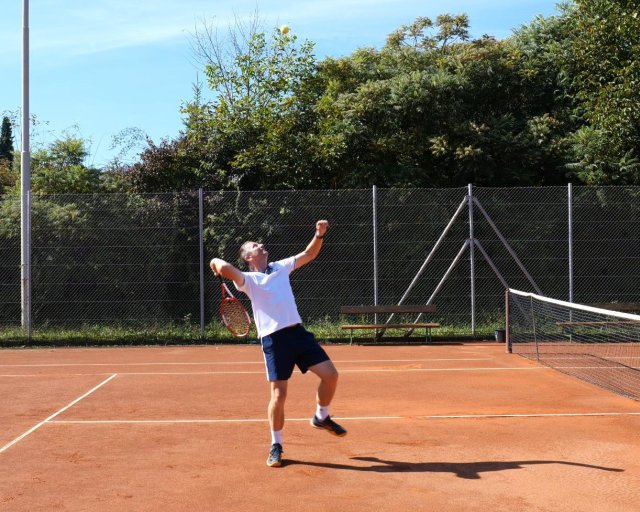
Players often times end up too much under the ball and hit the smash off balance.
There can be multiple reasons why the player ends up under the ball instead of behind it, such as:
- They misjudge the ball’s flight.
- There could be a “bad bounce” off an uneven surface.
- The ball could have some spin that causes an extra bounce.
- There could be a sudden gust of wind.
For all these reasons, you must not try to immediately position perfectly for the smash.
Instead, you need to first move too far from the ball, see how it bounces, and then quickly adjust with small steps or shuffles in the forward direction toward the ball and then hit the smash.
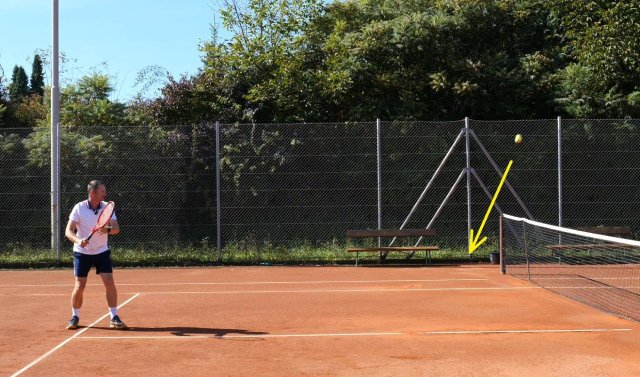
Always move "too far" initially so that you are ready for any surprise bounces...
In most cases, you will have enough time to move forward after the ball’s bounce, as it will hang in the air for a split second as it reaches the apex of its flight.
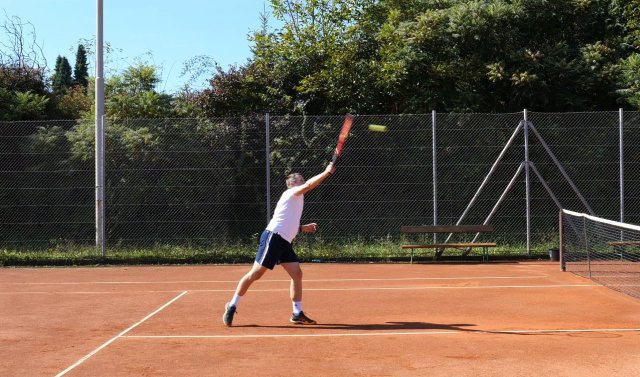
... and then move forward to hit the ball well in front being in balance.
Now you will have forward momentum into the ball, which will allow you to hit with more power.
You will also have the ball more in front of you, which will allow you to see the court and your opponent’s position better through your peripheral vision.
Just aim into a big target area in the open court, and you’re very likely to win the point immediately. If not, you can expect only another defensive lob, which means you’re still in an offensive position.
Tip #2 – Get Both Arms Up Immediately
The second most common mistake players make when they’re about to hit a tennis overhead on the bounce is that they keep the racket hanging down while they are positioning for the smash.
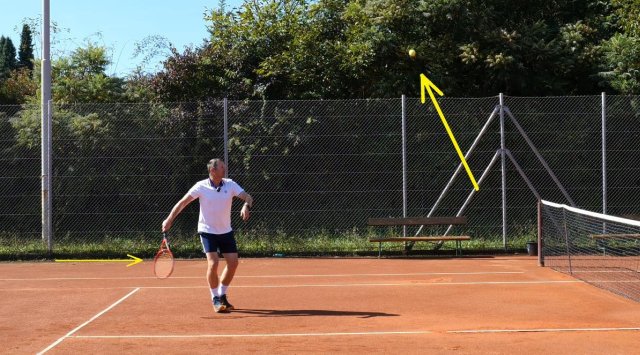
Don't prepare for the smash on the bounce like this...
Then as the ball bounces, they have to perform the whole backswing (downward, backward, and upward) just like they do when they serve. This makes it very difficult to time the ball well and hit it clean.
That’s why it’s much better to immediately get both arms up as you recognize the lob and then start adjusting your feet like suggested in tip #1.
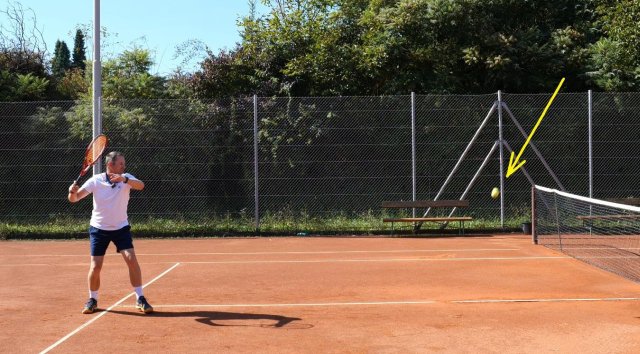
Instead, prepare immediately with both arms up and then adjust with your feet.
You can have the racket head just behind your head as you’re moving around or just on the side of your head for more advanced players.
The non-dominant arm should be up, but you don’t need to point at the ball as coaches like to teach. You’ll focus too much on what your arm and finger are doing instead of focusing on the ball and judging it well.
As long as the non-dominant arm is up in the general direction of the ball, it will help you judge the ball better and help you execute the smash biomechanically well.
Tip #3 – Stay Stable On The Ground
Tips #3 and #4 are related because we’re trying to correct 2 common mistakes that happen as the player is positioning for the overhead on the bounce.
Players often get too much under the ball and then reach up for it, so they are not stable on the ground but rather on their toes.
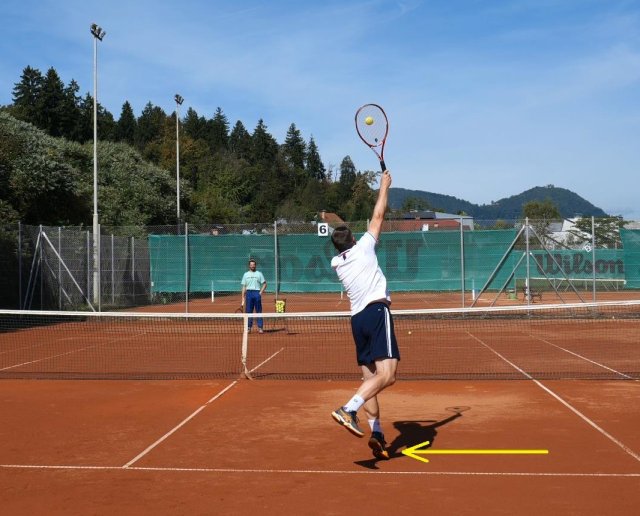
Players end up reaching up too high and not being stable...
When you are on your toes and hitting a smash, you don’t have much power or control.
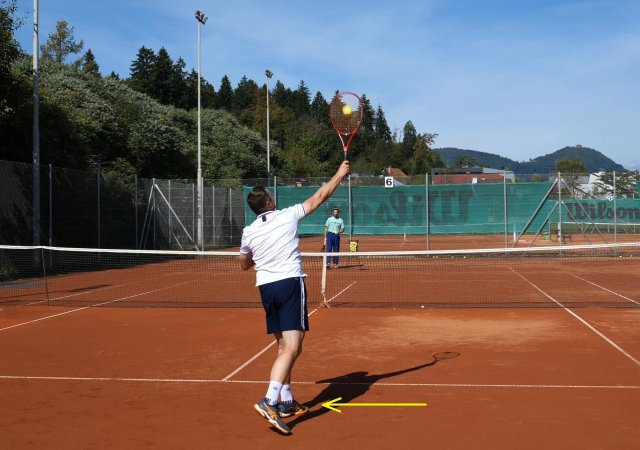
My foot is on the ground as I make contact with the ball which gives me control and power.
Instead, you should try to plant your front foot on the ground and keep it stable in the same way as when you are hitting a neutral stance forehand.
Tip #4 – Hit At A Lower Contact Point
When serving, you have to reach higher because you need a better angle downward and because you need to hit the serve into the service box.
But when you hit a tennis smash on the bounce, you already have a good angle downward (since you’re well inside the court) and you don’t need to hit into the service box.
That’s why you can hit the smash at a lower contact point and a bit more in front and to the side, where you’ll have the most power and control.
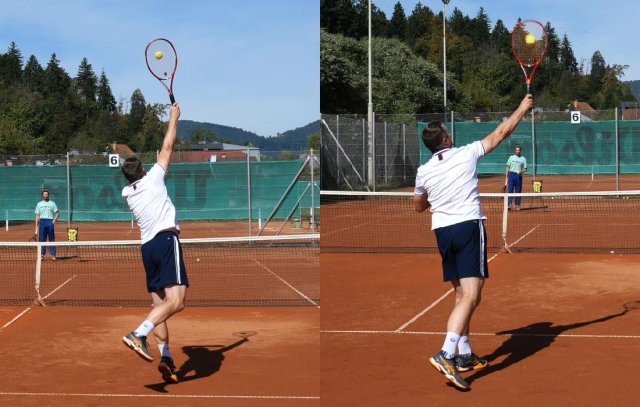
Note the difference in contact point and how the body is aligned...
So when you combine Tip #3 and Tip #4, you then want to stay stable on the ground with your front foot and make contact with the ball at a lower contact point (compared to the serve) a bit to the front and to the side. When you do that, you’ll have maximum power and control.
Tip #5 – Focus On Pronation When Hitting The Ball
Players tend to swing with the whole arm when hitting the smash on the bounce, but that’s quite risky, as the ball tends to end up in the net. There are simply too many forces downward.
Instead, you should focus on generating power more from the pronation (and internal shoulder rotation) movement.
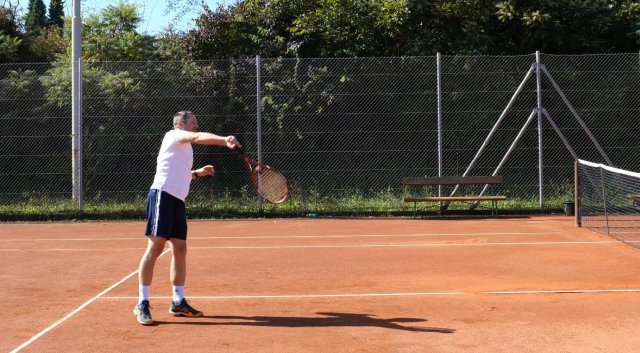
Hit the smash with an emphasized pronation in order to control the ball well.
If you’re not that skilled yet with pronation or it’s not crystal clear to you how the movement is performed, then check out the previous articles on pronation and what drills you can use to maximize the power of pronation.
In summary, if your opponent threw up a lob that is going to land way too short and bounce somewhere inside the service box, you’re in a very favorable position.
Your goal is to maximize your chances of winning the point from this situation, and the above 5 tips will help you do that.
Move too far from the ball bounce initially and only adjust with forward movement when you see how the ball bounces. Get both arms up immediately and only then start adjusting to hit the ball with a very comfortable contact point focusing on power from pronation.
Your comments and questions are welcome, as always!


Great lesson as usual. Can’t wait to try it
Very helpful tips. Thanks !!
Glad to have helped!
Haha! I almost never get given bounce smashes, but after I watched your video I got one the very next day! Three of your tips flashed through my mind – I’m thinking “Tomaz says stay back”, “Tomaz says keep both arms up”, “Tomaz says stay to the side”. Result: I hit an epic winner! Thanks Tomaz 🙂
Quick thinking, Steve, wonderful, thanks for sharing!
Just what I needed