
In part 3 of conversations with Colin, we go a bit deeper into how we can build tennis technique based on biomechanics.
If you missed the previous parts, jump first to part 1, where we discuss the main purpose of improving technique and why we must always have a clear intention.
In part 2, we start discovering how the body’s natural biomechanics need to be the foundation of tennis strokes as only then will we avoid struggling against our own body and the laws of physics.
The key message of this article is that tennis technique is not based on someone’s opinion but on the natural biomechanics of the body.
What confuses tennis players as they search for more information about tennis stroke techniques is that there are so many different opinions on how a forehand or a backhand needs to be hit.
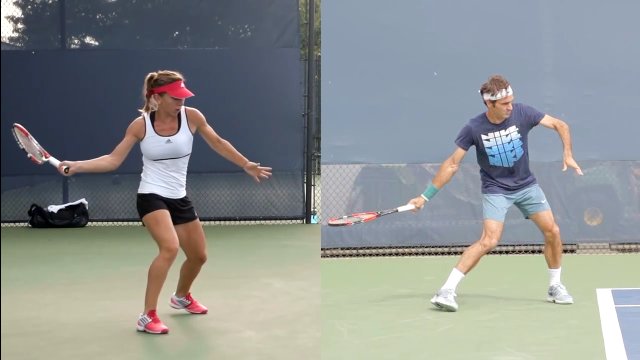
Not only do we see variations of the forehand technique between different players…
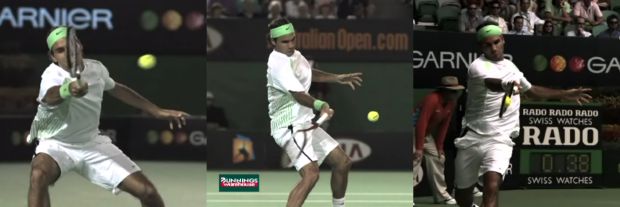
... we also see forehand variations of the same player! Then what is correct technique?
In reality, most tennis pros out there base their teachings on their own opinions instead of first understanding the simple biomechanics of the body and how it naturally wants to move.
They focus on player’s styles – which is what you see as the variations of the forehand technique among the players – and fail to see the foundations that we need to teach first.
So, in my point of view, most of the online and on court instruction does not work because it’s based on someone’s opinion and not on biomechanics and physics.
And the proof of that is you, dear reader, as you are still here online reading various tennis blogs and watching videos, still hoping that there is a solution for your troubles. Clearly, they have not been solved yet despite taking tons of tennis lessons and buying a bunch of online tennis courses.
The reason for not finding the solution yet is that the solution is counter-intuitive and quite illogical.
The Paradox Of Developing Correct & Effortless Tennis Strokes
When you hit a tennis ball with the racket and you miss, you will likely want to exert more control of the racket on the next shot.
That means you will grip the racket even tighter and try to control the racket even more by engaging a lot of muscles in your arm so that the racket won’t wobble or twist or swing around too much.
As you tighten your control of the racket, you use only your muscles to move it through space. You don’t use gravity, momentum, centrifugal force, swings and other elements of physics and biomechanics.
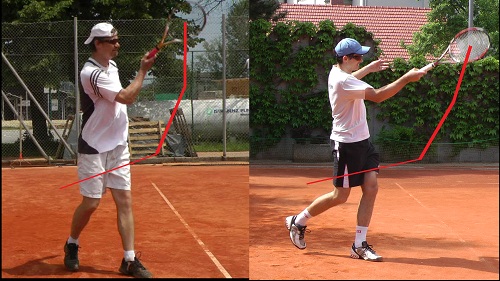
Recreational tennis player on the left using more muscles (tense) and former ATP player on the right using more of a swing (relaxed)
While it seems at first glance that exerting more control over the racket will help, it actually doesn’t. Not only you are still missing a lot, but you also lack power.
And so the most logical way to increase power and control is to try even harder.
Yet, it doesn’t work. It keeps you frustrated and confused because here and there you see a very skilled tennis player who executes his strokes effortlessly while still hitting the ball very fast.
That’s where the biggest paradox of tennis strokes lies: in order to get more power and control, you need to work LESS hard. (…with your arm! Your legs and body need to engage more!)
You need to loosen control of the racket and allow it to swing more.
Instead of using just your arm to control the racket, you need to try and engage your whole body from the legs upwards through your hips and core and eventually shoulders and arms to make sure your body is not fighting against itself.
It feels like you are giving up control – and, for a short while, you are – until you LEARN that there is another way of controlling the ball.
And that’s through an effortless and repeatable swing.
If we can swing very similarly over and over again, then we’ll hit a very similar ball – which is what I already showed in part 2 of this series of video articles on the topic of tennis techniques.
Why It’s So Difficult To Find A Solution To Effortless Tennis
The biggest obstacles in finding this counter-intuitive solution are:
- Simple logic: If the ball doesn’t go fast enough, I’ll try to hit it harder (meaning engaging more muscles in the arm and applying more “force” to the racket as it hits the ball) resulting in more tension.
- Playing for points too much: This causes even more tension in the body due to pressure and of course not being able to experiment at all with different ways of swinging at the ball because too much is at stake in every point.
- Playing on fast court surfaces or exchanging shots with friends at the speed that you cannot manage yet: You will keep tensing up when the ball is arriving since you are in time pressure.
- Playing with not very skilled tennis buddies who cannot give you many very similar balls in a row: You cannot get into a nice rhythm. They give you high, low, short and long balls with various rotations, and that prevents you from settling down and relaxing a bit more so that you can start playing in a more relaxed manner.
- Being very critical of mistakes: When this happens, you are unable to let go and experiment a little bit to see if there’s a better way of hitting a tennis ball.
- Simply not enough repetition to groove in and trust strokes where you let go and swing more: Tennis is a very demanding sport in terms of timing and ball judgment, and our brain needs to see thousands and thousands of ball flights to eventually better calculate the timing of our swing. Playing just twice a week for example will not get you very far in tennis.
I will explain the paradox of power and why more force doesn’t work in a future article.
Biomechanics As A Foundation And Technique As A Modification
So, what does it mean that biomechanics is the foundation of a tennis stroke?
I show Colin an example with my forehand: it is based on hip rotation, weight transfer and a swing (pendulum). Later on, I show the same principle with my one-handed backhand.
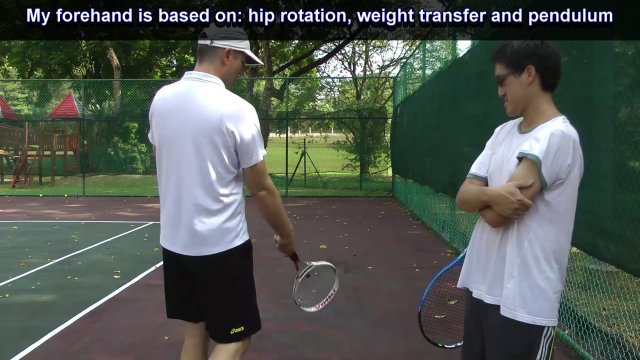
That’s the biomechanical foundation that generates effortless power and a repeatable swing.
This biomechanical principle with slight adjustments is also a foundation in other sports like baseball or golf where we swing something.
Now I need to modify this fundamental movement so that it works for the game of tennis.
To do that, I need to apply MINIMAL control of the whole motion so that I don’t “kill it”.
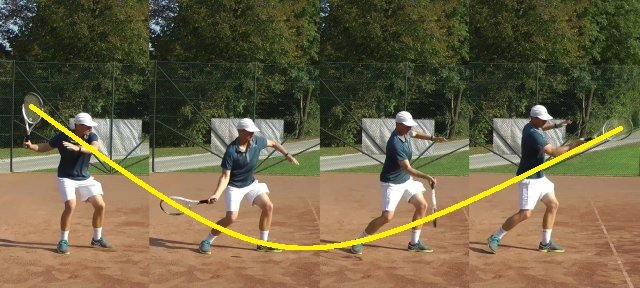
I need to maintain a swing which I then gently control to meet the ball
I can easily overpower the swing based on gravity, for example by exerting a lot of control over the racket with my muscles.
Once I lose that feeling of the swing, I don’t know what I should be looking for as the source of power and the source of consistent and repeatable movement that will produce a repeatable ball.
So, I need to very carefully “juggle” between maintaining the natural biomechanical movements of the body and the amount of control that I apply.
I explained this process before where I talk about “throwing and pushing” ratios that you have to adjust for every single ball.
As you can see, that requires a high level of attention to your body and knowing what you’re actually trying to do.
This is the process that will keep improving your strokes for a very long time.
My strokes were improving gradually for about 10 years following this process.
I am paying attention (feeling!) to the comfort level of my body while trying not to break down the natural swing and other natural movements of the body as I look to apply just the right amount of control so I can control the ball.
I am paying attention to the swing and trying to feel the right time to amplify it.
This is the same principle as when you sit on a swing (that you find in a children’s playground) and want to swing more.
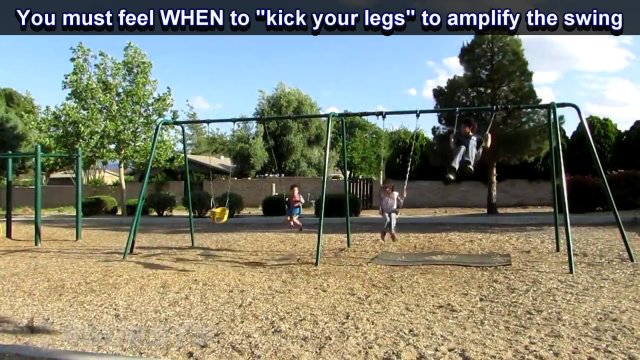
You simply feel the right moment to kick your legs forward or backward.
No one can explain to you in English how to find the right moment. You simply feel it after some time as you keep trying to time it.
We need to do exactly the same in tennis when we swing our racket towards the ball.
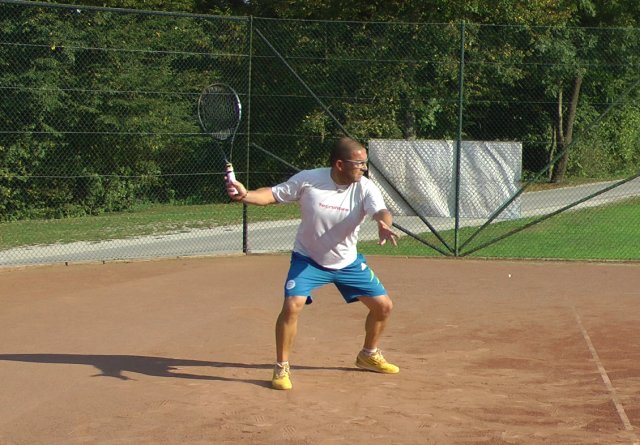
We need to feel the right time to amplify the swing, and we need to find ways of naturally doing that, which is through hip rotation and weight transfer.
Of course you need to be in very easy conditions so that you can pay attention to your body and feel these nuances. That means you must be receiving easy balls so that your mind is not taxed with judging the ball flight.
Again, I point out how detrimental competitive tennis is for your long-term development of tennis skills as you cannot pay attention to your body and feeling the swing while you play points.
In fact, your opponent’s main goal is to break down your rhythm so that you become even more inconsistent.
The real question you need to honestly ask yourself is this: Do I want to master the game of tennis, or do I just want to beat Joe this weekend in the singles match and fuel my ego (for short-term satisfaction)?
I am telling you that you cannot have both in the short term.
You cannot keep playing tennis matches and at the same time work on mastering the game of tennis because everything you build in free hitting sessions in terms of more natural and effortless strokes will be broken down in the next competitive tennis match.
In summary, my approach to developing and correcting tennis technique is based on helping the players first feel the basic biomechanical movements that are natural to the body.
If you don’t feel those, they you feel lost and very insecure when you play because you feel no safety or consistency of your strokes.
Or perhaps you can make your shots very safe, but your movements are very tense and you exert a lot of effort.
Only when you start to feel how the body would naturally want to move can you understand why tennis strokes have the form that they do.
You will understand that this form or shape of a forehand or a backhand is not based on someone’s opinion; rather, it’s based on biomechanics and laws of physics.
Then once you feel these natural movements that generate a lot of effortless power, you can modify them a bit so that they work for the game of tennis.
That’s why I am sharing a lot of perhaps unusual tips on various exercises that encourage a swing, that give you the feel of gravity, that help you feel centrifugal force and so on.
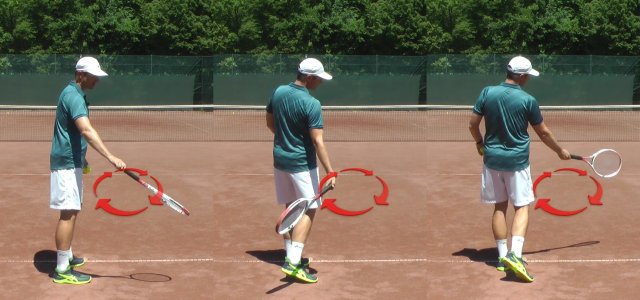
Swing outwards, rotate the body and the arm swings inside-out
For each specific stroke, I share plenty more drills in my courses that go deeper into the biomechanics of each stroke and how to build technique on top of that.
So, while the movements and swings that I point out are completely natural and comfortable for the body, you may not feel them initially because you have forgotten them.
It’s not that you have to learn how to rotate your hips or swing a weight; it’s that, in your everyday, mostly sedentary lifestyle, you lost the awareness of your body and how to use it in the most efficient ways.
That’s why I encourage you to use these exercises to wake up the feels of swing, body rotation, weight transfer, staying balanced and others so that your body can manage the demands of the game of tennis in a much more efficient way.
I’ll be posting more video articles on the fundamentals of tennis technique in the future, so stay tuned!

Your teaching has revolutionized my tennis ability.
The teaching on momentum, was the beginning of developing a great serve in a couple years.
https://www.staging.feeltennis.net/secret-effortless-serving/
Now the teaching of centrifugal Force for ground strokes, is also revolutionary!
https://www.staging.feeltennis.net/universal-swing/
I asked my teaching problem, “do all great players progress at an even rate of improvement ?” The answer is “no”.
I feel grasping they biomechanics, I have improved 20 years of practice without this understanding, into 1-2 years.
Thanks a lot, Ged, I am glad that you are on the right track!
Thanks Tomaz.
I’m sorry I didn’t correct my comments before posting them.
I was saying that I asked my teaching pro, “do good players progress at an even rate ? ”
His answer was what I expected: “no”.
I am 61 years old, yet playing the best tennis in 50 years, that I have played.
Because of your revolutionary teaching.
You have a gift of teaching that God has given you, I believe.
I recently found you on the internet and I like your approach to tennis. Tennis is my passion and you complement it. I see you are in Slovenia.
I have been all over Europe but never Slovenia. I read a book at the library and I love your country especially the mountains.
I plan to travel in Europe next year and I will be sure to look you up.
Gary
You are very welcome to visit, Gary, Slovenia is beautiful in the summer!
You say you should not be playing matches while learning corrected technique however at what point do your new strokes get tested so you can actually play under pressure? The ball machine gets you in the groove quickly. A pro can put the ball where you “need” it and then test your movement and how that affects your new stroke. But it seems to be a very long road for a recreational player.
Once you can move under pressure but still execute correct technique in a targeted manner….is it then do you go out and play actual matches? Is this how professionals do it if they are say trying to improve a groundstroke?
I’ve noticed the more I move the more likely old tight strokes may reappear. Or if I am getting tired…which is odd because you would think you get looser but I actually get “arm-ier!” Or if I have make grip changes I tend to get confused trying to remember to get to it first. It’s all very complicated to undo recreational strokes. Sometimes I wonder why I’m even bothering. It’s very frustrating.
Tina, your answer is in a book called “the talent code” Also a udemy course called “training the athletic brain” The reason you body goes back to the old way till you develop the new improved technique with lots and lots of repetiton has to do with the myelination of your neuro pathways in your brain.
in a nutshell,,,,, When you get into playing a match your minds focus now becomes on many other things such as where do i want to hit the ball, strategy, body position on the court , etc,,, and not on technique.
Your brain then sends a signal to the muscles on how to hit the ball( sort of like automatic pilot) because it is not focused on your technique,,, the signal it sends is the one that has the thickest fastest myelin insulation in your brains neurons for that particular movement, which is going to be the old way till you do enough reps of the new way of hitting that you are working on…
Hi Tina,
Yes, it’s a huge battle to undo incorrect strokes. You must rely on feel based exercises that give you the feeling of WHY is the new movement better than the old one.
Only with the help of feeling better in your body – meaning it’s effortless – do you have a chance of overcoming a bad habit.
You cannot overcome a bad habit but trying a new movement that is solely based on someone’s opinion.
As for how to get new techniques into matches, you need some intermediate steps.
Because at the moment you only have practice which is 0 pressure and a match which is pressure level 100.
You have no training in between and the gap is too big.
What we do with juniors is we play COUNTLESS games during the weeks, months and years that we train them where we keep score.
That way they are under some pressure but since they go to practice almost every day it’s not really that serious if they play a game to 11 with a certain task.
So we give them pressure level 30 for example and see how they do.
Secondly, they play practice matches, usually on weekends.
So that’s a match but it doesn’t count for rankings and it’s not in a tournament.
The only thing at stake is ego and that’s enough to create pressure.
So that’s pressure level 70 for example.
So we give juniors “stepping stones of pressure” if I can say so – and they manage to incorporate new techniques gradually into match situations.
What I did as a recreational tennis player is that I played many times two different types of “medium pressure” situations:
– I played with a friend a “free playing” session where we hit a few balls down the middle and then we play out the point. But we DON’T keep score! We play like that for 20-30 minutes sometimes. So there is some pressure since we “play a point” but we lower the pressure by not keeping score.
– I play with weaker opponents than me where we play a match and during that match I try to work on some things. If the score gets too close, like 4 all, I stop experimenting with my new techniques and focus on winning that match. 😉
I played literally hundreds if not thousands of matches with my friends where I was a better player and I experimented with new techniques and new tactics and therefore managed to practice under “some” pressure and that’s how in the long term the techniques that I worked on also worked in real matches.
But predominantly I just kept hitting the ball thousands of times with my friends down the middle for hours working on improving my strokes under no pressure at all.
Spot on explanation tomas,, movement the natural way where you don’t have to have focused control of the body initially then apply the control to finish.
Brilliant analysis Tomaz. We have to award you an honorary Phd in tennis psychometrics. Your target audience is probably people like me who think too much.
We sometimes watch 7 year old kids in Justine’s academy( Belgium) who hit the balls ( and serve the balls) just like the pros.
Do they think? That’s probably our problem!
I’ve been trying to develop a racket drop for 18 months. The most realistic advice is to be told by the web teachers that it will take you 2 years to change.
You are the only teacher to have given fair advice about this.
Terry
Hi Terry,
Yes, adults think too much. There is not thinking nor understanding required to learn tennis techniques.
What is required is the right exercises that develop the right movements and feels.
Kids do not ask questions and are not interested in understanding the “pronation” or anything like that and yet we can teach them perfectly good tennis techniques at the age of 10-12 years old.
I share my ideas here on the blog because adults want to know and we can’t change that. I try to explain things because most adults I work with are very confused about tennis and I want to give them a peace of mind. Once they understand something, they will hopefully stop thinking about it.
The second type of articles are feel based drills and ideas that help encourage the correct biomechanical movements of the body and take you away from thinking and more into feeling.
We can only FEEL when the stroke is right, we cannot tell that by thinking and evaluating it theoretically in the mind.
As for your drop on the serve, if you cannot develop it it means you don’t have a good throwing motion ingrained from childhood.
You need to do a lot of throwing of old rackets, balls, sticks, etc. You need to fix the fundamental problem before addressing it in the sports of tennis.
All adults need to understand is that there is nothing to understand!
Now you really made me understand that. 🙂
Tomaz, what I have come to understand from watching and reading your work, is that learning tennis is more like learning to play an instrument, than starting some other athletic activity. It is a process of programming patterns.
In music, we have practice, rehearsal, and performance, and we just accept that to progress, they have to be in a reasonable ratio to one another. There is also the same difference between trying to tell the body what to do, and allowing it to respond naturally to intent.
And there is the same antithesis between conventional teaching methods and the muscle relaxation that is the key to unlocking higher levels of performance (e.g. see http://www.alanfraserinstitute.com/philosophy.php).
That’s exactly right, Jamie. There are a few great sentences that describe very accurately what I am also trying to teach:
And from http://www.alanfraserinstitute.com/feldenkrais-method.php:
I am aware of the Feldenkreis method but have not studied it. I may do that when the opportunity arises as it’s definitely needed in the process of teaching tennis.
Hello Tomaz,
great training material, very exciting fotos and pictures based on biomechanics. Thank you so much. I really enjoy watching your sessions. As I have seen many of your Videos on fore- and backhand, I would like to know whether their is any session on the service. My feeling is, I get not enough power, which means speed behind the ball so my opponent can easily return my service. Any suggestions from your side?
Hi Harald,
The basic biomechanics of the serve is a throwing motion.
Throw balls, old rackets, light medicine balls (0.5 kg), swing things like two balls in a sock, the ServeMaster, etc.
I’ll publish a video on that too, stay tuned.
Great stuff Tomaz
Hey Tomaz, thanks for explaining is great details the bio-mechanics of strokes. I am of the feeling that if I’m relaxed and don’t overthink stuff and let it come naturally then I really have good days at the court. But if I’m paying attention to details then things start heading downward.
Having said that, my approach tennis forehand or something else I don’t know has started developing Golfers Elbow on my swinging hand. Do you know what I can do to continue playing as Dr. are saying to stop completely. I think may be it’s my technique and something not right in my bio-mechanics.
Appreciate your insight in this topic and help on my issues.
Hi Hasmukh,
The tennis elbow or golfers elbow usually happens because you hit the ball too late on the one-handed backhand.
That’s when the elbow is still bent at contact and the tendons over the elbow are still somewhat strained while the vibration of contact hits them. So they get inflammated.
So the key is to really hit the ball well in front when the elbow is already extended.
If that’s not the case, then it’s hard to say.
It could be late hitting on other strokes, it could also be be that you are playing with very stiff strings (polyester) and that causes a lot of vibration.
You can try softer strings and softer tensions. Sythentic gut and multifilament strings are nicer to the arm.
Resting is usually the best remedy for short term until the inflammation goes down but long term you can look at the things I mentioned.